Culture

Culture

The good, the bad and the ugly in books, exhibitions, cinema, TV, dance, music, podcasts and theatre.

Pure gold: My Master Builder, at Wyndham’s Theatre, reviewed

Theatre

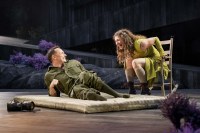
My Master Builder is a new version of Ibsen’s classic with a tweaked title and a transformed storyline. Henry and Elena Solness are a British power couple living in the Hamptons whose relationship is in meltdown after the accidental death of their son. Elena has scrambled to reach the top of the publishing world but she feels bitter that Henry’s career as an architect came to him so easily. When their marriage went awry, she played the field, seducing both men and women, and now she lusts after Henry’s protegé, Ragnar, a camp young stud who may be bisexual. Ragnar is almost too complicated to understand. He’s a philandering black Norwegian with dyed blond hair who speaks English in a Billy Bunter accent that includes flourishes such as ‘crikey!

Kingsley goes to the toilet

More from Arts

In 1978, I gave a poetry reading at Hull University. Philip Larkin was glumly, politely, in attendance. I was duly appreciative, knowing what it must have cost him. He was deaf as well as disaffected. Perhaps the deafness helped. The next day, we had a lunchtime drink at the University bar. We talked about Kingsley’s recently published Jake’s Thing, a fictionalised account of Kingsley’s sexual relations with Jane Howard. Larkin was puzzled: ‘It’s determinedly foul-mouthed, which I like, but there is a central implausibility. Jake can do it, but he doesn’t want to.’ An innuendo? A suggestion that Jake, and by implication Kingsley, couldn’t? He sipped something improbable like a Dubonnet. A year previously, Kingsley had taken me to lunch in Wheeler’s.

A fabulously entertaining new podcast about ancient Greece

Radio

How did a myth about the consequences of poor judgment become a parable for aspiration? The question is posed by the Greek writer-actor Alex Andreou in his fabulously entertaining new podcast. His topic is the ancient myth of Midas, king of Phrygia, who was granted his wish to have everything he touched turn to gold. Midas’s new world was brilliant for all of five minutes. What is a man to do with piles of metal when every person he comes into contact with is reduced to the same? The Midas myth has been mangled many times; Andreou recalls that Donald Trump co-authored a book in 2011 entitled Midas Touch in which he promised to reveal the secrets to entrepreneurial success.

A triumphant show: Self Esteem, at Duke of York’s Theatre, reviewed

Pop

The most compelling character in the newish documentary One to One: John & Yoko isn’t either John or Yoko. It’s one A.J. Weberman, inventor of ‘Dylanology’ and ‘garbology’. He’s shown practising both in the film, rummaging through Bob Dylan’s bins for clues to the thought process of genius.  Fifty years on, two things struck me. The first is how odd it is that Lennon and Dylan would let someone as obviously potty as Weberman anywhere near them. The second is that everyone is now Weberman. Think of the Swifties who decode every missive from Taylor; the fanatics who obsess over the sexual antics of boy bands based on convoluted readings of song lyrics; and people like me who spend wintry Saturdays driving around the Jersey shore visiting Springsteen locations.

‘I’ve seen controllers come and go’: Radio 3’s Michael Berkeley interviewed

Arts feature

A few years ago I had a panic-stricken phone call from a female friend. ‘Help!’ she wailed. ‘Remind me what classical music I like. I think I’m going to be a guest on Private Passions.’ I could understand her anxiety. The programme, which celebrated its 30th birthday this month, is BBC Radio 3’s lofty version of  Desert Island Discs. Eminent writers, scientists, artists and businessmen, plus the occasional book-plugging celeb, explain how music – mostly but not exclusively classical – is, well, one of their private passions. Even if, as in the case of my friend, it isn’t. It’s an honour to be asked on the show, which is presented by Michael Berkeley – the first classical composer since Benjamin Britten to be elevated to the House of Lords.

Worth watching for the dog: The Friend reviewed

Cinema

The Friend is an adaptation of the novel by Sigrid Nunez starring a harlequin Great Dane. If I remember rightly, Naomi Watts and Bill Murray are also in the mix somewhere but I can’t be sure. Who could notice anything but Apollo in all his noble, giant, majesty? Watts and Murray are fine – if they are even in it? – but Bing, who plays Apollo, is astonishing. It’s his first role, yet he must be a shoo-in for the Palm Dog prize at Cannes this year. Even if you’re not into the ‘non-action’ genre it’s worth it for the dog To be clear, though, this isn’t your usual cute-doggo movie. This isn’t Turner & Hooch. In fact, if you’ve read the book you’ll be wondering: how can it even be a film?

It should be illegal for TV baddies to profit from their psychopathic acts

Television

I’m about to give away the opening scene of the latest gangsters-are-cool drama MobLand. Don’t worry. It won’t spoil anything. By the end of this review you won’t want to watch even a moment of this dog’s breakfast of an atrocity of charmless, witless, misbegotten, amoral tripe anyway. So we’re in a basement with Tom Hardy, playing his usual amiably ruthless hard-man character. This time he’s called Harry Da Souza and he’s the chief fixer for a London-based Irish crime family called the Harrigans. On this occasion, Da Souza is mediating between two lower-tier rival gangs, whom he has orders to make apologise to one another. After much tense negotiation, the gang leaders agree to shake hands but refuse to apologise.

The disturbing ambient music of William Tyler

Pop

One could argue that all musical forms are essentially incomplete until the listener joins the party, but ambient music seems more needily co-dependent than most. Given that a typical sound bed is a blank canvas of amniotic electronica, much depends on the interpretation of whatever is laid over it: the drip and the drift; the scrape and the scratch; the arbitrary beauty of found sounds and field recordings. The meaning can be as banal or as profound as desired. Is that distant clanging the bells of mortal dread tolling for us all; or simply next door’s bin lid clattering on to the pavement?

The case for replacing nurses with robots

Theatre

Tending is a work of activism on behalf of the NHS. The script brings together the testimony of 70 nurses in a show spoken by three performers. It’s full of surprises and shocks. All NHS nurses are obliged to annotate their actions as they work. ‘If you haven’t documented it, you haven’t done it,’ they’re told. A nurse estimates that she spends 20 per cent of her time caring for patients and the rest of it chronicling her doings on bits of paper. There appears to be no feedback mechanism that enables the nurses to help managers find ways to improve the service. A nurse tells the story of a lunatic who barricaded himself inside a lavatory cubicle and slit his throat open. He couldn’t be helped because the locks operated from the inside only. Could this flaw be corrected?

Poulenc’s Stabat Mater – sacred, fervent and always on the verge of breaking into giggles

Classical

It’s funny what you see at orchestral concerts. See, that is, not just hear. If you weren’t in the hall during Poulenc’s Stabat Mater would you even realise that the tuba uses a mute in the final chord? Visually, it’s hard to miss – the thing’s huge, whether standing on the floor or being heaved into the instrument’s bell. The sound? A muffled, matte effect, quite unlike the usual nasal buzz of muted brass. But how droll of Poulenc, and how utterly in keeping with the raffish, trash-fabulous aesthetic of Gallic brass writing: a world where no symphony is complete without a pair of honking cornets à pistons. And how perfect, too, for this Stabat Mater, a fervent choral work that sounds nonetheless as if it’s about to break into giggles.

My Marco Pierre White obsession

Radio

Pierre White, Marco. Chef. Michelin stars: five (all handed back). Wives: three (all handed back). Restaurants owned: number unclear. Hours in a cell: 14. Party: Reform. Brands promoted: Knorr stockpots, Lidl, P&O Cruises. Protégé: Gordon Ramsay. YouTube views: hundreds of millions. Current residence: the countryside, somewhere near Bath, far far away from anyone who tries to talk to him. The obituaries will all call Marco Pierre White a ‘rock star’, and they will be correct. In the 1980s, he was all shaggy verve and sweat and ash. He ‘changed the game’ – as they all say – not so much through his cooking, but through his good looks.

Winning little narrative adventure: South of Midnight reviewed

More from Arts

Grade: A– For this winning little narrative adventure we are in the South – all gris-gris gumbo yaya, decaying mansions and ghosts of the underground railway – and it is a bit midnighty, what with the sinister otherworldly beings you fight.  Our protagonist is sassy, cornrowed Hazel, a mixed-race Lara Croft, who sets out to rescue her social-worker mother after her mobile home is swept downriver in a hurricane. Her snooty grandma Bunny, rotting in her vast plantation house, is no help whatever. But Hazel does manage to half-inch some magic hooks from granny’s ottoman, which allow her to manipulate glowing magic strands in the air and use them to unravel ‘haints’, the ropey-looking demon-things that pop up from time to time to attack her.

Devastating: WNO’s Peter Grimes reviewed

Opera

Britten’s Peter Grimes turns 80 this June, and it’s still hard to credit it. The whole phenomenon, that is – the sudden emergence of the brilliant, all-too-facile 31-year-old Britten as a fully formed musical dramatist of unignorable force. W.H. Auden had urged him to risk everything – to step outside his admirers’ ‘warm nest of love’ – and in the first moments of Peter Grimes, Britten does precisely that. The folk-opera bustle of the opening tribunal scene dissolves into the desolate bird cry of the first Sea Interlude and straight away, you’re in the presence of something unimaginably vaster and more true. It pins you to your seat. That was certainly the impression I had from Tomas Hanus, conducting the orchestra and chorus of Welsh National Opera.

How could anyone seriously think that Wagner’s politics haven’t been discussed enough?

In a recent article, the historian Katja Hoyer describes an event at the German Embassy prior to a Royal Opera House performance in May of Wagner’s Die Walküre. There she spoke with various individuals, some of them clearly Wagner ‘fans’, and she righteously declares: 'having studied [Wagner] as a historical figure, I’m perhaps also less able than most to forget the man behind the music.' Following some discussions about the production, as well as chats with those who had visited Bayreuth, she declares that 'there didn’t seem to be the slightest notion of controversy around the modern-day Wagner worship.

Exhilarating – but also exhausting: ENB’s The Forsythe Programme reviewed

Dance

The first time I saw the work of Trajal Harrell I stomped out in a huff muttering about the waste of public money and is this what the art of dance has come to. But perversely I was drawn back for more of its weirdness, and after The Köln Concert I am relenting. The guy might be on to something. A middle-aged, Yale-educated African-American with a melancholy air on stage, Harrell should probably be classified as post-post-postmodernist. In any case, don’t expect meaning to emerge clearly or logic to govern the movement he creates. His territory is queer in every sense of the term, dippy-hippie in spirit, and aesthetically far to the left in its rejection of order or hierarchy. Yet it is also open-hearted, innocently comical and slyly beguiling.

Good lawyers make for bad TV

Television

Given that TV cameras aren’t allowed to film British criminal trials, Channel 4’s new documentary series Barristers: Fighting for Justice is a courtroom drama without the courtroom. As for the drama bit, the programme does its excitable and occasionally successful best – but isn’t always backed up by its own participants, who on the whole are a serious and disappointingly discreet bunch. All of them, you imagine, would have plenty of cracking tales to tell after a few drinks. As things stand, however, they stick firmly to no-shit-Sherlock generalisations. ‘What I do is present the defence case on behalf of my client,’ said one in Tuesday’s episode. ‘It’s very important that innocent people aren’t convicted,’ argued another.

Was Sir John Soane one of the first modernists?

Exhibitions

Sir John Soane’s story is a good one. Born in 1753 to a bricklayer, at 15 he was apprenticed to George Dance the Younger and at 18 had moved on to Henry Holland. Later came major commissions, a professorship, a knighthood and gold medals. Fame followed. Along the way he added an ‘e’ to his surname and married Eliza Smith, an heiress whose fortune helped him to buy three houses in Lincoln’s Inn Fields as well as the collection that still fills one of them, which he left to posterity as a museum when he died in 1837. Soane’s son compared the image of his father in a library to ‘a eunuch in a seraglo’ Success attracts critics, though, and one of the keenest was Soane’s estranged son George.

Divorce are the best young British band I’ve seen in an age

Pop

Can we talk business for a moment? When reviewers like me go to big arenas, we get the best seats in the house, with fantastic sightlines and excellent sound (a PR who used to work for U2 told me she would routinely reassign press into even better seats than the already splendid ones they had originally been given; you do anything you can to get an extra 1 per cent more enthusiasm into the review). When we go to standing venues, though, we are as prone to the vagaries of geography as anyone else. And because we go to a lot of shows, we tend to arrive only five minutes before the turn we want to see goes on stage, which means we rarely find great positions.

Cartier used to be a Timpson’s for the rich

Exhibitions

In the fall of, I suppose, 1962, my friend Jimmy Davison and I, window shopping on Fifth Avenue, bumped into the glamorous Venezuelan playboy-grandee Reinaldo Herrera. Jimmy asked where he was going. ‘I’m just nipping into Cartier. They’re fixing my skis,’ Reinaldo replied. Autres temps, autre moeurs. I doubt anyone today uses the world’s most famous jewellers as their local Timpson’s, though I suspect Cartier’s unrivalled in-house craftsmen could still run up a supple sapphire USB cable if requested. I doubt anyone today uses the world’s most famous jewellers as their local Timpson’s Because that was partly the firm’s point. Apart from the staggering banque-busting biggies, they, almost uniquely, made the most exquisite smaller things.

Those behind this fabulous new comedy are destined for big things

Theatre

Rhinoceros by Eugene Ionesco is a period piece from 1959. It opens with the invasion of a French village by a herd of rhinoceroses. This paranormal event is never explained. In Act Two, the villagers start to imagine that they’ve become rhinoceroses and changed species. But one plucky sceptic, who defies conformity, refuses to swap his human character for an animal alternative. That’s it. Ionesco is offering the same arguments about peer-group pressure that Arthur Miller made with far more grace, artistry and psychological penetration in The Crucible. The show can’t decide what register to aim for and the cast are dressed in a mishmash of cheap costumes. Some wear white coats like asylum orderlies and some are in Primark expendables.

An astonishingly good new album from Black Country, New Road

The Listener

Grade: A Is that a kind of nod to Oasis in the album title? I can’t think of a band less like that grunting Manc convocation, except in the fact that BCNR are just about the biggest band in the country right now, as the Gallagher bros were all those years ago. Vocalist (of a sort) Isaac Wood has left and with him has gone the occasional temptations to stray into stadium bombast, à la Arcade Fire. Instead, with three females sharing vocals, we have evanescent chamber pop, occasionally buttressed by a certain glam swagger, almost always underpinned by plucked acoustic guitar and May Kershaw’s superb and imaginative piano. It is a beautiful album, from the sweet harmonies of ‘Besties’, to the Revolver-era McCartney of ‘Mary’.

Why is the British Museum hiding its great Orthodox icons?

Arts feature

The long neglected art of Byzantium and early Christianity is returning to the world’s museums. Last November, the Louvre confirmed plans for a 3,000 square metre department dedicated to the Byzantine legacy and more than 20,000 works from Ethiopia to Russia that are currently scattered across the museum’s cabinets. Having been initially shelved a decade ago, this monumental undertaking is scheduled to open in 2027, signifying a pivotal moment for the Christian arts of the Eastern Roman Empire to become a serious curatorial subject in European museums once again. (A precursor to the new department established in 1954 lasted but 15 years.) Byzantine art has been the subject of serious study in universities only since the 1940s.

Impeccable history of the free market – and from the BBC too

Radio

The launch of Radio 4’s Invisible Hands series has been both blessed and cursed by timing. It tells the story of Britain’s ‘free market revolution’, just as President Donald Trump overhauls the free trade consensus of the past 40 years and world leaders grapple with how to respond. The problem is the hypotheticals posed at the start of the first episode – that free market capitalism ‘might be in crisis’; that ‘the global free market might be under threat’ – are already out of date. It’s settled. Free trade is out, tariffs are in. Welcome to the trade wars. The world could do worse than look to the ‘Invisible Hands’ for a solution to the crisis.

Surprisingly good: Amazon Prime’s Last One Laughing reviewed

Television

‘What will it take to make Richard Ayoade laugh?’ If you find this question about as enticing as ‘Whose turn is it to deworm the cat?’ or ‘What is Keir Starmer’s favourite plant-based ready meal?’ I really don’t blame you. But still if you watch Last One Laughing (Amazon Prime), I think you might change your mind. The idea of this reality series is to confine ten comedians for six hours in a Big Brother-style enclosure and ban them, on pain of expulsion, from being amused by one another’s jokes. One misplaced smirk gets you a yellow card; the next ill-judged titter and you’re out on your ear. The winner, as per the title, is the last one laughing.

Sunny Schubert and iridescent Ravel: album of the week

The Listener

Grade: A Maurice Ravel was tougher than he looked. True, he dressed like a dandy and wrote an opera about a dancing teapot. But when he was rejected for military service in the first world war (he was 39 and 5ft) he practically forced his way to the front line as a lorry driver – sheltering for days in a forest near Verdun after his truck was disabled by shrapnel. Apparently, when he visited Vaughan Williams in London he went straight to the Victoria Station grill and ordered steak and kidney pudding. Just when you thought you couldn’t admire the man any more.  It’s the toughness that impresses in this new recording of his Piano Trio. OK, not toughness – more like tautness, perhaps; a clear-eyed, athletic sort of grace.

A horribly intriguing dramatic portrait of Raoul Moat

Theatre

Robert Icke’s new play examines one of the least appetising characters in British criminal history. Raoul Moat went on a shooting spree in July 2010 that left his wife injured, a cop blinded and an innocent man dead. This superb piece of reportage offers us a glimpse into the mind of a damaged brute. Moat had a rough childhood, like a lot of kids. His dad was absent, his mother was mentally unstable and when he was seven, she set fire to all his toys. Very traumatic, no doubt, but kids have survived worse. He grew into a 17st bully who felt cheated by the system and blamed everyone else for his woes. Part of the tragedy is that he had talent. He was energetic and ambitious. He worked as a bouncer, as a scrap-metal dealer, and as a tree surgeon with the tradename ‘Mr Trimmit’.