Culture

Culture

The good, the bad and the ugly in books, exhibitions, cinema, TV, dance, music, podcasts and theatre.

Why disaffected actors often make excellent playwrights

Theatre

Actors are easily bored on long runs. Phoebe Waller-Bridge once revealed that she staged distractions in the wings to amuse her colleagues. On the last night of Hay Fever, egged on by another actor, she bent over ‘and showed [her] arsehole’ to the on-stage actors. Nabokov’s plays are seldom performed. But he was alive to middling, mediocre dramatic clichés, fashions long-forgotten, but invaluably preserved in his 1941 lecture ‘The Tragedy of Tragedy’: ‘The next trick, to take the most obvious ones, is the promise of somebody’s arrival. So-and-so is expected. We know that so-and-so will unavoidably come…’ This is the lost convention, the stand-by that Beckett was frustrating in Waiting for Godot – with its tedious announcements and its adamantine disappointment.

Summer opera festivals have gone Wagner mad

Opera

Another week, another Wagner production at a summer opera festival. This never used to happen. When John Christie launched Glyndebourne in the 1930s, he hoped to stage the Ring. So he gathered a team of refugee musicians from Germany, who quickly assured him that it was impossible and he should stick to Mozart. The man who changed all that was Martin Graham, the plimsoll-wearing founder of Longborough Festival Opera, who died in April at the age of 83. Graham was irrepressible; a self-taught enthusiast. With no one around to tell him it couldn’t be done, he pushed ahead regardless, staging the Ring cycle twice in as many decades. And now look.

Ingenious: the Globe’s Romeo & Juliet reviewed

Theatre

Cul-de-Sac feels like an ersatz sitcom of a kind that’s increasingly common on the fringe. Audiences are eager to see an unpretentious domestic comedy set in a kitchen or a sitting-room where the characters gossip, argue, fall in love, break up and so on. TV broadcasters can’t produce this sort of vernacular entertainment and they treat audiences as atomised members of racial ghettos or social tribes. And they assume that every viewer is an irascible brat who can’t bear to hear uncensored language without having a tantrum. The result is that TV comedy often feels like appeasement rather than entertainment. Theatre producers are keen to fill the gap, and the latest effort by writer-director David Shopland declares its ambitions in its title.

Channel 4’s Beth is a sad glimpse into the future of terrestrial TV

Television

On the face of it, Beth seemed that most old-fashioned of TV genres: the single play. In fact, Monday’s programme was the complete version of a three-parter made for YouTube and excitedly announced as Channel 4’s first-ever digital commission. A less excited interpretation, however, might be that it was Channel 4’s first sign of surrender to the hostile forces of streaming now threatening all of Britain’s terrestrial networks. Either way, it was a peculiar watch that, over the course of its 36 minutes, felt less like a fully fledged drama than notes towards one. In a nervous bid to ensure YouTube viewers were gripped before they could search for something else, it began with a good-looking couple having sex. But not for long.

The gloriously impure world of Edward Burra

Arts feature

Every few years the shade of Edward Burra is treated to a Major Retrospective. The pattern is long established: Edward who? Forgotten genius, sui generis, well known for being unknown save by beardy centenarians and art tarts with ginny voices. Why have I never heard of this man? LGBT-ish avant la lettre, Polari-ish. After the show inhumation beckons again and he will disappear into an obscurity that cannot be relieved until the curatocracy once more lets loose the dogs of hype. George Melly and Dan Farson are no longer around to peal his name and Jane Stevenson’s impeccable and often funny biography suffers from its subject’s being a forgotten genius, sui generis, unknown save… etc. In later years Burra was the very picture of a different neglect: physical.

Literate and sensitive romance: Falling Into Place reviewed

Cinema

Falling Into Place is a love story written by Aylin Tezel, directed by Aylin Tezel, and starring Aylin Tezel. That’s a lot of Aylin Tezel so I was nervous going in. What if it’s too much Aylin Tezel? What if Aylin Tezel and I don’t get along? Who even is Aylin Tezel? But I knew within the first few minutes we were in safe hands and I was set to like this Aylin Tezel. In Falling Into Place she’s created a literate and sensitive romance that is allowed to unfold gently. If it’s ‘high-octane action’ you’re after, then your better bet this week is Ballerina, the John Wick spin-off. This is strictly for the low-octane crowd. Do not expect octane.

Why you didn’t want to get on the wrong side of Cecil Beaton

Exhibitions

‘Remember, Roy, white flowers are the only chic ones.’ So Cecil Beaton remarked to Roy Strong, possibly as a mild put-down to the young curator. But it was a curious put-down to make because Beaton broke his own rule happily, buying mountainous armfuls of speckled yellow, pink and scarlet carnations at Covent Garden and longing to fill his borders with Korean chrysanthemums and purple salvias. This small exhibition at the Garden Museum enjoys the sweet-pea surface of Beaton’s creations, while giving a flash of the glinting secateur that also made up such an important part of his personality. Beaton’s ability as an image-maker was astounding. Those famous photos of his Cambridge days with the Bright Young Things are still outrageous, a mad foray into camp pastoral.

V&A’s new museum is a defiant stand against the vandals

Exhibitions

In last week’s Spectator, Richard Morris lamented museum collections languishing in storage, pleading to ‘get these works out’. There’s an alternative solution: bring the public in. V&A East Storehouse, which opened last weekend, was designed by New York architects Diller Scofidio + Renfro to do just that. The museum’s collections were previously holed up in the creaking, late-Victorian Blythe House. The government decided to sell it in 2015, leading the V&A to find a new home in the Olympics’s former Broadcasting Centre in Hackney Wick, a big box since rebadged as Here East, an ‘innovation campus’. The Storehouse’s entrance indeed blends in with the startups and students sharing the building.

Excruciating: Sirens reviewed

Television

You had a narrow escape this week. I was about to urge you to watch Sirens, the latest iteration of that fashionable genre Ultra-Rich Lifestyle Porn, currently trending on Netflix. But luckily for you I watched it right to the end and got to witness the whole edifice collapsing like a speeded up version of Miss Havisham’s wedding cake. Normally, this doesn’t happen. Like most critics I have neither the time nor the work ethic to view a TV series in its entirety before putting in my tuppenny-ha’penny’s worth. I just assume that if something starts well or badly it’s going to continue that way. Not Sirens, though.

Thrilling: Garsington’s Queen of Spades reviewed

Opera

Tchaikovsky’s The Queen of Spades is one of those operas that under-promises on paper but over-delivers on stage. It’s hard to summarise the plot in a way that makes it sound theatrical, even if you’ve read Pushkin’s novella, and I’ve never found a recording that really hits the spot. And yet, time and again, in the theatre: wham! It goes up like a petrol bomb. With a good production and performers, Tchaikovsky hurls you out at the far end feeling almost hungover – head swimming, and wondering where those three hours went. The cast and staging at Garsington are very, very good.

Ridiculously enjoyable: Doom – The Dark Ages reviewed

More from Arts

Grade: A In the beginning, there was Doom. The videogame landscape was formless and void. But id Software created a square-headed space marine and several billion two-dimensional demons for him to kill with a shotgun, a chainsaw and a BFG (Big Fracking Gun); and several billion teenage boys saw that it was good, and they called it the First-Person Shooter, and lo, they gave up leaving their bedrooms altogether. The original Doom (1993) really was the genesis of a genre: dark, intense, relentless, addictive. The latest iteration of the game – which plunks our space marine and his demon hordes in a medieval world rather than a space station – stays true to its vibe, while using all the processing grunt available in next-gen consoles to tune that vibe up.

Provocative, verbose and humourless: Mrs Warren’s Profession reviewed

Theatre

George Bernard Shaw’s provocative play Mrs Warren’s Profession examines the moral hypocrisy of the moneyed classes. It opens with a brilliant young graduate, Vivie Warren, boasting about her dazzling achievements as a mathematician at Newnham College, Cambridge. She explains her future plans to a pair of mild-mannered chaps who clearly adore her. Like most of Shaw’s characters, Vivie is hard-nosed, emotionally cold, incapable of speaking concisely and boundlessly self-confident. Quite irritating, in other words. She plans to start a firm with another hyper-brainy female and to make a killing in the London insurance market. This occurs in 1902. Was it normal for two unmarried Edwardian women to enter the world of high finance straight out of university? Hard to say.

Museums: open up your vaults!

Arts feature

At any one time eighty per cent of the art owned by Britain’s many museums and public art galleries will find itself hidden away in storage. And once it is, it can stay there for years. Yet in these vaults are a wealth of treasures. It’s why I recently launched ‘Everyone’s Art’, which has a simple premise: to get these works out of the storeroom and into community centres, libraries, churches, village halls and schools, so their makers, and what they made, can finally be celebrated. Consider Henry Bright, a friend of the critic, writer and painter John Ruskin. Ruskin paid for Bright to accompany Turner on many of his sketching expeditions, where he was encouraged to paint what he saw.

Sincere, serious and beautiful: Glyndebourne’s Parsifal reviewed

Opera

‘Here time becomes space,’ says Gurnemanz in Act One of Parsifal, and true enough, the end of the new Glyndebourne Parsifal is in its beginning. We don’t know that, at first: the sickbed image that’s glimpsed during the prelude doesn’t resolve itself until the opera’s closing scenes. In between, characters appear on stage in multiple forms, at different ages – past and future selves attendant on the present, whatever ‘present’ means in Monsalvat. Wagner, after all, makes it clear enough that time in the Grail Domain moves in mysterious ways, and his whole musical strategy reinforces that truth.

The best radio at the moment is on the BBC World Service

Radio

Online viewings of Conclave increased threefold following the death of Pope Francis last month. At least some of the traffic was rumoured to have come from the Vatican itself. This raises many questions, but the most pertinent for me this week is, what did the cardinals think of the carpets? Do they really have coffee machines in their rooms like Tremblay? Minibars like Bellini? Their peace spoiled by the sounds of a lift shaft as in the case of long-suffering Lawrence? If any of these details passed you by, it’s worth watching the film again. In fact, after listening to an interview with the production designer, to be broadcast on BBC World Service next week, you will feel positively compelled to do so.

Fascinating royal clutter: The Edwardians, at The King’s Gallery, reviewed

Exhibitions

The Royal Collection Trust has had a rummage in the attic and produced a fascinating show. Displayed in the palatial gallery adjacent to Buckingham Palace, and described on headsets in the reassuring tones of Hugh Bonneville, are public tokens and personal treasures of two generations: Edward VII and Queen Alexandra, and George V and Queen Mary. Frocks, clocks and diplomatic gifts; purchases and mementoes that give the illusion that the royal family might be, after all, not so unlike us. There’s an unusual tea set, with odd, red photos: as princess, Alexandra took family snaps and had them printed on to these porcelain teacups in 1892, more than 100 years before Moonpig.

Why is the BBC making stuff up about Jane Austen?

Television

Jane Austen: Rise of a Genius began by saying that ‘getting into her mind isn’t easy’ – something you’d never have guessed from the rest of the episode, where both the narrator and the talking heads were able to tell us exactly what Austen was thinking and feeling at any given time. Like many Austen biographies, this one laments her sister Cassandra’s decision to burn most of her letters, but then takes full advantage of how little we consequently know about her to portray (or possibly make up) a woman whose attitudes are spookily close to its own. In a previous era, this might have meant presenting Austen as a gentle and contentedly domestic aunt. Now of course it means that ‘at a time when women were supposed to know their place, Austen ripped up the rulebook’.

Everyone should see the Globe’s brilliant new production of The Crucible

Theatre

Sanity returns to the Globe. Recent modern-dress productions have failed to make use of the theatre’s virtues as a historical backdrop. The Crucible by Arthur Miller is set in the 1690s (about a century after Shakespeare’s heyday) and the script works beautifully on this spare, wooden stage. To make the groundlings feel involved, the playing area has been extended into the pit with two separate platforms for the judges and the witnesses. James Groom, as Willard the demented jailer, terrifies the crowd by striding around the arena, barking madly at anyone who gets in his way. It grabs your attention. The dashing Gavin Drea (John Proctor) looks terrific in the lead role alongside Phoebe Pryce as his mistrustful, nervy wife, Elizabeth. Both play their parts with strong Irish accents.

A remarkable story: The Salt Path reviewed

Cinema

The Salt Path is an adaptation of the best-selling book by Raynor Winn. It tells the true story of how she and her husband, Moth, lost their home and lost all their money. At one point they go to a bank to withdraw all their funds: £1.38. And if that wasn’t bad enough he’s then diagnosed with an incurable neurodegenerative disease. So what do they decide to do? They decide to embark on a 630-mile walk along the South West Coast Path. Isn’t that what any of us would do, given the circumstances? It is a remarkable story and while this may well frustrate those who like a juicy plot arc – does working out if you can stretch to a bag of chips count as plot? – it stars Gillian Anderson and Jason Isaacs who make it rather glorious.

A lovely album: Saint Leonard’s The Golden Hour reviewed

The Listener

Grade: A+ The kids with their synths and hip producers, dragging the 1980s back: I wish they would stop. It was, in the main, an awful decade for music, the bands trite yet portentous, the stupid burbling bass guitars, hubris-stricken vocals and tinny drums. The kids retread all the dross. Yet if you were actually around and sentient in that avaricious decade, as was Saint Leonard, you could find a certain chill beauty in hidden corners. Not the New Romantics, not Japan, not SAW. Just small niches here and there of inventiveness and clever pop.

Those remaking Threads mustn’t soften the horror

Television

I was 11 years old when I saw the mushroom cloud go up but this wasn’t Hiroshima or Nagasaki in the 1940s – it was Sheffield in the 1980s. I was one of nearly seven million people who sat down on the evening of 23 September 1984 to watch a BBC drama called Threads, written by Barry Hines. For many viewers, choosing to watch this film about a nuclear attack on Britain turned out to be an epochal decision. Threads begins as a kitchen-sink drama, focused around a young couple in Sheffield. The realism of their lives is deftly blended with a documentary narration, making everything seem as real as any fictional drama ever could.

RIP to new music’s gentle, smiley radical

Danish composer Per Norgard – whose death at the age of 92 was announced this morning – was a towering presence in European new music, and the shine-bright timbres and heady narrative drive of his eight symphonies posed crucial questions about what it meant to be a symphonist during the late 20th century. In 2000 I was despatched to interview Norgard for a magazine and found a man as gentle and thoughtful as his music suggested he would be, with eyes that gleamed just like his woodwind writing. He had been in London to hear a performance of one his works – I forget which – but under discussion that afternoon was a new recording: the violin concerto he'd written in 1987, Helle Nacht.

The forgotten story of British opera

Arts feature

British opera was born with Purcell’s Dido and Aeneas, and then vanished for two-and-a-half centuries, apparently. Between the first performance of Dido in 1689 and the première of Britten’s Peter Grimes in 1945, serious British operas effectively didn’t exist – or so we’re told in textbooks and biographies. But what if there was a different story; a forgotten story of a lively, eclectic British operatic tradition that thrived in those missing centuries, and was buried only through a combination of accidents, economics and our enduring national snobbery about theatre that’s sung rather than spoken? And what if there was an organisation devoted to excavating these forgotten works and giving them a chance to live again?

Wes Anderson’s latest is as hollow as anything AI could come up with

Cinema

AI is coming for everyone’s jobs, but especially mine. There is absolutely no good reason for The Spectator to keep sending me to watch films with my wobbly biological eyes, not when they could just feed the latest releases into a computer, set the parameters to ‘contemptuous’, and watch a perfectly serviceable review assemble itself, for free, before their eyes. They’re losing money on every column. They may as well be paying a scriptorium full of monks to illuminate each copy of the magazine on vellum. I’m doomed, surplus to requirements, and the 21st century will replace me with a few lines of code. But it could be worse. At least I’m not Wes Anderson.

Magnificent: The Deep Blue Sea, at the Theatre Royal Haymarket, reviewed

Theatre

Richard Bean appears to be Hampstead Theatre’s in-house dramatist, and his new effort, House of Games, is based on a 1987 movie directed by David Mamet. The script sets up a rather laborious collision between two vastly different cultures. A gang of small-time crooks in Chicago are visited by a beautiful, high-flying, Harvard-educated academic who wants to investigate their lives. The catalyst for this unlikely set-up is therapy. Dr Margaret Ford is a successful shrink whose latest book has become a bestseller and she needs a new theme to write about. She speaks to a troubled young patient who owes $2,000 to a betting syndicate and when she visits their seedy gambling den she’s welcomed by the crooks and given an integral role in the team. Just like that.

Christopher Wheeldon’s real gifts lie in abstract dance

Dance

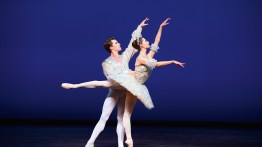
Christopher Wheeldon must be one of the most steadily productive and widely popular figures in today’s dance world, but I’m yet to be persuaded that he has much gift for narrative. His adaptation of the novel Like Water for Chocolate was a hopeless muddle; his response to Alice’s Adventures in Wonderland is mere vaudeville; and I’m praying to St Jude that nobody is planning to import his dramatisation of Oscar Wilde’s downfall, premièred in Australia last year. But as the elegant craftsman, and sometimes the inspired artist, of more abstract dance, he is without doubt a great talent. The Royal Ballet’s programme of four of his shorter pieces showcases his strengths.