Culture

Culture

The good, the bad and the ugly in books, exhibitions, cinema, TV, dance, music, podcasts and theatre.

These foolish things | 9 June 2016

Arts feature

No reliable statistics exist — it’s not the sort of thing you can audit — but England is surely the most haunted country on earth. And haunted not just by white ladies, ghosts, headless highwaymen, spooks and phantoms, but by a recurrent dream of Eden and other more recently lost pre-industrial worlds. Thus follies and summer houses, Eden’s buildings, are among the nation’s most distinctive contributions to world architecture. They might be ‘fragile and neglected trivia’, according to Clough Williams-Ellis, but their ghosts remain and every garden centre pays tribute to a collective yearning for open-air theatricality, so that dreams dreamt in Shugborough might be replicated in Solihull.

Let’s talk about sex

Exhibitions

At one time, Damien Hirst was fond of remarking that art should deal with the Gauguin questions. Namely, ‘Where do we come from? What are we? Where are we going?’ Hirst would sum up with a deft shift from post-impressionism to Michael Caine: ‘What’s it all about, Alfie?’ The new exhibition of work by the American artist Jeff Koons at Hirst’s Newport Street Gallery might raise the same query in a visitor’s mind. Among other sights, you are confronted by a number of brand-new vacuum cleaners, mounted over neon lighting tubes; soon afterwards by a shiny blue sculpture, six metres high, representing a monkey made out of twisted balloons.

Polluted by podcasts

Radio

Just to prove my esteemed colleague wrong I’ve been out there in podcast space looking for a wireless moment that will outclass the impact, the fascination, the compelling authority of much (though not all) of Radio 4’s daily output. Of course, there’s a lot of good stuff being made but how do you discover what’s worth spending time with? It’s hard to make a serendipitous discovery by surfing the web. There’s no equivalent to the simple switching of a button and that instant connection, our attention held, communication created, imagination fed. You have to work hard to find a podcast that has edge, knowledge, aural style; all you can do is research online, picking up tips on Twitter or Facebook, and listening to a lot of duds.

Arrested development

Television

Sometimes I wonder whether, of all the literary genres, graphic novels aren’t the most stupidly overrated. I can say this because I’m old enough to remember when they were just this obscure thing you had to seek out in specialist stores like Forbidden Planet, understood only by pale, nerdy teens and twenty-somethings who felt superior to, but unappreciated by, the real world outside. Then Watchmen came along and spoiled the party in much the same way Britpop ruined indie. Suddenly, graphic novels became everyone’s domain. See how the Guy Fawkes mask from V for Vendetta (Alan Moore was the author; David Lloyd the illustrator) has become almost as recognisable a global symbol as the McDonald’s golden arches.

No laughing matter | 9 June 2016

Opera

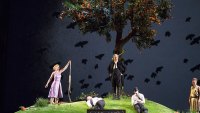
Rossini is the meat-and-two-inappropriately-shaped-veg of summer opera; he’s the wag in the novelty bow tie, the two satyrs shagging enthusiastically among the lupins and lobster on the cover of this year’s Glyndebourne programme. His comic bel canto frolics are the natural soundtrack to this off-duty opera-going, a champagne-perfect combination of frothy plots and fizzing coloratura. So why are they so hard to pull off? Perhaps it’s the pressure of expectation. It has been more than 30 years since Glyndebourne last staged Il barbiere di Siviglia, and hopes were high for Annabel Arden’s new production. For the first half-hour it looks as though they’re going to be met.

Doing bird

More from Arts

A decade ago, the French pianist and poly-math Pierre-Laurent Aimard announced that he was ‘very bored to live in a world that contains so much music that wants to please the masses’. It was a remark that might have dropped from the lips of the late Pierre Boulez, the part-pseud, part-genius who presided over an aristocracy of the avant-garde lavishly funded by the French government. Aimard was still in his teens when he was appointed pianist of Boulez’s Ensemble Intercontemporain in 1976. He made his name performing ruthlessly atonal music.

The lost world

Cinema

Every now and then, with great infrequency (alas), a film comes along that is like no other and completely knocks you for six, and that is Embrace of the Serpent. The first Colombian film to be nominated for an Oscar — it lost to Son of Saul, should you set any store by such things — it was filmed in the Colombian section of the Amazon basin, with a script developed in consultation with native tribes, and tells the story of a shaman’s encounters with two white scientist explorers, which unfold in different time periods. So far, so National Geographic; a world disappeared by colonialism and all that (sorry; our bad).

What lies beneath | 2 June 2016

Exhibitions

It was not so unusual for someone to turn into a god in Egypt. It happened to the Emperor Hadrian’s lover, a beautiful young man named Antinous, who was drowned in the Nile in the autumn of 130 AD. It was also the fate of Queen Arsinoë II, who had a complicated life. At the age of 15 she became wife to the 60-year-old ruler of Thrace. When he died in battle, she married her half-sibling, who murdered two of her sons. Her next husband was her full brother. A headless sculpture of Arsinoë stands about halfway around Sunken cities at the British Museum. It is, as a label rightly points out, an almost perfect fusion of Greek and Egyptian art. Arsinoë was represented as an incarnation of Aphrodite.

Spellbound | 2 June 2016

Arts feature

Isabelle Huppert does nothing by halves. And she doesn’t, I think, care greatly for journalists. She expects them to ask stupid questions. Sitting before me in an airless room in the eaves of Paris’s Odéon-Théâtre de l’Europe, she is tiny, dressed entirely in black and more or less unsmiling. Lily-skinned, red-haired, and with a fabulous curl in her upper lip, she’s appeared in more than 100 film and TV productions. Ninety minutes after our meeting, she will be on stage. I sense she wants this interview over fast. But at the start she makes me, I must report, comatose with wonder. I have adored Mme Huppert on screen for three decades, in which she seems to have had barely a month off work. I am, pathetically, spellbound.

Punchlines and punches

Cinema

Regular filmgoers must be losing count of the Rabelaisian revelries they’ve been invited to of late. You may recognise the type of do. The camera ushers you through a door and, wham, the music’s strafing your eardrums and everyone’s letting their hair down along, often, with their underwear. There’s usually a white horse grazing by the pool. The Ballard adaptation High-Rise has one such scene, as do the latest Le Carré film Our Kind of Traitor and the Saudi-set Tom Hanks vehicle A Hologram for the King. Throw on your party shirt and roll up for another courtesy of The Nice Guys. ‘Dad, there’s like whores here and stuff,’ says the heroine, who is no more than 12.

The supremes

Opera

When I interviewed Richard Farnes in Leeds six years ago about Opera North’s project of performing the complete Ring, he struck me as the most modest conductor I had met or could imagine, with the possible exception of Reginald Goodall, who actually at a deep level wasn’t modest at all. Everything I had heard Farnes conduct had been on the highest level, but none of it had been Wagner. I wasn’t sceptical of his ability to do a complete Ring cycle, just bemused in a general way about the boundless ambition of the work and the unassertiveness of the man who would lead it. Year by year my highest hopes have been fulfilled, as each of the four parts of the Ring received the best performance that I have heard live for many years, certainly during the present century.

War on want

Music

Radiohead have been at the top of the musical tree for so long now that it’s easy to forget what an irreducibly strange band they are. Last Thursday, during the first of their three hugely anticipated gigs at the Roundhouse, they uncharacteristically played three popular favourites on the run — in their defence, it was the encore — causing someone in the audience to call out for another one. ‘No,’ replied Thom Yorke with a smile, ‘this is all getting too much fun.

Emotional intelligence

More from Arts

The difference between a poor ballet of the book (see the Royal Ballet’s Frankenstein) and a good one — indeed two — was cheeringly pointed up by Northern Ballet last week, when it unveiled an intensely imagined new Jane Eyre in Doncaster and gave the London première of the efficiently menacing 1984 that I reviewed last autumn. It wasn’t really a surprise that Cathy Marston had a triumph with the Brontë —Royal Ballet-raised but Europe-bred, the choreographer has gradually developed a knack for character empathy and, crucially, a gift for externalising inner feelings in a vividly legible way.

Sound and fury | 2 June 2016

Radio

There are few jobs more dishonest than being a radio critic in Britain. I know this because it was how I got my first break 25 years ago as a columnist. In those days you used to get sent huge yellow envelopes full of preview cassettes, whereas now it’s all digital, but the fundamental lie is just the same: essentially you are telling the reader something they know not to be true — that BBC Radio 4 is a wonderfully civilised place to hang out, brimming with all sorts of marvellously fascinating programmes that transport you to another realm. Yes, of course it does happen. In the same way that when Grozny was reduced to rubble in the Chechen wars, I expect there was some beautiful old building left standing, a mosque maybe, which you could have gone to visit.

Impure thoughts

Television

Spoiler alerts aren’t normally required for reviews of Shakespeare — but perhaps I’d better issue one before saying that in BBC1’s A Midsummer Night’s Dream (Monday) Theseus dies near the end. Not only that, but Hippolyta and Titania fly off on butterfly wings to become lovers, and the mechanicals’ play goes down a storm. Personally, I’ve never been sure about the existence of that mysterious tribe known as ‘Shakespeare purists’. If they do exist, though, Russell T. Davies’s heavily cut and cheerfully tweaked adaptation seems almost deliberately designed to flush them out.

The great pretenders

Arts feature

There is fakery in the air. And maybe the French are done with deconstruction. A drone operated by a French archaeology consultant called Iconem has been languidly circling Palmyra, feeding back data about the rubble with a view to reconstructing the ruins and giving the finger to Daesh. Cocteau said he lies to tell the truth. Iconem flies to tell the truth. In April, an exhibition called The Missing: Rebuilding the Past opened in New York which examined ‘creative means to protest preventable loss’. It was timed to coincide with the temporary erection of a frankly underwhelming two thirds-scale replica of the Palmyra Arch in Trafalgar Square, London. It goes to Times Square, New York, in September.

Punk turns 40

Exhibitions

There have been many punk exhibitions over the years so I can’t help but chuckle at the ‘experts’ who are getting hot under the collar about the ‘sacrilege’ of housing punk memorabilia in museums. Hasn’t it always been the case that anything considered culturally significant ends up in a ‘cultural establishment’ of sorts? Joe Corré, son of Dame Vivienne Westwood and Malcolm McLaren, is even threatening to burn his punk collection in protest. Really!! The experts I know, i.e. band members, don’t seem too bothered about it. In fact, many will be turning up to do Q&As at the British Library’s tasteful if limited Punk 1976–78 exhibition.

Junk Bond

Features

You now need to be in your mid-sixties or older — a chilling thought — not to have lived your whole life in the shadow of James Bond. In 1953, the year of the Queen’s coronation and the conquest of Everest, Bond announced his arrival with the words, ‘The scent and smoke and sweat of a casino are nauseating at three in the morning’, the opening line of Casino Royale. His creator was Ian Fleming, a cynical, not-very-clean-living newspaperman with a chequered career behind him, who wrote the book to take his mind off ‘the agony’ of getting married for the first time.

Royal Court Theatre

More from Arts

If there were an Eddie the Eagle award for theatre — to recognise large reputations built on minuscule achievements — it would go to the Royal Court. Sixty years ago the English Stage Company arrived at ‘the Court’ determined to amaze the world with a new generation of thrusting young geniuses. It won instant notoriety with John Osborne’s Look Back in Anger. This sour bedsit melodrama earned the noisy support of a cabal of reviewers led by Kenneth Tynan who used it to advertise their powers of artistic foresight. Osborne’s next play, The Entertainer, was a cheerless and cumbersome allegory of Britain’s imperial decline, which lacked even the merit of prophecy. It was just a dramatised rehash of the previous decade’s headlines.

Myth-making

Opera

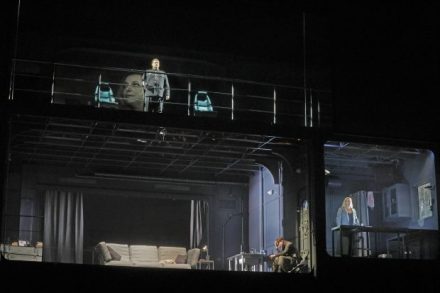
For years I have been telling people that they should listen to, in the absence of staged performances, Enescu’s opera Oedipe, preferably in the marvellous EMI recording from 1990, still available. It only occurred to me when I was preparing to go to the Royal Opera’s new production that I haven’t actually listened to a recording for many years — it seems to belong with its contemporary Busoni’s Doktor Faust as something more admired in the breach than the observance. My feelings now, after seeing the production by La Fura dels Baus, are mixed. There is a lot of lovely music here, and some strong drama. I’m not sure that the music, mostly, supports the drama or indeed that it, the music, has any specific qualities.

Giving Tate Modern a lift

More from Arts

Tate Modern, badly overcrowded, has built itself a £260 million extension to spread everyone about the place more. This means that there are more galleries and other big rooms for various modish activities — 60 per cent more space, they say. It opens on 17 June with a total rehang throughout. But having been shown round the place, I’ve become transfixed by the lifts. When it opened in 2000 they never expected nearly five million visitors a year — which is well down on its 2014 Matisse-driven peak of nearly six million, but still twice as many as it was designed for. So when they called back Swiss architects Herzog and de Meuron to extend the gallery that brought them fame, moving people around better was high on their to-do list.

Jane Austen on speed

Cinema

Love & Friendship is based on the little-known Jane Austen epistolary novella, Lady Susan, which was not published until after Austen’s death, and was then ill received. As G.K. Chesterton declared: ‘I, for one, would have willingly left Lady Susan in the wastepaper basket.’ Knowing what I know now and having, in fact, read Lady Susan, I, for one, would have willingly punched G.K. Chesterton in the head, had I been around at that time. And, had I wished to torment him further, which is highly likely, I might have then told him that it would one day be turned into the most delicious hoot of a film, so put that in your pipe and smoke it. I think he’d know he’d met his match.

Counting on sheep

Television

Going Forward (BBC4, Thursdays) is a BBC comedy about the continuing adventures of Kim Wilde, the fat, cynical but lovable nurse character played by former nurse Jo Brand. Now she has quit the NHS and is working in the private sector for a company called Buccaneer 2000 — which is, of course, exactly what a healthcare company would call itself in order to allay potential criticisms that it was backward-looking, heartless and rapacious. This is one of the series’ big problems. It wants to be naturalistic, almost fly-on-the-wall, observational comedy, with the dog wandering casually in and out, and parents and kids saying just the kind of things we all do in real life.

Inside the Ecuadorian embassy with Julian Assange: Risk reviewed

'This film would not have been possible without the following encryption tools,' is one of the least expected film credits I can think of. But then again, Laura Poitras’s Risk is not exactly your run-of-the-mill documentary. After her Oscar-winning Citizenfour, a gripping hour-by-hour account of Edward Snowden’s NSA surveillance disclosures from his Hong Kong hotel room, Poitras’s latest is an intimate portrait of WikiLeaks founder and editor-in-chief Julian Assange. Poitras started filming Assange at work in 2010 and her film follows the whistleblower’s mission and his various legal travails since then. As a result, Risk is far less dramatically sensational than Citizenfour, which unfolds over the course of several history-making days.

An ode to Honour and Fleming’s World History of Art

The heaviest book on my shelves is Hugh Honour & John Fleming’s A World History of Art. I have just put its 960 pages on the kitchen scales: 8lbs 4oz – the weight of a bonny newborn. If I cradle my copy tenderly today it is because Hugh Honour died last Friday 20 May at the age of 88. A World History of Art is the most famous, certainly the biggest, of his many books. At sixteen, after GCSE exams, my sixth-form history of art teacher sent me away with a copy.  I was not to come back in September unless I’d read it. The book is the scaffolding around which I have built everything I have learnt since of art history. A World History of Art is not like Ernst Gombrich’s Story of Art.

Keanu Reeves’ asshole motel owner is one of the more sympathetic characters: Neon Demon reviewed

The first time we see Elle Fanning in The Neon Demon, Nicolas Winding Refn’s cannibalistic catwalk, she’s reclining on a silk couch in a purple dress, her blonde hair up in an elaborate crown braid and her throat slashed. Colourful gemstones circle her eyes and deep red is streaking all the way from her neck down her arm. It doesn’t take long for us to figure out this isn’t a crime scene but a fashion shoot. In the next scene, Fanning ritualistically wipes the stage blood away while a makeup artist (Jena Malone) undresses her with her eyes. Malone is the first of several women who will look at Fanning with desire, envy or sheer hatred. In this film, looks don’t just kill. They lacerate, massacre and exterminate.