Culture

Culture

The good, the bad and the ugly in books, exhibitions, cinema, TV, dance, music, podcasts and theatre.

Woody Allen without the zingers: Materialists reviewed

Cinema

Celine Song’s first film, the wonderful Past Lives (2023), earned two Oscar nominations. So expectations were riding high for Materialists. Perhaps way too high. And, yes, it’s a letdown. It feels like an early Woody Allen but blunter, shallower, with no zingers, and a lead character that’s hard to care about. Dakota Johnson is our lead, playing a matchmaker who has two dreamboats (Chris Evans, Pedro Pascal) vying for her hand and throughout I was thinking: I should have your problems, love.  Should she be seduced by Harry’s penthouse or return to broke John? (Harry! He has silk sheets!) It’s billed as a romcom but those who expect that will be disappointed. It’s more an essay on modern dating.

Disconcerting but often delightful new Bach transcriptions

The Listener

Grade: B Everyone loves the music of Johann Sebastian Bach. Rather fewer people love the sound of an unaccompanied organ, so a cottage industry has developed among conductors and composers, retrofitting Bach for full orchestra. From Elgar and Mahler to showman-maestros like Stokowski and Henry Wood, orchestral Bach transcriptions have tended towards the spectacular, and they annoy all the right people. When Wood arranged the D minor Toccata and Fugue for a super-sized orchestra, he pre-empted the backlash by crediting it to a fictional Russian modernist, ‘Paul Klenovsky’. The critics duly raved.  Still, who knew that the late Sir Andrew Davis – the closest thing we had to a latter-day Thomas Beecham – was in on the same game?

Modest, interesting – no masterpieces: Millet at the National Gallery reviewed

Exhibitions

Jean-François Millet (1814-75). One Room. 14 items. Eight paintings. Six drawings and sketches. Modest, interesting. No masterpieces. The show appeals to the contemporary English preference for the unassuming, the humble, the unpretentious. Take ‘The Wood Sawyers’ (oil on canvas, 1850-2). Two figures are sawing a tree trunk with a long two-man bucking saw. Two thick sections have already been cut and the sawyers are busy with a third. The simplified trunk is like a salami, the bark corresponding to the floury skin. The main foreground figure with his blue rump has his foot braced against the trunk and commands our immediate attention. You can see the folds of flesh gathered at the back of his neck as he looks up from the task towards his fellow worker.

The rise of cringe

Classical

No one wrote programme notes quite like the English experimentalist John White. ‘This music is top-quality trash,’ proclaims his 1993 album Fashion Music. ‘We kindly ask the users of this CD to play it at the volume of a suburban Paris soundmachine or a London underground discman earphone as used by the kid next door.’ Track titles included ‘Epaulette’ and ‘Latin Flutes’. From what I remember – my copy vanished a long time ago – the music was cheap and very funny: tinny and dumb. I was reminded of White recently because trash is back. Everywhere I go, I find composers producing shamefully terrible music. Some deliberately, some inadvertently. What flavour of terrible? Not ugly or discordant. Not camp. More tonal and naff: works woven from the worn-out and iffy.

Rattigan’s films are as important as his plays

Arts feature

A campaign is under way to rename the West End’s Duchess Theatre after the playwright Terence Rattigan. Supported as it is by the likes of Judi Dench and Rattigan Society president David Suchet, there’s evidently a desire to right a historical wrong. Author of classics such as The Browning Version, The Winslow Boy and Separate Tables, Rattigan was known for his poise, melancholy and restraint, all of which put him at odds with the coterie of upstart writers of the 1950s – still amusingly known as the Angry Young Men. It’s an oft-repeated chapter of theatre history that arch-kitchen-sinkers such as John Osborne made the environment virtually impossible for Rattigan to work in. Rattigan joked about it at the 1956 opening of Look Back in Anger.

Wittily wild visions: Abstract Erotic, at the Courtauld, reviewed

Exhibitions

If you came to this show accidentally, or as a layperson, it could confirm any prejudices you might have about avant-garde sculpture. Pretentious, ugly and resorting to kink. Those pendulous string bags, that enormous turd – gimme a break. Except that would be a mistake. Because the work here is the real thing: the 1960s originals that spawned a million imitations and parodies. The exhibition is perhaps a little cool about selling itself, so allow me. This is a snapshot of the work of three artists around the time they all took part in a 1966 New York show called Eccentric Abstraction. Two of the artists, Louise Bourgeois and Eva Hesse, were nascent superstars.

The excruciating tedium of John Tavener

Classical

The Edinburgh International Festival opened with John Tavener’s The Veil of the Temple, and I wish it hadn’t. Not that they were wrong to do it; in fact it was an heroic endeavour. Drawing on three large choirs, members of the Royal Scottish National Orchestra and a sizeable team of soloists, this eight-hour performance was the sort of occasion that justifies a festival’s existence – the kind that, done well, can transform your perceptions of a work or a composer. It was certainly done well, and it certainly transformed mine. I’d never much minded the music of John Tavener. By the fifth hour of The Veil of the Temple, I was beginning to detest it.

The terrifying charisma of Liam Gallagher

Pop

You’d have thought Wembley Stadium was a sportswear convention, so ubiquitous were the three stripes down people’s arms from all the Adidas merch: veni, vidi, adi. Pints drunk: 250,000 a night, apparently. All along the Metropolitan line pubs noted an Oasis dividend. At a corner shop, I was sold an official Oasis Clipper lighter. It’s surprising Heinz hasn’t yet offered an Oasis soup; you get a roll with it. Plainly, an awful lot of people have missed Oasis. And an awful lot of people – Noel and Liam Gallagher included – saw the chance to make an awful lot of money from their reformation. I don’t think any of them – neither fans nor entrepreneurs – will have been disappointed. At Wembley, the atmosphere was remarkable.

What a slippery, hateful toad Fred Goodwin was

Theatre

Make It Happen is a portrait of a bullying control freak, Fred Goodwin, who turned RBS into the largest bank in the world until it came crashing down in 2008. Fred the Shred’s character makes him a tough subject for a drama. His morning meetings were called ‘morning beatings’ by terrified staff. He ordered executives to pitch him an idea in the time it took him to eat a banana. Inciting arguments between staff amused him and he once sacked an employee for saying ‘I tried’ instead of ‘I succeeded’. He was obsessed with colours and fabrics and he personally oversaw the design of the carpets and even the handwash at the bank’s headquarters. But James Graham’s play offers us very few clues about the origins of his character flaws.

Worth watching for Momoa’s gibbous-moon buttocks alone

Television

If you enjoyed Apocalypto – that long but exciting Mel Gibson movie about natives being chased through the jungle with (supposedly) ancient Mayan dialogue – then you’ll probably like Chief of War, which is much the same, only in Hawaiian. Like Apocalypto, it even has sailing ships appearing mysteriously from Europe with crews that serve the role of dei ex machina, rescuing endangered native protagonists at key moments. This time our based-on-a-true-story hero is Ka’iana, the 18th-century Maui chieftain who succeeded in uniting the four warring island kingdoms (Oahu, Maui, Molokai and Lanai) and turned them into the kingdom of Hawaii.

The tragic decline of children’s literature

Features

The other day, leafing through T.H. White’s The Once and Future King, which enchanted me as a child, I was bedazzled all over again. This time, though, it wasn’t the plot and characters that gripped me, but something better: vocabulary. ‘Summulae Logicales’, ‘Organon’, ‘astrolabe’, ‘metheglyn’, ‘snurt’, ‘craye’, ‘varvel’, ‘austringer’, ‘yarak’: all appear, exuding magic, within the first few pages. Ten points if you know what ‘yarak’ means. The Once and Future King (1958) is a masterful retelling of the Arthurian cycle, both comic and tragic, following the young Arthur, known as ‘Wart’, as he grows into the legendary King; and these fascinating words are not pretentious, but appropriate.

Edinburgh Fringe’s war on comedy

Arts feature

Every day my inbox fills with stories of panic, madness and despair. The Edinburgh Fringe is upon us and the publicists are firing off emails begging critics to cover their shows. If the festival is a national X-ray, this year’s image is shadowed by emotional frailty and a distinct sense of humour failure. The brochure is full of performers advertising their mental disorders (ADHD, OCD, PTSD, and so on), as if they were badges of achievement. The chair and chief executive of the Fringe say that the festival means ‘giving yourself over to the (safe) hands of our performers allowing yourself to be swept away by their creativity’. The word ‘safe’, in brackets, assures nervous visitors that their mental wellbeing won’t be jeopardised.

The future of gardening looks bleak

Since 2005, a Chinese man called Zheng Guogu has been creating a garden inspired by the strategy game Age of Empires. The project is ongoing, so the garden is expanding. It currently covers 20,000 square metres but it may yet become larger, spreading over more of Yangjiang, where Guogu lives. It’s not clear how he came by all this space. Nor is it immediately obvious how a garden can be inspired by a game in which you go to war with others. Perhaps he’s particularly fond of invasive species. This is all quite intriguing and unusual, and most visitors to Garden Futures: Designing with Nature will have questions. Who is this guy? How does he handle his borders? Is his preference for perennials or annuals? Does he watch Gardener’s World? Where does empire-building come in?

Should we look forward to such things as the ‘Chia Chair’, which ‘is designed to entice us to take a seat but it is actually a bed for chia seeds’

The masterpieces of Sussex’s radical Christian commune

Exhibitions

Ditchling in East Sussex is a small, picturesque village with all the trappings: medieval church, half-timbered house, tea shops, a common, intrusive new housing developments down the road, a good walk from the nearest train station and the Downs on its doorstep. But the resonance of the place owes much to the remarkable artistic activity that has bloomed since Eric Gill moved his family there in 1907. It was part craft commune, part lay monastery, a living experiment in distributism, the radical Christian political philosophy that held that land should be distributed as widely as possible. It was an attempt to resurrect the medieval guild.

Three cheers for the Three Choirs Festival

Classical

The Welsh composer William Mathias died in 1992, aged 57. I was a teenager at the time, and the loss felt personal as well as premature. Not that I knew him; and nor was he regarded – in the era of Birtwistle and Tippett – as one of the A-list British composers (John Drummond, the Proms controller of the day, was particularly snobbish about Welsh music). But Mathias was a composer whose music I had played; whose music, indeed, me and my peers actually could play. His Serenade was a youth orchestra staple. It felt good to know that its creator was alive and well and working in Bangor, and when he wrote his Third Symphony I listened to the première in my bedroom, live on Radio Three. Like I say, it felt personal.

Why I don’t get the blues

Pop

The Louisiana bluesman Buddy Guy is releasing a new album this week. It is called Ain’t Done With The Blues – a statement which one might argue seems redundant considering Guy, who is 89, has been releasing albums with the word ‘blues’ in the title since 1967’s Left My Blues In San Francisco. Since then, we’ve had A Man And The Blues (1968), The Blues Giant (1979), DJ Play My Blues (1982), Damn Right, I’ve Got The Blues (1991), Rhythm & Blues (2013), The Blues Is Alive And Well (2018) and The Blues Don’t Lie (2022). This is a man who isn’t ever going to give David Bowie a run for his money in the shapeshifter stakes; Guy’s listeners can have their music any colour they want, as long as it’s blue, blue, electric blue. This is how it has to be.

Pacy, fast-moving and graphically lavish: Tony Hawk’s Pro Skater 3 + 4 reviewed

More from Arts

Grade: B+ Tony Hawk is an old guy these days. The most famous sk8r boi ever to have lived is now 57. A sk8r geezer, if you will; and the video games celebrating his glory days are of an age too. Gamer-geezers who remember losing hours to the original Tony Hawk’s Pro Skater games will welcome this pacy, fast-moving, graphically lavish remake. The Sex Pistols and Run-DMC and suchlike blare in your ears as you guide your skater around any number of wildernesses of kneecap-imperilling concrete. (Gen-Z players will probably be mystified by the floating VHS tapes that you need to pick up as you skate.) You can do ollies and kickflips and medusas and acid drops, grinds and spine transfers and skitches, and manuals and reverts and wallplants.

One of the best productions of Giselle I have ever seen

Dance

Giselle is my favourite among the 19th-century classics. Blessed with a charming score by the melodically fertile Adolphe Adam and a serviceable but resonant plot, the drama – loosely based on a story by Heine – holds water without being swollen by superfluous divertissements. Its principal characters – the village maiden Giselle and her nobleman-in-disguise seducer Albrecht – are complemented by strongly drawn subsidiary figures: Giselle’s jealous swain Hilarion, her anxiously protective mother and the merciless Queen of the Wilis who presides over Giselle’s afterlife. There’s plenty for the corps to do, as well as a jolly pas de deux in which younger dancers get a chance to shine as merry peasants. And it’s all done and dusted in two acts and less than two hours.

The demise of South Park

Television

President Trump has a very small willy. His boyfriend is Satan. He’s a con man who will sue you for billions on the flimsiest of pretexts but will probably settle for a few hundred million. If this is your idea of cutting-edge satire then you are going to love the new season of South Park, which includes a number of scenes of Trump stripping off in his White House bedroom and trying to interest the devil in his minuscule appendage. But if I were Paramount+ and I’d just signed a $1.5 billion deal for the exclusive five-year rights to South Park, I think I’d be feeling a bit shortchanged by the première of the show’s 27th season. Sure, you could argue that South Park was always this way: the first episode (in 1997) was, after all, titled ‘Cartman Gets An Anal Probe’.

The NHS is to blame for Bonnie Blue

Television

Channel 4’s documentary begins as the ‘adult content creator’ Bonnie Blue (real name: Tia Billinger, 26, Derbyshire) prepares to beat the world record of men shagged in 12 hours. Spoiler: she beats it, raising the bar to 1,057, though she was a bit nervous that no one would show up. You might wish to see her cry – because you despise her, or because you need some sign she’s human – but the worst she suffers is a nasty flu. It does somewhat clarify things to discover that Bonnie Blue had been an NHS financial recruiter Bonnie Blue was prohibited from selling the tape on OnlyFans – the porn website where, until recently, she was making more than £1 million a month – because it’s considered an ‘extreme challenge’.

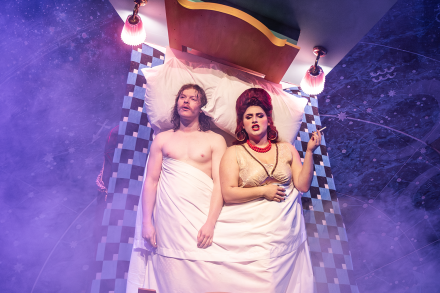
Wonderfully corny: Burlesque, at the Savoy, reviewed

Theatre

Inter Alia, a new play from the creators of Prima Facie, follows the hectic double life of Jess, a crown court judge, played by Rosamund Pike. As a high-flying lawyer with a family to care for, she knows that ‘having it all’ means ‘doing it all’. When not in court, she skivvies non-stop for her indolent husband and her useless son, who telephones her at work to ask why his Hawaiian shirt isn’t in the fridge where he left it. She races home, finds the shirt, irons it back and front, and then starts to prepare supper for eight guests. Husband and son pretend to help by Frisbeeing the dinner plates around the kitchen and tossing pots of taramasalata to each other. A spillage of gunk lands on the kitchen floor and Jess promptly kneels down and wipes it clean.

Why has the world turned on the Waltz King?

Arts feature

On 17 June 1872, Johann Strauss II conducted the biggest concert of his life. The city was Boston, USA, and the promoters provided Strauss with an orchestra and a chorus numbering more than 20,000. One hundred assistant conductors were placed at his disposal, and a cannon shot cued The Blue Danube – the only way of silencing the expectant crowds. Estimates vary, but the audience was reckoned to number between 50,000 and 100,000; in all, there must have been a minimum of 70,000 people present. This month’s Oasis reunion only played to 80,000. The result, in an age before modern amplification, was much as you might expect. ‘A fearful racket that I shall never forget as long as I live,’ was Strauss’s own description. Still, the point stands.

Brilliant rewrite of Shakey: Hamlet, at Buxton Opera House, reviewed

Opera

‘There is good music, bad music, and music by Ambroise Thomas,’ said Emmanuel Chabrier, but then, Chabrier said a lot of things. I adore Chabrier – who couldn’t love the man who wrote España and turned Tristan und Isolde into a jaunty quadrille? – but it doesn’t do to take him too literally. Thomas ended his career as a notoriously crusty director of the Paris Conservatoire, and when the French musical establishment puts you on a pedestal younger composers invariably start hurling the merde. Scraps of Thomas’s music survive in all sorts of odd corners (a snippet from his opera Mignon crops up in The Life and Death of Colonel Blimp). I’ve always found it rather appealing.

Magnificent: Stevie Wonder at BST Hyde Park reviewed

Pop

The highs of Stevie Wonder’s Hyde Park show were magnificently high. The vast band were fully clicked into that syncopated, swampy funk, horns stabbing through the synths, the backing singers adding gospel fervour. And Wonder – now 75 – sang like it was still the 1970s, his voice raspy one minute, angelic the next. Anyone who heard that phenomenal group play ‘Living for the City’ or ‘Superstition’ and didn’t feel ‘ants in my pants and I need to dance’, as James Brown once put it, should resign from life: they do not deserve such joy. That said, there were oddities. We were blessed with visits from four of Wonder’s nine children, two of whom were given whole songs to sing while the great man had a breather, as were three of the backing singers.

The power of BBC’s The Narrow Road to the Deep North 

Television

It’s been a good week for fans of TV dramas that are set partly in Syria, feature poetry-lovers confronting extreme violence, like to keep their viewers in the dark (sometimes literally) and have main characters with Australian accents (sometimes accidentally). But there are also significant differences between the two examples on display – with The Narrow Road to the Deep North the much more sombre and The Veil the considerably more bonkers. Adapted from Richard Flanagan’s Booker-winner, The Narrow Road began in Syria in 1941. Through what would prove the programme’s characteristic murk, a group of Australian soldiers led by one Dorrigo Evans could just about be seen rescuing a young boy and joshing about the respective size of their penises.