Ukraine

Russia has been preparing for war with the US for decades

The lights were blinking off. As raucous pro- and anti-Trump crowds flooded into Washington for the presidential inauguration in January 2017, the DC police department’s citywide surveillance cameras stopped recording. Within seconds, 123 of its 178 surveillance cameras, including those monitoring the streets around the White House and the headquarters of multiple federal agencies, had been ‘accessed and compromised.’ The intelligence gap lasted for three days, from January 12 to 15. Coming on the heels of Russia’s covert intrusions into the 2016 campaign, officials at first feared Vladimir Putin—or other bad actors, from China, Iran or North Korea—had dramatically upped their game to create more chaos in American society and its politics.

The reality of being ‘under siege’ in Kyiv

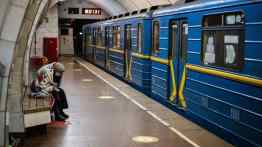
Kyiv, Ukraine I've never commuted into a warzone by train before, but I can now recommend it. The express train to Kyiv from Lviv near Ukraine’s Polish border has several advantages over coming in by car. Firstly, it avoids a 14-hour motorway drive, where fuel is short and traffic jams are long. Plus, the online booking app still works far better than any in Britain. Despite the risk of Russians-on-the-line, the train has been kept running to help Ukrainians flee Kyiv for the Polish border. But it returns to Kyiv largely empty, save for a few Ukrainians on mercy dashes to pick up relatives. We trundle through the night, the lights dimmed. Vodka is shared round. The only problem is that we arrive into Kyiv central station at 5am, three hours before curfew ends.

Putin’s dream of annexing Ukraine is over

As the Russian invasion of Ukraine enters its third week, it is becoming abundantly clear that the Kremlin’s maximalist geopolitical aims of regime change and a ‘greater Russia’ which includes Ukraine and Belarus are no longer achievable. The question now is how much damage will Russian forces inflict on Ukrainian cities and their brave defenders before Putin and his advisors lower their ceasefire conditions to terms that Ukraine’s leaders and population can accept. Ukraine is in a strategically stronger position than many in the West appreciate, but the war on the ground is still stacked in Moscow’s favour in the short term.

Peace and its consequences in Ukraine

From our US edition

It is now a matter of consensus that Vladimir Putin never intended to fight the type of war that now faces him in Ukraine. What was plainly meant to be a blitzkrieg-style assault has devolved into a war of attrition, with death, destruction and violence on a scale unseen in Europe since the disasters of the last century. It is quite plain that the Kremlin, despite its bluster, is aware of this. The Kyiv government's claims of Putin dismissing his generals and raving in fury at his security services are consistent with events on the battlefield; indeed, after two weeks of fighting, Russia has only managed to decisively claim one Ukrainian city.

volodymyr zelensky ukraine invasion

Foreign policy is not SimCity

From our US edition

History is relayed through anecdotes. And there's one anecdote about foreign policy in particular that keeps coming back to me. It was 2013 and President Barack Obama's advisors were weighing what to do about Syria. Dictator Bashar al-Assad was then waging a bloody civil war against an increasingly jihadist-dominated rebellion, destabilizing the Middle East and feeding a refugee crisis. Enter that ridiculous balloon John Kerry, then the secretary of state, who at a White House principals meeting stood up and began bloviating about the need to bomb the Assad regime. Kerry was interrupted in the midst of his JFK LARPing by General Martin Dempsey, the chairman of the Joint Chiefs of Staff.

john kerry president

Boris Johnson rejects Europe’s open approach to Ukrainian refugees

One of the most extraordinary (and moving) videos to have emerged since the invasion of Ukraine shows scenes at Berlin Central Station where refugees are paired upon arrival with locals offering accommodation. An unprecedented crisis has been met with an unprecedented public response – some 350,000 beds have been offered in Germany now. Over a million in Poland. People’s generosity has risen to the challenge – without government getting in the way to slow things down. Could it happen here? https://www.youtube.com/watch?v=7DHi92_xBLs We risk ending up doing more than any European country to arm the Ukrainians but less than any other to help refugees Michael Gove is set to launch a British equivalent – but with a difference.

Why won’t Pope Francis condemn Russia?

From our US edition

On February 25, the day after Russia invaded Ukraine, Pope Francis met with Aleksandr Avdeyev, Russia’s ambassador to the Holy See. Yet rather than summoning Mr. Avdeyev to the Vatican, Francis called at the Russian embassy, just two blocks from the Castel Sant’Angelo. The visit was a violation of diplomatic protocol. Heads of state don’t just pop ‘round to the local embassy. Over the next couple of days, it became clear that Francis wouldn’t be paying the same honor to Ukraine’s ambassador. Even more strikingly, Francis refused to condemn Russia for the attack. Vatican-watchers fumed. On February 28, the Vatican’s secretary of state released a video condemning the conflict “unleashed by Russia against Ukraine.

vatican

Why is the EU attacking Poland and Hungary in a crisis?

With Russian bombs harassing Kiev and Kharkiv, the two unsung heroes of Europe have been Poland and Hungary. With very little notice, they have between them welcomed, fed and accommodated well over a million refugees from Ukraine. This they have done gladly and without complaint. Yesterday the European parliament passed a ponderous 2,500-word resolution devoted to Poland and Hungary. An appreciation, perhaps, or even a vote of thanks? Not exactly. It was actually a call for the EU to take steps as soon as possible to block payment of EU budget and Covid recovery funds to both countries, and criticising Brussels for not having started the process earlier. Why?

Putin’s neo-communism is doomed to fail

It is responsible for inequality. For financial instability. And probably for poverty, racism and global warming as well. We have heard a lot about neoliberalism over the last 20 years. But now Vladimir Putin’s Russia is going in completely the opposite direction. The world is about to witness an experiment in what can only be described as neo-communism. The twist is that, unlike its liberal counterpart, it will be a complete failure – and the best thing the West can do is wait for it to implode. A Big Mac is not going to be any better when it is grilled by the Russian government Over the last three weeks since Russian soldiers moved across the border into Ukraine it has become clear that Putin is trying to recreate a Soviet empire.

Refugees in film: a cinematic guide

The tragic ongoing events in Ukraine have highlighted the plight of refugees, with over 2m people (mainly women and children) fleeing the country since Russia invaded on 24 February 2022. Sadly, refugee crises have been occurring since the dawn of what may ironically be called ‘civilisation’, most notably the Biblical Exodus from Egypt and Caesar’s conquest of Gaul, which began when the Swiss Helvetii confederation, under pressure of Germanic tribes, sought to cross into Roman territory on their westward journey to safety.

ukraine

Ukraine and the war for your mind

From our US edition

Deterrence works. Russia's nukes are the only thing keeping the US from full-out war in Ukraine just six months after retreating from Afghanistan. The unprecedented propaganda effort by Ukraine and its helpers in the American mass media to drag the US and NATO directly into the fight has failed — so far. But the struggle — the one for your mind space — is not over. To understand what follows, you have to wipe away a lot of bull being slung your way. Insanity is not the only explanation for Putin’s actions of the past few weeks.

Why taking cold showers could help Ukraine

I found myself in Berlin at the weekend gasping for breath in a cold shower, doing my bit for Ukraine. Berliners are a phlegmatic bunch but the arrival of a European war two hours from their doorstep is triggering memories of much darker periods of conflict and stirring not-so-dormant feelings of solidarity and direct action. Could cold showers be the answer? Last week the German government undid decades of foreign policy, announcing massive investment in German defence spending and sending anti-tank and air defence weapons to Ukraine. Chancellor Olaf Scholz called Putin’s invasion a Zeitenwende, a ‘watershed moment’ as he pledged €100 billion to upgrade German’s defence forces and committed to top the two per cent GDP contribution to NATO.

Chernobyl Two?

The electricity supply to the ruined nuclear plant at Chernobyl in Ukraine has been cut off. According to one knowledgeable source I spoke to, this is a serious problem as power is needed to pump water around spent nuclear fuel rods stored there. There is a back-up diesel generator, but it has just one day’s supply of fuel left and once that runs out, the temperature could start to climb. If the water evaporates, the zirconium metal ‘fuel assemblies’ could start to melt – with radioactive material released into the atmosphere. This would not be anywhere near as bad as the original Chernobyl disaster, in 1986, when a reactor had a power surge and exploded – but still bad enough.

Dostovesky and Putin’s useful idiots

When I was 17 I heard the name Dostovesky, and was enthralled. Just the name felt so glamorously intellectual, so deep. I began to read some of his novels, and my hunch was vindicated. A bit later I delved into his ideas, and my admiration became more nuanced. I partly admired his defiance of the rational humanist arrogance of the West, but I was also wary of his reactionary mystical nationalism, his faith in the anti-liberal Russian soul.  It seems that a lot of religiously minded intellectuals struggle to get past stage one. They are so taken with the flinty glamour of this writer that their critical faculties atrophy. They allow their aesthetic admiration to influence their religious politics.

This is what liberal war fever looks like

In a private letter written in 1918, the recently deposed German chancellor Theobald von Bethmann-Hollweg admitted that in the run-up to the Great War, 'there were special circumstances that militated in favour of war, including those in which Germany in 1870-71 entered the circle of great powers' and became 'the object of vengeful envy on the part of the other Great Powers, largely though not entirely by her own fault'. Yet Bethmann saw another crucial factor at work: that of public opinion.'How else,' he asked,'[to] explain the senseless and impassioned zeal which allowed countries like Italy, Rumania, and even America, not originally involved in the war, no rest until they too had immersed themselves in the bloodbath?

What’s behind Russia’s new Z symbol?

National symbols are usually proudly emblazoned for all to see. That’s the point of them. One, though, seems rather to have crept up on us in recent weeks, being flashed almost like a secret tattoo and then quickly covered up again. It is the letter ‘Z’ that Russians have started using to denote national solidarity and support for their country in the war in Ukraine. The Z came to international notice when a Russian gymnast, Ivan Kuliak, displayed it prominently on his strip two weeks ago while standing next to a Ukrainian competitor at a tournament in Qatar. He now faces a disciplinary inquiry as under the rules such symbols must not be worn.

Is it time to break up the Home Office?

When was the last time the Home Office produced some good news? Even in the middle of a crisis that most will concede the government has handled quite well, the department has managed to generate the usual abysmal headlines. Even the Foreign Office, slow as it was in cracking down on Russian oligarchs, couldn’t steal the limelight. There may perhaps be a narrow defence to be made over particular policies. Sources in the department point out that the Ukrainian government would prefer refugees to remain in neighbouring countries than come all the way to Britain. But take a step back and such arguments start to look ridiculous. Britain wouldn’t have to take millions of refugees to create an easier pathway for the few fleeing war with family here.

Is global warming really more dangerous than Putin’s nuclear threats?

Having just dusted down my Geiger counter and argued with the family about whether or not there is room for our dog, Jessie, in the cellar fallout shelter, I thought I would check in with the Bulletin of the Atomic Scientists to see how long we’ve got before our recently acquired small paddock sprouts its first crop of Cobalt-60. The Bulletin of the Atomic Scientists was begun in 1945 by the physicists who, having devoted several years of their lives to the Manhattan Project, suddenly realised that their striving might not be, in the end, exclusively beneficial for the human race. As the most lionised of them, J. Robert Oppenheimer, put it at the time (without a great deal of cheer): ‘Now I am become death, destroyer of worlds.