Theresa may

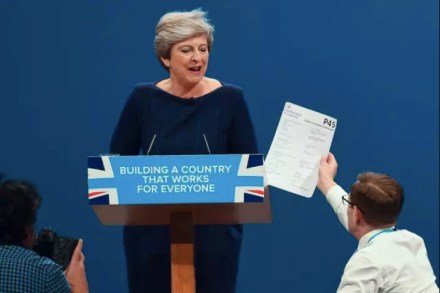
Watch: Theresa May presented with a P45 during conference speech

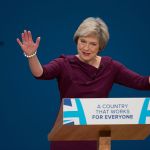
Oh dear. Theresa May's leader's speech at conference has descended into farce. As the Prime Minister tried to unify her party, one attendee had other ideas. Simon Brodkin interrupted May's speech mid-flow and presented her with a P45. Security had to escort him out  with the 'comedian' heckled by attendees. That's the picture of conference sorted then...

Theresa May’s Conservative conference speech, full text

A little over forty years ago in a small village in Oxfordshire, I signed up to be a member of the Conservative Party. I did it because it was the party that had the ideas to build a better Britain.  It understood the hard work and discipline necessary to see them through. And it had at its heart a simple promise that spoke to me, my values and my aspirations: that each new generation in our country should be able to build a better future. That each generation should live the British Dream. And that dream is what I believe in.

Forget the Nasty Party. This is the Knackered Party.

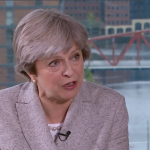
Tory conference is yawning on with neither furious fights nor much evidence that anyone knows how to fix the party's problems. The most energetic bit of it so far has been Theresa May's round of media interviews this morning, in which the Prime Minister appeared to have been turned on to 1.5x speed as she nervously gabbled her answers and tried to sound happy. Other spots of colour come from non-MPs, such as Ruth Davidson. The hall isn't packed, the atmosphere flat, and members and MPs look bewildered and miserable. The Tories are starting to resemble Labour at the end of its last spell in government. The party was exhausted.

Sunday shows round-up: Is Boris Johnson unsackable?

Theresa May – We've listened on student fees The Prime Minister marked the start of the Conservative party conference (and her 61st birthday) with a customary appearance on the Andrew Marr Show. First on the agenda was the announcement of a change in the government's policy on university tuition fees. May stated that she wanted to raise the threshold at which students start to pay back their loans, and that she intended to scrap a planned increase in level of fees to a maximum of £9,250 a year. Marr accused the Prime Minister of presiding over a screeching U-turn: https://youtu.be/IOnfnAKbifU AM: The policy that you stoutly defended for years, which ended up with £9,000 a year fees for students, did that work? Was it a failure as a policy?

Theresa May’s unconvincing performance on the Andrew Marr Show

This morning has been a reminder of how difficult this conference will be for the Tories. Two policies were announced overnight and neither have landed well. Theresa May then delivered a nervy performance on the Andrew Marr Show that will have done little to reassure Tories that she can turn things round. On tuition fees, the Tories have announced a freeze in their levels. It is hard to understand the politics behind this. It raises the salience of the issue without coming up with a solution. Those who went Labour because of their policy of abolishing fees won’t be won over by this. The other policy announcement is more money for George Osborne’s old Help to Buy scheme. But this doesn’t deal with the fundamental housing problem, a lack of supply.

Conservative party conference, day one: The Spectator guide | 1 October 2017

The Conservative party conference is underway. In the days after the doomed snap election, Theresa May didn't look as though she would make it this far. But the Prime Minister has clung on. Here are the highlights to look out for on day one: Party conference: 10.30 - 12.30: Meeting of the National Conservative Convention. Alexandra Suite, Midland Hotel  14.00 - 14.50: Welcome to Conference: Conference Chairman; Conservative Party Chairman; First Secretary of State 14.50 - 15.45: Delivering a fairer future for young people: Secretary of State for Education; Secretary of State for Communities and Local Government 15.45 - 16.

Theresa May’s tense conference

A few weeks ago, Theresa May seemed surprisingly stable as Tory leader, given the mess of the snap election. Her cabinet had finally stopped squabbling about Brexit and Conservative backbenchers were largely backing her to continue. But on the eve of party conference, things don't look so great. Firstly, the Cabinet unity has disappeared again. The Prime Minister's Florence speech opened up a war of bids for her attention from Brexiteers and Brexitsceptics alike, all of whom believed that the Prime Minister is so malleable on policy that she just needs to hear the same thing over and over again before she believes it.

Theresa May needs to show some urgency

Tomorrow is Theresa May’s birthday. But as I say in The Sun this morning, Tory activists won’t be giving her presents. Instead, they’ll be letting her know what they think went wrong with the election campaign. My information is that Theresa May won’t apologise for the campaign. But she will make clear that she intends to accept the recommendations of the report by former party chairman Eric Pickles and the 1922 chair Graham Brady into the election debacle. But May needs to do more than begin to repair relations with her party. She needs to speak to the country too. At Labour conference last week, Jeremy Corbyn painted the Tories as tired, out of ideas and clinging to power for power’s sake.

Capitalism is the best system, but it has been undermined by Quantitative Easing

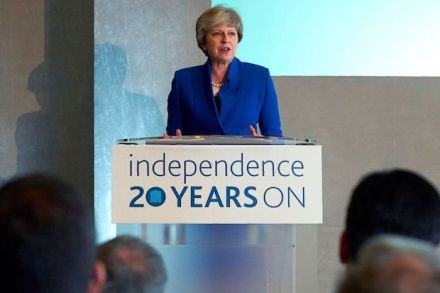
The Prime Minister spoke today at the Bank of England to celebrate its 20 years of independence. But she has failed to recognise the irony of trumpeting the virtues of capitalism in the seat of monetary policymaking which has, for the past ten years, undermined many of the principles on which capitalism is based. In theory, the central bank operates independently of Government, but in practice, its unconventional monetary policies have acted as a democratically unaccountable arm of the Treasury. It is understandable that, in the face of the 2008 financial crisis, policymakers were looking for new ideas to save the banking system.

Tories weren’t ready for snap election, says Tory who called snap election

At Conservative party conference next week, expect a lot of soul-searching over what exactly went wrong for the Tories in the snap election. Happily, the Prime Minister has kicked proceedings off early – telling the House magazine that the big problem was that the Tories just weren't ready for an early election: 'I think the other issue was the need to have, in a sense, a less centralised campaign. You obviously need to have a central focus in the campaign. But I think that an awful lot of people out there in the party worked hard on the ground, and there is a feeling that there wasn’t the ability to do what they wanted to do. There weren’t the links with the centre that there should have been. That’s one of the issues we need to look at.

The lady’s not for quitting

Even Damian Green seems to find it odd that he’s the second most important person in the government. When asked, the First Secretary of State plays down his influence — in fact, he plays down most things. When David Cameron wanted the Tories’ immigration policies out of the spotlight, he put Green in charge of them. And when Theresa May wanted someone she could trust to be her deputy after the disastrous general election, she chose one of the few people in the cabinet whom she can call a friend. The pair have known each other since Oxford, and now talk face-to-face every day. When we meet in his magisterial cabinet office headquarters, he talks about her with enthusiasm.

The real winner of Germany’s election is Jean-Claude Juncker

Even if Germany had Britain’s first-past-the-post electoral system, Angela Merkel would be struggling this morning to form a government. With 33 per cent of the vote, her Christian Democrat and Christian Social alliance has suffered its weakest showing in 68 years – tempered only by the equal failure of the socialists. It might have been a moment for Emmanuel Macron to seize the crown of de facto leader of Europe were it not that he, too, suffered a lower-profile though no less significant electoral reversal over the weekend – in Senate elections the La Republique En Marche party won only 23 of the 171 seats up for grabs. With his popularity ratings plummeting and his labour market reforms hardly begun, the Macron bubble has well and truly been burst.

‘Long and vain’: Europe’s press reacts to Theresa May’s Florence speech

Following months of tortured negotiation between the UK and the EU, Theresa May delivered her speech in Florence yesterday in an attempt to break the Brexit deadlock. Mrs May proposed a two-year transition period during which Britain would retain its access to the single market and confirmed that the UK Government will honour its commitments to the EU budget. She also spoke of the ‘shared challenges and opportunities’ that face the UK and the EU in a bid to build consensus. Here’s how Europe’s press reacted to the long-awaited speech. France France’s centre-left daily, Le Monde, agrees with Theresa May that Brexit negotiations can be extended beyond March 2019, however, points out that all member states must be in favour of such a move.

Britain may have lost faith – but Germany still believes in the EU

Theresa May’s Florence speech may have been welcomed with cautious optimism by Michel Barnier, but the reaction in Germany has been decidedly more downbeat. ‘In substance, May is bringing no more clarity,’ tweeted German MEP Manfred Weber. ‘I am even more concerned now.’ Weber is Chairman of the centre-right European Peoples Party, the biggest grouping in the European Parliament, and a rising star in Angela Merkel’s Christian Democratic Union. So does he speak for Merkel? Well, that would be pushing it, but while ‘Mutti’ maintains her deafening silence about all matters Brexit, it’s probably the closest we’re going to get.

The big questions Theresa May must answer

Theresa May’s speech in Florence was fine as far as it went, I say in The Sun this morning. A time limited transition is a sensible way to smooth out Brexit. But May didn’t answer the really big questions in this speech: what kind of future relationship with the EU does the UK want? How does it think regulatory divergence should be managed? The problem is that the Cabinet is divided on these questions—and neither side is strong enough to win the argument. So, Boris and Gove can stop Hammond and Heywood from getting what they want. But they can’t win the debate themselves. The result is a stalemate. This means the government doesn’t have clear direction on this crucial question.

May’s Brexit speech leaves some key questions unanswered

Theresa May’s speech in Florence set out more detail on the government’s position on transition. But it did not answer the question of what the UK’s final relationship with the EU should be, and how the UK thinks regulatory divergence between it and the EU should be managed. May’s transition proposal, though she still prefers the term implementation period, would see the UK continue to obey all EU rules and regulations and accept free movement, albeit with registrations of new arrivals. In effect, Britain would be staying in the EU but as a non-voting member. She suggested that this transition last two years. But she also said it should go on for as long as necessary for the new systems to be put in place.

Theresa May’s Florence speech on Brexit, full text

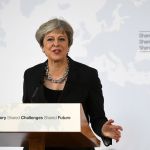
It’s good to be here in this great city of Florence today at a critical time in the evolution of the relationship between the United Kingdom and the European Union. It was here, more than anywhere else, that the Renaissance began – a period of history that inspired centuries of creativity and critical thought across our continent and which in many ways defined what it meant to be European. A period of history whose example shaped the modern world. A period of history that teaches us that when we come together in a spirit of ambition and innovation, we have it within ourselves to do great things. That shows us that if we open our minds to new thinking and new possibilities, we can forge a better, brighter future for all our peoples. And that is what I want to focus on today.

What the papers say: Theresa May needs to show more Brexit optimism

Theresa May’s Brexit pitch today will deliver to the EU ‘divorce terms that she hopes it can’t refuse’, says the Times. An early draft of her speech suggests she will start by explaining the choice of location, Florence; a city, the PM will say, ‘that taught us what it is to be European’. This begs the questions of what it means to be 'both British and European in the age of Brexit’, says the Times. Expect to hear mention of Britain being ’outward-looking’ and ‘global’ once again. But given that today's address ‘must be the speech of her life’ she cannot rest on saying things she has already said.

The Cabinet’s Brexit negotiation

Theresa May will give her Brexit speech in Florence today safe in the knowledge that she finally has the full backing of her Cabinet – at least, until the warm prosecco comes out at party conference. After a difficult week, Cabinet ministers today met on Thursday a two-and-a-half hour meeting where approval was given. In an attempt to demonstrate unity, the two poles of the Cabinet's Brexit debate – Philip Hammond and Boris Johnson – left No 10 together. Whether this new Cabinet unity can last is another matter entirely. It's expected that May will use the speech to propose a transitional deal with the EU of up to two years – along with a financial offer somewhere in the region of £20bn euros. Yet even this could still prove problematic.

The Spectator Podcast: Brexit Wars

On this week's Spectator Podcast we look at the final Brexit war amongst the Conservatives. We also discuss the maverick politician taking Ukraine by storm, and get on the blower with Blowers. First up, with a 4,000 word intervention by Boris Johnson doing the rounds this week, ahead of Theresa May's pivotal Brexit speech in Florence, the Conservatives look more divided than ever on the European question. Will it be EEA minus or CETA plus? Or are we headed for an even more mongrel departure? These are the questions James Forsyth asks in this week's cover piece, and he joins the podcast along with Henry Newman, director of Open Europe. As James writes: "The time for choosing is fast approaching for Theresa May.