Theresa may

When will Theresa May realise that Parliament hates a ‘power grab’?

Nothing has the potential to harm Theresa May’s weakened government more than a battle over the rights of Parliament. Just remember the PR disaster for the government that was the government’s High Court battle with Gina Miller over the right for a Parliamentary vote on the exercise of Article 50. Having fought and lost in the courts, the government had no trouble whatsoever in passing the Article 50 legislation. Why expend so much energy in a battle which makes you look authoritarian and yet which you never needed to fight in the first place? Tonight, Labour will be hoping to repeat the exercise with the vote on the second reading of the European Union (Withdrawal) Bill.

Theresa May’s exit strategy

Nearly all Tory MPs now agree Theresa May should stay on as Prime Minister. She must get the party through Brexit, they say. A leadership contest now would risk splitting the party over the European issue. One senior Tory who was agitating to depose May back in July has told me that he has now decided it would be best if she stays until 2019. But this desire to keep her in place for Brexit should not be confused (especially not by Mrs May) with a desire to see her fight the next election. The number of Tories prepared to even contemplate following her into another battle remains vanishingly small. Memories of her performance in the general election are far too vivid, and painful, for that. So if Brexit is her main job, how is it going?

The Conservative Party needs to be the party of family once again

Earlier this week, academics at Oxford and Cambridge were likely to be cock-a-hoop that their universities top international leagues tables taking both gold and silver spots. Britain leads the world when it comes to getting top places in international league tables of higher education. As a country, we sell TV shows across the globe and are cultural leaders pushing our soft cultural power; the Premier League is the most watched football league in the world; the City of London is the money capital of the world. Unfortunately, there are things we are less good at. In another league table published recently, Britain sits pretty much rock bottom when it comes to families breaking up. The UK leads the world in the number of families we have falling apart.

Parliament needs to do far more than just stand up to the latest government power grab

What a surprise: a government trying to make it easier to get legislation through the House of Commons. Today's Huffington Post story that Leader of the House Andrea Leadsom is trying to ensure that there is a Tory majority on every committee scrutinising legislation is just the latest example of Theresa May's government making every effort to make life easier for itself. Journalists at the Number 10 lobby briefing today pointed out that the Tories haven't actually won a majority and therefore do not deserve to have a majority in public bill and delegated legislation committees. Rather astonishingly, the Number 10 spokesman responded that 'the government has a majority on the floor of the House'.

Family is the key for breaking the reoffending cycle

Lord Farmer’s review on prison reform, launched this week at the Centre for Social Justice think tank, is ground-breaking for a number of reasons. For starters, it gets family. In an incontestably broad consultation, comprising hundreds and hundreds of interviews with prisoners across Britain, the resounding message that came back was about family. ‘If I don’t see my family I will lose them, if I lose them what have I got left?’, one prisoner told Lord Farmer. The statistics bear this out: the odds of reoffending are 39 per cent lower for prisoners who receive family visits than for those who don't. To be left bereft by the family sucks away the motivation so critical to rehabilitation.

The letter row is a reminder of Theresa May’s weakness

Some things never change. It's the end of the first week of the new term and the Conservatives are finishing it with a row about Brexit. Although there are several rows currently brewing on Brexit – from amendments to the EU (withdrawal) bill to David Davis's 'stability' – the one that is giving the Prime Minister the biggest headache involves a letter and a minister. The letter – thought to have been destined for the Sunday Telegraph – says that Britain should not pay into the EU budget during a transition period and must be able to sign trade deals straight after Brexit. These demands go further than current government policy and it has been circulated among Brexit-backing Tories, with dozens said to have signed it so far.

Portrait of the week | 7 September 2017

Home On being asked if she meant to lead the Conservatives into the next election, due in 2022, Theresa May, the Prime Minister, said: ‘Yes. I’m in this for the long term.’ Echoing Peter Mandelson’s remark in 2001, she said: ‘I’m not a quitter.’ Research by Conservative Home found that 52 per cent of Conservative party members wanted her gone before 2022. A memo from Lynton Crosby sent in April, before Mrs May called an early election, turned up in the Mail on Sunday: ‘Clearly a lot of risk involved with holding an early election, and there is a real need to nail down the “why” for doing so now.’ The Duchess of Cambridge announced that she was expecting her third child.

Theresa May gets a Brexit lesson from Parliament

Today has been a reminder of just how hard getting the Brexit legislation through parliament will be for Theresa May. In the Commons today, various Tory MPs made clear their concerns about the EU withdrawal bill and the powers it gives to the executive. While the bill will pass easily at second reading, the government is almost certain to have to give some ground to get the bill through committee stage. Already there is talk about a compromise involving votes on statutory instruments on the floor of the House. At the same time, there’s been the leak of a letter that is being circulated among clean Brexit Tory MPs which sets out that not only should the UK leave the single market and the customs union but that this country should be able to do trade deals throughout the transition.

May’s exit strategy

Nearly all Tory MPs now agree Theresa May should stay on as Prime Minister. She must get the party through Brexit, they say. A leadership contest now would risk splitting the party over the European issue. One senior Tory who was agitating to depose May back in July has told me that he has now decided it would be best if she stays until 2019. But this desire to keep her in place for Brexit should not be confused (especially not by Mrs May) with a desire to see her fight the next election. The number of Tories prepared to even contemplate following her into another battle remains vanishingly small. Memories of her performance in the general election are far too vivid, and painful, for that. So if Brexit is her main job, how is it going?

Starting again at 48

My name is Katherine and I’m an intern at The Spectator. What does that say about me? If you had to guess, you’d probably assume I was just finishing university and that I’m perhaps the niece or goddaughter of someone important. Because that’s how the media works, isn’t it? That I’m probably unpaid, but it doesn’t matter because my parents will sort me out — that’s if they didn’t buy this internship for me in a charity auction in the first place. And to be honest, that’s exactly how I imagined interns, too. Yet here I am, a 48-year-old mother of three. I felt embarrassed telling my husband I was applying for this scheme, suspecting he might think l had taken leave of my senses.

PMQs Sketch: Theresa May and Jeremy Corbyn are back in control

Mrs May was back to her former self today. Cool, brusque, snappy and effective. Electoral disaster has served her well. Is it possible she planned this all along? Having brilliantly sacrificed her majority, she’s now indispensable to her weakened party. Her lack of defences defends her. Just one Commons defeat and Corbyn could walk into Number 10. The Labour leader was transformed too. The vegan diet appears to have drawn a circle of spiritual detachment around him. He didn’t get narked today. He wasn’t petulant or hoity-toity. He didn’t rant or snarl. The wheedling note of the dentist’s drill never entered his voice. He seemed measured and in control. Smooth, even.

May fried over public sector pay at PMQs

Jeremy Corbyn and Theresa May spent their lunchtime talking about McDonalds. Unfortunately for the Prime Minister, it was McStrike, rather than a lunchtime order, that dominated her first PMQs since the summer recess. Asked to show support for those workers currently taking industrial action against the fast food giant, May would only say that it was a matter for McDonalds – before going on to attack Labour for not doing more to tackle zero hour contracts when they were in government. This felt evasive and allowed Corbyn to go on and pit her against the side of the workers when he asked about the government's diluted plans to crackdown on corporate excess. Although Corbyn asked several topical questions effectively, his problem was that he asked too many.

Jacob Rees-Mogg drops a hint about what job he wants in the reshuffle

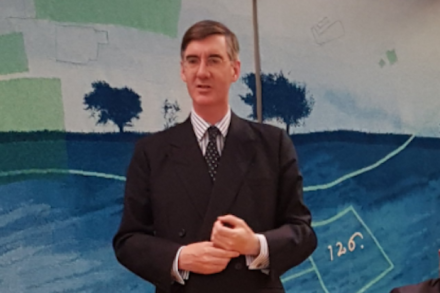
Although Jacob Rees-Mogg likes to insist that he is an unsuitable candidate for the role of Prime Minister, he still manages to fit in an impressive number of media appearances, public speaking engagements and constituency visits for your average backbencher. Tonight Rees-Mogg descended on the Boothroyd room in Portcullis House for a Conservative Voice event to share his thoughts on the state of his party. He criticised CCHQ for taking power away from local associations, praised the work of volunteers in the election campaign and called for a manifesto at the next election that would not be met with surprise by Tory members.

Theresa May is right to think there’s more to life than Brexit

The general election in June changed the politics of Brexit in ways that some pro-Leave commentators are desperately trying to ignore but which anyone actually doing politics has now accepted: 'no deal' is not an option, because there is not a Commons majority that would accept the steep drop out of the EU onto the rocks of the jagged WTO rules below. There certainly isn't a majority in the country for that option, and a PM who tried to sell a 'no deal' Brexit would be asking for removal and possibly an election the Tories could lose. There will be a deal, in the end, because the Conservative Party, despite its fondness for self-harm, always stops short of full-blown suicide. Anyone who tries to tell you otherwise is either deluded or trying to mislead you. Or both.

MPs hold breath for cross-party social care talks

Theresa May created many problems for herself in this year’s snap election. Some are rather difficult to ignore, like fewer MPs and no Conservative majority. Others are very tempting and advantageous to ignore, like social care. The botched manifesto proposal on the long-term funding of social care has made reform even less attractive to politicians who were already minded to set up as many independent reviews and commissions as possible in order to avoid telling the public that this is going to cost a lot of money to fix. Meanwhile the sector is even more on its knees than it was before. Crises don’t get better just because politicians ignore them.

Should Tory MPs want a reshuffle promotion from Theresa May anyway?

Who does Theresa May want to promote in her reshuffle? On our Coffee House Shots podcast today, we discuss how the Prime Minister actually feels powerful enough to even consider moving ministers around, and why she might want to delay that reshuffle for as long as possible. But there's another question worth asking, which is who wants to accept Theresa May's offer of a promotion? One of the names being mooted is Tom Tugendhat, currently the chair of the Foreign Affairs Select Committee. Tugendhat has only recently taken that position, but it wouldn't be an unprecedented move: Rory Stewart left his position as Defence Select Committee chair in 2015 after less than a year because he was offered a ministerial job.

Should Theresa May reshuffle her Cabinet?

When Parliament returns tomorrow, Theresa May will come back to work to find her position a bit more secure than it was when she left for the summer break. With no obvious leadership challenger and her party vaguely united behind her, May looks safe in No 10 in the coming months – even if her claim that she could lead her party into another election looks dubious at best. It follows that talk has now turned to how she could shore up her position and assert her authority on her party. The Times reports that the prime minister and her allies are planning to use the threat of a reshuffle to further bolster her authority.

What the papers say: Why a reshuffle isn’t the answer for the PM

Britain will have to pay some kind of Brexit bill to leave the EU, accepts the Sun. But that shouldn’t mean having to ‘pay a penny more than is due’. The Sunday Times reported yesterday that Theresa May is considering offering £50bn to keep Brussels happy. The Sun has a simple message: we hope that Brexit secretary David Davis is telling the truth when he describes such reports as nonsense. It’s not only the PM who comes under pressure in the Sun’s editorial today; the paper also takes aim at Brexit chief negotiator Michel Barnier for saying the UK needs ‘educating’ about the price of leaving the EU.

What did Theresa May mean by that?

Even some senior figures in Downing Street were unaware that Theresa May was going to say she wanted to lead the Tories into the next election, I write in the Sun this morning. The Prime Minister’s statement took Westminster by surprise. But even inside Number 10 there are doubts as to how seriously to take what she said. Indeed, I haven’t yet spoken to anyone who is genuinely convinced that she will lead the Tories into the next general election campaign. (Tory MPs were so calm about what May said precisely because they don’t think it is actually going to happen.) I think it is fair to say that May’s intervention was not perfectly calibrated.

How Theresa May plans to sneak policies past MPs

If Theresa May is in it for the 'long term', does this mean that she plans to do big things with her premiership? The Prime Minister promised a great deal when she stood on the steps of Downing Street over a year ago, but has so far delivered a snap election which messed up her chances of actually achieving what she promised. She now has to rely on a party which doesn't share all of her values - the DUP - or the good will of Labour MPs who happen to support what she wants to do. But this is all about May's weakness in the House of Commons Chamber. She can still make as many changes as she wants to policies using secondary legislation.