Satire

A small world: Shibboleth, by Thomas Peermohamed Lambert, reviewed

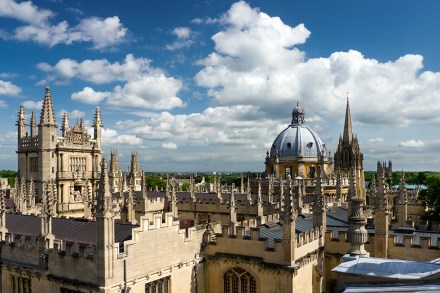
Two shibboleths are treated in Thomas Peermohamed Lambert’s audacious debut novel. The first is the University of Oxford; the second is the Israeli-Palestinian controversy. ‘It is the great issue, isn’t it? The great shibboleth.’ Edward, the protagonist, is a state-educated undergraduate whose connection to Islam is a Muslim grandfather from Zanzibar. He finds himself in a world of wealthy public school boys with ‘a social calendar, rugby fixtures and sexual assault hearings’, and girls from sister schools, ‘fully recovered from eating disorders’. This fictitious world is outdated, but Lambert’s satirical touch still hits the mark about ‘the creatures of the written word [the university] specialised in churning out, as if the country needed more of them’.

Excruciating: Sirens reviewed

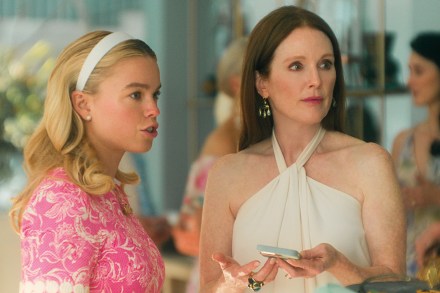
You had a narrow escape this week. I was about to urge you to watch Sirens, the latest iteration of that fashionable genre Ultra-Rich Lifestyle Porn, currently trending on Netflix. But luckily for you I watched it right to the end and got to witness the whole edifice collapsing like a speeded up version of Miss Havisham’s wedding cake. Normally, this doesn’t happen. Like most critics I have neither the time nor the work ethic to view a TV series in its entirety before putting in my tuppenny-ha’penny’s worth. I just assume that if something starts well or badly it’s going to continue that way. Not Sirens, though.

Satire and settled scores: Universality by Natasha Brown reviewed

In 2023 Natasha Brown published an article taking the reader behind the scenes of two interviews that she had given to newspapers in Australia and Spain while promoting her debut novel, Assembly. The point was to expose sleight of hand in the resulting write-ups, to say nothing of shabby conduct more generally. One interviewer, eager for her ‘to admit that I was influenced by two television shows which aired after my novel went to print’, asked, a propos of nothing, if she had a boyfriend. ‘It’s not clear whether this question came from the creased printout he regularly consults,’ wrote Brown, acidly.

A satire on the modern art market: The Violet Hour, by James Cahill, reviewed

In James Cahill’s first novel, Tiepolo Blue, Don Lamb, a Cambridge art historian, expressed outrage when ‘Sick Bed’, a Tracey Emin-like installation, is erected in the college quad. It is tempting to imagine what Lamb would now make of the many artworks on display in The Violet Hour. Here, Cahill steps away from the rarefied world of academia and public galleries to expose the excesses of the international art market. At the centre of the book’s many strands is Thomas Haller, whose violet-coloured panels partially inspire the title. He is a world-renowned artist who, in the words of his erstwhile best friend and dealer, Lorna Bedford, has become ‘the moneyed ghost of his former self’.

The White Lotus is off to a shaky start

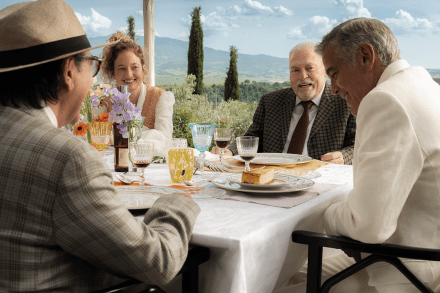
The White Lotus, now back for a third series, could perhaps be best described as Death in Paradise for posh people. Most obviously, this is because its plots revolve around murders in an idyllic location – only with a far bigger budget, a much starrier cast and several episodes per story. But there’s also the fact that it follows the same pattern every time. So it was that season three began this week, rather like its predecessors, with some lovely scenery, a dead body and a caption reading ‘One week earlier’. After that, we duly watched a bunch of rich, good-looking Americans arriving at a luxury White Lotus resort where they were welcomed by the resolutely smiling staff and a nervous manager, before gazing round and marvelling at the beauty of it all.

‘Was I cast because you couldn’t get anyone else?’ Cate Blanchett discusses Rumours

At last, a film about the G7. There have been more movies than you can shake a stick at set in the Oval Office and No. 10 and other citadels. But not once has cinema gathered democracy’s prime septet in the same frame, the way the annual Group of Seven summit does. Until Rumours. ‘Did you cast me because you couldn’t get anyone else to do it?’ Blanchett asks To play the leaders of the free world at this geopolitically sensitive moment, Rumours has attracted stars of magnitude. Cate Blanchett is the German chancellor, Charles Dance the American president. Roy Dupuis plays Canada’s pin-up prime minister and Alicia Vikander gives us her Swedish secretary-general of the EU.

Learning difficulties: The University of Bliss, by Julian Stannard, reviewed

You have been warned. First, David Butterfield has excoriated Cambridge University in these pages, leaving its standing devalued. Now Julian Stannard, a poet and novelist, delivers in fiction a devastating evisceration of other current universities. The University of Bliss belies its title. This is a work of high satire and Stannard vents his frustration with more than a touch of Swiftian saeva indignatio. His ridicule is extreme and addictively readable. The novel follows the career of the newly appointed vice chancellor Gladys Nirvana, partial to foot massages which transport her to regions signalled by her surname and give her acute sexual gratification.

A post-Brexit entertainment: The Proof of My Innocence, by Jonathan Coe, reviewed

This is a novel that spans the Truss administration, from its heady dawn to its decline and fall 49 days later. The Proof of My Innocence starts as a satire, not so much of Truss and her world but the ideologists who thought that the prime minister’s brief, shining moment was their long-cherished future. They meet in a collapsing Cotswolds castle to hear from delegates such as Josephine Winshaw, who intones that everything now is woke: ‘Paying your TV licence was woke. Getting vaccinated was woke... buying avocados was woke, and reading novels was woke.’ Another speaker praises a reactionary novelist to a much smaller audience. Into this milieu steps Christopher Swann, a blogger. To him the radical economic libertarianism that Truss represents stems from early 1980s Cambridge.

Nothing was off-limits for ‘the usual gang of idiots’ at Mad

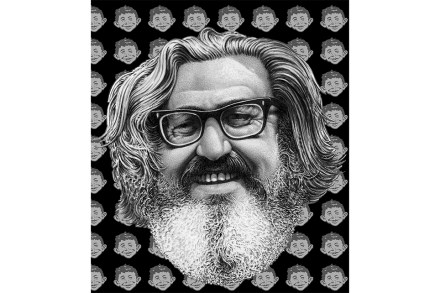
As many of us who grew up in America in the 1960s and 1970s learned, Mad magazine didn’t, as our parents warned us, warp our brains – because our brains were pretty warped to begin with. It was a time when what passed for culture was almost entirely scripted by Madison Avenue, promising that overpriced concoctions of sugar water and aspirin would eliminate all pain, social awkwardness and anxiety, or transport us to happy, sex-crazed beach parties with packs of photogenic young people.

Do men and women need different podcasts?

Do men and women need different podcasts? The notion goes against the unisex, every-sex, what-is-sex-anyway culture we have come to inhabit. Yet this week we find, on the BBC no less, a podcast dedicated to men’s problems and one satirising women’s problems. Some would say the pushback has begun. Geoff Norcott’s Working Men’s Club is a recorded stand-up comedy act performed to a studio audience in Leeds. Norcott describes it as a place ‘to discuss proper bloke stuff’, by which he means beer, sport and masturbation (cue laughter), but much more than that, men’s physical, mental and emotional health (initial silence). He jibes at the male habit of squashing feelings and ignoring signs to visit the doctor.

Headed for the canon: Withnail and I, at the Birmingham Rep, reviewed

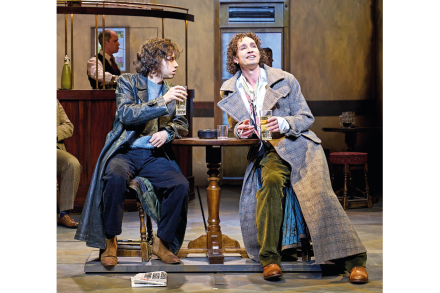
After nearly 40 years, Withnail has arrived on stage. Sean Foley directs Bruce Robinson’s adaptation, which starts with a live rock-band thumping out a few 1960s hits. The musicians take cameo roles as maids and coppers. The show needs a larger cast especially for the tea-room scene – ‘We want the finest wines available to humanity’ – which calls for a big crowd of crumbling old crocks. Never mind. The production would have thrilled diehard fans. As for newcomers, they would probably have been better to start with the film. This production of Withnail would have thrilled diehard fans – newcomers less so Robert Sheehan delivers a glitzy, karaoke version of Withnail which is all surface and very little inner torment.

Fools rush in: Mania, by Lionel Shriver, reviewed

Pearson Converse teaches literature at Verlaine University, Pennsylvania. She exists in an alternative universe to our own in which the Mental Parity Movement holds sway.  There is intellectual levelling, and no ‘cognitive discrimination’. This is high satire, exaggerated, crude, inviting ridicule of the social system portrayed, close to the great satirists of the 18th century in tone if not in style.   Yet Lionel Shriver’s Mania is more than just a satire. It is a study of Pearson’s family life and her ‘unbalanced’ relationship with her best friend from childhood, Emory. Pearson has three children: an intellectually gifted girl and boy by a high-IQ sperm donor, and an averagely intelligent girl conceived with her tree-surgeon partner, Wade.

Do we really need this unsubtle and irrelevant play about Covid?

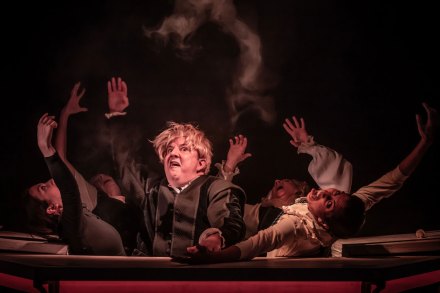
Pandemonium is a new satire about the Covid nightmare that uses the quaint style of the Elizabethan masque. Armando Iannucci’s play opens with Paul Chahidi as Shakespeare introducing a troupe of players who all speak in rhyming couplets. A golden wig descends like a signal from on high and Shakespeare transforms himself into the ‘World King’ or ‘Orbis Rex’. This jocular play reminds spectators with a low IQ that Orbis is an anagram of Boris. The former prime minister, also labelled the ‘globular squire’, is portrayed as a heartless, arrogant schemer driven by ambition and vanity. He retells the main events of the pandemic with the help of an infernal aperture which works as a dungeon, a hospital and, finally, as a version of Hades into which the characters are sucked.

Fast and furious: America Fantastica, by Tim O’Brien, reviewed

It’s been said again and again but rarely so plainly illustrated: American life is now too berserk for fiction to keep up. Tim O’Brien’s wild, rollercoaster satire America Fantastica is as wacky as its title suggests; but it can’t compete with the daily trainwreck that calls itself the land of the free and the home of the brave. O’Brien tracks with furious contempt the spread of a highly contagious illness: mythomania and delusional conspiracy theories infecting the body politic and poisoning a defenceless citizenry in the dark pre-Covid days of 2019. The name ‘Trump’ is never mentioned in the novel, but the ‘avalanche of oratorical whoppers’ issuing from the White House is the obvious source of O’Brien’s raging dismay.

A satire on the American art world: One Woman Show, by Christine Coulson, reviewed

Christine Coulson worked for more than 25 years at the Metropolitan Museum of Art in New York, where she wrote hundreds of wall labels. In One Woman Show, her second novel, she tells the tragicomic life story of a Wasp-ish porcelain girl called Kitty Whitaker almost entirely in the same 75-word format as if she were an artwork. The 20th-century tale is presented as an exhibition, made possible, we’re told on the opening page, by ‘gin, taffeta and stock dividends’. It’s a wonderfully clever concept, and a book that lends itself to being read in a single sitting, during which you’ll feel the corners of your lips curl upwards again and again.

Ugly and humdrum: Brokeback Mountain, at @sohoplace, reviewed

Brokeback Mountain, a play with music, opens in a scruffy bedroom where a snowy-haired tramp finds a lumberjack’s shirt and places it over his nose. Then he inhales. Who is this elderly vagrant? And why is he absorbing the scent of an abandoned garment? Two hours later, at the play’s close, we finally learn that the old man, Ennis, is sniffing a shirt that once belonged to Jack Twist who became his lover while they worked as shepherds in Wyoming. Yes, shepherds. The ‘gay cowboy’ label is a misnomer because the lads are ranching sheep, and their affair belongs to the half-forgotten days of homosexual persecution. The precise year, 1963, is signalled to us with a clunky line from Jack about JFK’s decision to escalate America’s involvement in Vietnam.

Life’s survivors: The Angel of Rome and Other Stories, by Jess Walter, reviewed

Anyone who has read Jess Walter’s Beautiful Ruins will want to turn straight to ‘The Angel of Rome’, the title story in this second collection by the versatile American author. Like the novel that elevated Walter from an underrated writer of police procedurals and thrillers to one capable of bestsellers, ‘The Angel of Rome’ is set in Italy and features a filmset and glamorous actors. Both are also partly based on real life. In Beautiful Ruins, Walter plays with what happened during the filming of the 1963 epic Cleopatra. Here he bases the story on an episode in the life of Edoardo Ballerini, an actor who read Beautiful Ruins.

Why the national divorce worked: a future history

From our US edition

The following is an excerpt from Yale University law professor Elizabeth Friedkin’s remarks to the 2026 International Federation of United Conscious Uncoupling Professionals. When then-Representative Marjorie Taylor Greene first proposed the dissolution of the United States of America in 2023, many feared she was threatening a second Civil War, including most of us in this room. Over the past two years, however, we have witnessed a benign break-up that is now a beacon to dissatisfied land conglomerates the world over. I was skeptical when I was chosen to serve as arbitrator, but I will be the first to admit that I underestimated the shrewdness of Ms. Taylor Greene.

national divorce

Pure scorn without wit or insight: Triangle of Sadness reviewed

The latest film from Ruben Ostlund received an eight-minute standing ovation after its screening in Cannes and also won the festival’s top prize, the Palme d’Or, and this has left me entirely baffled: what, the film I’ve just seen? The one where every scene is far too long? The one billed as a ‘satirical black comedy’ even though the targets are easy and it doesn’t say anything and I didn’t laugh once? That film? I should add, it’s not for the emetophobic. One of the scenes that goes on far too long involved so much vomiting that I could only watch the bottom 5 per cent of the screen. Ostlund needs someone like my mother in his life to tell him it’s not clever, it’s not funny, pack it in.

Bodies Bodies Bodies cancels its characters to death

From our US edition

Movies that define an era — Fast Times at Ridgemont High, Easy Rider, Casablanca — rarely get stuck there, even if anachronistic references and jokes fly by without notice today (does anyone watching Fast Times today know what a mimeograph is?). Annie Hall and Nashville are as particular to mid-1970s America as they are timeless works of art, both emotional panoramas of a period filled with affluent and successful but unhappy people, confused and eventually destroyed by their own wandering eyes and broken hearts. You didn’t have to have lived through the disappointment of the late 1960s — Vietnam, all of the assassinations — to feel the exhaustion and disillusionment of these films: it’s in every frame, often unsaid.

bodies