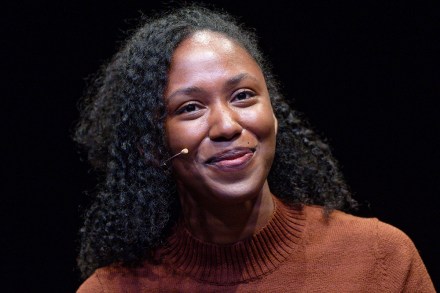
Anthony Cummins

Gavin Mortimer, Colin Freeman, Lawrence Osborne, Lionel Shriver and Anthony Cummins

From our UK edition

34 min listen

On this week’s Spectator Out Loud: Gavin Mortimer looks at how the French right can still win (1:48); Colin Freeman interviews Americans who have fought in Ukraine and feel betrayed by Trump (11:01); Lawrence Osborne details his experience of last week’s earthquake, as he reads his diary from Bangkok (18:38); Lionel Shriver defends traditional, monogamous marriage (24:07); and, Anthony Cummins examines media satire and settled scores as he reviews Natasha Brown’s Universality (31:13).  Produced and presented by Patrick Gibbons.
Satire and settled scores: Universality by Natasha Brown reviewed

From our UK edition

In 2023 Natasha Brown published an article taking the reader behind the scenes of two interviews that she had given to newspapers in Australia and Spain while promoting her debut novel, Assembly. The point was to expose sleight of hand in the resulting write-ups, to say nothing of shabby conduct more generally. One interviewer, eager for her ‘to admit that I was influenced by two television shows which aired after my novel went to print’, asked, a propos of nothing, if she had a boyfriend. ‘It’s not clear whether this question came from the creased printout he regularly consults,’ wrote Brown, acidly.

A bubo-busting muckfest: Hurdy Gurdy, by Christopher Wilson, reviewed

From our UK edition

In an essay for Prospect a few years back the writer Leo Benedictus noticed how many contemporary novels used what he called a ‘hindered’ narrator: that is, a protagonist (often a child) whose partial understanding of their world forces us to read between the lines. Unreliable narrators set out to deceive. By contrast, hindered narrators — such as the trapped five-year-old in Emma Donoghue’s Room — genuinely believe what they tell you: it’s all they know. As in Room, a hindered narrator can supply drama and pathos, but it’s handy for farce, too, as Christopher Wilson knows well.

Tame family dramas: Christmas in Austin, by Benjamin Markovits, reviewed

From our UK edition

My partner’s brother once found himself accidentally locked into his flat on Christmas Day, which meant having to spend it alone with his dog — an outcome he may shortly have cause to recall with no little longing, given that we’ve decided to host this year. At least we haven’t sneakily invited his ex along too. That’s the curveball flung at one of the characters in Benjamin Markovits’s new novel, the latest in his unashamedly old-fashioned and vastly enjoyable quartet-in-progress about a high-flying, Obama-era American family modelled, as you might guess, on his own. In the first part, A Weekend in New York, the parents and siblings of journeyman tennis pro Paul Essinger gathered to watch him compete in the first round of the US Open.

Highly charged territory

From our UK edition

I first heard of this tragicomic spy romp around Israel and Palestine when Julian Barnes sang its praises in the Guardian a few months ago, having been ‘lucky to see an advance proof’. Lucky? Well, he and Nathan Englander do share an agent, who perhaps noticed that Dinner at the Centre of the Earth just happens to take its epigraph from a novel by, er, Julian Barnes. That’s showbiz, I guess; and in any case, a spot of sly boosterism rather suits this mixed-up tale of cloaked allegiances, which never quite supplies the facts you need to grasp what’s going on — at least not during the globe-trotting, time-toggling fug of the novel’s opening half.

The evil that men do

From our UK edition

Early one summer’s morning in 1994, Paul Jennings Hill, a defrocked Presbyterian minister, gunned down a doctor, John Britton, as he arrived for work at an abortion clinic in Florida. Unrepentant by the time of his execution nine years later, Hill (who I really don’t recommend Googling) was associated with the Army of God (ditto), which urges the murder — or ‘justifiable homicide’ — of abortion providers in the United States. Given how often Joyce Carol Oates’s awesomely prolific output concerns male violence and women’s bodies, it’s no surprise to find her using this as material; with Trump vowing to undo Roe vs Wade, it’s timely.

Free love’s fallout

From our UK edition

Ann Patchett’s new novel is an American family saga involving six children, 50 years and too many coincidences to count. The premise is straight out of John Updike — a writer she admires — but her eye is on free love’s fallout, not its thrills. As the title hints, she’s interested in the larger family units that itchy-footed spouse-swappers inadvertently create when they do the dirty on their kin. It opens with Bert, a father of three with another baby on the way, sneaking a kiss from Beverly, a married woman hosting a christening party for her second child, Frances.

You can run but you can’t hide

From our UK edition

In The Circle, Dave Eggers’s satirical dystopia about an insatiable Google-like conglomerate, there’s a scene in which drones hound a social-media refusenik to his live-streamed doom; the character’s name, Mercer, was a nod to the American philosopher Ralph Waldo Emerson, whose 1841 essay ‘Self-Reliance’ saw Twitter coming. At least that’s a hunch that looks fairly sound now that Eggers has written a novel about going off-grid in the woods.

Strange sightings in Essex

From our UK edition

I suspect some readers might be too cool for this lovely book, partly because, despite its gothic horror set-up, it sets out unashamedly to lift the spirits; and partly because historical novels are sometimes derided as escapist, as if they’re only a fallback for authors who can’t keep up with, say, immigration or the internet. It takes place over a single year in the 1890s, in an Essex village where — if the rumours are to be believed — a monstrous sea creature skulks in the estuary, blamed for horrors from disembowelled livestock to a man’s corpse washing up on the marsh, his neck snapped. Up from London amid this panic is Cora, a wealthy amateur naturalist, liberated by the death of her abusive husband.

More blood and tears

From our UK edition

Irvine Welsh’s 1993 debut novel Train-spotting flicked a hearty V-sign in the face of alarm-clock Britain. ‘Ah choose no tae choose life,’ crows its giro-cheating antihero Mark Renton, proudly enslaved to heroin instead of mortgage repayments. But when Welsh revisited his native Leith for a 2012 prequel, Skagboys, he threw over this bourgeois-taunting amorality for blunter politics: Renton, it transpired, first turned to heroin for pain relief after police beat him up on a picket line during the 1984 miners’ strike. In Welsh’s latest novel, it’s the turn of Renton’s psychopathically violent frenemy, Francis Begbie, to get an origin story involving the abuse of state power. As a boy (we now see) Begbie struggled with dyslexia.

A plague on all P-words

From our UK edition

This isn’t a book to read before lights out. It’s about a mentally ill man whose mother exiles him from rural Ireland after years of rumours and reprisals related to his habit of startling passers-by with his bared erection. She has tried strapping him to a chair and bolting the door, but all that did was give him a fetish for not emptying his bladder. Now Martin John is flat-sitting in south London, working as a nightwatchman and hoarding old Eurovision tapes and lists of words beginning with P. But menacing this toehold on equilibrium is the arrival of an ill-disposed male lodger, who swiftly becomes the object of his paranoia. Martin John’s fevered brain (it’s always ‘Martin John’) gives the novel its jagged rhythm.

Sibling rivalries

From our UK edition

In The Past (set chiefly in the present) four middle-aged siblings spend an eventful summer holiday in the Devon country house vacated by their dead grandparents. When Alice, a failed actress, turns up with an unannounced male guest who’s still at university, her footloose ways vex the others — particularly the youngest, Fran, a harassed teacher with two small children, Ivy and Arthur. Then there’s demure Harriet, the eldest sibling, who needed to grow up fast when their mother Jill died young. Her secret diary shows how far her selflessness edges into repression, not least after she accidentally spies on her brother Roland in bed with his latest wife, a taut Argentinian named Pilar.

The mask of death

From our UK edition

Remember Ebola? It killed more than 8,000 people last year — before we were all Charlie — with a quarter as many again dying since January. Almost all the deaths have occurred in the war-weakened west African states of Guinea, Liberia and Sierra Leone; no licensed drug or vaccine yet exists for a virus that claimed its first victim almost 40 years ago in Zaire, now the Democratic Republic of Congo. The spread of that maiden epidemic northwards over the border with Sudan is the basis for Amir Tag Elsir’s punchy short novel, Ebola ’76, originally published three years ago and now translated with fluency and keen timing by two young Arabists, in a fetching edition from a small London outfit focused on African and Middle Eastern subjects.

A jaunty romp of rape and pillage through the 16th century

From our UK edition

The Brethren, by Robert Merle, who died at the age of 95 ten years ago, was originally published in 1977, the first in a sequence of historical novels that sold millions in their native France but have gone untranslated until now. Set in a plague-ridden, conflict-ravaged 16th century, rife with beheadings, hangings, abductions and rape, it’s a visceral yet strangely jaunty chronicle of provincial life after the Reformation. The title refers to a partnership between war veterans Jean de Siorac and Jean de Sauveterre. One is a libidinous medical graduate, the other a more dour Protestant with a dim view of his pal’s bastard-fathering ways. Together they hang up their swords and use their accumulated plunder to hoover up land in southwest France and build a dynasty.

A family novel that pulls up the carpet before you’re even in the door

From our UK edition

I first mistook David Gilbert’s second novel for the sort of corduroy-sleeved family saga at which American writers excel. The main character, Dyer, is an elderly author gathering his sons about him in Manhattan after the funeral of a boyhood friend, Charles. There’s Richard, a Hollywood screen hack whose teenage journal Dyer lifted for a prize-winning novel; his half-brother Andy, 17, on a mission to pop his cherry with Dyer’s sassy young agent; and Jamie, a documentary maker whose time-lapse footage of an ex-girlfriend’s death from cancer has gone viral. What muddies their stories is that they reach us via Charles’s son, Philip, a frustrated writer who left his wife and kids for a 20-year-old Vicodin addict he met on a sex site.

This year, discover Michel Déon

From our UK edition

In Roberto Bolaño’s novel 2666, the efforts of an academic claque propel the mysterious German author Benno von Archimboldi onto bestseller lists across the Continent. But ‘in the British Isles, it must be said, Archimboldi remained a decidely marginal writer’. Bolaño’s joke came to mind when I looked at the website of the French novelist Michel Déon, who has won awards and been translated ‘into German, Spanish, Portuguese, Italian, Greek, Turkish, Russian, Chinese, Lithuanian, Indian, Japanese, Polish, and once in English’, even though he’s lived in Ireland for more than 40 years. At least it’s twice now, thanks to the excellent Julian Evans.

Red or Dead by David Peace – review

From our UK edition

The last time David Peace wrote a novel about football he got his publishers sued for libel, which may help explain why his new one avoids invention wherever it can squeeze interest out of such stony matters of record as team sheets and attendance figures. Red or Dead follows the legendary manager Bill Shankly from his arrival at Liverpool — second-division stragglers in 1959 — to his death in 1981, seven years after retirement, having built a league-winning team that went on to rule Europe. Seldom does a novel, dedicated at such length to a single life, venture so scarcely into the mind of its subject; the gamble is that Peace’s biblically iterative method is strong enough to sustain but not overwhelm you. All the novel’s effects depend on repetition.

Americanah, by Chimamanda Ngozi Adichie, and Ghana Must Go, by Taiye Selasi – review

From our UK edition

Excitement over the extraterritorial birthplace of authors on Granta’s recent list of Britain’s best young novelists must have been old news in the United States, where the New Yorker’s equivalent exercise four years ago turned up Americans from China, the Dominican Republic, Ethiopia, Latvia, Nigeria, Peru, Russia and Serbia. Roughly speaking, this immigrant fiction makes a threefold appeal: it’s exotic, yet familiar (‘our’ culture measured by the standards of another), with a hairshirt’s prickle, too (by showing how short we fall). Chimamanda Ngozi Adichie’s new novel briefly features an eight-year-old Pennsylvanian boy who, before his nanny arrived from Nigeria, never knew that oranges contained pips.

A red rag, or just bull?

From our UK edition

Howard Jacobson’s new novel is a satire on modern literary publishing seen through the eyes of a writer, Guy, who wants to sleep with his mother-in-law even though he’s married to a stunner famed for her casseroles and ‘street blow jobs’ (that’s what it says). Things happen in it not to feed the story but to feed punchlines: Guy’s agent dies backpacking in the Hindu Kush only so Jacobson can say that ‘a literary agent going missing was too common an occurrence to attract speculation’. The gag is typical for the sense of moral and aesthetic collateral damage left in its wake. Overstatement is key to Jacobson’s style, as if he might become a comic writer simply by being a writer you can’t take seriously.

The courage of their convictions

From our UK edition

HHhH is a prize-winning French novel about a writer writing a novel about the plot to kill the Gestapo boss Reinhard Heydrich. A lot of people reckon it’s a big deal — Martin Amis, Mario Vargas Llosa, me — so naturally there’s a backlash afoot. In a fit of territorial pissing disguised as an interview, Michael Burleigh revealed that Laurent Binet ‘does not even read German’ (which HHhH admits on page 28) and professed surprise that his research failed to take in a Heydrich biography published (as Burleigh didn’t say) almost two years after HHhH first came out. I suppose part of the problem is that Binet asks for trouble with clever-dick lines like this one: ‘This scene is not really useful, and on top of that I practically made it up.