When following up a successful sitcom, should a writer head off into new territory or not? That was the question facing Dan Levy after Schitt’s Creek and John Morton after WIA – and now we have their answers: ‘yes’ and ‘not really, even with a change of country’ respectively. Curiously, both seem to have made the wrong choice.
‘Schitt’s,’ Levy has explained, ‘was so warm and sweet and cuddly. My natural curiosity was to go somewhere else more dangerous’; specifically, to provide ‘a story that’s thrilling but never not funny. That became the big challenge of the writers’ room.’
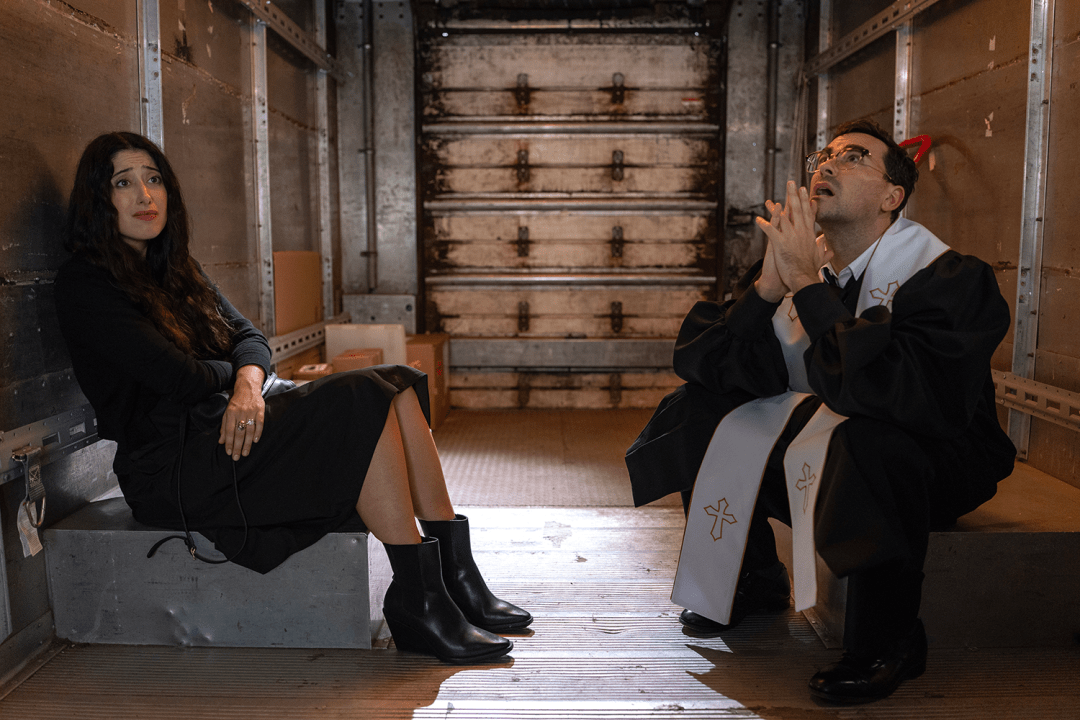
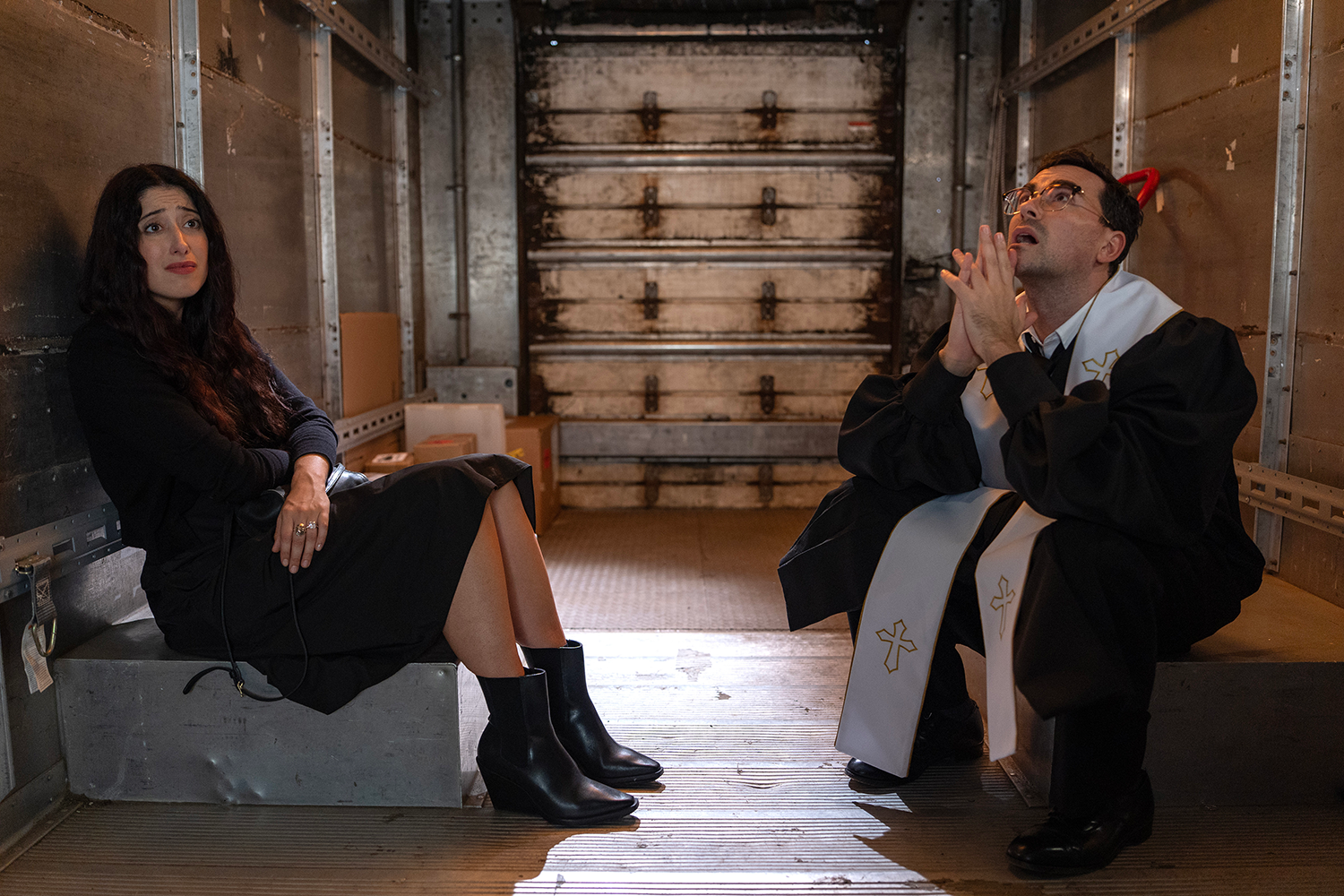
Seeking to rise to it, Big Mistakes – co-created with Rachel Sennott – began with the New Jersey siblings Nick and Morgan (Levy and Taylor Ortega) at the hospital bedside of their senile, incontinent grandmother, whose dying wish was apparently to have a diamond necklace of the kind that she’d lost on her honeymoon. Given that Nick’s a pastor and Morgan an elementary-school teacher, this was financially unfeasible. But figuring that their grandmother wouldn’t know the difference, they found a passable replica in a cheap gift shop. Oddly, the owner wouldn’t sell it to them, so Morgan stole it instead.
When they got back to the hospital, the old woman had just died, but they put it round her neck anyway so that she could be buried in it – which gave them the sense of a job well done and earned them some rare praise from their scene-stealing mother Linda (Laurie Metcalf).
Soon afterwards however, the shop owner showed up with a gun, explaining that he’d been minding the far-from-cheap necklace on behalf of a major criminal – but not why he’d chosen to hide it in the plainest of sights. As part of the show’s non-cuddly policy, Nick and Morgan were therefore obliged to dig up granny and retrieve it from the coffin. Which so impressed the major criminal (as it happens, a Russian called Ivan) that he gave them burner phones so that he could contact them to carry out various ‘errands’, most involving the delivery of envelopes stuffed with cash.
As set-ups go, this one unsurprisingly felt both effortful and implausible – although not as much as more or less everything else about the four episodes I’ve seen so far. In theory, I suppose, the notion of two very different grown-up siblings (her, reckless and messy; him, uptight and fearful) bickering away childishly while being drawn ever deeper into a life of crime might just have supplied the desired mix of thrills and jokes. The trouble is that the thrills aren’t all that thrilling and the jokes not all that funny.
Nor are they ever combined, just lurched between – as if the folks in the writers’ room had kept panicking that one of the two elements was being neglected and so suddenly had to be cranked up. This in turn leaves the characters without any real centre, seeming instead to be dependent at any given moment on whether the show had decided it was time for some tension or some comedy. Under the circumstances, the cast can perhaps be forgiven for never quite knowing what to do: a problem most of them solve by overacting wildly. In short, Big Mistakes is hysterical – but not in a good way.
Twenty Twenty Six sees the return of Hugh Bonneville as Ian Fletcher, first seen in John Morton’s Twenty Twelve as the Head of Deliverance for the London Olympics and then as the BBCs’ Head of Values in the wonderful W1A. Now, he’s landed up in Miami as the Head of Integrity for the 2026 Fifa World Cup.
The trouble is that the thrills aren’t all that thrilling and the jokes not all that funny
Once again, Morton deftly skewers jargon-ridden corporate nonsense – but the ‘once again’ bit does mean that the law of diminishing returns rather sets in. The same applies to Bonneville’s undoubted skill at looking perplexed at the madness around him – and to the impregnably ignorant young Turks in charge of social media.
Meanwhile, there are other problems too. Morton was always on solid ground mocking peculiarly British anxieties about saying anything that might come across as possessing certainty. But it turns out he’s less sure-footed on foreigners, taking refuge in such stereotypes as a fiery Mexican woman, an aggressive, money-obsessed American and a gentle Canadian.
And talking of gentleness cunningly brings me to a final point. Morton has acknowledged that he’s ‘not temperamentally suited’ to savage comedy. This characteristic was a perfect fit for the essentially bumbling worlds of Twenty Twelve and WIA (although the latter did have a welcome edge of exasperation at BBC ass-covering). But what to do when it comes to Trump’s America? Morton’s answer is to not make it Trump’s America at all, but a sort of kindlier parallel universe – which feels, at best, like a pulling of punches and, at worst, like a disappointing cop-out.



Comments