Putin

The Alaska summit went much as expected

From our US edition

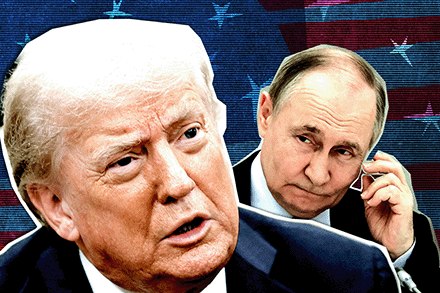
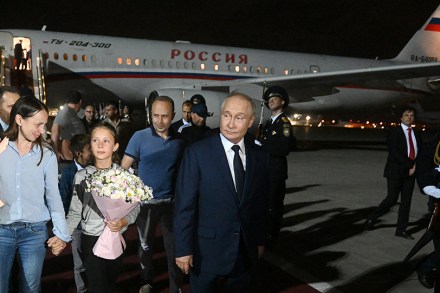
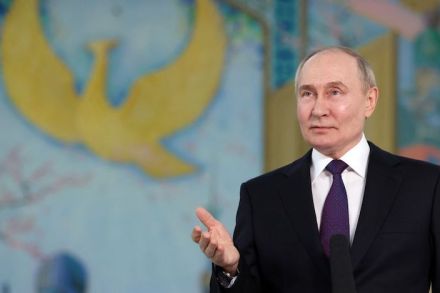
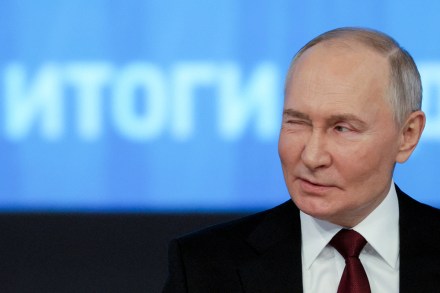
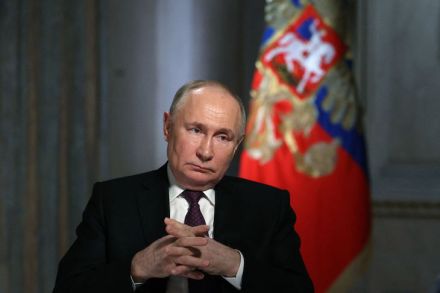
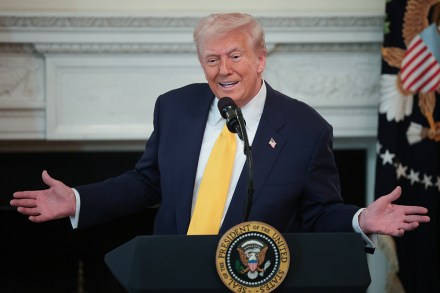
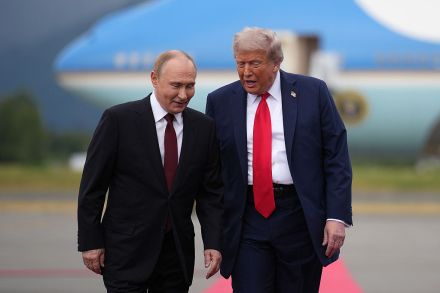
The summit between Presidents Donald Trump and Vladimir Putin ended predictably, without a ceasefire deal or, it seems, assent on much else. Trump said “Many points were agreed to, and there are just a very few that are left,” but failed to offer any details. Even if true, the leftovers are critical, and the gulf between the two governments on the war remains huge. Critically, Putin cares more about security than image or economics, and understandably believes that he would lose leverage by agreeing to halt military operations before winning the concessions he demands from Ukraine. Nevertheless, the summit improved, however slightly, the prospects for negotiating an end to the war.

Trump Putin

Trump, Putin, and the hidden power of the Bering Strait

From our US edition

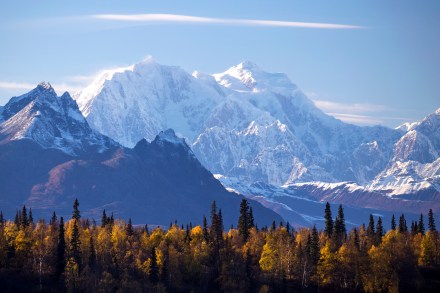
Ahead of the Trump-Putin summit in Alaska to discuss Ukraine, President Trump said there would be “some land swapping.” He waxed lyrical about “prime real estate.” The summit’s location is a good example of land swaps and prime real estate and is in a region of growing geopolitical importance.   In 1867 Russia "swapped" Alaska for $7.2 million in a deal mocked as Seward’s Folly after Secretary of State William H. Seward who negotiated the exchange. It turned out to be a snip. Commercially viable oil was discovered three decades later and has brought in more than $180 billion in revenue since Alaska became a state in 1959.

Trump Putin Alaska Bering Strait

Does European solidarity over Ukraine matter?

14 min listen

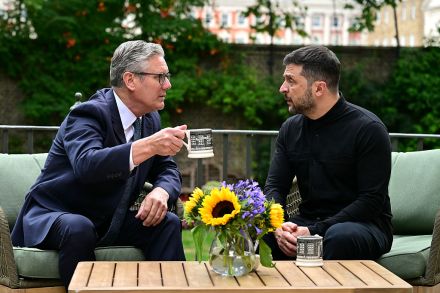
Ukraine's President Zelensky has spent today with Keir Starmer at Number 10. This is in anticipation of tomorrow's Alaska summit between Presidents Trump and Putin – where European leaders will be notably absent. Zelensky's visit to the UK is designed to project an image of solidarity with Starmer, and European leaders in general – but does it really matter? And is Putin really closer to accepting a ceasefire? Tim Shipman and James Heale join Lucy Dunn to discuss Plus – Tim talks about his article in the magazine this week, for which he spoke to George Finch, the 19 year old Reform councillor who is leader of Warwickshire County Council.

Why are Trump and Putin meeting in Alaska?

Donald Trump and Vladimir Putin are due to meet in Alaska this week. On the table: a discussion on how to end the war in Ukraine. Trump has been pushing hard to end the war. What's the significance of meeting in Alaska, what are the prospects of the war ending, and what are both sides hoping to achieve? Freddy Gray is joined by The Spectator's associate editor Owen Matthews, who writes on the subject in this week's magazine.

Trump – the conventional foreign policy President?

28 min listen

Trump has said he's "very, very unhappy" with Russia, and threatened severe tariffs against them if there's no deal on Ukraine within 50 days. He's also sending more weapons to Ukraine in coordination with NATO. What's behind his change of heart on foreign policy, and how's his MAGA base responding? Freddy Gray is joined by deputy US editor Kate Andrews, and Sergey Radchenko, professor at the Johns Hopkins School of Advanced International Studies. You can watch this episode here.

Putin’s stranglehold on the Russian press

Since Vladimir Putin came to power in 2000, the Russian press has been slowly, methodically strangled, which has forced existential choices on newspaper and TV journalists. Twenty-one have been killed – beaten, poisoned or gunned down. Others, such as Andrei Soldatov and Irina Borogan, highly regarded investigative reporters, have been forced into exile. Yet others, like the ‘dear friends’ of this book’s title, have chosen a different path – to cleave ever closer to the regime. The authors tell the fascinating story of those choices and allow us a glimpse of why they were taken.

Who started the Cold War?

Over a few short months after the defeat of Nazism in May 1945, the ‘valiant Russians’ who had fought alongside Britain and America had ‘transformed from gallant allies into barbarians at the gates of western civilisation’. So begins Vladislav Zubok’s thorough and timely study of the history of the Cold War – or, as he nearly entitled the book, the first Cold War. For the themes that underpinned and drove that decades-long global conflict – fear, honour and interest, in Thucydides’s formulation – are now very contemporary questions. ‘The world has become perilous again,’ writes Zubok, a Soviet-born historian who has spent three decades in the West: Diplomacy ceases to work; treaties are broken. International institutions, courts and norms cannot prevent conflicts.

Can Ukraine secure its military survival?

From our US edition

The Trump-Putin honeymoon is over. After three months of lengthy one-on-one phone calls, a handful of false starts on negotiations and flashes of Trumpian boosterism over the prospect of great commercial deals with the Kremlin, a fourth summer of war in Ukraine looks inevitable. Vladimir Putin will pretend to negotiate, while at the same time continuing to pound Ukraine’s cities with missiles and pressing forward on the ground. The Ukrainians will continue to scramble for men and resources with which to defend themselves. And the White House will continue to blame both sides for not reaching a deal. Over these three months of false hope, Putin has made two things very clear.

Ukraine

Putin orders new offensive

‘You want a ceasefire? I want your death,’ said Russia’s chief propagandist Vladimir Soloviev during prime time television, the camera zooming in on his face. His message was aimed at both Ukrainians and Europeans urging the Kremlin to stop the war. Soloviev, alongside a chorus of other Kremlin loyalists and military experts, has lately been gloating about how Vladimir Putin weathered western pressure and secured Donald Trump on his side. There will be no peace, they say, until Ukraine capitulates to Russian demands. Putin, as if to prove the point, announced yesterday that he had ordered the military to begin creating a ‘security buffer zone’ along the Ukrainian border – which is not quite the peace process Trump has been calling for.

The Russian spies hiding in plain sight

In June 2022, Vladimir Putin tipped up at a party at the headquarters of Russia’s foreign intelligence service, the SVR. This was to mark, of all things, the centenary of the country’s programme of deep-cover spies, who live for years abroad under elaborate false identities while passing secrets back to their masters at home. The weirdness of that espionage hoopla, just four months after the invasion of Ukraine, leaves one wondering what other bizarre birthday events Putin might have in his diary. The 85th anniversary of the assassination of Leon Trotsky, perhaps? Ah, you can imagine the banter. The cracker hats. The roll-out noisemakers.

There was Easter but no truce on Ukraine’s frontline

Kramatorsk, Donetsk region In a wooden Greek-Catholic church on the frontline of a warzone, encircled by red tulips and military vehicles, the priest’s sermon is woven through with the war – just like the soldiers’ Easter baskets, packed not only with paska bread, pysanky and sausages, but also with drones, waiting to be blessed. ‘This drone will be at work tonight – enforcing the ceasefire,’ a soldier whispers to me, smiling. The priest looks over a hundred soldiers in front of him, the church so packed that some must listen from the outside, and says that Ukraine will defeat evil, just as Jesus did. ‘The enemy is killing Him in our men and women, they are torturing Him in captivity, our mothers wash their faces with His tears,’ he says.
My DC bunker

From our US edition

Washington, DC My office this week has been the Starbucks on Capitol Hill. Any random subscriber to my Substack can get a half-hour with me if they book a slot. I do this a lot when I travel and oddly, given the rot of this rotting world, I rarely come away with the feeling that here were 30 precious minutes I’ll never see again. I often want to spend an hour or two. And no one yet has killed or even attacked me. A leftist policy wonk did show up without an appointment, but he just wanted to talk about Ezra Klein. One of this week’s characters was a Russia expert at a foreign policy thinktank, who seems to really know his stuff. He filled in important nuances ofthe Prigozhin coup. Yevgeny Prigozhin never meant to overthrow Vladimir Putin, he said.

curtis yarvin dc
nightmaring

Play Putin at his own game by ‘nightmaring’ his world order

From our US edition

There’s a delicious Russian verb that derives from the criminal underworld: “koshmarit,” literally “to nightmare someone.” It usually denotes how authorities give criminals, or anyone they dislike, so much relentless hassle from so many different angles they bend them to their will. Vladimir Putin, always keen to bring mafia language into politics, was the first Russian statesman to make use of it in public – he once instructed his authorities to stop “nightmaring” the business community. I keep returning to that word when I think of how Putin’s own foreign policy could be restrained to make real the Reaganite slogan that helped Donald Trump win the election: “peace through strength.

Will Trump join the strongman club?

The world’s most exclusive club, of presidents-for-life, is growing. It already includes Putin of Russia, Xi of China, Lukashenko of Belarus, Sisi of Egypt and Kim of North Korea. Then there are the other permanent rulers, MBS of Saudi Arabia and the rest of the Gulf monarchies, not forgetting Khamenei of Iran, and half a dozen African leaders. Now Turkey’s president, Recep Tayyip Erdogan, is trying to join the club. He has engineered trumped-up charges of terrorism and corruption against the man who might beat him in forthcoming elections, Istanbul’s mayor. More importantly, Donald J. Trump openly admires such autocrats and clearly wants to be one himself. This is the age of the strongman – and the world is far more dangerous because of it.

Has Ukraine called Putin’s bluff?

12 min listen

Last night there was a huge breakthrough in Ukraine peace talks, with Zelensky accepting a US proposal for a ceasefire and placing ‘the ball in Putin’s court’, according to Marco Rubio. While getting Zelensky to accept is a huge diplomatic win, the proposal hinges on Putin agree to the terms of the ceasefire – which will last for 30 days but can be extended by mutual agreement. ‘I’ll talk to Vladimir Putin. It takes two to tango,’ said Donald Trump. Can Putin afford to reject the deal? And could this be the basis for a lasting peace? Meanwhile, Keir Starmer has been getting a lot of credit for his role in the Ukraine peace process and the perception that he has stepped up to meet the crisis.

Putin

Why Putin could reject a ceasefire

From our US edition

With all the good news coming out of the Jeddah talks about a 30-day ceasefire in Ukraine, there’s only one question that needs to be answered: Will President Putin be interested in any kind of deal right now? President Trump is convinced that Putin wants peace. But if the Russian leader truly wants to end his war, will he do so on America’s terms, or will he wait until he achieves one of his main objectives — the total subjugation of the four provinces in eastern Ukraine that he claimed to have annexed in the first seven months of the invasion? At a ceremony in St. George’s Hall at the Kremlin in September 2022, Putin declared that Russia now had four new regions: Donetsk, Luhansk, Kherson, and Zaporizhzhia.

Trump has shifted the world in Putin’s favour

The verbal pummelling of Volodymyr Zelensky in the White House last week was an ugly moment of bitter truth. We saw the West tearing itself apart thanks to Donald Trump’s vanity and J.D. Vance’s disdain for the Ukrainian leader. If there is anything positive to be taken from the uncomfortable spectacle, it is that Europe now understands it has to take its defence much more seriously. And it is a mercy that negotiations between Zelensky and Trump have not been derailed for good. The Ukrainian President spent the week doing what his US counterpart accused him of failing to do: thanking the US for military and other aid it has received since Russia’s full-scale invasion three years ago. Zelensky appears keen to return to the table to discuss a minerals deal.

Why Europe needs to take the Putin threat more seriously

From our US edition

Russia’s war on Ukraine presages a dire future for all of Europe unless Vladimir Putin’s military is decisively defeated. That is the powerful and persuasive argument advanced in Keir Giles’s new book. To appreciate fully the importance of his contentions, you must acknowledge not only Giles’s own status as a supremely well-connected senior fellow at the famed Chatham House think tank in London but even more so the all-star cast of international military luminaries who have publicly endorsed his analysis: the now-retired US generals John Allen and Ben Hodges, UK general David Richards, Australian general Mick Ryan, plus former Estonian president Toomas Hendrik Ilves. Giles’s assertions thus should be taken with the utmost seriousness.

Giles

The Roman approach to ending a war

We await the full details of Donald Trump’s ‘take it or leave it’ solution to the Ukraine war, but at least Romans liked that sort of clarity. Take the war between Rome and the Carthaginian Hannibal, begun in 218 bc. Rome had already defeated Carthage in a long drawn-out battle over the possession of Sicily. In search of revenge, the father of young Hannibal made him swear never to befriend Rome. His family conquered southern Spain, rich in silver mines, agriculture and manpower, and when in 219 bc Hannibal sacked Saguntum, a town allied to Rome, Rome sent an embassy to clarify the situation. The Carthaginians complained of Roman treachery and asked what they wanted.

Ukraine war, three years on

13 min listen

Today marks three years since the start of Russia's full-scale invasion of Ukraine. From early fears of a swift Russian victory to the Kharkiv offensive and the slow war of attrition that has played out since, each stage of this war has been hard to predict. None more so than this stage, with the USA drastically changing tack and tearing up the transatlantic alliance by pursuing back-channel peace talks with Putin. Europe has been left scrambling. Where do we go from here? And with an isolationist USA, the breakdown of the European consensus on Ukraine and the UK's armed forces being hollowed out, who is left to defend Europe? James Heale speaks to Katy Balls and Keir Giles, a senior consulting fellow at Chatham House. Produced by Oscar Edmondson.