Putin

Why Putin still needs Wagner

It will be a matter of deep regret for Vladimir Putin that, in the wake of Yevgeny Prigozhin’s ill-fated attempt to overthrow Russia’s military establishment, he has finally been forced to come clean about the Kremlin’s association with the Wagner Group. Deniability is a vital facet for a veteran spook like Putin. Even when Wagner’s band of mercenary cut-throats were spearheading the assault on the east Ukrainian city of Bakhmut earlier this year, the Russian leader rebutted claims of Prigozhin’s involvement. ‘He runs a restaurant business, it is his job – he is a restaurant keeper in St Petersburg,’ Putin told Austrian television.

The Wagner Group isn’t Russia’s only private army

Allowing a psychopath to form a private army of violent criminals may not, on reflection, have been Vladimir Putin’s greatest idea. But Yevgeny Prigozhin’s mutinous Wagner Group is by no means the only private army operating in Russia. Over the past couple of months no fewer than five armies have been fighting on Russian soil. Only one of them, the official Armed Forces of the Russian Federation, is directly subordinate to the Kremlin. Pay can run to £2,400 a month, an attractive offer when the average wage in the provinces is under £600 The 12,000-strong semi-irregular forces of Chechen president Ramzan Kadyrov, officially known as the 141st Special Motorised Regiment but more famous as the ‘Kadyrovsty’, are effectively the Praetorian Guard of a regional leader.

Russian failure is a lesson for America

From our US edition

We may never understand the series of events and decisions that led Yevgeny Prigozhin to stage an armed rebellion against Russian president Vladimir Putin’s administration with his Wagner Group private military company, or PMC. Prigozhin was opposed to the planned forcible incorporation of Wagner into the Russian armed forces. He also came to be a sharp critic of the fabricated rationale for Russia’s war on Ukraine and the sloppy way it was being waged by its generals, who are more focused on politics than on defeating Kyiv.

russian military

The Wagner uprising has left Putin isolated

Both Vladimir Putin and the mercenary Wagner Group have been dramatically weakened by yesterday’s attempted coup. Wagner’s nominal leader, Yevgeny Prigozhin, goes into exile while his group will no doubt lose its privileged status. Putin, meanwhile, has been publicly and massively humiliated, a dangerous position for an autocrat. Firstly, Putin’s famed security forces proved completely helpless during a mutiny. Secondly, the mutineers – whom he called ‘traitors’ and promised to severely punish – will go unpunished. Putin had to make major concessions to bring an end to the coup, although what those concessions include is not yet clear. What is clear is that he was unable to crush the most serious threat to his authority in 23 years.

This failed coup will be just the beginning

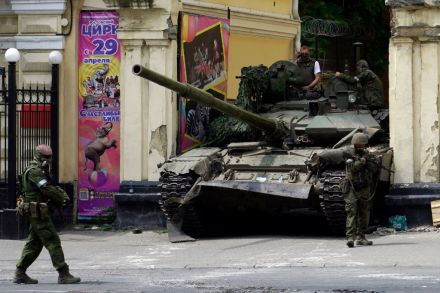
Yevgeny Prigozhin has just exposed the full extent of Vladimir Putin's weakness. In less than 24 hours, the leader of the Wagner mercenary group made extraordinary progress - taking control of the southern Russian city of Rostov-on-Don, the headquarters of the Southern Miliary District, and posing the most serious challenge to Putin’s leadership. The president did not look all-powerful, but unable to control Prigozhin as he said his 25,000 troops were willing to march on Moscow. Back on 9 May, when Prigozhin's challenge to Vladimir Putin first became evident, I argued in The Spectator against the idea that Putin was ‘in charge’ of the situation.

Prigozhin leaves Rostov

Yevgeny Prigozhin, the leader of the Wagner mercenary group, has left Rostov-on-Don and ended the armed insurrection against Vladimir Putin. After one of the most extraordinary days in Russian history, he said he marched within 125 miles of Moscow but said he decided to go no further to avoid bloodshed. Putin, who had ordered his army to crush Prigozhin and imprison his men, has agreed to drop all charges. After a Belarus-brokered peace deal, Prigozhin will self-exile in Minsk, according to the Kremlin. Footage emerged showing him being bid farewell by cheering crowds in Rostov and winding down his window to greet them. A few hours earlier, he released the following statement on Telegram: We marched out on 23 June on the Justice March.

How the Ukraine war remade our world

From our US edition

War has a stronger appetite than any of the countries that wage it. Aggressors, defenders, small states and superpowers are all on the menu. Take the war in Ukraine, for example. The war really started in 2014 when Russia annexed Crimea and fomented secession in the Donbas. America slapped Moscow back with sanctions. This was virtue-signaling. Sanctions might sting Vladimir Putin and his cronies, but how could they change Russia’s interest in Crimea? The peninsula is Russia’s gateway to the Mediterranean. Sanctions can’t alter geography. Ukraine had a friend in Vice President Joe Biden, and it had his son Hunter on a Ukrainian oil company’s payroll. Then disaster struck — the Bidens were gone and Donald Trump became president.

ukraine

Putin’s nuclear reshuffle is designed to antagonise Nato

Days before Nato leaders descend on Vilnius for the alliance’s annual summit next month, things will be afoot just across the border in Belarus. In a meeting with Belarusian leader Alexander Lukashenko at his summer residence in Sochi on Friday, Putin revealed that Russia will start deploying nuclear weapons to the country on the weekend of 7 and 8 July.  Putin’s decision to move nuclear weapons into Belarus just three days before the Nato summit begins in Lithuania is almost certainly no coincidence. As the alliance he regularly rages about prepares to sit down to discuss defence and deterrence, the Russian president is metaphorically puffing out his chest to remind them that he is worth taking seriously, actually.

The lives of even anti-Putin Russian artists are being made impossible

Swift and sure, the guillotine blade came down on Russians in the West on 24 February last year, the day Russia invaded Ukraine. The logic was clear as concerned Putin loyalists; cutting them off from western gravy trains in the face of their dear leader’s grotesque aggression made some sense. They could bed down with the devil, so to speak, but not on our buck. So one doesn’t weep much over the relegation to Europe’s fringes of the likes of openly pro-Putin musicians such as pianist Denis Matsuev or the former LSO and Munich Philharmonic chief conductor Valery Gergiev. Then there’s the soprano Anna Netrebko, who, seen as being close to Putin, was sacked immediately by the Met when she didn’t condemn the Russian President fast enough.

Is it too late to save America?

From our US edition

Regular readers may recall how fond I am of a mot from the British diplomat, author and art collector Edgar Vincent, the first (and, as it happened, the last) Viscount d’Abernon: “An Englishman’s mind works best when it is almost too late.” When I first encountered Lord D’Abernon’s saying, I was impressed by its slightly disabused cheerfulness. “Whew,” I thought. “As usual, some impending disaster was neatly avoided at the last moment by the wit and pluck of the doughty Brits.” The drama of the near-escape added to the sweetness of relief. Surely we Yankees — most of whom, until recently, were basically displaced Brits — could also be counted on to display the requisite derring-do at the critical moment. Could we though? “Almost too late.

america

Use Russia’s money to destroy Russia’s military

From our US edition

After thirteen months of war, Ukraine’s infrastructure is in a dire state. Its armies are preparing for a counteroffensive, and its economy is not likely to fare any better this year than it did in the last. Kyiv will need more money from the West — and the West will have to provide. The need is clear, but the will, in the United States and Europe, less so. Thankfully there is a way around this looming problem, courtesy of the Central Bank of the Russian Federation.  Representative Stephanie Bice of Oklahoma has submitted the Make Russia Pay Act, which authorizes the federal government to seize, deem as forfeited, and liquidate Russian assets that are currently frozen in the US.

vladimir putin hawks

A history lesson for Joe Biden

From our US edition

Some moderately clever people, reflecting on the confusing morass of current events, knowingly quote George Santayana’s most famous observation: that those who cannot remember the past are condemned to repeat it. Since the past is largely an almanac of unfortunate (not to say horrific) events, the idea that we are “condemned to repeat it” concentrates the mind in approximately the way Dr. Johnson said the prospect of hanging in a fortnight tends to do. But of course the past never really repeats itself. When it comes to history, Heraclitus rules: you cannot step into the same river twice, mon brave. Moreover, as that sage of Ionia said, “the true nature of things loves to conceal itself.

Vladimir Putin

How to win the war that everyone is losing

From our US edition

Russia is losing the war in Ukraine. So is Ukraine. And so are we. Imagine the good guys win tomorrow. What exactly will we have won? Ukraine was the poorest country in Europe even before the war. Afterward it will remain as dependent on American dollars as it is now — and on American arms. Russia will not have disappeared, after all. The last war-torn and impoverished country that required open-ended American support was Afghanistan. Yet all the weapons and funds we lavished on Hamid Karzai and Ashraf Ghani failed to keep the Taliban at bay after we left. The money also didn’t help with Afghanistan’s corruption problem. Will it help with Ukraine’s? In 2021, Transparency International ranked Ukraine second only to Russia as the most corrupt country in Europe.

war

There’s no excuse for Russia’s downing of a US drone

From our US edition

A US MQ-9 Reaper drone’s propeller was hit by a Russian Su-27 fighter jet over the Black Sea on Tuesday, causing the drone to lose control and crash. Before the fighter made contact with the drone, it and its wingman released fuel in what was likely an attempt to impair the American aircraft. The drone was in international airspace — which Russia seems to acknowledge — leaving no justification under international law for Moscow’s aggressive actions. Whether or not the physical contact was premeditated remains unknown. The Kremlin claims the drone’s “sharp maneuvers” caused it to crash and that its jet did not hit it.

vladimir putin army

Erdogan’s plan for war, and peace

There are ‘global issues that we both have on our plates’, US Secretary of State Anthony Blinken said, mysteriously, when he met with his Turkish counterpart last week. Foreign Minister Mevlut Cavusoglu, standing by Blinken’s side, thought the same. ‘We will focus on areas of partnership in bilateral and regional issues.’ Diplomacy as usual, then. Behind the boring platitudes lies a serious rift between Turkey and the United States. In late December, Syrian and Turkish defence ministers met in Moscow in the first proper meeting between the two governments in a decade. There are plans for another meeting between foreign ministers that could lead to a direct meeting between Turkey's leader Recep Tayyip Erdogan and Syrian president Bashar al-Assad.

Why Putin won’t take Hitler’s way out

The last time Europe fought a major war, there was no shortage of planning. We knew what peace meant. Winston Churchill and Franklin Roosevelt issued their Atlantic Charter in August 1941, before the Allied victory was anywhere close. This was followed by more meetings and conferences, including in Tehran in 1943 and later at Yalta, in Crimea, in 1945. The fighting never stopped, but there was a lot of thinking about the future of Germany, Europe and the new world order.  This sort of thinking is less evident today with Ukraine. Maybe it’s because Russia’s war in Ukraine, as bad as it is, isn’t yet a world war. It is happening some place out there, in ruined towns that few have ever heard of, and fewer still really care about. People are dying, but they are not us.

Putin’s war has exacted a terrible toll on Ukraine

Putin badly miscalculated. The Russian army terribly underperformed. Kyiv has shown unexpected resilience in the face of what experts thought was far superior Russian firepower. This, we’re told, is the story of Russia’s invasion of Ukraine, and all of it is true. Vladimir Putin’s talk of a ‘dirty bomb’ is evidence of how badly the war is going for him. Russia has been taught a bitter lesson, one that other trigger-happy, self-proclaimed great powers would be wise to heed. But one part has been missed. For all of Russia’s difficulties, it is in a far better shape than Ukraine. Fighting has left Ukraine in ruin.

What Zelensky has taken from his former TV career

Volodymyr Zelensky is one of the few leaders of modern times whose charisma, determination and sheer cojones can be said, without exaggeration, to have changed the course of history. In the first hours of the Russian invasion the US famously offered to evacuate him from Kyiv to a safer location, to which his response was (in spirit, if not in actual words): ‘I need ammo, not a ride.’ His determination to remain in the heart of his besieged capital seriously confounded Putin’s invasion plans, which were predicated on quickly toppling or murdering him.

Is Putin preparing a nuclear strike?

Russia is peddling implausible tales of Ukrainian ‘dirty bombs’. Kyiv and the West are embarked on a campaign to counter this propaganda, and again the talk is of the risk of Moscow using weapons of mass destruction in Ukraine. And that’s the point. First of all, Russian Defence Minister Sergei Shoigu broke months of relative silence – with the West, at least – and called his British, American, French and Turkish counterparts. His main message was to assert, with no evidence in support of his claims, that Kyiv was preparing to use a dirty bomb. This is a conventional munition, around which is packed radioactive materials, which is dispersed when it explodes.

Welcome to the age of nuclear blackmail

From our US edition

Vladimir Putin’s recent announcement that he was not bluffing about using nuclear weapons against the West in his war on Ukraine is one of the strongest indications yet of the risks the liberal world now faces in opposing authoritarian aggression. In the face of Russian aggression, or in committing the United States to defending Taiwan, as President Joe Biden did yet again recently, Washington and its partners face the possibility of direct confrontation with the world’s most powerful, nuclear-armed militaries. For the first time in a generation, Western powers risk being checked by adversaries willing to threaten massive conventional and nuclear warfare. The era of cost-free intervention to uphold the liberal world order is over.

nuclear