Hitler

The madness of Nazism laid bare

‘If the war is lost, then it is of no concern to me if the people perish in it.’ Bruno Ganz, who not so much portrays Hitler as becomes him in Bernd Eichinger’s 2004 film Der Untergang (Downfall), spits the Führer’s nihilist venom so convincingly that the fundamental insanity of Nazism is at once laid bare, even to his closest collaborators. The madness of Nazism is now merely Hitler himself, and when on 30 April Ganz/Hitler, entombed in the Führerbunker, shoots himself, the film’s tension is at once gone. What follows is just rats fleeing the hole; and the rest, as it were, is silence. But it was not. VE (Victory in Europe) Day was not celebrated in London until 8 May, and in Moscow on 9 May.

If we want to tackle anti-Semitism we must challenge hate speech, not censor it

One month on from the Charlie Hebdo massacre, free speech is still under attack. The outpouring of public revulsion at the bloody silencing of ‘blasphemous’ cartoonists after the attack was inspiring. It was a visceral display of support for the right to speak one’s mind – as crudely, offensively and blasphemously as one chooses – that has been absent for some time. But deep-rooted ambivalences have remained – and now these look to be exploited by policymakers looking to institute blasphemy laws of their own. When it comes to cracking down on aberrant ideas, Europe has long been leading the way. Restrictions on hate speech are in place across Europe.

Tom Stoppard’s The Hard Problem review: too clever by half

Big event. A new play from Sir Tom. And he tackles one of philosophy’s oldest and crunchiest issues, which varsity thinkers call ‘the hard problem’. How is it that a wrinkled three-pound blancmange sitting at the top of the spinal cord can generate abstract thoughts of almost limitless complexity? In real life Sir Tom is said to have such a flair for philosophical chitchat that he can fire off searching observations about Descartes, mind-body dualism, the nature of immateriality, being and non-being, the ‘cogito’ and so on, until those around him have slithered into a coma. Which is not rude of them.

Process of elimination: the horrors of Ravensbrück revealed

Concentration camps in Nazi Germany were originally set up in 1933 to terrorise Hitler’s political enemies; as war drew near, their function expanded to gratify his obsession (and that of Reichsführer Himmler, as head of the SS which administered them) with ‘purifying the race’ by getting rid of gypsies, Jews, ‘asocials’ — prostitutes, criminals, vagabonds — as well as the mentally ill and handicapped. An all-female camp at Ravensbrück, set up in 1938, soon afforded the prison doctors a steady supply of women — the ‘rabbits’, as these prisoners became known — for medical experiments .

Shirley Williams: Saving my mother from the scriptwriters

Shirley Williams sits at the head of a table in a large conference room in Lib Dem HQ. She will be 85 this year, but still has a finger in many a pie, most of which we’re not to talk about here, including the predicted wipe-out of a generation of her party’s MPs at this year’s election. It’s one of the reasons she never made it to see the Tower of London poppies. Too busy. She also had to dash to Russia where she is on the board of the Moscow School of Political Studies. ‘It is all about teaching people about democracy and has fallen under the frown of Mr Putin, which is why I had to go.

What unites Churchill, Dali and T.S. Eliot? They all worshipped the Marx Brothers

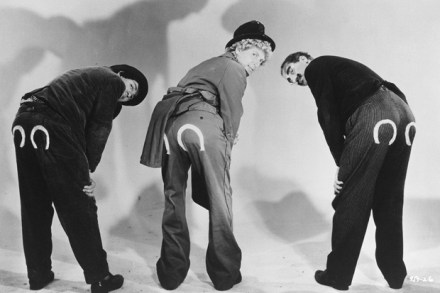
‘I had no idea you were so handsome,’ Groucho Marx wrote to T.S. Eliot in 1961 on receiving from him a signed studio portrait. The Missouri-born Eliot was the Marx Brothers’ devoted fan; three years later, in June 1964, Groucho called on the 75-year-old poet at his home in London. Eliot was interested in the Marx Brothers’ first undisputed film masterpiece, Animal Crackers (1930), while Groucho wanted only to quote from ‘The Waste Land’; however, the men agreed that they shared a love of cats and fine cigars. Winston Churchill was another who admired the Marxes and their deliciously mad repartee. During an air attack on London in May 1941 he found himself watching Monkey Business (1931), and was ‘glad of the diversion’.

That’s another year gone and, against the odds, I’m still here

A fruity voice on the train’s announcement system said, ‘Ladies and gentlemen, make sure you have all your belongings, family members and what have you with you when alighting from the train. We are now arriving in the naughty little station of Newton Abbot.’ This carriage was empty. The Teign estuary sparkled in the Sunday morning sunshine. The line from Totnes in Devon to Paddington is a lovely journey at any time of the year across the farms and pastures green of Devon, Somerset, Wiltshire and Berkshire.

The Nazi origins of the Vienna Phil’s New Year’s Day concert

It may be the last water-cooler moment in world television. On the first morning of the year, at 11.15 Central European Time, in a place that considers itself the epicentre of Europe, a group of men in formal dress mount the Musikvereinssaal stage in Vienna to perform a ritual that passes for culture and tradition. It is, of course, neither. The music is strictly bar-room, written by members of the Strauss family as social foreplay for the soldiery and serving classes in low taverns. Like most forms of dirty dancing, the music rose vertically from barroom to ballroom and was soon performed as encores by symphonic orchestras to dowager purrs of wie schön. The New Year’s Day concert is an annual jellybox of waltzes, polkas, galops, marches and any old tritsch-trash.

Hiding in Moominland: the conflicted life of Tove Jansson

Tove Jansson’s father was a sculptor specialising in war memorials to the heroes of the White Guard of the Finnish civil war. He did not like women. They were too noisy, wore large hats at the cinema and would not obey orders in wartime. Tove used to hide to spy on his all-male parties, where everybody got astoundingly drunk and attacked chairs with bayonets. ‘All men are chums who will never leave each other in the lurch,’ she concluded. ‘A chum doesn’t forgive, he just forgets — women forgive everything but never forget. Being forgiven is very unpleasant.’ Father and daughter had such a strained relationship that she sometimes had to run to the loo and vomit.

Egon Schiele at the Courtauld: a one-note samba of spindly limbs, nipples and pudenda

One day, as a student — or so the story goes — Egon Schiele called on Gustav Klimt, a celebrated older artist, and showed him a portfolio of drawings with the abrupt query, ‘Do I have talent?’ Klimt looked at them, then answered, ‘Much too much!’ One gets an inkling of what Klimt was getting at from the feverishly intense work on show in Egon Schiele: The Radical Nude. From childhood, Schiele drew with manic fluency. His father, a syphilitic stationmaster, was irritated to discover that a sketchbook, a gift to the boy intended to last for months, had been filled in less than a day.

Dylan Thomas: speeches for Hitler, balderdash for Walton and the true meaning of Under Milk Wood

My father came across Dylan Thomas in a Swansea pub in 1947. ‘Chap over there,’ said one of the regulars ‘is a poet.’ ‘What’s his name?’ asked my father. ‘No idea.’ That Thomas’s celebrity was rather patchy, even in his hometown just a few years before his death, illustrates how much his fame owes to the fans and memorialisers who have stoked the legend ever since. His centenary falls on 27th October. He was morose, shy, florid-faced and hyper-sensitive. He described himself as having ‘the countenance of an excommunicated cherub'. His first poems, published in the 1930s, were greeted with cautious interest. Edith Sitwell championed him. So did Cyril Connolly. Sceptics found his imagery inscrutable or meaningless.

I felt so awful I almost prayed that we would crash

This is about life up high. Two weeks ago The Spectator had that rapscallion and mischief-maker Peter McKay writing about how great it is to pilot a plane. (He’s taking lessons and has flown solo.) I’ve always been told that riding a motorcycle and piloting a plane are about the same, and McKay is a motorcyclist. His build, looks and accent are far more suited to riding on two wheels than to piloting a plane (that role is more one for a Cary Grant type). But I am being snobby and writing like McKay — cattily. Reading about flying brought back pleasant memories, but also a tragic one. When my little girl was 19 and at UCLA (that’s a university in Los Angeles, for any of you unfamiliar with places of higher learning), she informed her mother and me that she wanted to become a pilot.

Deborah Devonshire: JFK’s friend, Hitler’s antagonist, The Spectator’s columnist

The lives of the Mitford Sisters have riveted, and repelled, anglophiles since the thirties. Diana Mitford once wrote, 'I must admit "the Mitfords" would madden ME if I didn’t chance to be one'. Their hold on the public imagination can be attributed to a mixture of aristocratic eccentricity, romance, rebellion, devotion, betrayal, estrangement, tragedy, and loss; and through it all, a uniquely irrepressible wit. And although much of it will survive in the memoirs, biographies, novels, and collected letters they and others have written, the last living link has been lost with the death of Deborah, the youngest of that astonishing sextet.

Hugh Trevor-Roper: the spy as historian, the historian as spy

Shortly after the war began in September 1939, the branch of the intelligence services called MI8, or the Radio Security Service, recruited H.R. Trevor-Roper (as his name would appear the following year on the title page of his first book, his acerbic and somewhat anti-clerical life of Archbishop Laud). He was a young Oxford don, or would-be don, a research fellow of Merton. His academic career was now interrupted for six years: nominally commissioned in the Life Guards, he plunged deep into the murky world of secret intelligence. Before that, and before he turned to Modern History, Trevor-Roper had been a brilliant classicist, winning a string of university prizes.

The real Dad’s Army was no joke

Dad’s Army, the sitcom to end all sitcoms, portrayed the Home Guard as often doddery veterans. In one episode, Private Godfrey’s genteel sisters are seen to prepare their Regency cottage for the feared Hitler invasion. ‘The Germans are coming, Miss Godfrey,’ Lance Corporal Jones warns. ‘Yes I know, so many people to tea,’ she chirrups, adding: ‘I think I’d better make some more.’ In contrast to Godfrey, the sitcom’s street-smart spiv Joe Walker could be relied on to come up with the goods. In his rakish trilby indeed he supplies the platoon with contraband cigarettes and is familiar with the legendary backs of lorries what things fall off of.

Hitler’s Valkyrie: Unity Mitford at 100

On 8 August 1914, four days after the declaration of war, Unity Valkyrie Mitford was born, the fifth child and fourth daughter of David and Sydney Freeman-Mitford, who admired the actress Unity Moore. Grandfather Redesdale suggested Valkyrie, after his friend Wagner’s Norse war-maidens. The fact that Unity Valkyrie had been conceived in the town of Swastika, Ontario, where her father was prospecting for gold, made it all the more portentous. A few weeks after her birth, Unity and her mother (‘Muv’) joined ‘Farve’, who was with his regiment in Newcastle. His quarters were so cramped that Unity was laid to sleep in a drawer.

From Göring to Hemingway, via Coco Chanel – the dark glamour of the Paris Ritz at war

In Midnight in Paris, Woody Allen did a good job of showing how foolish it is to be obsessed by previous generations who’ve passed through Paris. Going back through the years, each group of geniuses turns out to be just as drunk and silly as the next, albeit with longer cigarette holders. Tilar Mazzeo, who has written biographies of Coco Chanel and the woman behind Veuve Clicquot, has done a similar service with this history of the Ritz. Focusing on the hotel is partly a device to write about the German occupation, but it’s mainly a way of gathering all the old Paris icons under one roof. Marcel Proust, Ernest Hemingway, Marlene Dietrich and Coco Chanel all drank cocktails there, and no one comes out of it well.

Churchill was as mad as a badger. We should all be thankful

Land sakes! Another book about Winston Churchill? Really? Give us a break, the average reader may think. Actually though, as title and subtitle suggest, this isn’t just another biographical study. It’s at once odder and more conventional than that. More conventional because, in some ways, it is just another biographical study. Odder because — instead of being a straightforward discussion of Churchill’s literary work — it sees literature as the key to his biography. More than that, its author seems to think he has hit on a ‘new methodology’ in which ‘we can write political history as literary history’. Well, perhaps.

Charlie Chaplin, monster

No actual birth certificate for Charles Spencer Chaplin has ever been found. The actor himself drew a blank when he went on a rummage in Somerset House. The latest research suggests that he was born ‘in a gypsy caravan in Smethwick, near Birmingham’. But surely the truth has been staring people in the face ever since the Little Tramp first popped on the screen: Chaplin is the lost twin of Adolf Hitler. Peter Ackroyd almost suggests as much. Both men first drew breath in April 1889. They had drunken fathers and nervous mothers. There were patterns of madness and illegitimacy in the family tree. They were short and sported an identical moustache. They had marked histrionic skills, each man ‘appealing to millions of people with an almost mesmeric magic’.

How Denmark’s Jews escaped the Nazis

Of all the statistics generated by the Holocaust, perhaps some of the most disturbing in the questions they give rise to are the following. Of the Jews in Hungary, the Netherlands, Greece, Latvia and Poland, between 70 and 90 per cent died, while the corresponding figures for Estonia, Belgium Norway and Romania were between 40 and 50. In France and Italy somewhere around 20 per cent perished. In both Bulgaria and Denmark, however, just one. Bo Lidegaard’s Countrymen is the story of how Denmark to a great extent saved its  Jewish population from the labour and extermination camps, but it inevitably raises issues of equal relevance to the rest of Europe.