Hugh Cecil

Process of elimination: the horrors of Ravensbrück revealed

From our UK edition

Concentration camps in Nazi Germany were originally set up in 1933 to terrorise Hitler’s political enemies; as war drew near, their function expanded to gratify his obsession (and that of Reichsführer Himmler, as head of the SS which administered them) with ‘purifying the race’ by getting rid of gypsies, Jews, ‘asocials’ — prostitutes, criminals, vagabonds — as well as the mentally ill and handicapped. An all-female camp at Ravensbrück, set up in 1938, soon afforded the prison doctors a steady supply of women — the ‘rabbits’, as these prisoners became known — for medical experiments .
Beasts in battle

From our UK edition

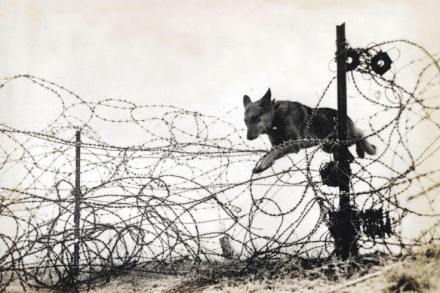
‘Never such innocence again’ wrote Philip Larkin of an unquestioning British people on the eve of the first world war, and much has been made, not unreasonably, of the trusting frame of mind in which young men of that time accepted the arguments for war in 1914. ‘Never such innocence again’ wrote Philip Larkin of an unquestioning British people on the eve of the first world war, and much has been made, not unreasonably, of the trusting frame of mind in which young men of that time accepted the arguments for war in 1914.

The diary that proves Anthony Seldon wrong about the first world war and the public schools

From our UK edition

In March 1915 the 27th Earl of Crawford and Balcarres, with an already distinguished political career behind him, took the unorthodox step of enlisting, aged 43, as a private in the Royal Army Medical Corps. In 1916 he returned to England from France to take up important government duties, but for 14 months he had been a medical orderly on the Western Front, the only cabinet minister to serve in the ranks in the first world war. He was based at the casualty clearing station at Hazebrouck, close to the principal areas of British military activity in 1915. He kept a diary throughout this time — now admirably edited by his cousin Christopher Arnander — giving a unique close-up view of the great war though the eyes of a shrewd participant.

To see how good Journey’s End is, just look at who it’s offended

From our UK edition

‘You have no idea,’ wrote the publisher Ralph Hodder-Williams in 1929 to one of his authors, what terrible offence Journey’s End has given — and terrible pain too, which is a great deal more important. I think you will agree that the chronic alcoholic was extraordinarily rare. He was referring to R.C. Sherriff’s controversial tragedy of the trenches, which was then, 11 years after the war, enjoying an unexpected box-office success in the West End, where it played for nearly 600 performances. Its success came as a surprise, not only because Sherriff (1896–1975) was an unknown writer, and exclusively male war plays were not particularly popular, but also because audiences were expected to sympathise with an unusual war hero.

The art of deception

From our UK edition

Max Beerbohm, dandy, cartoonist and penetrating drama critic, was par excellence the observer of the glittering English period that stretched from the 1890s to the death of Edward VII, poking unsparing but mainly good-humoured fun at the peculiarities of its political and cultural leaders: Swinburne, Asquith, Lloyd George, Chesterton, Kipling and the King among them. At the same time he was himself part of the scene, the master of a carefully cultivated style. His fellow critic Desmond MacCarthy once wrote of him: I remember walking one night down Piccadilly behind that high-hat with its deep mourning band. It was then perched above a very long dark top-coat with an astrakhan collar... In a gloved hand this figure held an ebony stick with an ivory collar...

A soul in agony

From our UK edition

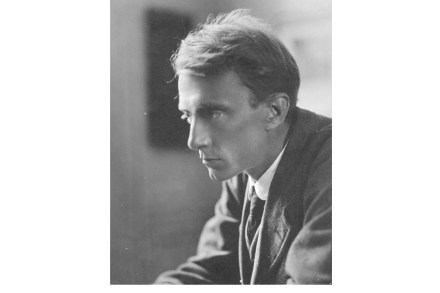
In this compelling book, Matthew Hollis  analyses how Edward Thomas, for years a frustrated literary critic and prose writer on rural themes, became all at once, at the age of 36, a poet of genius. It was his close friendship with the American poet Robert Frost which, in 1914, precipitated this long-delayed fulfilment. Married while at Oxford University, Thomas, to support his wife Helen and the three children whom they rapidly produced, burdened himself with writing ill-paid book reviews — sometimes as many as 15 a week. Of his own numerous books some were potboilers, others more distinguished, and all rather heavy in the hand, including the life of his hero, Richard Jefferies, the great 19th-century nature and country writer.

From void to void, with time to kill

From our UK edition

Just as the slaughter in the trenches of Flanders and northern France gave birth to the tragic verses of Wilfred Owen, so the experience of bombing and being bombed between 1940 and 1945 generated its own major poetry in Britain and the USA. The scale of the catastrophe was vast: 55,000 of British Bomber Command aircrew, with an average age of 22, lost their lives, as did 60,000 British civilians roasted, suffocated, buried alive or blown to bits. German civilian deaths far exceeded this and have been estimated at around 580,000 (of these victims, more were women than men, and many were children), not to mention the millions of homes, churches and national monuments that were destroyed.

Anything for a laugh

From our UK edition

A hundred years ago, when Britannia still ruled the waves, the Royal Navy fell victim to a humiliating hoax, reports of which kept the public amused for a few wintry days in February 1910. Disguised as ‘members of the Abyssinian Royal family’, with woolly wigs, fancy-dress robes and burnt-cork complexions, a gaggle of young people managed to trick naval leaders into receiving them on an official visit aboard the state-of-the-art battleship Dreadnought, Britain’s proudest national emblem. The ridiculous party, which included Virginia Stephen (the future novelist Virginia Woolf), were conducted solemnly round the wonders of the newest naval technology, jabbering in a nonsense language and escaping just as the spirit-gum holding on their beards began to melt.

Living the pagan idyll

From our UK edition

For years an intimate friend of my mother Rachel Cecil, Frances Partridge inhabits my memory from early childhood. Before she reached 50, her dark, delicate skin was already seamed with a thousand wrinkles like a very old woman’s, although she remained youthful all her prodigiously long life, retaining an acute power of sympathy. She would ask one searching personal questions and loved arguing, but good-humouredly, despite her strong pacifist and anti-religious convictions which were hotly contested in my home. Her youthfulness showed also in her birdlike gaze and musical, emphatic voice, the hallmark of the Bloomsbury circle with which she was so long associated.

In a class of his own

From our UK edition

‘Voltaire and the Sun King rolled into one’ is how Elizabeth Longford has described her Oxford tutor Maurice Bowra. As Fellow and then Warden of Wadham College from 1922 to 1970 and successively Professor of Poetry, Vice Chancellor of the University and President of the British Academy, this short, powerfully built, unbeautiful, but magnetic man for years gave the tone to the university. He was a brilliant wit and a challenging and imaginative college tutor. Late in his career, he fought an intelligent rearguard defence of the University’s independence. His biographer, Leslie Mitchell, well-known for his works on Whig history, has drawn on years of local Oxford knowledge and unpublished manuscript material for this penetrating portrait.

Memoirs of the Great War

From our UK edition

Survivors of a Kind, by Brian Bond In Survivors of a Kind, Brian Bond, one of our most distinguished modern military historians, has written an absorbing and affectionate study of the military memoirs of the first world war, bearing all the authority of a life- time’s work on the British Army. With some of the 20-odd names in this book the reader will be familiar: Siegfried Sassoon’s and Robert Graves’ sworks have stayed in print, and it is fair to say that most British people’s views of the Great War today are largely shaped by Goodbye to All That and, if not by Memoirs of a Fox-Hunting Man or Siegfried’s Journey, at least by poems like ‘Base Details’.

Not forgetting the horses’ indigestion

From our UK edition

The appearance of this volume is an important publishing event. It is the first book in ten years from one of the outstanding historians of our age. Its brevity and unflamboyant presentation are deceptive. Those who have admired Norman Stone’s work in the past will not be disappointed — it is full of surprises and provocative statements. Coming from an expert on Great War Russia who has now settled in Turkey, the balance of the book is tipped refreshingly away from the conventionally favoured Western Front, and much more towards the Russian, Balkan, Asia Minor and Italian Fronts, though the Middle East (unexpectedly), Africa, and more far-flung parts do not get much attention.

Singing in the mud

From our UK edition

This is a courageous and original book. Its editor, Vivien Noakes, is resisting, though not alone (Martin Stephen, Anne Powell, Dominic Hibberd and John Onions could also be cited), a trend of opinion which has shown no sign of receding over the past 50 years: this has effectively labelled Wilfred Owen, Siegfried Sassoon, Isaac Rosenberg, and, at a pinch, half a dozen others as the only true voices of the Great War. The canon, mainly anti-war in outlook and confined almost entirely to the Western Front, has dominated the British anthologies, which in turn have profoundly influenced national perceptions of that war. In fact, for 1914-18, the proportion of optimistic and patriotic war poetry to anti-war poetry was very high.

Public servant, private saint

From our UK edition

Leonard Woolf had a passion for animals, not unconnected with an appetite for control. Dogs (with the occasional mongoose or monkey) were his companions to the end of his life. Discussing human nature, he put them on an equal plane: ‘There are some people, usually dogs or old women, extremely simple and unintellectual, who instinctively know how to deal with life and with persons, and who display an extraordinary and admirable resistance to the cruelties of man, the malevolence of providence, and the miseries of existence.

The sunlight on the garden parties

From our UK edition

Listing page content here As a social and economic phase of English life the ‘Edwardian age’ had a longer span than the ten years of Edward VII’s reign. It began, roughly speaking, with Queen Victoria’s silver jubilee in 1887 and ended with the outbreak of the first world war in August 1914. Although a far from static period, it was characterised throughout by a jingoistic pride in British world power, then at its apogee, by a growing materialism and hedonism, and, despite an uneasy questioning of the social and political bases on which the Victorian age had rested, by an enduring belief in progress and Britain’s power in the future.

Will Haig end up as a cuddly toy?

From our UK edition

If you ask most people in Britain today for their views on the first world war, they tell you that it was a futile holocaust in which our nation’s brave and disillusioned young men were herded into a hell of mud and machine-gun fire by incompetent products of the English public schools. Executions for cowardice were a daily occurrence. Fairly or unfairly, they will cite such various sources as Ben Elton’s Blackadder Goes Forth, Alan Clark’s The Donkeys, Sebastian Faulks’ Birdsong, the poems of Siegfried Sassoon and Wilfred Owen and sundry articles by Max Hastings and others. This is the modern myth.

A season in Hell

From our UK edition

This sensitive, outspoken diary begins during the dark last days of the ‘dead little, red little army’, the British Expeditionary Force which bolstered the French left flank in Flanders from mid-August 1914. With the desperate defence of Ypres, through Hallowe’en into December, when the Germans were repeatedly beaten off, began the stalemate of trench warfare. The war was expected to be over by Christmas, but all that was over was any movement. The diarist, the redoubtable Sir Morgan Crofton Bt., was a regular soldier from a line of military forebears. Wounded in South Africa, he had retired at 35, as a captain in the Second Life Guards, early in 1914, only to rejoin when war broke out.