History

Hunting and working

Why are scholars so prone to melancholy? According to the expert, Robert Burton of Christ Church, it is because ‘they live a sedentary, solitary life… Why are scholars so prone to melancholy? According to the expert, Robert Burton of Christ Church, it is because ‘they live a sedentary, solitary life… free from bodily exercise and those ordinary disports that other men use.’ Not this one. The most remarkable characteristic of the young and maturing Trevor-Roper was his frenzied pursuit of foxes and hares on horse and foot, and his capacity for long marches through Oxfordshire, Buckinghamshire and the Borders in search of spiritual refreshment or a rendez-vous with a horse.

Ranking the Presidents

Like Matt Yglesias and Jonathan Bernstein, I’m delighted that Ulysses S Grant’s reputation is currently being revised and that, consequently, he’s no longer thought of as one of the worst Presidents in American history. The latest Siena College poll of “presidential scholars, historians, and political scientists” puts Grant towards the middle of the pack in 26th place. Still too low but certainly a step in the right direction. As is always the case in such matters the Rushmore Four plus FDR take the top five spots though this time, for some inexplicable reason, Teddy Roosevelt has supplanted Lincoln and come in second, behind FDR. These exercises are mainly entertainments for

An ideal banker

At last, thirty years after his death, we have a proper biography of the enigmatic but inspirational banker Siegmund Warburg, extensively researched and beautifully written. Previous efforts fell short. A Man of Influence (1988), written by Jacques Attali, workaholic aide to President Mitterrand, showed a careless disregard for accuracy. The Warburgs (1993) by Ron Chernow contained a great deal of interesting information, including for the first time a public account of Warburg’s affair with the Russian prima ballerina, Danilova, but left the impression, in the words of his astute long-time partner, troubleshooter and friend Henry Grunfeld, that Siegmund Warburg was not a man you would want to meet. David Kynaston,

More than a painter of Queens

The last words of Hungarian-born portraitist Philip de László, spoken to his nurse, were apparently, ‘It is a pity, because there is so much still to do.’ As Duff Hart-Davis’s biography amply demonstrates, for de László, art — which he regarded as ‘work’ as much as an aesthetic vocation — was both the purpose and the substance of his life. The last words of Hungarian-born portraitist Philip de László, spoken to his nurse, were apparently, ‘It is a pity, because there is so much still to do.’ As Duff Hart-Davis’s biography amply demonstrates, for de László, art — which he regarded as ‘work’ as much as an aesthetic vocation —

Secrets and silences

Charlotte Moore’s family have lived at Hancox on the Sussex Weald for well over a century. Charlotte Moore’s family have lived at Hancox on the Sussex Weald for well over a century. Hancox is a large, rambling house, and the Moores are a family who throw nothing away. Charlotte Moore still cooks on a 1934 Aga. Every drawer and every cupboard bulges with letters, diaries, receipts, even cheque book stubs. Moore has pieced together this chaotic archive to construct the history of her family. It is a complex but riveting story. Hancox was bought in the 1891 by a 23-year old spinster named Milicent Ludlow. Both her parents had died,

Might and wrong

‘Was all this the realisation of our war aims?’, Malcolm Muggeridge asked as he surveyed the desolation of Berlin in May 1945. ‘Was all this the realisation of our war aims?’, Malcolm Muggeridge asked as he surveyed the desolation of Berlin in May 1945. ‘Did it really represent the triumph of good over evil?’ All wars pose moral dilemmas for those who fight them, and the Second World War more acutely than most. How many allied lives was it legitimate to risk in pursuit of victory, even over an enemy of unspeakable wickedness? How many enemies was it legitimate to kill? Is the question even worth asking? This admirable book

A flammable individual

On the night of 18 October 1969, thieves broke into the Oratory of San Lorenzo, Palermo, and removed Caravaggio’s Nativity. On the night of 18 October 1969, thieves broke into the Oratory of San Lorenzo, Palermo, and removed Caravaggio’s Nativity. The altarpiece has not been seen since. Three decades later, in 1996, Italians were aghast when the Mafia claimed responsibility. Somewhere in the Sicilian capital of Palermo, it seemed, a gangland capo sat in awed admiration of the stolen Christmas canvas. Far from submerging rivals in wet concrete, now the Cosa Nostra were enthusiasts of 17th century religious art. Born in 1571 near Milan, Caravaggio was a flammable individual. Contemporaries

The pride of the Sackvilles

Knole is a country house the size of a small village in the Kent countryside. For the past 400 years it has been inhabited by 13 generations of a single family, the Sackvilles. The present Lord Sackville, Robert Sackville-West who lives with his family there, has written a scholarly book on Knole’s effect on the family and vice versa. It was Thomas Sackville who in the 1590s transformed a late medieval manor house into the Renaissance mansion that has become today’s tourist attraction. Like the Cecils, who were his colleagues in government, he made little distinction between enriching the crown and his own family, just as today’s MPs fiddled expenses

A tireless campaigner

Why haven’t we heard of Phillis Bottome? In her 60-year career she published 33 novels, several of them bestsellers, short stories, essays, biographies and memoirs. Why haven’t we heard of Phyllis Bottome? In her 60-year career she published 33 novels, several of them bestsellers, short stories, essays, biographies and memoirs. She lectured widely in Britain and America. She was translated into nine languages. Her 1937 novel The Mortal Storm predicted the horrific consequences of Fascism. MGM made a film of it, starring James Stewart — the studio’s first openly anti-Nazi film. It premiered in America in 1940, just as Hitler’s troops entered Paris, and was arguably influential in persuading the

Aces high

Seventy years after the RAF repelled the Luftwaffe, the Battle of Britain continues to have a powerful resonance. The conflict not only decided Britain’s very survival as an independent nation, but was also imbued with an epic moral purpose. The epochal months of 1940 represented the classic fight between good and evil, between freedom and tyranny, this romantic symbolism given added strength by the soaring rhetoric of Winston Churchill. The 70th anniversary of the battle this summer has prompted a surge of new books and the republication of several old ones. Among the best is the comprehensive new study by James Holland, a historian who has already won international acclaim

The poetry of everyday life

In an age when it is fashionable to travel with a fridge, Nicholas Jubber’s decision to take an 11th-century epic poem as his travelling companion to Iran and Afghanistan can only be admired. In an age when it is fashionable to travel with a fridge, Nicholas Jubber’s decision to take an 11th-century epic poem as his travelling companion to Iran and Afghanistan can only be admired. Written by the poet Ferdowsi sometime around 1000, the Shahnameh or Book of Kings consists of a whopping 60,000 couplets, four times the length of the Odyssey and Iliad combined. By turns mythical and historical, it tells the story of 50 shahs from the

A rather orthodox doxy

‘His cursed concubine.’ That was the imperial ambassador Eustace Chapuys’ judgment on Henry VIII’s second wife, Anne Boleyn. ‘His cursed concubine.’ That was the imperial ambassador Eustace Chapuys’ judgment on Henry VIII’s second wife, Anne Boleyn. And that was mild. The abbot of Whitby called Anne a ‘common stud whore’. The judge Sir John Spelman noted during her trial that ‘there never was such a whore in the realm’. And, of course, Henry VIII beheaded her. Anne, rather like our own Diana, caught some heavy flak for having a sexy reputation. She was gossiped about as the court bike long before she shacked up with the king, and was convicted

Robbing Peter to pay Paul

Two hundred years ago Jeremy Bentham wrote a tract which purported to demonstrate that the Christian religion was in effect manufactured by St Paul and not by Jesus. This was actually quite a common ploy at the time: a means by which freethinkers could assail Christian tenets without being prosecuted. And because St Paul’s writings occupy such prominence in the New Testament, and are plainly a major authority for so much Christian theology and understanding, there was reason well in excess of mere subterfuge to justify the procedure. In his restrained and in many ways compelling Introduction to his translations of the New Testament Rabbi Brichto (who died last year)

Bannockburn Should Be Celebrated

The usually estimable David Maddox has a very strange post up at the Scotsman’s politics blog complaining that Alex Salmond wants to exploit the 700th anniversary of Bannockburn. Apparently: While Bannockburn is a battle which Scots should take historic pride in, seeing off an invading English army which had numerical superiority, it nevertheless is symbolic of anti-English feeling which are rife with the SNP and nationalist movement as a whole. So much for the “positive nationalism” which Mr Salmond claims to espouse. It is difficult to escape the feeling that this will be a year long “hate the English” festival in the run-up to a double election in 2015. This

Robin Hood and the Laffer Curve

I’ve been assuming that Ridley Scott’s interpretation of the Robin Hood saga must be terrible. After all, it’s nearly a decade since Black Hawk Down, Scott’s last properly good movie. But now AO Scott pops up in the New York Times to suggest, though he may not mean to, that the movie has something going for it after all: You may have heard that Robin Hood stole from the rich and gave to the poor, but that was just liberal media propaganda. This Robin is no socialist bandit practicing freelance wealth redistribution, but rather a manly libertarian rebel striking out against high taxes and a big government scheme to trample

Genetics, God and antlers

‘Two things fill the mind with ever new and increasing admiration and awe, the oftener and more steadily we reflect on them: the starry heavens above and the moral law within.’ Oren Harman uses this quote from Immanuel Kant to open one of the chapters of The Price of Altruism, and it’s an observation that — after the steady reflection on moral law that Harman’s book invites and encourages — only seems more true by the end. ‘Two things fill the mind with ever new and increasing admiration and awe, the oftener and more steadily we reflect on them: the starry heavens above and the moral law within.’ Oren Harman

Not our finest hour

Ever since Edward II’s deposition and grisly murder in the dungeons of Berkeley Castle in 1327, his reign has always been regarded as a particularly embarrassing interlude in English history. Ever since Edward II’s deposition and grisly murder in the dungeons of Berkeley Castle in 1327, his reign has always been regarded as a particularly embarrassing interlude in English history. In 1908, when there was still some pretence that such subjects had a place in the classroom, teachers were advised that the period should be ‘passed over in discreet silence’. Not only was it one of fruitless civil war; Edward was also thought to have been a homosexual, who doted

The woman behind the god

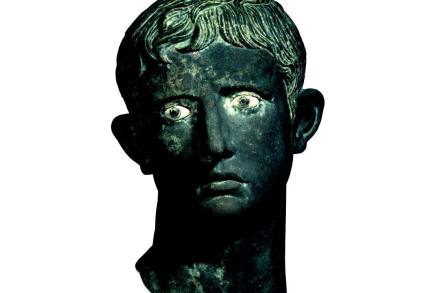
The emperor Augustus was the original god/father. Julius Caesar was often referred to as ‘the divine Julius’, but his nephew (and adopted son) was the first Roman to have temples dedicated to him in his lifetime. If uncle Julius had died a natural death, or in some brave battle, the Roman upper class would never have suffered the decimation (and then some) which Caesar’s ‘son’ and heir visited upon it under the rubric of vengeful piety. His last and greatest enemies had had nothing to do with Caesar’s death. Mark Antony had been Julius’s number two and was actually Octavian’s brother-in-law; Cleopatra had been his uncle’s most passionate love. After

The map turns red

Norman Stone forsook the chair of modern history at Oxford university for Ankara after realising that the ‘conversation at high tables would generally have made the exchanges in the bus- stop in the rain outside seem exhilarating’. Norman Stone forsook the chair of modern history at Oxford university for Ankara after realising that the ‘conversation at high tables would generally have made the exchanges in the bus- stop in the rain outside seem exhilarating’. Dur- ing an earlier incarnation at Cambridge, Stone taught a galaxy of historians. His protégés include David Blackbourn, Harald James and Richard Overy, followed by Niall Ferguson and Andrew Roberts, all bar two now working at