Food

The vast landscape of American barbecue

Some 25 years ago, I walked into the University of South Carolina library to check out a book on the history of barbecue. I had just finished a PhD in American literature, but had become more interested in culinary history. I had also taken to driving the state’s backroads, seeking out old-school barbecue restaurants. Researching the history of barbecue seemed the perfect next move. To my surprise, no one had published a book on the subject. The most that had been written about pre-20th century barbecue were a few sparse paragraphs in larger works on food history. I ended up having to write one myself. It took a while. The first edition of Barbecue: The History of an American Institution was published in 2010.


The mindfulness behind the cooking of Buddhist nun Jeong Kwan

I am somewhat allergic to food nomenclature: zero-waste, plant-based, seasonal, small plates, “live cultures,” foraged, farm-to-fork. It’s not that these are inherently off-putting concepts, but I associate them with “foodie” fads, gimmicks and big egos. All of those trendy labels could apply to the food cooked by the “philosopher chef,” a Buddhist nun called Venerable Jeong Kwan, plus you could throw in a dash of mindfulness and eastern spirituality for good measure. Yet Kwan, who is venerated by Le Bernardin’s Eric Ripert and Noma’s René Redzepi, and has featured in an episode of Chef’s Table, is the furthest thing from an ego-chef.

Why EU farmers would object to a South American trade deal

It was a weekend of mixed emotions for the European Union. There was the news from Donald Trump that he will impose a 10 percent tariff on eight European countries in retaliation for their opposition to his plans to take control of Greenland. But on a brighter note, the EU finally signed the Mercosur trade agreement with several South American countries. The European Commission hailed it as the creation of ‘a free-trade zone of roughly 700 million people’, one which they promise will save EU companies more than €4 billion a year in customs duties. Ursula von der Leyen, the Commission president, said: ‘We choose fair trade over tariffs, we chose a productive long-term partnership over isolation.

A restaurant so perfect I hesitated to review it

From our UK edition

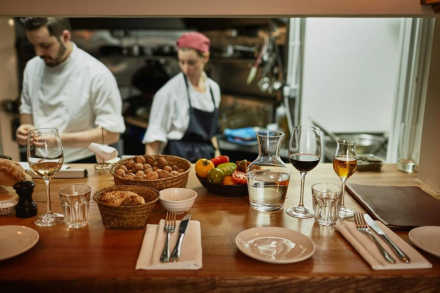
Sometimes you find it, H.G. Wells’s door in the wall, but to tapas: a restaurant so perfect you hesitate to review it. Each critic kills the thing she loves, because to love it is to change it. But I can’t just review palaces for psychotics containing lamps that should not exist, comforting though the idiocies of the very rich are. So here is a review of 28 Church Row, Hampstead. I will try not to make it read like a Hampstead novel about the unreliability of memory, but I might forget to do this. Church Row is the prettiest street in Hampstead: a ragtag of Georgian houses beloved by television stars who wake up one day, understand they are vulgar and buy a house that isn’t. I can’t afford one, but I saved a man from death in Church Row once, which is unusual for this column.

The EU vs the farmers

It was a weekend of mixed emotions for the European Union. There was the news from Donald Trump that he will impose a 10 per cent tariff on eight European countries in retaliation for their opposition to his plans to take control of Greenland. But on a brighter note, the EU finally signed the Mercosur trade agreement with several South American countries. The European Commission hailed it as the creation of ‘a free-trade zone of roughly 700 million people’, one which they promise will save EU companies more than €4 billion a year in customs duties. Ursula von der Leyen, the Commission president, said: ‘We choose fair trade over tariffs, we chose a productive long-term partnership over isolation.

Let’s bring back elevenses

From our UK edition

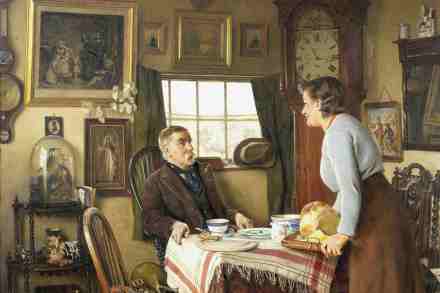
Join me, if you will, for a short stroll down the Charing Cross Road, back in the days when it was festooned with bookshops and Morris Oxfords. At Cambridge Circus, there was a large catering equipment shop owned by my great-uncle, Bill Farnsworth. He made it big when he sold water coolers to the American military. Above the enormous ground-floor showroom was his counting house, where men in tailored suits laboured over ledgers on high sloping desks, dipping their nibs into ink pots. This would have been about 1960. Were you to have a meeting with Bill in his office, say in the late morning, he would invariably turn to his walnut drinks cabinet and offer you a glass of something reviving and strong; a sherry, port or brandy, perhaps. Armagnac? It’s very good.

France’s bistros are dying

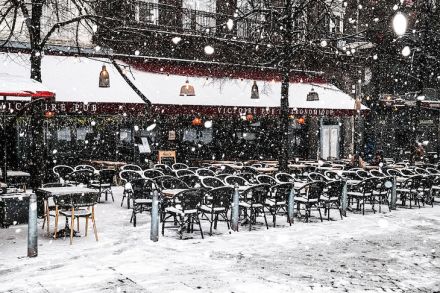
Emmanuel Macron says France’s traditional bistros should be granted Unesco world heritage status. Speaking at the Élysée this week, the French president vowed to help save the country's traditional cafes. "This is a fight that we want to take on, because our cafés and bistros aren’t just selling croissants, baguettes and traditional products – they’re also on the front lines of preserving French craftsmanship and know-how," Macron told a group of French bakers at the annual Epiphany cake ceremony. France doesn't need to list its bistros. It needs to decide whether it still wants them Macron is right about what the bistro represents. For generations, it has been a shared meeting place as much as a commercial one; somewhere to linger and belong.

How to eat in Cuba

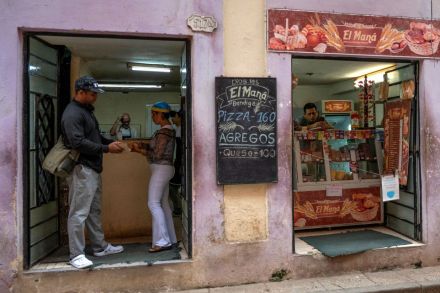
My apartment in Havana is on a rooftop overlooking the sea, which sounds grand and penthousey, but it’s not – it’s the former caretaker’s hut. It also sits above my parents-in-law’s place, which offers challenges, but does mean that most days I wander down for lunch. When I first moved in, I didn’t speak Spanish and so would enjoy these meals in ignorant bliss, smiling winningly as I guzzled down pork, rice and beans. I tried not to ask my now-wife to translate because I didn’t want to interrupt what I imagined were hugely erudite discussions; she’s a literary professor and her parents are both philosophers. Slowly, though, I began to understand, Spanish revealing itself like a song on the wind.

Scott’s vs Mayfair

From our UK edition

Kingsley Amis was obsessed with Scott’s on Mount Street, Mayfair, and he knew a lot about food. He ate himself to death. In his unwise James Bond continuation novel Colonel Sun – Ian Fleming also loved Scott’s – Amis had Bond ponder that ‘every meal taken in those severe but comfortable panelled rooms [is] a tiny victory over the new hateful London of steel and glass matchbox architecture’. Bond then presumably dropped his knickers, because there is as much projection in Amis and Fleming as there is in this column. Even so, I know how they feel about Scott’s. Mayfair is now the UAE with democracy and rain. It is gold and pink for toddler princes, and Scott’s, which is the colour of a Barbour, remains a tiny victory in brown. Of course Amis loved it.

Italian food is revolting

From our UK edition

About a week into an open-ended early pandemic stay in Ortigia, the antique, tourist-beloved spit off Siracusa on Sicily’s eastern coast, I had an epiphany. I hated the food. I’d just had a few bites of a clammy aubergine parmigiana, and a plate of oily tuna steak dressed with a bit of lemon was on its way to me. I felt sick and couldn't face another bite – and yet, supposedly, I was right in the heartlands of the finest continental gastronomy. This, at least, is the orthodoxy of the world, of tourists low- and high-end and home cooks everywhere – and especially in Italy itself.

I’ve been duped by the Toby hoaxers

From our UK edition

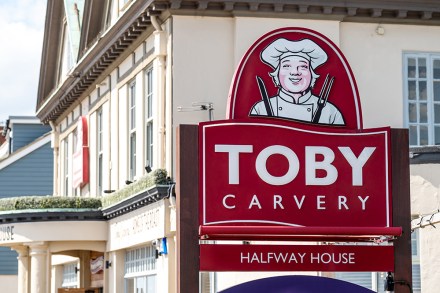
Going to see QPR on Boxing Day has become a tradition in the Young household – and not because we hold out much hope of winning. The Hoops have only won 19 of the 71 Boxing Day fixtures we’ve played since 1882, when the club was founded. The last time was in 2018, when we beat Ipswich 3-0 at home, and we haven’t won away since 1967. But going to watch our team, however poorly we play, beats festering at home in that fallow period between Christmas Day and 1 January, so my three sons and I piled into the car for the 150-mile round-trip to Fratton Road in Portsmouth. We had an additional reason for making the journey, which was a special Christmas offer from Toby Carvery whereby anyone called Toby could eat for free.

I’m a Jew who loves Christmas

From our UK edition

On more than one occasion, I have found myself being lectured by non-Jews (always men) about why I am incorrect in my Jewishness. Judaism is a religion and I can’t be Jewish if I am an atheist, some say. The ones that accept the atheism then feel compelled to categorise me as a ‘cultural’ Jew whose identity is defined by rituals and customs passed down over the centuries. And then there’s the stern mystification about the relatively minor role that Hanukkah plays in the spiritual calendar for Jews. It is hard for some to realise that while it involves lights and wintry nights, Hanukkah is not remotely the equivalent of Christmas. Nothing in Judaism is.

Hell is a motorway service station

From our UK edition

If OPM had released an antithetical response to their 2000 magnum opus ‘Heaven Is a Halfpipe’, I’m certain it would have been called ‘Hell Is a British Service Station’. Had this song been made, I think it would have gone a little something like this: ‘If I die before I wake / I’ll spend eternity in a Welcome Break / ’Cause right now on earth, I can’t do jack / I’m at a service station and my tyre’s flat / Now hell would be a Roadchef / With a Costa bacon bap / And hell would be the toilets / After a curry at Watford Gap.’ Admittedly, the lyrics could do with some workshopping, but you get the point.

How to cater for the dreaded Ozempic Christmas guest

From our UK edition

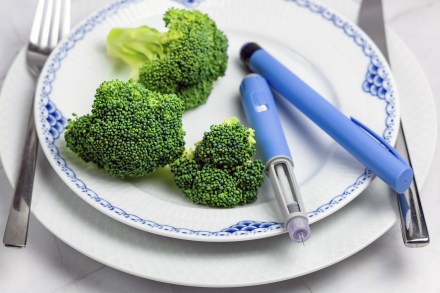
A close relation of mine is taking Ozempic. I shan’t name them or give anything else away other than to say this: they are set to ruin our Christmas lunch. They know it, and we know it. Welcome to British Yuletide 2025 – a country where more than 1.5 million people are estimated to be using GLP-1 agonists such as Ozempic, Mounjaro and Wegovy, with the vast majority (90 per cent) obtaining the drugs privately. NHS analysis of Ozempic hotspots reveals Leicester, Thurrock in Essex and the Wirral to be where users congregate. Clearly, they haven’t done an analysis of private users in Oxfordshire where I live.  This being so, we are locked in a curiously modern etiquette conundrum.

Table manners are toast

From our UK edition

Food courts appear to be everywhere in London at the moment and, for reasons too boring to go into here, I found myself at three of them across the capital in the space of four days last week. (Yes, before you ask, I am beginning to question my life choices as a result.) Not that there is anything innately wrong with food courts as a concept, of course. If you’ve been to one, you’ll know the drill, which is essentially that they are semi-industrial spaces lined with vendors plying all manner of street food from locations that aren’t too challenging to the average British diner.

What makes money ‘short?’

I heard on the wireless a reference to the growing number of small political parties getting funds from short money. I’m afraid I let it slide past me as one of the many things about money that I don’t understand. Short is an extremely productive element in English vocabulary. Short-haul journeys preceded by decades the invention of airplanes. The unlikely sounding shorthorn carrots have been with us since the 1830s. The Americans favor short hundredweights, which are only 100lb instead of the Imperial 112lb; worse, the standard ton is consequently a short ton of 2,000lb, a long way off the metric tonne, to which British tons approximate.

Survival here is about logistics: Disneyland Paris reviewed

From our UK edition

Alcoholics know that hell is denial, and there is plenty at Disneyland Paris in winter. This is a pleasure land risen from a field and everyone has after-party eyes, including the babies. The Disney hotels operate a predictable hierarchy: princesses at the top, Mexicans at the bottom. We, the Squeezed Middle, are at the Sequoia Lodge with Bambi, where I learn that I like canned birdsong, and that is fair. You don’t consume dream worlds, because that is not their nature. They consume you. We stand in the Magic Kingdom and stare at Mickey Mouse-shaped food and a fake Bavarian castle – it’s Ludwig’s, not Sleeping Beauty’s – painted pink. Disney culture is impregnable: hence the fortress. It only needs – it only feeds on – itself.

A right royal travesty: Lilibet’s reviewed

From our UK edition

Elizabeth II was a god and a commodity: now she is gone it is time for posthumous exploitation. Lilibet’s is a restaurant named for her childhood nickname at 17 Bruton Street, Mayfair, on the site of the house where she was born. It was inevitable that Elizabeth II would eventually get a personal restaurant. Princess Diana ate in the Café Diana – English breakfasts and kebabs – on the Bayswater Road and George VI is the inspiration for the superb Guinea Grill – mostly sausages, or rather it is the sausages I remember – near Lilibet’s. Because that is what the British do to our monarchs and their intimates. We eat them and call it love.

I’m a Christmas pudding convert

From our UK edition

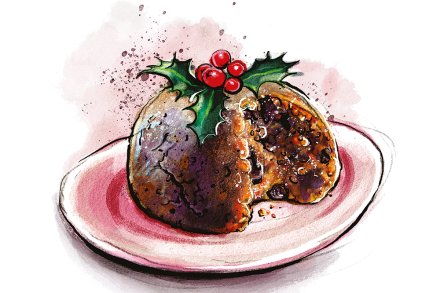
I used to be a Christmas pudding denier. I couldn’t see the attraction of a dense pudding made mostly of currants; frankly, I’d rather have a trifle. Of course, I was wrong: I was judging Christmas pudding by poor examples, those that sat on the edge of a Christmas lunch tray at school or were half-heartedly doled out by other pudding sceptics (I’m looking at you, Mother). My conversion came about thanks to a party – a Christmas pudding party. Not a party for eating Christmas puddings but rather one where the guests made Christmas puddings. It was hosted by my friend Kate and I went along out of love for her, rather than love for the pud. Under Kate’s keen eye, and following her great-granny’s recipe, we creamed kilos of butter and sugar in a big plastic tub.

The glory of gravy

From our UK edition

In Robert Louis Stevenson’s Treasure Island, when Ben Gunn is found by Jim Hawkins, sunburnt and wide-eyed after three years of being marooned on the island, the first thing he asks Hawkins for is cheese: ‘Many’s the long night I’ve dreamed of cheese – toasted mostly.’ As a greedy person prone to daydreaming, I’ve often wondered what my ‘cheese – toasted mostly’ would be. A dozen oysters? A cold negroni in a fluted tumbler? A perfect quivering soufflé? I think it’s gravy. That’s my desert island dream, the idea I can’t shake, the touchstone I’d return to. I’d take gravy in any form: thick and rich, made from meat scraps, a thin, boozy jus whisked up from pan scrapings, even the ‘from granules’ stuff, stirred in a plastic jug moments before serving.