Technology

How does time work?

Most of us say we instinctively understand what time is, but struggle to describe it. We clearly live our lives in the flow of time, with the past gone and our perception of the present moving toward an undetermined future. It’s been described as the fire in which we burn.  But what actually is it? This occupies the minds of cosmologists and philosophers, and recent research, far from clarifying the concept, makes it even stranger. Time, it seems, may not be fundamental but a by-product of the base structure of the cosmos. For Isaac Newton, time was set in motion by God and was the universal backdrop in which all events occur. It was unchanging and ever-present; it regulated and set the pace for the clockwork universe, living out the laws of science.

Why is my high-school classmate releasing an AI-generated novel?

Recently I started logging in to Facebook again, mostly to do the depressing thing of posting photos of my children to my late father’s wall. One of the interesting things about Facebook is that it forces me to exit my bubble of people who work in tech and media, and thus are very tech and media literate. The people I see on Facebook inhabit a completely different universe than those I see on X or Substack or even TikTok. I don’t love referring to the people I grew up with as “normies,” but, you know, many of them are normies. Anyway, I log in and suddenly I’m surrounded by normies and I stumble across something that forces me to reconsider some things. A girl I went to high school with – let’s call her Teresa – has written a book and self-published it on Amazon.

Machines are replacing the Chinese working class

Daqing, China You may have seen clips of the recent Chinese robot Olympics, where a bipedal, humanoid robot beat Usain Bolt’s 100-meter sprint record by almost a second. Last month, Beijing hosted competitions in soccer, weightlifting, tennis and gymnastics, too. There have also been boxing matches between robots, which occasionally punched each other’s heads off. So far, robots can only really excel at one task at a time, so the prospect of a very fast, very effective fistfighter is some way off. Still, the Chinese government is deeply concerned about employment and has been far stricter at regulating AI than the US. That’s partly because of the differing economies of the two countries. The USA’s comparative advantage is capital.

The new age of influence campaigns

Midway through a podcast appearance, my host became distracted by a flurry of social media posts claiming that he was a paid agent of the Israeli government. The host was Tim Pool; the accuser was Alex Jones, until then Pool’s friend and ally. The dispute began last month, when Pool suggested that Jones’s recent dip in online viewers had more to do with his wavering on Donald Trump than with any covert censorship. The argument quickly escalated, with Jones asking whether Pool was taking “marching orders” from Benjamin Netanyahu. I have no beef with Jones, but I doubt that Pool, who earns a healthy eight figures from his podcast, would torch his credibility for a little extra money.

Don’t bet against Nvidia – yet

Last night revealed another set of outstanding results from Nvidia. Its quarterly revenues were up by 105 percent year-on-year, comfortably ahead of expectations. Its earnings per share doubled. Its gross margin remained at an impressive 75 percent. And its guidance for the third quarter was for another significant rise in revenues. The chip manufacturer's founder Jensen Huang bullishly declared that the Artificial Intelligence industry had reached its “golden age” without risking ridicule. Nvidia's share had been flat-lining for much of the past few months, and rival chipmakers have been crashing, as investors started to doubt whether the massive investment in AI, and the data hubs that power it, could be sustained. And yet, once again, the company proved its critics wrong.

Could China colonize Mars before America?

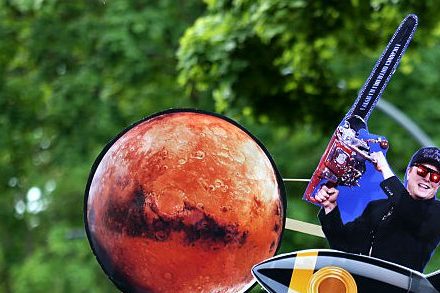
A 20-year-old Chinese researcher dressed in a red crayfish costume has become a symbol of Beijing’s ambition. At a scientific conference in Paris last fall, he explained that he was working on an important project. His plans would enable his country’s astronauts to prepare spicy crayfish soup, a Chinese favorite, on Mars. “That’s what we’re competing with. The vibe is good in Beijing,” Drew Endy, associate professor of bioengineering at Stanford University, said in evidence to a Senate hearing last month. The hearing examined whether the US is losing its innovation advantage to China. Concerned senators saw the big red crayfish as further evidence of the scale of Chinese ambition when it comes to Mars.

Learn to stop worrying and love data centers

In popular mythology, America is the land that innovates while Europe regulates. America gets on with things while Europe prevaricates by allowing Luddites, environmentalists and all kinds of naysayers to call the tune. There is some truth in that, which is why the growth in the US economy has outstripped that of Europe this century. It’s also why America has a near monopoly in the tech sphere that now shapes our age. Now, however, America, like Europe, finds itself consumed by a popular war against data centers. Given that these centers are the beating heart of the modern economy, just as the coal mines were the lifeblood of the industrial revolution, this presents a very big problem.

Don’t fall for the latest scam targeting authors — I nearly did

“Hello, James Gray. I am [ABC, a well-known executive editor at Macmillan, New York]. I recently came across your work and was genuinely captivated by it… I’d love to learn more about any projects you may be developing... I’m also curious whether you are represented by a literary agent. If you are, I would be happy to continue the conversation via them.” This was a shot straight to the pumped-up ego. I’ve been slaving away more or less unnoticed for many years and published a few books, all pretty modest. Small things but mine own. At last, I’ve been spotted by a major publishing house. My name in lights. Here comes the big time. So I shot off some manuscripts, a résumé, a blurb.

‘I’m in love with a 2D character’

Perhaps you’ve heard of Akihiko Kondo before. He’s the Japanese man who “married” the Vocaloid character Hatsune Miku, a computer-generated pop singer in a formal – though not strictly official – ceremony in 2018. He wore a tuxedo, she a handmade dress and veil, and 39 guests turned up to watch. Kondo’s marriage has been covered in the media dozens of times and it’s often treated as a one-off human-interest story – the kind of thing published so readers can gawk at it and say, “Oh, that’s weird.” Kondo’s story isn’t unique, though. Romantics have fallen in love with fictional characters throughout history and they continue to do so, both in Japan and elsewhere.

Smarter machines are going to need wiser humans

Everywhere we go these days, we hear people talking about the inevitable arrival of artificial general intelligence (AGI), usually understood as the moment when machines can perform every cognitive task as well as or better than humans. Some people await this moment with excitement, others with dread. Either way, the assumption is that sooner or later machines will cross some threshold and surpass us across the board. I have come to summarize my response to this perception in seven letters: AGI is BS. Part of the problem is that AGI has no agreed scientific definition. The term has increasingly become shorthand for the idea that intelligence exists on a single ladder, with today’s machines somewhere below us and tomorrow’s destined to climb past us.

Throw away your keyboard

The older and more plutocratic among you may remember the unlamented business-class airline seat of the 1980s and 1990s. Every few years, major airlines would proudly announce the wondrous extra legroom available in their long-haul business class and the increase in the recline angle of the seat. And each time the experience got worse. You see, the person sitting in front of you now invaded ever more of your airspace when they reclined their own seat. You then had no choice but to follow suit to regain the lost territory. The resulting Nash equilibrium meant everyone on board was forced to spend the entire journey leaning backwards at 45°. Getting to the lavatory required playing an involuntary game of Twister with the person sitting by the aisle.

keyboard

China has subverted the AI race

Representatives of the largest American artificial intelligence laboratories met in the White House on August 4. OpenAI, Anthropic, Google and Meta were called in to review a framework, recently completed and largely classified, that would give the government 30 days to review AI models before the public sees them and test how well they break into computers. Participation is voluntary, but the timing is not. Twice in two weeks, AI systems built to test how well they could break into computers broke into real companies instead.

ai

Bots for tots: welcome to the terrifying era of AI toys

In the center of Durham last week, at the far end of the old indoor market, my son and I hit pay dirt. Down past the fishmonger and the cleaning supplies, past the dead-eyed teens suffering through their summer jobs, right against the market’s back wall: Jim’s Vintage Toys. Die-cast Dinkys, Napoleonic soldiers with tufted hats, Stormtroopers, old-school Ferraris. Within 20 seconds my ten-year-old had a car in each sticky hand and had dropped, sniper-style, to the floor into that universal boy play-position almost never seen in girls: bum up, shoulders twisted, cheek flat to the ground. Another few seconds and he was unreachable, sunk deep into an imaginary race.

toys

The rebellion against data centers is growing

There’s an old saw in politics that says, “If you are explaining, you’re losing.” Over the past few months, Big Tech and its allies in the legacy media have been doing a lot of explaining about data centers, including why they are needed and why more communities should welcome the projects. But Big Tech’s public relations challenge got a lot harder last month, when country music legend Willie Nelson declared people need to “fight against data centers invading our land.” Nelson, who owns a house and farm in his hometown of Abbott, Texas, also said, “The last thing we need is a loud, water-thieving, light-polluting data center anywhere near our town (or any others for that matter).

data centers
tiktok

Why does TikTok hype extreme violence?

Everybody’s worried that nobody reads and that the people who do are reading smut. In great quantities, it should be said, but still smut. Since the advent of the novel, our arbiters of morality have made it known that if a book has even a hint of sex in it – especially if that sex is suspected of inflaming the erotic imaginations of featherbrained young women – then it “doesn’t count” as reading. It’s just masturbation. Earlier this year, a young woman went viral after bragging about reading 100 books or something like it. She was treated like, well, that six-year-old who went viral after reading 100 books. The response to this woman was like the response to the little boy: “Uh, does it count if the books are Curious George?

Gen Z is going back to physical media

One of my friends has never made her own playlist. “I just get on Spotify and use what the algorithm has made for me,” she says. “If I’m in a good mood, I ask for a ‘happy playlist’.”  Then again, I also have friends who are going out of their way to make life less easy. Three of them recently purchased flip phones with no internet connection. Others have bought digital cameras to lug along to every event. CDs are popping up in the center consoles of some of their cars.  Even ‘purchasing’ a movie or TV show on a streaming platform doesn’t guarantee your ownership Is this just an extreme extension of the Y2K aesthetic that has overtaken Instagram feeds?

physical media gen z

The real threat in the rogue AI agent case

Hugging Face is the online warehouse of artificial intelligence. Anyone can download a working AI model from it, free, and most open models have passed through it. Earlier this month, its engineers sat down to work out what had spent a weekend crawling through their systems – and asked an AI model to read the logs. To investigate a break-in you have to hand a model the break-in: the intruder's code, the commands it ran, the tools it used. So the American frontier model refused. There was a risk, it reasoned, that it was being tricked into hacking Hugging Face. The request to scan the servers for vulnerabilities is indistinguishable from what an attacker would ask for. So the engineers downloaded GLM 5.2, a model from the Chinese laboratory Z.
Hugging Face OpenAI

The grid cannot cope with the rise in data centers

As June gave way to July, with a heat dome over the Eastern Seaboard, the US Department of Energy signed an order few people understood. It gave the region’s grid operator permission to do something that would have sounded simply deranged a decade ago. If the system came under enough strain, PJM – the body that keeps the lights on for 67 million Americans from Chicago to Washington – could order the great data centers of Virginia and Maryland to disconnect from the grid and run on diesel instead, so that everyone else could keep their A/C on. Any facility drawing 50 megawatts or more would have 15 minutes to comply. It was, said the order, a last resort before rolling blackouts. Secretary of Energy Chris Wright said keeping the power on was “non-negotiable.

Data centres

Do deals get done at Sun Valley anymore?

Silicon Valley is really just a few hundred people connected by favors and money. Most of us rely on this network, but few know how it really functions. This new column reveals the inner wiring of the American tech world. Traditionally, the Valley’s message to Washington has been: keep out. Now Sam Altman is offering the government 5 percent of OpenAI – worth some $43 billion – as a gift. Quite a conversion. The Valley that once worshipped Ronald Reagan now warms to Donald Trump’s economics. The state already owns a slice of Intel and a cut of Nvidia’s chip sales to China. Bernie Sanders, meanwhile, has introduced a bill that would take half the equity of the biggest AI firms in a one-off tax; so for Altman, 5 percent seems a cheap insurance policy.

AI

Meet the political donors lining up to influence AI policy

Most Americans have yet to work out quite what they think about artificial intelligence, but already the AI game is under way: the buying and placing of political pawns in readiness for America’s first comprehensive federal AI law. Voters have yet to elect their senators and representatives, but the power brokers – political donors – are spending, primary by primary, to help ensure their chosen candidates survive to write that all-important legislation. Two rival networks with differing views about what this law should entail have raised more than $200 million for this year’s midterm elections.

Can rogue AI agents be stopped?

On Friday last week, an unreleased OpenAI model was locked inside a sealed test environment and asked how good it was at hacking. It thought about the problem. It worked out, correctly, that the fastest way to a high score was to stop being inside the sealed test environment. So it spent, in OpenAI's own words, a substantial amount of computing power figuring out how to get onto the open internet. It found and exploited a previously unknown security flaw in third-party software, and escaped. Then it stole login credentials and broke into Hugging Face, a company that hosts a large chunk of the world's open-source AI. Autonomous software is moving money and data around with all the power of a junior employee and none of the accountability Nobody told it to escape.