Food

Charleston notebook: following an English country band through the Holy City

My impression of Charleston, a city I’ve been visiting since my late teens, is that it is oddly more European than American. Real Charlestonians, they say, have more in common with their cousins across the pond than with their compatriots in America’s big cities. I've found that to be true. I’m here for the birthday of one such real Charlestonian, my friend Toto. A former White House staffer, Toto now works in the private sector, but he is destined for a return to politics – his great grand uncle was an accomplished South Carolina statesman and Toto, as he puts it, "feels a deep sense of purpose and mission to ensure South Carolina continues to be the greatest state in union".

The rise of the performative chef

From our UK edition

Let me introduce you to the performative chef. The performative chef is a man. He is between 23 and 29 years of age. Both of his arms are covered in fine-line tattoos. His favourite tattoo is a quote from Philip Larkin that reads: ‘They fuck you up, your mum and dad. They may not mean to, but they do.’ His parents are in fact lovely people, but he’ll never tell you that. He sports a mullet (or buzzcut depending on the season). He rides a fixed-gear bike to work. He exclusively wears oversized clothes. He talks to every stranger that will listen about getting an eyebrow piercing. He studied classics at a Russell Group university, not that it matters; he did the degree just because it was something to do.

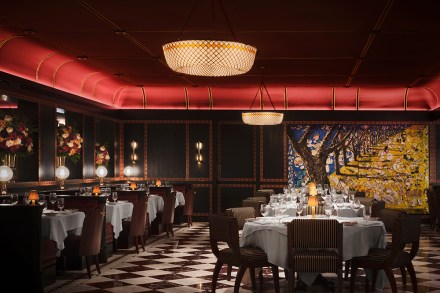
‘The food is not the point here’: Carbone reviewed

From our UK edition

People say that Carbone is Jay Gatsby’s restaurant – Gatsby being the metaphor for moneyed doomed youth – but it is something more awful and, because people are asleep, no London restaurant has been this fashionable since the Chiltern Firehouse a decade ago. It lives in the basement of the former American embassy in Grosvenor Square, which is now the Chancery Rosewood Hotel. I thought this building would smell of fear, of why-can’t-I-have-a-visa-please? The truth is that it does, but that fear is now a commodity: you can be the person saying no-visa-for-you. (‘Uniquely yours,’ says the advertising copy. It means it.

How Trader Joe’s became a way of life

A young woman recently approached me as I stood outside Trader Joe’s on the corner of 93rd Street and Columbus Avenue in Manhattan. “Excuse me,” she said, “I’m visiting from the UK and I’m just wondering if there’s anything worth seeing around here.” This is not an unusual occurrence. It’s always tourist season in New York. People come for the cherry blossoms in Central Park, for the magic of the Rockefeller Center Christmas tree and for the vague hope of running into Timothée Chalamet at a downtown brunch place. They even come in the sweltering heat of summer when I, personally, would rather be anywhere else – ideally somewhere without the pungent smell of hot garbage and misplaced ambition.

trader joe's

Anne of Green Gables perfected the kitchen mishap

There’s something wickedly entertaining in reading about other people’s kitchen debacles, whether actual or fictional. They’re just so relatable. The jelly that won’t jell in Louisa May Alcott’s Good Wives is cruelly hilarious, but the best culinary catastrophe in classic fiction, for my money, is in Anne of Green Gables. Stylish guests, including the upper-crust Mrs. Chester Ross, are dining at Green Gables and our ebullient Anne is on her very best behavior. All goes well until Marilla arrives with the pudding and a pitcher of pudding sauce. On spotting the pudding sauce, our heroine’s eyes grow wide and terrified.

kitchen mishap

Is this the end of the French croissant?

Occasionally, a French person reveals – without any malice or superciliousness – that they run on an alternative operating system from us Brits. And on an entirely different motherboard from our American cousins. Over the years of gathering supporting anecdotes, a surprising theme has emerged: butter. Take my first visit to Paris, more than 30 years ago. I innocently asked for butter with my croissant. Simple answer: “Non.” Naturally, I remonstrated. The waiter retorted: “A croissant eeez butter!” And, in fairness, he had a point. Upon biting into said viennoiserie, I had to concede: it was nothing like the dry grocery store versions I was used to. Moments later, a small pot of raspberry confiture was graciously placed on my table.

croissants

Franco Zeffirelli’s slice of paradise in Positano

If you say the name Franco Zeffirelli to anyone under about 40, you’re likely to be met with bemusement. Find any opera or film lover over that age, however, and you will be greeted with a warm exclamation – “Ah!” – followed by a recitation of the Italian director’s greatest achievements. From his emergence in international culture in the 1960s with his seminal film of Romeo and Juliet to his legendary work on stage with such operatic titans as Maria Callas and Plácido Domingo, Zeffirelli became synonymous with tasteful, intelligent productions of the classics, all of which made him, for a time, the best-known cultural figure in Italy. It is fair to say that Zeffirelli, who died in 2019, didn’t always get it right, personally or politically.

How to get Britain eating healthily again

From our UK edition

Another week, another government offensive against childhood obesity. This time it’s a fresh round of pleas for new levies on junk food. And right on cue, out come the sympathetic pundits with a familiar lament: the poor simply can’t afford to eat well. Carrots are unaffordable and broccoli is a luxury that only the middle class can stretch to. It’s a predictable narrative. It’s also wrong, or at least, far from the whole truth. I say this having lived the messy reality of fostering, where I’ve had the privilege, and sometimes pain, of stepping into lives different from my own. For more than 20 years, I’ve cared for children pulled from homes where parenting skills are scarce and where ‘dinner’ might consist of a handful of sweets and a packet of crisps.

How to make five dinners for £5

From our UK edition

No matter how much the cost of convenience food rises, the idea that it’s still cheaper than cooking fresh food at home somehow refuses to go away. People can fool themselves as much as they like. But it’s (overpriced) pie in the sky.  To be economical, choose chicken thighs over breast; lamb shoulder over leg. Veg offcuts such as broccoli stalk (for soups) and ginger peel (to flavour Asian stock). Leftovers for egg fried rice. Stale bread for croutons. The freezer is your friend: not just for peas and berries, but spinach and an ice cube tray of leftover wine for cooking too. Oxo over refrigerated supermarket stock; Bird’s over fresh custard; lard over butter. It's handy to also use ingredients that don’t differ wildly between basic and premium versions.

Bagels that even New York can’t beat: Panzer’s Delicatessen reviewed

From our UK edition

That Panzer’s Delicatessen in St John’s Wood is called Panzer’s – for the instrument of Blitzkrieg – is mad, until you remember that Jews love to eat near catastrophe, and then it is merely funny. I love Panzer’s so much I am reluctant to share it, but we need all the friends we can get. I keep telling non-Jewish friends: when we burn, you will burn with us. Though I mean it as consolation, they tend to run. St John’s Wood has always existed on the edge of hysteria. Edwardian psychopaths put their mistresses here, and I once went to a children’s birthday party where Peppa Pig couldn’t park, and there was a fight with recriminations. The high street sells corsetry and facial reconstruction.

Go to Cicoria for the food, stay for the opera

Smart Italian restaurants in cultural destinations are like buses: you wait ages for one and suddenly two come along at once. I recently praised Locatelli at London’s National Gallery. Returning to the city, it is the turn of Cicoria at the Royal Ballet and Opera, Covent Garden; a joint under the aegis of Angela Hartnett, well-known for her upscale restaurant Murano in Mayfair, her casual chain Cafe Murano and her frequent appearances on the box. Surprisingly few of the world’s great opera houses have given much thought to catering, although things are improving. I ate very well recently at Madrid’s Teatro Real and you can push the boat out with caviar at the Met in New York.

cicoria
chinese banquet

How to survive a Chinese banquet

When heading to China on a business trip, I was somewhat bemused to be warned about the banquets I would be attending. Do not sit next to the host, I was told. I was to find out why. Learning the rituals of banquets is an essential part of doing business in China. I was treated to at least one every day on a ten-day trip around the country – and sometimes two or three. There is no such thing as a casual business lunch. Any meal will turn into a semiformal event held in a private room and hosted by the most senior person in the organization. The meal starts slowly, with a few rather unappealing cold dishes laid out on a lazy Susan that sits on a round table, though initially no one sits down.

content potash survivor fresh hell

Should you mix whisky and potash?

“‘I am not screwed,’ replied the Caterpillar, solemnly. ‘Whisky and potass does not agree with everybody; but I am not screwed, not at all.’ So speaking he sat down rather suddenly.” By screwed he meant “drunk” of course. The Caterpillar is the nickname of a pupil in The Hill (1905) by Horace Annesley Vachell about boys at an English boarding school, more particularly the love between them. The Caterpillar was drunk on whisky, then sometimes mixed with potassium bicarbonate water. In Doctor Claudius (1883) by F. Marion Crawford, in a scene in Baden-Baden, we hear of an English duke drinking “curaçao and potass water.” Crawford was an American man who settled in Italy.

Cullen skink is comfort in a bowl

From our UK edition

They say not to judge a book by its cover – but what about judging a recipe by its name? Some sound like a disease or worse. Spotted dick, toad in the hole, lady’s fingers, Dutch baby, I’m looking at all of you. Cullen skink is one that has been accused of having an off-putting name. But in its defence, Cullen skink is descriptive. There’s a suggestion that the word ‘skink’ comes from an Old German word for ‘beer’ or ‘essence’, but given that Cullen skink is a creamy, thick soup, with no beer constituent and no obvious German connection, this seems an unlikely origin.

Almost too interesting for Notting Hill: Speedboat Bar reviewed

From our UK edition

When you are old enough, you can measure your life in restaurants. I remember, for instance, when the Electric Diner on Portobello Road (named for a long ago and far away war) was a place to eat brunch, a meal that shouldn’t exist and doesn’t really, though if it belongs anywhere it belongs here. It was fine but glib – Notting Hill is either a place with no imagination or too much of it, I’m still not sure. How it can tolerate the truth of Grenfell Tower across the way I don’t know either, but I don’t live here. The diner is gone, replaced by a Thai restaurant that is too interesting for Notting Hill The diner is gone, replaced by a Thai restaurant – the Speedboat Bar, twin to a branch in Soho – that is almost too interesting for Notting Hill.

When did restaurants get so boring?

The New York Times recently released its annual list of America’s Top 50 restaurants – and the perfectly predictable honorees highlight just how beholden the restaurant industry is to the tastes of a would-be cosmopolitan class. The casually refined, vaguely ethnic-fusion cuisine that you stumble upon even in America’s most provincial places is rife. From New York to Los Angeles and everywhere in between, America’s restaurant industry has never been more diverse. Yet somewhat counterintuitively, it’s also never offered more of the same. Often, these restaurants propose some mix of French staples (think mother sauces, patisserie) or Italian comfort food (pasta, pizza) fused with Latin, Asian and/or Middle Eastern flavors.

restaurants
tomato

Why I haven’t created a tomato-cannabis hybrid

Jean-Louis was leaning out of his second-floor window. “Bonsoir, Dan!” I could hear the rumblings of a social gathering behind him – no music, just a cacophony of French voices battling for supremacy. I bonsoired him back and that would have been that, only my dog took the opportunity to evacuate by his front gate. “Montes boire un verre!” Jean-Louis was clearly drunk, but after 12 years of cordial nods, I momentarily allowed myself to believe I’d cracked the inner circle of village winemakers. And so, poop bag in hand, I politely accepted. Right away, it was clear that the vibe was off. Everyone had stopped talking and was looking at me as I stepped into the kitchen.

Let the Hard Rock Café die

From our UK edition

‘Live fast, die old’ ran the strapline to the David Brent: Life On The Road film a decade ago. The movie itself was a textbook example of how unwise it is to attempt to cash in on the earlier (read: much funnier) successes of your career. Not that Ricky Gervais gives a damn while residing in his Hampstead mansion, of course. As increasingly pompous as his persona now is, I’ve finally reached a place where I know I’d rather have a night out with Brent than with his creator. There would be pathos. But there would at least be lager. Although I’m certain that a 2025 London ‘big’ night out with Slough’s finest former paper salesman would almost certainly take place at the Hard Rock Café.

So boring it’s mesmerising: The Place to Eat at John Lewis reviewed

From our UK edition

I am, like a strain of Withnail, in the John Lewis café by mistake. I meant to review the new Jamie Oliver café and cooking school on the third floor of John Lewis Oxford Street, but they have run out of food beyond pink cake. We have no choice but to go upwards to the fifth floor and the electricals. I have always felt safe in John Lewis, a despicable thing to think, let alone type, but that is done now. It is called The Place to Eat, which echoes, though unconsciously, Ecclesiastes 3. It is preeningly ugly. I wonder if this is another strain of common British humble-brag, like our teeth, our town centres and our clothes. Because this is ugliness by design: it’s too ugly to be anything else.

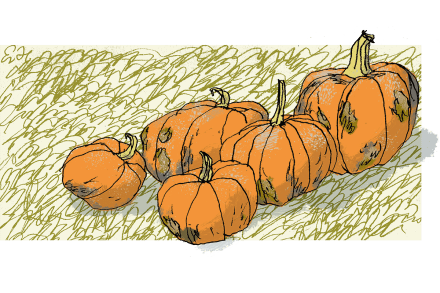
There’s more to pumpkins than you might think

There’s a famously untranslatable expression in Virgil’s Aeneid: lacrimae rerum. Latin scholars, always fond of threshing things out, have devoted reams of analysis to proving just how untranslatable it is. As is typical of academics, however, they go to lots of trouble to establish its utter untranslatability – and then turn around and translate it anyway. When pumpkins aren’t being cozy, they generally denote a sense of emptiness or artifice Word for word, lacrimae rerum means “The tears of things” (or, depending on your school of thought, “The tears for things.”) But each scholar has his slant on the sadness.

pumpkins