
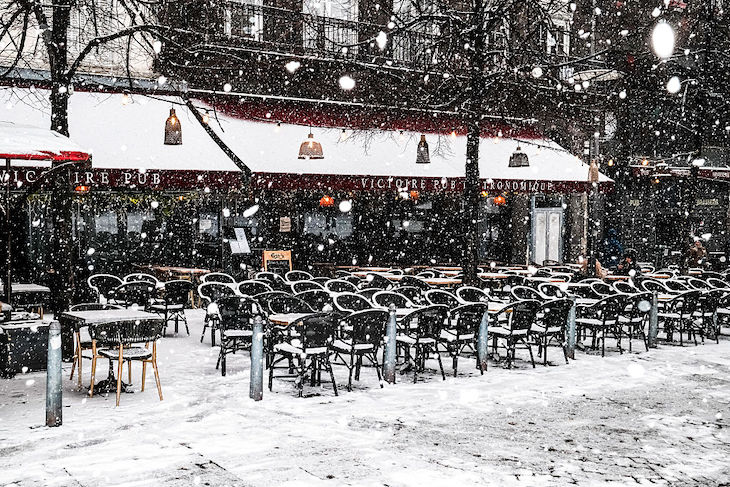
Emmanuel Macron says France’s traditional bistros should be granted Unesco world heritage status. Speaking at the Élysée this week, the French president vowed to help save the country’s traditional cafes. “This is a fight that we want to take on, because our cafés and bistros aren’t just selling croissants, baguettes and traditional products – they’re also on the front lines of preserving French craftsmanship and know-how,” Macron told a group of French bakers at the annual Epiphany cake ceremony.
France doesn’t need to list its bistros. It needs to decide whether it still wants them
Macron is right about what the bistro represents. For generations, it has been a shared meeting place as much as a commercial one; somewhere to linger and belong. Yet the fact that France is now seeking international heritage protection for its bistros is also an admission of decline. Around 40,000 remain today, down from roughly 500,000 a century ago, and their numbers continue to fall year after year, squeezed by rising rents, changing habits, delivery apps and fast-food competition.
While Paris talks about preservation, the reality of provincial France tells a different story. France now counts more than 11,000 kebab shops and some 50,000 fast‑food outlets. They have become the most visible face of provincial decline. Cheap, open late, cash‑based and multiplying, they fill the gaps left as traditional businesses disappear. In Fère‑en‑Tardenois, a town of 3,000 people in Picardy, the butcher, the bookshop and the café have gone. In their place, six fast-food shops line the high street.
When plans in late summer emerged for a seventh fast food shop, the mayor tried to stop it. “We no longer have a bakery, but we have kebabs,” he told the local press. Residents complained of noise, rubbish and fights at night. The regional prefecture struck down the ban, citing the fast-food owners’ “freedom of trade.”

That phrase has quietly come to define the tension at the heart of French policy. France speaks endlessly about culture, identity and heritage, yet defaults to a strict interpretation of commercial freedom whenever local authorities attempt to shape their town centers. While police warn about potential criminality at small cash‑based businesses, the rules give mayors little room to shape their high streets.
Ministers insist they are trying to push back. Last year parliament adopted a new bill designed to make it easier for villages to reopen cafés and bars, cutting through the licensing rules that have made it simpler to open a takeaway than a bistro. MPs sold it as a way of restoring what they call the social heart of small towns. Guillaume Kasbarian, who sponsored the text, said that the goal was to reinforce the opening of places of life and social exchange. “Bars are above all places for people to come together in very rural areas,” added Fabien Di Filippo of Les Républicains. Yet the fightback comes late, just as Macron turns to Unesco to preserve what’s already disappearing. In many towns, the café’s role as a meeting place has been replaced by takeaway counters and delivery apps. The high street remains busy, but it no longer looks traditionally French.
A burger joint or a kebab shop sells calories, not conversation. A bistro once offered a sense of belonging, while a fast‑food outlet offers anonymity. Sociologists note that younger generations see no contradiction between loving French cheese and ordering fast food at midnight via an app. Meanwhile entire town centers are being hollowed out by the spread of kebab shops.
This shift from café to kebab has taken on a political dimension. On the right, the kebab has become shorthand for immigration and insecurity. On the left, opposition to fast‑food saturation is dismissed as xenophobia. What everyone can agree on is that the shift represents the disappearance of shared civic spaces. What makes this sting is not simply economics but culture. Bistros were never just places to eat or to have a drink. They were places where neighbors met, arguments erupted and politics was debated. The butcher’s counter and the line at the boulangerie anchored community life. A kebab shop does not replicate that.
France likes to think of itself as the land of gastronomy. Unesco enshrined the “gastronomic meal of the French” as world heritage in 2010. Politicians wax lyrical about terroir and cuisine. But the everyday reality of many provincial towns is no longer three courses and a bottle of wine. It is fries in a cardboard box and pizza delivered by app. Residents of Fère‑en‑Tardenois now complain that their main street has become a “rue des kebabs.”
Macron understands this, at least instinctively. He’s right to say that these places preserve a way of life. But Unesco status is what cultures seek when everyday life has already slipped away. A living café or bistro does not need international protection. Once a bistro becomes heritage, it has stopped being normal.
France doesn’t need to list its bistros. It needs to decide whether it still wants them. If “freedom of trade” always trumps local life, the bistro will survive only as a plaque, a logo and a speech at the Élysée Palace.






Comments