My apartment in Havana is on a rooftop overlooking the sea, which sounds grand and penthousey, but it’s not – it’s the former caretaker’s hut. It also sits above my parents-in-law’s place, which offers challenges, but does mean that most days I wander down for lunch.
When I first moved in, I didn’t speak Spanish and so would enjoy these meals in ignorant bliss, smiling winningly as I guzzled down pork, rice and beans. I tried not to ask my now-wife to translate because I didn’t want to interrupt what I imagined were hugely erudite discussions; she’s a literary professor and her parents are both philosophers. Slowly, though, I began to understand, Spanish revealing itself like a song on the wind. I realised that it wasn’t French psychiatrist Frantz Fanon they were discussing, but food. Cubans, it turns out, have an infinite capacity to discuss what they eat, have eaten and hope to eat in the future. Como, comí, comeré.
Cubans, it turns out, have an infinite capacity to discuss what they eat, have eaten and hope to eat
Cuba is not famed for its cuisine. When the British food critic A.A. Gill visited in 1999, he refused even to use the word food for what he was served, describing it instead as “doof.” The restaurants may have improved thanks to a degree of privatization, but in other ways things have worsened. Due to Cuba’s collapsed economy, many staples – including sugar, which once brought fortunes to the island – are now being imported.
My pat phrase a few years ago was that all Cuba needed to be a true paradise was one good Whole Foods. This was because I’d go to a state supermarket, queue for two hours, and then discover they only had one product. Once that was truffle oil, aisle after aisle of it. Presumably some Mexican wholesaler had offloaded it on a naive or corrupt Cuban bureaucrat.
More successful but also stressful were trips to the agromercado, the dirty, loud and in my early days quite terrifying fruit and vegetable markets. I remember being in the line up for a stall and everyone laughing at me. The lady hawking the fruit had just offered me her papaya, telling me it was moist and juicy. Pork, another local staple, disappeared with the economy and so meat, when we could get it, arrived in frozen packages from the US (food isn’t embargoed) or Vietnam. It wasn’t the best quality. My son Santiago was born in 2021 and, once weaned, I wasn’t having him eat that.
Fortunately I have a sideline in travel writing, so when trips took me through Miami I’d drop by Publix and fill suitcases full of food. I became what the Cubans call a mula (different from the mulas who fly into Miami from Latin America – no goods get hidden up my bottom).
I bought a cooler bag with a shoulder strap which holds 20kg of meat. To this day, it’s my carry-on. Obviously, I always get stopped at security. One customs officer in Miami, after looking into the bag, said, “What you got in there, your grandma?”
Arriving home though, I feel like a great dad. The meat is frozen and then used exclusively for my little boy. In the early days, as he sat there happily gumming strips of prime USDA tenderloin, I would look at him, then look at the Vietnamese chlorinated chicken on my plate, then look again at him. In those moments, I confess, I did think, “what are we doing here?”
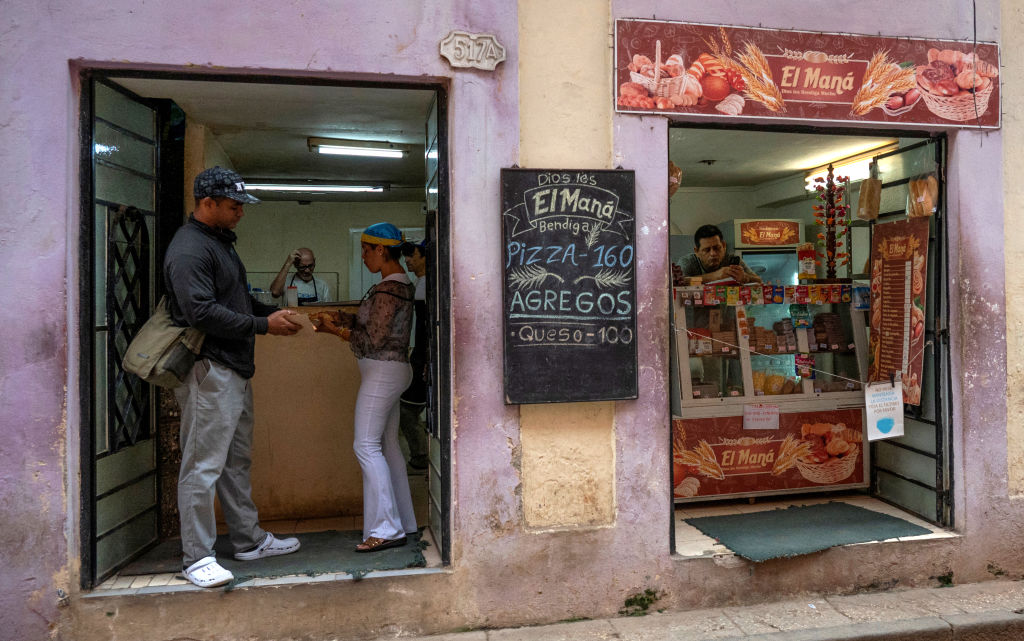
But for those of us with dollars, life has grown better. The Cuban government, realizing people were going to starve, authorized private entrepreneurs to import food. This has meant the arrival of corner stores, which have been a boon for those who can afford them – which, tragically, isn’t most Cubans, whose salaries and pensions have been destroyed by hyperinflation.
All this has seen my relationship with food shift. I now really, really appreciate nice things, far more than before. Good stock can send me into reverie, as can a piece of ordinary chocolate. This goes for the remaining Cuban products, too: a mango eaten while standing in the sea, say, or a roadside stall selling pan con lechón (roast pork sandwiches) or guarapo (fresh sugarcane juice).
Also, I’ve grown wily. I now source small luxuries, returning with them. A job in Puglia, Italy, saw me visit Masseria Maccarone, an olive oil farm. The owner, Alessandro, hooked me with these words: “Trust me, I’m a professor of olive oil.” Now I have bottles delivered to Miami, then I fly it in. It’s still cheaper than the industrial olive oil in the stores here. I do the same thing with maple syrup, which I get either from Cabane du Pic Bois or Comme Avant in Québec. Salami and pâté come from Spain and France. These amazing things delight my wife and her parents. They suffered through Cuba’s “special period” in the early 1990s, when the collapse of the Soviet Union, Cuba’s then-benefactor, saw them almost starve. They can do a full hour of happy family discussion about a few drops of good Puglian olive oil over lunch. Now, of course, I join in.
This article was originally published in The Spectator’s January 19, 2026 World edition.






Comments