Food

The Ivanka Harvest

In Bentonville, Arkansas, far from the Beltway bubble, Ivanka Trump is talking about her latest venture. Her topic isn’t politics but produce – specifically, supply chain inefficiencies and supporting American farmers. “We launched Planet Harvest to reimagine how American produce moves,” she says, with her signature polished delivery. Gone are the West Wing offices and policy portfolios. Now it’s all about “reducing food waste, expanding access” and other wholesome buzzwords that perfectly capture the current moment in American food politics. This agricultural pivot isn’t just convenient timing, as Ivanka jumps on the MAHA bandwagon. It’s a masterclass in political repositioning.

The oyster is your world

Oysters have recently achieved near-meme status as one of several “pick-me” foods alongside the dirty martini, pickles, tinned fish and other briny staples popularized online by Gen Z. These foods are noted for their slightly polarizing air – expressing a preference for them communicates an evolved palate, a niche preference, a willingness to see past an aesthetically questionable facade (the bumpy pickle, the barnacle-encrusted oyster). However, unlike its fellow “pick-me” travelers or its late, meme-ified millennial predecessor, avocado on toast, the oyster itself cannot be readily dismissed as a passing fad.

oyster
flowers

The allure of edible petals

Saying it with flowers used to be the thing – now we’re serving it with them. Edible florals have become quite the fashionable choice. There will be geraniums in your salad, lavender in your latte and hibiscus in your chocolate. Meghan Markle is making floral ice cubes, Jeremy Salamon is infusing his homemade vinegar with chamomile and Jamie Oliver is mercilessly pickling magnolia petals. There’s a Michelin-starred food joint-slash-florist in New York City, Il Fiorista, where you can get your favorite blooms stewed, baked, boiled or fried. The cocktails are swimming with garden truck, nasturtium leaves dye the buttermilk green and you could once, at any rate, lunch on sliced lotus root dusted with pine pollen (which sounds like a recipe for a positively Homeric sneeze).

Montana

The highs and lows of Montana’s state fair

There isn’t a lot for a kid in Montana to do in summer. School’s out and the heat is relentless – so stifling that the only real escape is the cool embrace of the fruit and vegetable aisle at Albertsons. By July, my hometown’s lone waterpark was overrun with feral, overweight preteens, their bellies jiggling as they stampeded across the scorching cement. After an overpriced afternoon at the waterpark, many of these kids would head to McDonald’s for dinner. The more upmarket option was to try to exploit a family with a country club membership. The fast food there is classy; quick but not greasy – think mini tacos and peppery chicken strips served with a petite white cup of ranch on the side. But down the highway are the real fast-food joints.

A crisp and refreshing account of the apple

In Food for Life, Tim Spector’s book on the science of eating, the author gives the chemical makeup of a mystery food, listing more than 30 scary-sounding E numbers, sugars, acids and chemicals, before revealing that it is an… apple. Sally Coulthard’s book, The Apple, shows that it’s the apple’s complexity as well as its familiarity, that makes it the ideal punchline for Spector, and, for Coulthard, a perfect vehicle to carry the history of how we grow, trade, cook and eat together and take responsibility for each other and the environment (or not).

apple

What’s RFK Jr. really up to?

Health Secretary Robert F. Kennedy Jr.’s program to Make America Healthy Again (MAHA) appears to be ahead of schedule. At the start of the month, the burger chain Steak ’n Shake announced that it would be frying its food in beef tallow rather than seed oils — and other major restaurant groups are following suit.This week, Kennedy, who hates seed oils and processed foods, rewarded Steak with an almighty PR stunt. He sat down with Fox News’s Sean Hannity to enjoy a burger (Hannity had two) at a branch in Florida. “People are raving about these French fries,” said JFK’s nephew. “They’re amazing,” Hannity agreed.It remains to be seen if the “RFK-ing” of fast food will achieve substantial results.

rfk

What would it take to make America healthy again?

The Executive Order establishing President Trump’s Make America Healthy Again Commission presented some big, fat, sobering truths. “Six in ten Americans have at least one chronic disease,” the order says, “and four in ten have two or more chronic diseases.” It also notes that our people don’t live, on average, as long as those in other developed nations: 78.8 years in the US compared to 82.6 years in our cousin countries. How did this happen? How did the world’s most powerful nation ever get to the point where 77 percent of its youth can’t qualify for military service and we need a commission to stop us from spiraling faster and faster down the Doritos Loco Tacos-Ozempic highway? Robert F. Kennedy Jr.

healthy

The small town in Ontario with a world-class chocolatier

I’m sipping Madagascan hot chocolate out of white-and-gold Haviland Limoges, and nibbling on Venezuelan milk-chocolate bonbons, under an oil painting of Queen Victoria. I am on a visit to Guild Chocolates, “the finest chocolate shop in Petrolia,” in southern Ontario. The town’s population was circa 6,000 at the last census and on a Saturday morning, the chocolate shop is the place to be. During my visit, a sign on the Dickensian, wood-paneled storefront clearly indicates the shop is temporarily closed, but people keep turning the door handle and popping their heads in hopefully. Jaclyn Sanders, proprietor and chocolatier, calls warmly and apologetically out to them. Jaclyn opens her shop only one day a week: Saturdays from 10 a.m. to 5 p.m.

chcolate

Why German-origin Americans keep quiet about their culinary contributions

Irish Americans are arguably the most ostentatious in their national celebrations. It is hard to imagine any other group getting a day off work and spending it turning the Chicago River green. I wrote of my own Irish pride in these pages last year. March 17 was the highlight of our social calendar. My grandfather inaugurated our city’s St. Patrick’s Day parade, which still runs in Great Falls, Montana, today. Montana — especially Butte — is famous for its Irish population, which makes up 15 percent of residents. But there is a significantly larger ethnic group in Montana, whose traces of national pride are almost imperceptible. According to a US Census Bureau survey in 2020, 24 percent of Montanans claim German ancestry.

German

The Caviar Kaspia experience

It’s been almost 100 years since Arcady Fixon, a refugee from the Russian Revolution, opened the doors of Caviar Kaspia on Place de la Madeleine in Paris, and began beguiling his fellow exiles and the crème of Paris society with the exotic flavors of his homeland: shiny black caviar, served with blinis or potatoes, and ice-cold vodka. After being passed down through family hands, Caviar Kaspia is now owned by the charismatic entrepreneur Ramon Mac-Crohon, who has ensured that the place has lost nothing of its prerevolutionary charm: Nicolas II’s seal sits alongside antique porcelain in a display cabinet, and Nicolas Swertschkoff’s Troika, depicting a Russian horse-drawn sledge moving through snow, still hangs in the dining room.

Why did Spain leave behind such terrible food?

I can still remember it: probably the worst seafood dinner of my life. A slice of fish that was simultaneously cold, hot, dry, crumbly and rubbery, surrounded by overcooked vegetables and accompanied by a mysterious whiff of cigarette smoke. It was so repellent that even though I was famished, I summoned the waiter, returned the dish and retired to my room, there to endure a dinner of Pringles from the minibar. What made it worse was that I was in a celebrated fishing port. All I had to do was look out the window and I could see trawlers bringing in some of the world’s finest fish from some of the planet’s richest seas. It was dismaying, saddening, deflating and left me starving. What it was not, however, was surprising.

Spanish

I can’t stand Stanley Tucci

I love Italian food, and I love food writing and TV shows, so you might think I’d love Stanley Tucci. And yet I find him creepy and his recipes are rubbish. I can’t be the only one. The actor, who I first saw in the brilliant film Big Night, about a Jersey Shore Italian-American restaurant, is probably best known for The Devil Wears Prada, a film I adore. His character in that film did wind me up, but it took a while before Tucci himself got on my nerves. I suppose it began with him coming over all chef, like he’s the new Anthony Bourdain. I kept being told to watch his TV series where he travels around Italy, but the sight of his smug face on my screen turned out to be more than I could bear.

Stanley Tucci

Ship shape: Normandie, the biggest French restaurant of all

These pages recently carried a lament for the little French restaurant, and the loss from the cities they once graced of a certain element of gentility and, yes, class. On the same subject, let us consider another era when class was valued more highly, and which produced the classiest, and the grandest, French restaurant of all. This requires a journey. In July 1936, a Chicago family, relations of mine, embarked on an unrushed two-month European vacation. A meticulous Thos. Cook & Son-Wagons-Lits, Inc. itinerary routed them first to France, then Italy, Switzerland, Germany, Holland and finally to England. It was a thoroughly first-class affair.

French

How Eastern Europe is leaving Western Europe behind

I'm in the tiny riverside town of Virpazar, in the little Balkan country of Montenegro; and under the white geisha face of a late summer moon I am warily ordering the celebrated local delicacy. It is carp — caught from the nearby, slivovitz-clear waters of Lake Skadar (biggest lake in the Balkans!). But what makes me wary is the preparation. The carp is apparently marinated, and served cold, with boiled potatoes and greens. Cold slimy fish with hot spuds and spinach? It sounds like some nightmare culinary “specialty” from the old communist bloc (of which Montenegro was once a part, within Yugoslavia). I’m veteran enough to remember a few of these. “Famous” flatbreads that came with rancid lard.

Eastern

How to host the perfect Christmas party

Cool guests, hot food; cool music, warm hostess: the recipe for the perfect party, and the motto of Perle Mesta, one of the most successful postwar Washington hostesses. Good King Wenceslas, a model host of even greater status, lived out this motto in legendary style centuries earlier. His guests were cool, if not downright frozen; their host was warm of heart (and sole, as the page discovered on treading in his footprints). The food was hot, for the king ordered up pine logs along with the flesh and wine. As for the music, the rude wind’s wild lament must have been on the cool side — though jollier tunes would surely have prevailed once the king and his fellow diners made it back to the royal fireside.

Christmas
Paris

Catching my breath in Paris

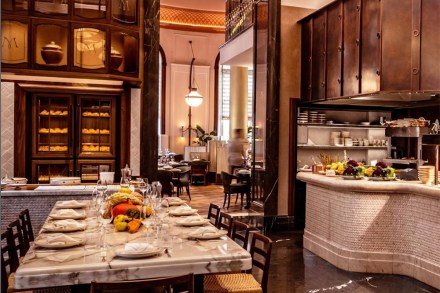
September felt like a long month — and I needed to escape London. The Spectator had just been sold — and while the transition from one editor to another brought excitement, it was also exhausting for everyone. Paris felt like the perfect retreat. And of course, the Eurostar is the fastest — and most enjoyable — way to get there from London. A friend of mine lives near the Gare du Nord, and as she was in London for a night, I borrowed her keys, jumped on the train and arrived in Paris as evening fell. Alone and hungry, I made my way to Les Deux Gares, a stylish hotel nestled between Gare du Nord and Gare de l’Est. Designed by Luke Edward Hall, whose aesthetic is unmistakably English, the restaurant inside is quintessentially French — and superb.

Casa Bonita

Casa Bonita, the greatest restaurant in the world

Colfax Avenue is the longest commercial street in the United States. It’s over fifty-three miles long, from the foothills of the Colorado Rockies all the way through the capital of Denver and out to the Eastern plains. It is littered with single-story, seedy roadside motels, some with working neon signage and some without. Hemp shops and dispensaries have moved in now as well. East of Denver, it has gained a sort of urban-legend reputation for sex work, vagrancy, crime and as of late, migrant gang activity. However, West Colfax is legendary for another reason. Nestled in the corner of a semi-rundown strip mall in the suburb of Lakewood, next to a coin-op laundromat and a Dollar Store, sits the mythological pastel-pink stucco tower of Casa Bonita.

Dining with the Chinese food pioneers of New York

For first-time restaurateur Bolun Yao, New York is a city to experiment in: “I feel like New York is the city that is always exploring new things. If you have a new idea, you put it here.” The Chinese-born entrepreneur — who has also spent significant time in New Zealand — came to NYU to complete a master’s degree in food studies. He quickly fell in love with the fine-dining Korean scene, including the two-Michelin-starred Atomix and COTE, America’s only Michelin-starred Korean steakhouse. Both merge contemporary and traditional techniques and ingredients. “Wow, that’s really, really smart and really creative,” the twenty-eight-year-old recalls thinking. “Why is there not a Chinese restaurant that does the same thing?

Chinese
Souls

Chicken soup for the souls: a feast for the dead

It’s indisputable. Food & Drink is The Spectator’s most important section. Ask yourself this: if you hadn’t eaten in days, would you have the slightest interest in perusing the deft political analysis, elevating cultural commentary and scintillating wit to be found the rest of the magazine? Without food, the only reading worth bothering with is Preparation for Death. As starvation sets in, only the two inevitables remain — Death and Taxes — and what need to worry about taxes? Tombstones have no mailboxes, shrouds no pockets. For over a millennium, November has been the month of the dead. The eleventh has been dedicated to fallen soldiers ever since World War One; but All Souls’ Day goes back much farther.

In praise of Halloween food

If you’re hesitant to ask someone if they are American or Canadian — the latter are often offended to be mistaken for the former — ask them instead about their favorite holiday. It isn’t a foolproof method, but if they say Halloween then you know you’re talking to an American. No other nationality would choose it — because no one else gets it so right. The origins of All Hallows’ Eve belong to Ireland and Scotland. The Celtic festival Samhain was not only a huge feast to mark the start of winter: it was a day full of superstitious activity, which included bonfires to clear the air of ghosts and sacrifices to appease anything all-powerful that might curse food supplies during the dark months.

Halloween