Education

Why work experience matters more than ever

In my recent BBC2 documentary, Posh & Posher, I explained how networking and contacts played a crucial role in giving those with the right connections an early leg up in their careers. Internships and work experience are proving increasingly crucial to opening doors and opportunities in later life. Many have expressed the view that the best intern and work experience opportunities in fields like politics, finance and the media are going disproportionately to those who are already privileged and well-connected. From what I've seen myself in recent years I suspect that to be true. The Mail on Sunday gives a classic example (and a potentially embarrassing one for the Tories) of how it can work.
Overall, a win for Gove

Michael Gove has won on the substance in the judicial reviews of his decisions on Building Schools for the Future. The judge has rejected the claim that Gove acted irrationally and found that he has the authority to make the decisions he did. There will have to be reviews of six of the decisions because of a failure to consult fully and a full equalities assessment will have to be done - yet another example of one of the traps that Labour has left behind and that the coalition needs to scrap as soon as possible. But this is hardly the victory that it is being portrayed as by some. Crucially, the judge has ruled that “the final decision on any given school or project still rests with him [Gove].  He may save all, some, a few, or none.

Burnham’s slide to the left

One of the more depressing sights in politics at the moment is how Andy Burnham is leading the Labour party back to its comfort zone on education. Burnham, who The Spectator once named minister to watch, seems to have jettisoned all of his Blairite reforming instincts. He now wants to draw as many dividing lines as possible and side with the vested interests and the status quo at every turn. In last night’s education debate, Barry Sheerman, who chaired the education select committee during the Labour years, pointed out that Gove’s education plans are building on the last government’s incomplete reforms. As Sheerman put it, “I am going to be honest: much of the Bill could have come from the previous Labour Administration.

Levelling higher education’s playing field

Last summer I was showing some 17 year olds around the House of Commons. They were bright and engaged and all wanted to go to university. But as they told me what they were doing for A-Levels my heart sank. They were all doing subjects that were going to put them at a massive disadvantage in applying to a top-rank university. The most worrying thing was that they were completely unaware of this. So it is welcome news that the Russell Group, made up of the 20 best universities in the country, has now published a guide advising students on which A-Level subjects are held in the highest regard by universities. This is the kind of information that schools that regularly send children to top universities pass on almost automatically to their pupils.

Forget Mandarin. Latin is the key to success

As promised, here is an extended version of an article from the skills supplement in this week’s issue of the Spectator. On the face of it, encouraging children to learn Latin doesn’t seem like the solution to our current skills crisis. Why waste valuable curriculum time on a dead language when children could be learning one that’s actually spoken? The prominence of Latin in public schools is a manifestation of the gentleman amateur tradition whereby esoteric subjects are preferred to anything that’s of any practical use. Surely, that’s one of the causes of the crisis in the first place?

Introducing Britain’s skills crisis

Did you know: Britain trails well behind other countries such as the US, Germany and Poland when it comes to educating its workforce? Did you know: the number of young people not in employment, education or training has risen by around 40 per cent over the last decade? Did you know ... oh, you get the idea. All the statistics, and more, are in the booklet on Britain's Skills Crisis that is included in this week's Spectator. For CoffeeHousers who don't buy the magazine (although you should, etc – purchasing options here), you can read the supplement for free via this snazzy, page-turning whatsit. We'll also put one or two of its articles up on Coffee House in due course.

Gove entrenches his reforms

In another sign of how the pace of Gove’s reforms is quickening, the education secretary has told local authorities that all new schools should be free schools or academies. This is a big step towards changing the default nature of the system from state-funded and state-run to state-funded but independent.   Local authorities will not be able to open a bureaucrat-controlled school unless they can satisfy the Secretary of State that there is no free school or academy provider willing to step in.   Gove has always argued that once free schools and academies become a significant part of the system it’ll be no more politically possible to abolish them than it would be to take sold-off council houses back into public ownership.

The Brutal Bigotry of Low Expectations

Bagehot has a properly righteous post lambasting teachers who complain that it's too difficult to teach their charges to read and write and count properly. A week later, a BBC Radio 4 phone-in programme, Any Answers, featured a pair of state school teachers, both with 30 years of experience, again pouring scorn on the dangerously “academic” bent of the English baccalaureate, and Mr Gove’s related desire to see a more rigorous syllabus in history, involving such things as learning a framework of important dates and events to give children a sense of the essential chronology of British and world history. Such history is never going to be relevant to many pupils, one of the teachers said. What do you mean by relevant, asked the radio presenter.

Gove raises the spectre of an electoral pact

Michael Gove has reignited talk of a Tory Lib Dem pact by urging people in Hull to vote Lib Dem to keep Labour out at the local elections. Gove’s intervention was not planned but it does reveal how he thinks. Gove’s department is the most coalitionised. Not only is there a Lib Dem minister there in Sarah Teather, tellingly the only Lib Dem minister not to moan to the Telegraph’s undercover reporters about her colleagues. But there is also David Laws, who is acting as an unofficial adviser to Gove. Anthony Wells’ thorough analysis of an electoral pact suggests that it could do well in the seats where it matters.  Obviously, all this discussion of pacts could be overtaken by events if AV passes.

There is a lot more to immigration than simply totting up the net migration figures

The good news is that most people in Britain think that people in their local area mix pretty well  regardless of differences in race, religion and the rest of it. According to the latest Citizenship Survey from the Department for Communities and Local Government for April-September last year, about 85 percent of people think that their neighbourhood is cohesive, community-speak for the absence of overt ethnic and religious tension. But when it comes to attitudes to immigration a slightly different view emerges. About 78 percent of Brits would like to see immigration reduced; well over half, or 54 percent, want to see it reduced a lot. That's roughly the same level for the four years that this exercise in Cohesion Research has been underway.

Is it worth paying young people to stay on at school?

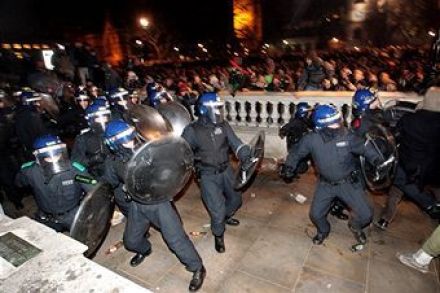
Today's political news is brought to you by the letters E, M and A. Eeeema. While the political establishment debates the abolition of EMA – the Educational Maintenance Allowance – inside Parliament, campaigners will be protesting against it on the streets outside. The police, who are used to these things by now, have already set up the barricades. Behind all the fuss and froth, the argument is really this: is EMA good value? The coalition claim that paying 16-18 year-olds up to £30 a week to stay on at school is not only expensive, but also wasteful.

Cameron’s public service reforms are still stuck in New Labour’s intellectual territory

The man known to the Cameroons as ‘The Master’ casts a long shadow. David Cameron has re-launched his public service reform agenda and there was more of a whiff of Blair in the air. His speech was understated. He eschewed references to radicalism and appealed to continuity instead. The favoured phrase of the moment is ‘evolution not revolution’, and Cameron traced the lineage of his reforms to those of the thwarted Blair administration (and the market reforms of the Thatcher and Major years). He was so deep in New Labour’s intellectual territory that he was at pains to stress that the ‘spending taps have not been turned off’.

Exclusive – Adonis: I back Gove

Is Michael Gove’s school reform a hideous distortion of the Labour Academies programme, as Ed Balls put it, or the fulfillment of that agenda? Until now Lord Adonis, the architect of the Academies programme, has kept silent on the issue. But he’s interviewed in The Spectator tomorrow by Matthew Smith, editor of Attain magazine. Here is a brief extract: 'Ed Balls has declared Gove’s plans for academies as ‘a total perversion of Labour’s policy, which was about turning round under-performing schools in disadvantaged areas’. Adonis’s response is rather different.  ‘Neither I nor Tony Blair believed that academies should be restricted to areas with failing schools.

Hughes’ social engineering crusade

No wonder some backbench Tory MPs are apoplectic: courtesy of David Cameron, Simon Hughes has been elevated from soapbox to pulpit. Hughes' first statement as the government's university access adviser is to suggest that universities should limit their intake of students from private schools. He told the Guardian: 'I think my message to the universities is: You have gained quite a lot in the settlement. Yes, you've lost lots of state money, but you've got another revenue stream that's going to protect you. You now have to deliver in turn. You cannot expect to go on as you are. It has failed miserably.'   Hughes' appointment was controversial, another instance of well qualified, determined and loyal Tories being denied preferment to placate Lib Dem egos.

Gove’s school reforms approach a tipping point

Today marks something of a milestone for Michael Gove’s school reform agenda. Free schools – i.e. ‘Academies’ which are independently run, yet within the state sector – now account for more than 10 percent of British secondaries. This is what I have always thought of as a tipping point – where independent schools offer real competition to council schools (i.e. those run by their local authority). One hesitates to sound too confident, but the genie of choice seems to have been yanked out of the bottle, and a few facts are worth nothing: 1. There are now 407 Academies open, twice the amount in May 2010. The 400 mark was, for Tony Blair, totemic - a goal that he made Gordon Brown sign up to as a condition of the handover.

Across Europe, students are protesting against the end of their entitlements

A month ago I found myself in the space of one week in two different countries, yet in the midsts of what felt like the same phenomenon: the political awakening of a new generation. In both London and Rome, students took to the streets to protest against government policies in numbers and in ways that those who graduated just a few years before would have found anachronistic, odd even. Unsurprisingly, given the historical, political and even emotional differences between Britain and Italy, there were differences between the protests. But as I walked the packed streets, listened to the protests, read their slogans, I heard similar arguments - particularly about the lack of fairness. When both events were finished, Whitehall and Via del Corso looked similarly destroyed.

Tzars and advocates

The coalition’s attempt to talk to two audiences at once is on full display today. The Times reports on the appointment of the Tory Lord Heseltine as a growth czar and his warning against bashing the bankers. Meanwhile, The Guardian reveals that Simon Hughes, the deputy Lib Dem leader, is to be the coalition’s access advocate. Hughes’ appointment is intriguing. On one level, the appointment of Hughes—who abstained in the fees’ vote—is a way of trying to draw a line under the matter within the Liberal Democrats. Clegg clearly hopes that having abstained Hughes will be better able to sell the package to sceptical party activists.

Writing the Laws

Even out of office, David Laws remains one of the most important figures in the coalition. He was one of only two Lib Dem MPs — the other being Danny Alexander — to attend Nick Clegg’s strategy session at Chevening on Friday morning. He’s also played a crucial role in rolling out the pupil premium, effectively working out of Michael Gove's department.   So it is pretty much certain that he’ll return to government once the Standards’ Commissioner has delivered his verdict. Where Laws will be slotted in is far less certain. Today, the well-sourced James Chapman reports that he’s been lined up for a Minister of State job at the Justice Department.

Classic mistakes

In a good omen for the newly announced fund-raising charity ‘Classics for All’, the Education Secretary, Michael Gove, stated in his White Paper the other week that Latin and ancient Greek would, after nearly 25 years, become officially permitted national curriculum subjects. So classics has finally come in from the cold. But why on earth were the languages frozen out in the first place? In 2006, Lord Dearing was asked by the then education secretary, Alan Johnson, to see what could be done about the dramatic slump in the number of pupils taking GCSEs in foreign languages. Languages had been made voluntary after the age of 14 in 2004.

Why education should be for profit

Michael Gove’s free schools programme has been heralded as the cutting edge of the coalition’s structural reform programme. Removing the dead hand of the state and allowing new schools to emerge makes the Big Society project tangible at least. But already – and unsurprisingly – the reforms are running into difficulty. By the end of the summer, only 62 schools had applied for “free school” status. They will all be run on a not-for-profit basis. Perhaps, just perhaps, this is the start of a cascade. But it’s doubtful. If you want real innovation and improvement in the educational sector, people need to be able to make money out of it. That would surely bring about a flood of exciting, new entrants to the market.