Covid

Does getting Covid-19 protect you against reinfection?

How well does prior exposure to the SARS-CoV-2 virus protect you against reinfection? It has been a hotly-debated subject since the first trickle of reported cases of reinfection with the virus began to be reported last spring. Now, a study involving 16,000 students from South Carolina has attempted to quantify the protective effect of natural infection. The students involved in the study, which is published in the journal Clinical Infectious Diseases, were each swabbed for a PCR test last autumn, as a condition of being allowed to return to campus. They were swabbed again this spring in similar circumstances.  Out of 16,101 students, 2,021 were found to be infected in the autumn. Of these, 44 – or 2.

The fatal flaw in the Covid travel restrictions

Here are two Covid questions, thrown up by the rate at which the Indian variant is infecting parts of the UK. First, does it show that the traffic light system, which was designed to prevent the UK from importing new strains and variants from abroad, is unfit for purpose? The delay of one to two weeks in moving India from the amber to red category – which I’ve been banging on about for a month – is relevant, and looks like a serious government mistake. But isn't there a more fundamental flaw in the system? Ministers keep pointing out that with India in the amber category the UK should have been protected – because passengers from India were supposed to quarantine at home for 10 days and take tests on days two and eight.

Sweden, Covid and lockdown – a look at the data

Over the last year, the debate about lockdown has been driven to extremes – everyone has, by now, made up their mind. Sweden has been used as an example of either a liberal heaven or Covid hell. To the outside world, Sweden is a country that defied lockdown, carried on regardless and ended up with what is (now) the highest case-rate in Europe. In reality, Sweden shows that you don't need lockdown to significantly reduce mobility: it forced down two waves. It failed to protect care homes, leading to a scandal of thousands of avoidable deaths. But the question is whether, by avoiding lockdown, it managed Covid while minimising damage to the economy, society, healthcare and schools. I looked at this in my Daily Telegraph column a few weeks ago.

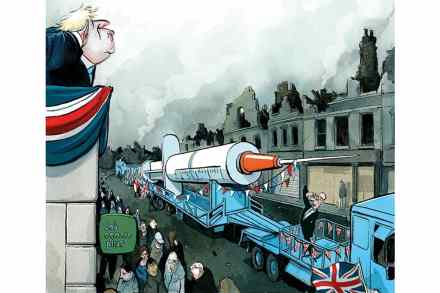
Labour are deluding themselves about Boris’s ‘vaccine bounce’

That vast battalion of pinko pundits who confidently expected Boris Johnson to get a drubbing in last week’s elections has already reached a consensus on why it is that he did so well and Keir Starmer so badly. To summarise: the Prime Minister is a lucky general who benefited from a 'vaccine bounce'. He will fall straight back down to earth once this current crisis is over. The electorate will soon start concentrating on what really matters, like the cost of his curtains. In the long list of reasons why Labour keeps losing, its tendency to underestimate and misunderstand its opponents should figure large. Because the truth of the matter is that Johnson has not 'got lucky'.

Is working from home here to stay?

National Work from Home Day might not be a calendar highlight but it has undoubtedly taken on increased significance during the pandemic. Remote work is du jour and the big question now is: will it become the new normal? Take headlines at face value and we’re living in both a Zoomshock dystopia and a commute-free Shangri-La. We're selfishly contributing to the hollowing out of city centres, and we're righteously boosting the local economy. The same ministers now pushing for hybrid working to become the default unless employers have good reason to forbid it were last summer warning absenteeism risked making people more 'vulnerable' to getting sacked. We should probably be wary of those who say: 'Covid killed the office. Long live hybrid working'.

Will our vaccines stop the Indian variant?

As we have often found with Covid-19, no sooner does a path seem to emerge out of the woods than the trees close in again. On Monday, the Prime Minister confirmed that the further relaxation of lockdown rules – including the reopening of indoor hospitality – would go ahead as planned next week. Daily totals of deaths from Covid-19 have been running at very low levels – indeed deaths from all causes are now running 7.3 per cent lower than the recent five-year average, according to the ONS.

The sermons poked out of the songs like busted bed springs: Van Morrison livestream reviewed

Over the decades, Van Morrison’s role within the tower of song has shifted from chief visionary officer to head of complaints. It’s not a promotion. The title track of his new album, Latest Record Project, Volume 1, is a rebuke to those who insist on living in an artist’s past rather than his present. A laudable sentiment, perhaps, but one less easy to put into practice when Morrison’s present consists of 28 tracks which hone an already ornery world view to a paranoic peak. When he isn’t griping about his divorce he’s peddling half-baked conspiracy theories, sneering at internet users and ‘media junk’, and bitching about modern music, crooked politicians and false prophets.

A ‘cautious cuddle’? No thanks, Boris

There have been some truly dystopian spectacles during the past year-or-so of lockdowns. Cops using drones to spy on dog-walkers. Park benches sealed off with yellow tape. Curtain-twitchers dialling 999 after seeing the bloke next door go for a cheeky second jog. But this headline surely tops all of that: ‘Hugs will finally be legal again from next Monday.’ Read that again. We live in a country in which the government has accrued so much power that it now gets to tell us when we may hug each other. This should send a chill down the spines of all who care for liberty. To be honest, I wasn’t even aware hugging had been outlawed. I’ve been hugging people for months.

Are Meghan’s Covid claims correct?

When you are on the side of global enlightenment, the standards of proof required for your assertions tend to be somewhat lower. This perhaps explains why Meghan Markle’s comments during an event called the Global Citizen’s Vax Live concert were so widely reported yet so little challenged by the usual army of self-appointed ‘fact-checkers’ who swoop on anything to do with Covid. She claimed that women 'have been disproportionately affected by this pandemic', citing a 'surge in gender-based violence, the increased responsibility of unpaid care work and new obstacles which have reversed so much progress for women in the workplace'.

Merkel is right to reject Biden’s vaccine patent plan

She handed the vaccine procurement process over to the European Union. She didn’t invest much in new production. And she allowed an American multinational to take control of a brilliant discovery by a small German biotech company. Angela Merkel, the out-going German Chancellor, has not had much success battling the Covid-19 crisis, and her handling of vaccines has been a catastrophe from start to finish. But she has finally got one thing right: she is defending the patents that protect the pharmaceutical industry. In the last week, president Biden has signalled that the United States is ready to back suspending patents on Covid vaccines.

The ‘Covid deaths’ that are not caused by Covid

Registered Covid deaths fell to just one on Monday, leading many to comment that the epidemic in Britain is effectively over. One day’s statistics don’t mean an awful lot, especially over a bank holiday, but what about the wider picture? Over the UK as a whole, there have been 90 deaths over the past seven days, a fall of 41.2 per cent over the previous seven day period – although that, too, may be affected by the bank holiday. A more in-depth analysis, offering more context – although a little out of date – is provided by the latest weekly analysis of deaths from all causes, published today by the Office for National Statistics and covering the week ending 23 April.

‘I’ve seen the bare bones of London’: street painter Peter Brown interviewed

‘I’ve been seeing the bare bones of London,’ explains the landscape artist Peter Brown, who is known affectionately as ‘Pete the Street’. We meet on the corner of St Martin’s Lane, where he is painting the view facing north, taking in the Coliseum, the Duke of York theatre and an Iranian restaurant called Nutshell. ‘The pandemic has been a good opportunity to paint all these West End theatre awnings.’ What has he noticed about London during the pandemic? ‘UPS vans, everywhere,’ he says. How about Deliveroo bikes? ‘I’ve spotted less of those.’ Has London changed over the past year? ‘I met a bloke on Old Compton Street who described how it feels really well to me,’ Brown says.

Despotic laws can — even should — be ignored, says Jonathan Sumption

Jonathan Sumption has developed ‘many strange habits over the years’, he tells us disarmingly, and one of these is to read the international press. ‘I read the French and German press most days, and sometimes the Italian and Spanish press as well.’ Some might think the retired Supreme Court justice was showing off. But these remarks were addressed to a group of German judges at the end of 2019. His message to them was that the British people might have been wrong to vote for Brexit — but they were not, as reported in the continental press, ‘at best naive and at worst mad’. That’s good to know.

Can Cummings really hurt Teflon Boris?

Seldom have so many keyboard warriors and political activists professed so much dissatisfaction towards the government of the day. For some left-wing bloggers and tweeters, the number one cause of outrage of the moment is so-called 'Tory sleaze', a subject to be added to an already formidably long list of gripes towards Boris Johnson that includes Brexit, the claim that Britain is not very racist and his alleged unforgivable bungling of the Covid crisis. On the right, there is now, if anything, an even wider array of issues igniting fury towards the Prime Minister.

Covid advisor’s Cheltenham amnesia

Steerpike finally got his hands this week on a copy of Failures of State by the Sunday Times Insight duo Jonathan Calvert and George Arbuthnott about Britain's experience of Covid. While not exactly a barrel of laughs, Mr S did enjoy one contribution from SAGE member Susan Michie, professor of health psychology at University College London and a Communist party member of 40 years. Reflecting on the decision to allow Cheltenham racing festival to go ahead in March 2020, Michie told the authors: I thought Cheltenham should definitely not have been allowed to go ahead. I remember looking at the television images of what was happening there and feeling slightly nauseous about it, just feeling: 'God, this is awful.

How much of a threat is the South African variant?

For residents of six London boroughs, as well as those in Smethwick in the West Midlands, the partial relaxation of lockdown rules this week hasn’t quite gone according to plan. They’ve had a day out in the sun, alright, but not necessarily sitting enjoying food and drinks in a pub garden – more likely they have been standing in a long queue to get ‘surge tested’ for the South African variant of SARS-CoV-2, the virus which causes Covid-19. So how much of a threat is the South African variant? In spite of anecdotal claims from South Africa that the new variant was affecting younger people, there is no evidence that it causes more severe illness.

Our doctor’s surgery is beginning to look like a Category A penitentiary

When the time came for the nurse to ring me to take my blood pressure, the phone simply didn’t ring. I was at the horses doing fencing so I checked my messages to make sure I hadn’t missed this ground-breaking event. But no, there was no voicemail saying: ‘Hello, this is the nurse calling to take your blood pressure.’ I was extremely disappointed because I had hoped my cynicism was about to be proved unfounded. There did appear to be no way a nurse could take my blood pressure over the phone. But I had sort of hoped there might be. And I think that tiny part of me that was hoping for such a daft thing was the sheep-shaped part of me that wants to trust the NHS like the other happy sheep people, despite evidence to the contrary.

The UK’s vaccine roll-out has ended the Brexit debate

The country would remain implacably divided for a generation, with Remain and Leave replacing class and geography as the new fault line in British politics. International investors would take a generation to come round to the idea. And campaigns to re-join the EU would grow in strength as the chaos deepened. Even a few months ago, it was possible to argue that Britain's tortured debate about leaving the EU would run and run without any seeming end. And yet since then something very interesting has happened. The UK’s comparative success at rolling out Covid-19 vaccines has in effect sealed the Brexit deal. The debate is now over, both here, and around the world.

Can Spain’s Europhilism last?

'Suppose a man be carried, whilst fast asleep, into a room where there is a person he longs to see and speak with; and be there locked fast in ... he awakes, and is glad to find himself in so desirable company, which he stays willingly in ... I ask, is not this stay voluntary? I think nobody will doubt it: and yet, being locked fast in, it is evident ... he has not freedom to be gone.' Happy in a room he cannot leave, the man John Locke imagined during his musings on free will might almost be a metaphor for contemporary Spain in the European Union. Awakening from the long sleep of Franco’s dictatorship, the Spanish people were delighted to find themselves in the EU where they had always wanted to be and where their country is now locked fast into the Eurozone.

Why I’m worried about the teenage cancer generation

As I sit here writing this, it’s just over one year ago since the first lockdown was imposed, without which I would have been touring with The Who. That included our annual concert for the Teenage Cancer Trust at the Royal Albert Hall. Now, one of the UK's premier calendar events has been cancelled for the second year running. It leaves a gaping £3 million deficit in the charity’s funding. Likewise, Teen Cancer America, the charity I founded with Pete Townshend in the United States, has lost $4 million in revenues we would have raised if our tours had not been cancelled. It’s heart-breaking to see so many charities in trouble when they are needed the most.