Covid

Prepare for China’s nationalist turn

In recent days, it has been striking how many people in Westminster and Whitehall now think the lab leak theory is the most plausible explanation of Covid’s origins. China’s apparent success last year at stamping out the virus at home — with technological competence and sheer brutality — while cases spiked in the West, created a fear that the future belonged to Beijing.  But, as I say in the magazine this week, the growing plausibility that the virus leaked from a lab highlights the Achilles’ heel of the Chinese system: its lack of a mechanism for error correction. It is not that a lab leak couldn’t have happened in the democratic world, but it is far harder to imagine it being covered up here.

Why the vaccines should prevent a deadly third wave

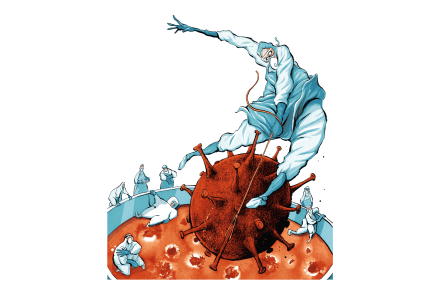
Among the scientists and medics calling this week for caution in the government’s reopening of the economy was Dr Lisa Spencer, a consultant in Liverpool and honorary secretary of the British Thoracic Society, who warned on the Today programme on Tuesday that the country was covered with a series of ‘mini Covid volcanoes’ which ‘could explode and send a massive gas plume across much more of the UK.’ Her reasoning was that a quarter of adults could still be susceptible to Covid-19, either because the vaccine didn’t work for them or because they refused to have the vaccine at all. She suggested that 10 per cent of people might refuse to have the vaccine.

Is Britain prepared for a different corona disaster?

Amidst the drama of Dominic Cummings's appearance in front of MPs last week, perhaps the most important thing the PM's former adviser said was almost entirely ignored. As well as slating his former boss, Cummings criticised the UK’s disaster planning. The pandemic has shifted attention to how Britain would deal in the future with another respiratory virus, but arguably a bigger threat to this country – and, indeed, the world – has been forgotten. When it comes to dealing with solar flares, Cummings's said, ‘the current Government plan is completely hopeless. If that happens then we’re all going to be in a worse situation than Covid’.

Will lockdown still be eased on 21 June?

While Boris Johnson used the bank holiday weekend to get married, scientists have been busy filling the airwaves with various warnings about proceeding with the final lockdown easing on 21 June. There have been a series of statements from both government advisers and other scientists arguing that in the face of rising cases of the Indian variant – which the World Health Organisation now calls ‘Delta’ – it would be unwise to press ahead with the next stage of the roadmap this month. Nervtag member Prof Ravi Gupta has said the UK appears to be in what could be described as the early stages of a third wave – with an ‘exponential’ rise in cases.

Did NHS discharges ‘seed’ Covid into care homes? A look at the data

Did Matt Hancock’s negligence lead to Covid seeding into care homes because patients were not tested before being discharged? This was one of Dominic Cummings’s more potent charges  and it brings back memories for me because I spent a chunk of last summer looking into this. In my line of work, the success rate for stories is quite low: investigate five avenues and you’re likely to find four dead ends. So you end up with a lot of data and research that’s never used, because the original premise doesn’t hold up. I was (and remain) critical of much of government policy on Covid response: it seemed horribly plausible to me that panicked NHS discharges were behind the staggering care home death count.

Was Matt Hancock guilty of ‘negligence’?

The Health Secretary Matt Hancock has insisted that he promised the Prime Minister and his former chief aide Dominic Cummings only that all elderly and vulnerable patients would be tested for Covid on discharge to a care home when there was adequate testing capacity, and not with immediate effect. This is Hancock’s defence against Cummings’s charge that the Health Secretary lied to him and the PM when promising to test patients prior to them going to a care home. But I understand Cummings has documentary evidence that as late as May last year he and the PM feared they had been misled by Hancock about how he would protect the elderly in care homes, and that he was guilty of ‘negligence’.

Is the daily drip of Covid statistics still helpful?

It is hard to remember a time when the daily drip of Covid statistics was not part of our lives. Since March 2020, we have been greeted every afternoon with a stream of government released data filling us in on the number of infections, hospitalisations and deaths. But how necessary is it today? With a current seven-day average of only seven Covid deaths a day, the lowest level since 15 March 2020, what do we stand to gain by continuing with this current approach? It is becoming increasingly apparent that the Indian variant is not going to swamp hospitals – and that concerns about fully unlocking on 21 June are over-egged. Even if this particular variant does prove to be more transmissible, the effectiveness of the vaccines prevents it from being of much concern.

The Covid lab leak theory is looking increasingly plausible

In March last year, it was widely agreed by everybody sensible, me included, that talk of the pandemic originating in a laboratory was pseudoscientific nonsense almost on a par with UFOs and the Loch Ness monster. My own reasoning was that Mother Nature is a better genetic engineer than we will ever be, so something as accomplished at infection and spread could not possibly have been put together in a lab. Today, the mood has changed. Even Dr Anthony Fauci, the US President’s chief medical advisor, now says he is ‘not convinced’ the virus emerged naturally.

The many failures of China’s vaccine programme

At the start of the year Sebastián Piñera, president of Chile, went to Santiago airport personally to greet a consignment of vaccines from China. ‘Today is a day of joy, excitement and hope,’ he said from a podium on the tarmac. ‘As you see behind me, there is the plane that brought a shipment of almost two million doses of Sinovac vaccines.’ By April, Chile had suffered one of the worst Covid surges in Latin America. The joy and hope, it seemed, had been misplaced. A few weeks ago, Chile’s government announced that, after a real-world study involving 10.5 million Chileans, Sinovac turned out to be only 16 per cent effective at reducing the risk of infection after one shot and 67 per cent effective two weeks after the second dose.

Scotland is open – and desperate for English tourists

When I told my friends I was heading to the Outer Hebrides on holiday — escaping from London as soon as it was legal to do so — I thought they might be envious. Instead, a few were worried for my safety. ‘Just don’t say you’re from England,’ suggested one. Another encouraged me to ‘lay low’ with my fiancé when boarding the three-hour ferry from Ullapool to Stornoway. Dangerous times, they seemed to think, for anyone down south to head to the Highlands and islands. I initially brushed off these concerns as confusion over Covid restrictions. Travel rules have changed so many times over the last year — not just nationally but locally. Each of the devolved administrations has often given different guidance.

How much damage to the government has Dom’s bomb done?

The more anticipated a parliamentary appearance, the less it tends to live up to its billing. But Dominic Cummings’s testimony before MPs on Wednesday was one of the more remarkable parliamentary moments of this century. His attacks on his former boss were jaw--dropping. He said that it wouldn’t have helped if Boris Johnson had chaired Cobra meetings at the start of the crisis since the Prime Minister didn’t take Covid seriously and that it was ‘completely crazy’ that the country had to choose between Johnson and Jeremy Corbyn at the last election (this remark was particularly astonishing given Cummings’s influence on the Conservative campaign). But his criticisms of the entire way that the British state works were just as significant.

Portrait of the week: Bashir’s reckoning, Dominic Cummings’s evidence and ‘secret’ local lockdowns

Home The BBC was engulfed in doubts after a report by Lord Dyson blamed Martin Bashir for deceiving the late Diana, Princess of Wales, before interviewing her on television in 1995 — and the BBC for failing to investigate properly. The Duke of Cambridge said: ‘It brings indescribable sadness to know that the BBC’s failures contributed significantly to her fear, paranoia and isolation that I remember from those final years with her.’ He said that had the BBC properly investigated complaints, ‘my mother would have known that she had been deceived’ before her death in 1997. The former chairman of the BBC, Lord Hall of Birkenhead, resigned as chairman of the National Gallery.

Racing badly needs the full relaxation of restrictions

Humans are herd animals too. Jockeys, trainers, owners and those enjoying the few prized media attendance slots for racing behind closed doors have agreed that without the crowds it simply hasn’t been the same experience. TV coverage of racing is first class going on brilliant and has provided vital information and entertainment through lockdown, but we in the racing tribe need to be regularly on the course, rubbing shoulders with the like-minded: ‘Did you see what that one did last time at Newbury? Why isn’t X riding his regular stable’s two-year-old here?

How can we feed our horses when there’s no hay?

‘We’re closed for lunch,’ said the farmer, sitting behind the counter of his farm shop with a scowl on his face, not eating anything. ‘Well then,’ said the builder boyfriend, ‘I’ll come back.’ And the BB went off to have a bite to eat at a nearby caff, where he texted me the news that he had yet to score, but was going to try again later. There is no hay, or at least there is not enough hay in any given place to make farmers want to sell it. While the human food supply managed to recover from last year’s panic-buying, animal forage was different, because there really is a limited supply of that, not just an imagined shortage. Farmers only got one cut of hay last summer because of dry weather, which would have been bad enough.

Boris will be delighted with Dominic Cummings’s evidence

Here it was. At long last. Dominic Cummings in the flesh at the parliamentary select committee. He was dressed in the same immaculate white cotton shirt that he sported for his ‘agony in the garden’ appearance in Downing Street a year ago. But this time he wasn’t in the dock. He was like a school governor on prize-giving day, handing out gongs, and delivering the odd stiff rebuke to senior prefects. Matt Hancock got a dressing-down he won’t forget. He was accused of misleading officials and the public. ‘He should have been fired for at least 15 or 20 things,’ said Dom, ‘for lying to everyone on multiple occasions.’ Whoops. Time for Hancock to start work on his memoirs. Boris got off fairly lightly.

The tragedy of Dominic Cummings

Dominic Cummings's main concern as he appears in front of MPs is to identify the failures of government and ensure everyone knows they weren't his failures, but those of the fools who refused to listen to him. It's rather a tragic final act, for the truth is that Cummings did fail (and, to be fair, he has admitted some of his failings in front of the committee). Not so much as regards the pandemic (although given his influence, it is hard not to assign some culpability to him) but in his stated desire to improve the overall performance of government. For those of us who admired his intellect, his drive and his ambition to use data and technology to improve the decision-making that affects millions of people, it is a crushing disappointment.

Why Boris shouldn’t be optimistic about the Bolton Covid data

I am bemused by Boris Johnson’s optimism about the prospects for full unlocking on 21 June, based on the data he says he is seeing. Because the government’s own daily published data is showing worrying trends for the Indian variant. For example, there were 280 Covid infections reported for Bolton alone yesterday, 10 per cent of the UK total, and as you can see here the trend is steeply upward: That would be less worrying if there was also a steep rise in Covid testing in Bolton. But there isn't. As you can see here, the ratio of positive test results to tests carried out in Bolton – the positivity ratio – is holding fairly steady at about 7.5. It is obviously encouraging that there has not been a sharp associated rise in hospitalisations.

Has India’s second Covid wave peaked?

While the Indian variant continues to dominate the headlines, India itself seems to have dropped out of the news a bit. What is going on there?  It was reported yesterday that India notched up a record number of Covid deaths on Tuesday – 4525 – which indeed was the record of any country during the pandemic. However, that number needs to be put in the context of the country’s population of 1.3 billion. Grim as it is, it works out at 3.5 deaths per million. This is a fraction of the 27.6 deaths per million recorded in Britain on 20 January 2021. Tuesday’s figure is likely to be the high tide mark in India’s second wave of Covid Tuesday’s figure is also likely to be the high tide mark in India’s second wave of Covid.

Just how far will the NHS go to get me jabbed up?

More threatening letters from the NHS demanding I let them jab me up with two Covid vaccinations. Or as the builder boyfriend put it: ‘Now that more people are choking to death on paella getting stuck in their windpipe than are dying of Covid, how are they going to force us to get vaccinated? And what are they going to do about the dangers of paella? Ban paella? Require paella to carry a warning? Tell people they must wear a mask when coming into contact with paella?’ I don’t mind being denounced as stupid, by the way. My own mother rang me and told me off for being stupid after I first wrote that I didn’t want the jab. I told her that was fine. I went through it with Brexit. I’m used to being called stupid when polite society disagrees with me.