Covid

Boris tries to avoid a vaccine war

After France’s Europe Minister became the latest politician to threaten a vaccine export ban on the UK, Boris Johnson used today’s press conference to try to diffuse the row ahead of Thursday’s summit of EU leaders. When asked in the Q&A session whether such an export ban could derail the UK roadmap for ending lockdown and if the UK would retaliate, the Prime Minister stressed the need for cooperation from all sides. No. 10 fear retaliatory measures in the event of a vaccine export ban could make the situation go from bad to worse Johnson said the UK would continue to work with European partners to deliver the vaccine rollout – suggesting

Vaccines should mean more freedom – not less

Do vaccines lead to freedom – or to more lockdown rules? That very question would have seemed bizarre a few weeks ago, when Matt Hancock told this magazine that he’d ‘cry freedom’ when the most vulnerable had been protected. But now, things are swinging the other way. The end of the second wave in Britain (infections and intensive care admissions are down 95 per cent from the peak) has not been followed by reopening. Instead, it’s being used as rationale to continue lockdown for months to come. The latest is international travel: the freedom to leave the country. As we reach the milestone of over half of UK adults having

Stanley Johnson and the Covid loophole

Labour have been taking a cheeky pop at the PM’s father today in the Guardian over new coronavirus regulations coming into force later this month. Under the guidelines from 29 March, people will be allowed to leave the UK to prepare a second home for sale or rent as part of a list of specific ‘reasonable excuses to travel’ outside the country. Andrew Gwynne has dubbed this the ‘Stanley Johnson clause’ in a reference to the latter allegedly breaking Covid guidelines by travelling to his Greek villa to make it ‘Covid-proof.’ In typically partisan style, Gwynne claims that:  For hardworking families facing the prospect of missing out on summer holidays, it will stick in

Why are Covid conspiracies so appealing?

The recent decision by several European countries to suspend the use of the AstraZeneca vaccine will have thrown petrol on the bonfire of conspiracies surrounding the pandemic. These range from believing that vaccines contain microchips so that Bill Gates can track you, to believing that the virus is a global conspiracy to allow governments to introduce new draconian measures to control their populations. Why are so many conspiracy theories thriving today and what do they tell us about ourselves? During my time serving in Iraq I heard lots of conspiracy theories. Many concerned exaggerated capabilities of the equipment we had, such as the belief that night-vision goggles and even Army-issued

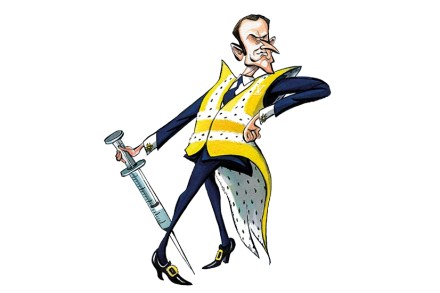
Is Macron losing control of France?

There may be a touch of the Monday blues for Emmanuel Macron this morning as he scans the headlines in France. A new poll reveals that vaccine scepticism in his country has reached record levels, thanks to his recent belittling of the AstraZeneca vaccine. Sixty-one per cent of those canvassed expressed their doubts about the vaccine, up 18 per cent from last month. Only 23 per cent said they had confidence in the AstraZeneca jab. In contrast, 75 per cent of British people have faith in the vaccine. But if the French are increasingly reluctant to be vaccinated, they are determined to enjoy the arrival of spring – Covid restrictions

Let’s call time on Britain’s gerontocracy

The boomers are eating their grandchildren. They don’t see it this way, of course, but they are doing it nonetheless. Covid, or rather the British state’s response to the pandemic, is just the latest evidence of this. Whatever you make of Boris Johnson’s handling of the pandemic, one thing is clear: the cost of lockdown will be funded by young people in taxes for years to come. But it will most of all be paid for with time. We can find ways to minimise the impact of the government debt, but we can’t give people a year of their lives back. It is a natural part of history that good

Where’s Nicola Sturgeon?

After being accused last night of misleading the Scottish parliament, Nicola Sturgeon’s daily Covid briefing was high on Mr Steerpike’s watch list today. Alas upon tuning in, viewers were greeted with the sight of Jeane Freeman, the country’s health secretary (under fire for quite different reasons) rather than her embattled party leader. Asked by Sky about whether Sturgeon should resign, Freeman snapped back that: ‘This is a Covid briefing and that is what I am here to answer questions on’ before (quelle surprise) saying she still believed her colleague did not mislead parliament and that she should not resign. So where is Sturgeon and why is not doing her much loved daily

Shock as NYT praises Britain

In recent years Britain has become something of a Bermuda Triangle for the New York Times. Since voting for Brexit in 2016, the UK has become reimagined in the reporting of the Gray Lady’s esteemed reporters. It is a strange, desolate place, where locals huddle round bin fires on the streets of London, gnawing on legs of mutton and cavorting in swamps during the summer, ever fearful of the despot Prime Minister, Boris Johnson. But has all that now changed? Mr S was minded to call the Tower to check on London’s ravens after seeing an article published today titled: ‘Britain’s ‘One-Jab’ Strategy’ with the subheading ‘Britain’s “one-jab” strategy is working, offering

Has Britain fallen victim to the Asian vaccine war?

The success story of Britain’s vaccine rollout has hit its first major obstacle: five million doses of the AstraZeneca vaccine will be held up for a month. But how many of us knew it was India, not manufacturing plants in the UK or Europe, that was supplying a considerable amount of our vaccine needs? And does the delay show that Britain is now caught in the middle of an emerging vaccine war in Asia? The delayed jabs are being manufactured in the Indian city of Pune (pronounced Poona). Sometimes known as the ‘Oxford of the East’, the city – already famous for the manufacture of car parts – is about

Is India to blame for the UK’s vaccine delay?

The UK vaccination programme has been such a success to date that until yesterday evening it seemed a formality that the government would achieve its target of offering all adults at least a first dose of a Covid vaccine by July. Indeed, on Monday it looked as if this date might be brought forwards when it was announced that there would be a huge uplift in vaccine shots available, thanks to the arrival of a large consignment of AstraZeneca vaccine from India. Instead of 2 million doses a week, the vaccination programme would be able to deliver 4 million doses. On Wednesday evening, however, that hope was shattered. Firstly, Ursula

How real is the performing arts exodus?

Think back 12 months to when you first felt the pandemic. Not when you first read about Covid-19, but the moment of impact — the lurch in the stomach as it hit you that this time, it really wasn’t going to be OK. For Emma Cook, a freelance stage manager on the John Cleese farce Bang Bang!, the moment came during a rare week off. ‘I was sitting in a restaurant near the Bush Theatre in London, waiting to go and see The High Table, and I got a message from a friend who had just flown back from overseas: “Why are the theatres all closed?”. I thought, no they’re

Public Health England’s obesity obsession

Few government agencies have had a worse pandemic than Public Health England (PHE) whose mission is ‘to protect and improve the nation’s health and to address inequalities.’ Criticisms levelled at PHE over the past 12 months include failing to expand diagnostic testing and contact tracing, discouraging the use of face masks, failing to share infection data with local authorities and overcounting the number of Covid deaths in England. It has also been slated for focusing too much on lifestyle choices at the expense of properly preparing for a pandemic. In 2018/19, some £220 million of the public health budget was spent on anti-obesity schemes – more than twice the budget

Watch: Nicola Sturgeon’s hostile Covid briefing

First Minister Nicola Sturgeon appeared to be in a poor mood today, after David Davis used parliamentary privilege in the Commons last night to make a series of allegations against the Scottish government over its handling of the Salmond investigation. After the ITV journalist Peter Smith asked Sturgeon about the new allegations at the Scottish government’s Covid briefing, the First Minister at first refused to answer the question at all, saying ‘I’m not having this briefing side-tracked into the latest instalment of the conspiracy theories we’ve all be hearing about for a long time’. Sturgeon then took a rather more hostile approach, saying she would only answer questions from the

The SNP’s nonsensical Covid book ban

Why is the SNP banning books? On 5 January the Scottish government introduced a strict new lockdown in response to the spread of a more infectious strain of Covid-19. As a student at the University of Edinburgh, one particular restriction has baffled me ever since. Unlike in England, Wales or Northern Ireland, the Scottish government decided to ban students from reading, borrowing or even touching books in their university libraries. Even as fears rose over the rapidly spreading ‘Kent’ variant, it seemed that this policy lacked any scientific foundation. The Scottish government’s explanation for its book ban is baffling, and seems to be just copied and pasted advice from public

Why the hospital money row is going to the wire

The row over the NHS pay rise is taking up most of the political attention when it comes to the health service at the moment. But it’s not the only – or indeed the biggest – problem facing the politicians and officials involved. This morning Matt Hancock appeared before the Health Select Committee, and after being grilled on the proposed pay increase, found himself having to explain why, with just 16 days to go, hospitals still have no idea what their Covid-related funding is going to look like for the next six months and beyond. The NHS budget for 2021/22 still has not been signed off. Hancock insisted that the

Don’t blame the EU for the latest Covid vaccine clash

Far from subsiding, as it seemed to be doing last week, the European war over the AstraZeneca vaccine has intensified. Over the past few weeks, EU leaders have swung from accusing the company – and Britain – of hoarding the vaccine and failing to supply it to EU countries, to claiming that it is ineffective, back to accusing us of hoarding it again. But the decision by several European countries to suspend rollout of the vaccine over fears of blood clots is the most serious challenge yet. This time, however, the blame cannot be laid at the door of the EU – the European Medicines Agency continues to declare the

The EU-AstraZeneca row: a complete timeline

Oh dear. This morning Sweden has become the latest European country to suspend use of the AstraZeneca-Oxford University vaccine. It follows reports that some people have suffered blood clots after being given the jab despite AstraZeneca’s data showing there have only been 37 such reports among the 17 million people across Europe who have been given the vaccine. Yet while some European health ministries across the continent are raising concerns about its effectiveness, others are lambasting AstraZeneca for failing to deliver enough jabs. French Europe minister Clement Beaune appeared on Radio Classique this morning and raised the prospect of the EU actually suing the company over breach of contract. Citing

The cash kings of Covid

March 2020 was a grim moment for most people. The coronavirus pandemic had spread beyond China’s borders and was rampaging through Iran, Italy, Spain, the UK and the US. But for Glencore, the world’s largest commodity trading company, it was the opportunity of a lifetime. Glencore’s oil traders, who operate from an office a few steps from Berkeley Square in London’s Mayfair, had recognised the deadly seriousness of the new virus earlier than most. Now, as planes were grounded and office workers told to stay at home, they sprang into action. Because of the lockdowns, oil demand was collapsing at the fastest rate in modern history. Within a few weeks

Europe’s vaccine suspensions could come back to bite Britain

Germany is the latest country to suspend the Oxford-AstraZeneca coronavirus vaccine over concerns about possible side effects. The Netherlands and Ireland have taken similar steps. So too has Denmark, Norway, Bulgaria and Iceland, while Italy and Austria have halted the use of certain batches of the drug as a precautionary measure.  Britain has done many things wrong in its handling of the pandemic, but it has done one thing well: the rollout of the jab. It’s the one place where we have useful lessons to teach the world in Covid-19. Europe, in particular, does not appear to be listening. Vaccine programmes as ambitious as the one needed now require joined-up international co-ordination and action. These latest delays