Art

Proscribing legalised drugs

‘My wife says these drugs turned me into a zombie, but the truth is I wouldn’t know, as I have hardly any memory of the past 40 odd years.’ The Mail printed Keith Andrew’s testimony, a 74-year-old retired electrician who has guzzled prescribed benzodiazepines for nearly half a century. Andrew is one an estimated 1.5 million British people who have been addicted to valium and other tranquilisers. Whether addiction is voluntary or not is irrelevant. Anti-anxiety treatment remains a laxly regulated area of medicine: more than 8 million prescriptions are made each year and there are an estimated 100,000 illicit addicts currently using. In a fascinating piece in the Telegraph,

Life beyond the canvas

Angela Thirlwell’s previous book was a double biography of William Rossetti (brother to the more famous Dante Gabriel) and his wife Lucy (daughter of the more famous Ford Madox Brown). Angela Thirlwell’s previous book was a double biography of William Rossetti (brother to the more famous Dante Gabriel) and his wife Lucy (daughter of the more famous Ford Madox Brown). Now she has once again turned her attention to the margins of the Pre-Raphaelite group, with a joint portrait of the four women who influenced Ford Madox Brown: his two wives, Elisabeth and Emma, and two women for whom he had spiritual affinities, and (probably platonic) romantic yearnings. Elisabeth was,

A dramatic streak

Late in the 19th century, archaeologists digging in the Roman Forum discovered a lime kiln. It had been built to incinerate marble into an aggregate for the mortar for the new structures of the Middle Ages. Inside were statues of six Vestal Virgins, stashed together like firewood. Their arms had been snapped off. The image came to mind as I read this excellent new book on the artist John Armstrong (1893-1975). In the 1930s he painted a series of ruined streets, with broken statues and broken monuments. They are bare and stark, and there is nothing like them in 20th-century British art. The first Armstrong I saw stopped me short:

A dream made concrete

You are celebrated as the architect of one of the most famous buildings in the world, now in your late eighties and living quietly in your home outside Copenhagen. One day a beautiful blonde German girl knocks on your door. She is clutching a folder of her photographs of the extraordinary structure on the other side of the world which, following a dispute in 1965 with a new Australian Government, you have never seen completed. For her, that architectural work was love at first sight. For you, her images are a love letter that confirms the enduring greatness of your conception. It is happiness on both sides, and its fruit

Master of accretion

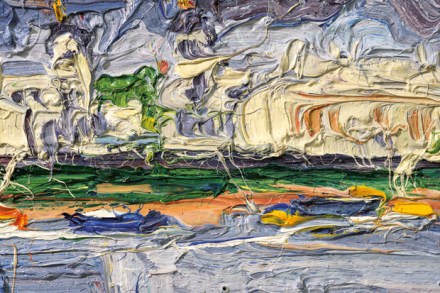
Frank Auerbach (born 1931) is one of the most interesting artists working in Europe today, a philosophical painter of reality who works and re-works his pictures before he discovers something new, something worth saving. William Feaver, in this grand new monograph, calls Auerbach’s paintings ‘feats of concentration’, and stresses the hard work which goes into their construction, despite their appearance of spontaneity. Feaver has a gift for the evocative phrase: ‘Studied yet impulsive, ranging from darkness to radiance and from the declamatory to the subdued, they are keyed to an air of resolve as unguarded as joy, as involuntary as grief.’ This is a book strong on context. Auerbach emerges

The king of chiaroscuro

These days, it is easy to take it for granted that Caravaggio (1571-1610) is the most popular of the old masters, yet it was not ever thus. In my Baedeker’s Central Italy (published exactly 100 years ago), he is acknowledged as having been ‘the chief of the Naturalist School’, but it is pointed out that from the outset ‘it was objected that his drawing was bad, that he failed in the essential of grouping the figures in his larger compositions.’ The first major exhibition of his works — in what has only very recently been established as the city of his birth, Milan — did not take place until 1951.

The optimism of a suicide

A postal strike would have been a disaster for Van Gogh. Letters were his lifeline and consolation. Not only did he receive through the mail his regular allowance from his brother Theo but, in letter after letter in return, he poured out his thoughts and feelings, recorded his work in progress and conveyed his impressions of books, people and places. In his often solitary existence, he was an avid recipient and kept in touch with a variety of correspondents, especially when he was in the South of France during the last two years of his life. The glory must be shared, however, with Theo, in that he kept Vincent’s letters,

Repeat that, repeat

When the Louvre invited me to organise for the whole of November 2009 a series of conferences, exhibitions, public readings, concerts, film projections and the like on the subject of my choice, I did not hesitate for a second and proposed the list. Thus Umberto Eco on the genesis of this book, published simultaneously in Italian, French and English. Considering those parallel manifestations of the project, it was perhaps to be expected that this, its sole printed version, would be situated at the more ingratiatingly ludic end of the Eco spectrum. The Infinity of Lists is a work less of theory than of taxonomy. Flaunting his extraordinary erudition, but flaunting

Romantic approaches

Spectator readers will know that Andrew Lambirth is a romantic, a force for the literary and poetic approach to art criticism, so he is an admirably empathetic guide to Hoyland: In England the subversive underground Romantic spirit has never run dry, it consistently nourishes art in this country and erupts forth in strange and unexpected ways. The late work of John Hoyland is one such unpredictable manifestation. Mel Gooding’s standard monograph covers Hoyland’s career to 2006, but such is the artist’s productivity that, despite serious heart surgery last year, many of the excellent colour plates — the majority in the case of the 46 full-page illustrations — are of new

Surprising literary ventures | 9 September 2009

Patricia Highsmith, as readers will know, was the author of the upmarket thrillers Strangers on a Train and The Talented Mr Ripley, among others. She was also a keen artist, and illustrated (rather than wrote) the rare book Miranda the Panda is on the Veranda, to text supplied by her friend Doris Sanders. Its pages, somewhat Seussian in tone, include statements such as: ‘Mabel Grable, a sable, reads a fable at the table in the stable near the gable with a cable’; ‘A monk and a skunk and some junk on an elephant’s trunk’; and ‘A veil on a snail.’ The book was published by Coward-McCann, who also handled her

Dilly-dallying romance

Translated to Borsetshire, John Constable’s courtship of Maria Bicknell would provide more material than any script editor could handle without straining audience impatience beyond endurance. Nine years it took, from initial yearnings and tacit engagement to get them to the altar at St Martin-in-the-Fields and even then, in October 1816, it was the quietest of weddings. Over those years Constable’s ardour was divided. ‘Deplorable as our case is, I would not be without it for the world’, he wrote to his beloved early on when she was at her most inaccessible. That left him plenty of time in which to obsess over his art. Martin Gayford has an eye for

From worthless to priceless

A combination of art history ‘lite’ and the personal touch — a common yoking together these days, even in books supposedly of art history ‘full strength’ — makes for, in Philip Hook’s hands, an engaging read. As a dealer and auctioneer, and the author of several thrillers, he has advantages not given to the general run of such investigative writers. His subject is the rise of French Impressionist painting, after its initial years of critical contempt and commercial failure, to international mass appeal and soaring value. It’s a familiar story, frequently told, and a reader looking for new light on the fortunes of Monet, Pissarro, Renoir, Sisley et al. will

Shrine of a connoisseur

Sir John Soane’s Museum, London, by Tim Knox, photographs by Derry Moore Sir John Soane’s Museum is very nearly a folly — a mad grotto in the midst of Georgian London. It is clearly the monument of someone both eccentric and egocentric. What saves it from being Hearst Castle, Liberace’s palace or Michael Jackson’s Neverland, is that its creator was a great architect — the Bank of England was his masterpiece. In the early 1790s Soane and his rich wife bought No. 12 Lincoln’s Inn Fields. The house was rebuilt to Soane’s designs, and they moved there in 1794. This book, with its fine, atmospheric photographs by Derry Moore and

Red Star Over Russia

Winston Churchill’s cousin, the sculptor Clare Sheridan, gazes up at her bust of Trotsky, made during a trip to Moscow in 1920. Her subjects were leading Bolsheviks including Felix Dzerzhinsky, the founder of the KGB, Lenin and Trotsky. While she worked, she asked Lenin, via a translator, if Churchill was the most hated man in Russia. ‘He is our greatest enemy because all the forces of capitalism are behind him,’ he replied. Sheridan’s mother wrote to her on her return: ‘I forgive you, darling, as I would even if you had committed a murder,’ but Churchill never spoke to his cousin again. Sheridan left England for New York, where her

Horses decline, dogs advance

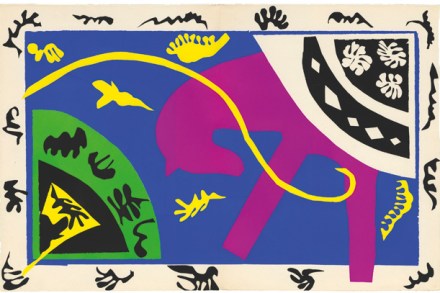
The Dog: 5000 Years of the Dog in Art, by Tamsin Pickeral Dogs: History, Myth, Art, by Catherine Johns The Horse: A Celebration of Horses in Art, by Rachel and Simon Barnes These three books are concerned with the representation in art of man’s most successfully domesticated wild animals,: the dog and the horse. Dogs, as carnivores, domesticated themselves as early as 14000 BC, picking up scraps of meat left lying around by our prehistoric ancestors. Horses, as herbivores, were not attracted to such scraps. They were captured in the wild and broken in. Dogs were Jacks-of-all-trades. They were guardians of our houses (a Pompeiian mosaic from the second century

The Leap from the Judas Tree

Stephen Chambers, by Andrew Lambirth Of the same 1980s generation as Peter Doig and the Young British Artists (Damien Hirst, Tracey Emin et al), Stephen Chambers has always pursued a far more maverick, and profoundly more interesting, path. Starting out as a well-regarded, heavy-duty abstract painter while still a student at St Martin’s School of Art, he had his perceptions utterly changed by a spell as a Rome Scholar c.1983, the pursuit of a way of painting that could pin down his intensely sensual response to the complexities of the seen world quickly becoming the preoccupation of a lifetime. The outcome is paintings which, in their idiosyncratic blending of figurative

The new look that never aged

The Allure of Chanel, by Paul Morand, translated by Euan Cameron Should anyone ever ask me that daft magazine question about who you’d invite to your dream dinner-party (‘anyone in the world, alive or dead’) my answer would be short: Mademoiselle Gabrielle Bonheur Chanel, on her own, with only an ashtray between us. And maybe an ace simultaneous translator, lest my pidgin French bore her to volcanic rage. She was easily bored and, though she was a lifelong anglophile, she never liked women much. Fantasy dinners aside, this enchanting, tiny book is the closest anyone can get to a face-to-face with Coco. It’s written in her voice (‘that voice that

A grand overview

This unassuming book is in fact a valuable addition to the Proust bibliography. The author, himself a painter, has had the apparently simple idea of extracting all references to works of art in the great novel in an attempt to demonstrate Proust’s knowledge of, and reliance on, paintings to give resonance to his characters and to present them to his readers in an indelible physical form. The exercise proves both seductive and enlightening. Proust was a translator of Ruskin, yet he rejected Ruskin’s message that art has a moral foundation. For Proust art was a self-explanatory and self-sustaining exercise which excluded praise and condemnation. His work is filled with characters

Photopoetry

Photopoetry, by Manuel Alvarez Bravo Manuel Alvarez Bravo, born in 1902, lived to be 100 and worked as a photographer in Mexico for eight decades. He was destined to spend his life as a clerk in a provincial tax office but escaped with the help of Edward Weston and Tina Modotti. This collection, which contains 370 of his images, confirms his versatility. His work included landscapes, portraits, reportage, nudes and occasional excursions into surrealism. It is frequently described as ‘mysterious’ by critics looking for context or commitment. But there is no mystery; it is just that Bravo was generally more interested in form than in argument. He was not concerned