Michael Amherst

Rich, beautiful and vital: John Craxton, at Pallant House Gallery, reviewed

From our UK edition

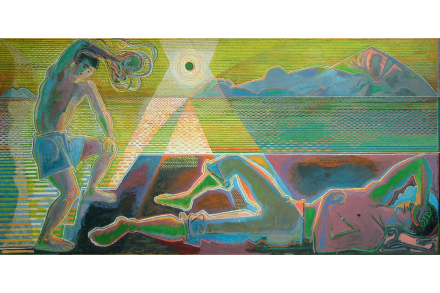
The sensuality of the light in John Craxton’s painting ‘Two Figures and Setting Sun’ (1952-67) has to be seen to be believed. Viewing this large work in Pallant House, you feel its full force. Craxton was concerned with a scene’s essence, rather than simply its appearance and here he achieves not merely an effect but affect. In spite of most of the light being painted in yellows and oranges rather than white, the contrast and refraction of the rays produce a blinding sensation much like staring into the sun on a hot day.   It was as a chorister at Chichester Cathedral that Craxton’s daily encounter with two 12th-century Romanesque bas-reliefs taught him the timelessness of great art; that, even though it was from the distant past, something fresh and modern endured.
‘Ballistics’ by D.W.Wilson is a novel about what it really is to be a man

From our UK edition

Ballistics is the debut novel from D W Wilson. It playfully and interestingly twists and pulls at the heart of what we understand about human relationships. This is rural Canada, where men are men and Hemingway is a sissy. These are the blue-collar workers of Bruce Springsteen and no problem is too small not to be solved by increased muscle, increased drinking or, failing that, the ballistics of the title. Yet, underlying the bravado and occasionally excessive butch depictions of butch life, this is a subtle novel. For example, we are repeatedly told that Cecil West, the grandfather at its heart, is an unreconstructed male and that it’s ‘a hell of thing to picture, Old Man West as a romantic’.

What is the point of fiction if not to expand horizons?

From our UK edition

While Ian McEwan’s recent piece in the Guardian is not expressly termed a treatise on the value of art, it is hard to see it otherwise. What is the use of fiction, what can a novelist tell us of, ‘why the Industrial Revolution began, or how the Higgs boson confers mass on fundamental particles…?’ he asks. At the heart of this modern day ‘defense of poesy’ is McEwan’s devotion to realism: it is realism that falls last to ‘the icy waters of scepticism’ and it is realism that saves him from it. He gives an account of how his thirteen year-old self, so overcome by the description of the 1900 heatwave in The Go-Between, leaves his seat in the library to check the archives of Punch.

Having it both ways

From our UK edition

A new paperback edition of The Stranger’s Child is released today. Michael Amherst reviews the book. The failure of Alan Hollinghurts’s The Stranger’s Child to make the Booker shortlist has been met with widespread shock. Yet arguably the greater shock is why the book ever received such rave reviews in the first place. The examination of memory; challenging the truth of history and biography, depicting them as shams, created fictions based on the preoccupations of the surviving participants; the impossibility of things enduring – none of this is new.

Creative writing courses made me a better reader

From our UK edition

As I came to the end of my English degree I applied to several universities for further study on Joseph Conrad, along with UEA for their creative writing programme. Owing to a misunderstanding with my tutor her reference arrived at East Anglia late and I was told my application would be deferred to the following year. Like many graduands I’d enjoyed university, enjoyed my English degree and believed that further study would be every bit as intellectually and socially stimulating. However, over the summer I began to have my doubts. I was going to do a Masters by Research and increasingly realized that being in a strange city, without the benefit of course mates, reading and re-reading the complete works of Conrad, Schopenhauer and Nietzsche might be rather depressing.

More than just a pretty boy

From our UK edition

There seems to be something of a fashion at the moment in panning James Franco’s literary debut, Palo Alto. If you are looking for motives they are not hard to find: Franco is nauseatingly prolific – not only did he host this year’s Oscar ceremony but he was also nominated for his performance in 127 Hours; he recently took four Masters programmes and is now doing a PhD at Yale; he’s a keen artist and has presented his work at the Clocktower Gallery in New York. Oh, and he’s all right to look at too. Gucci agree, having made him the face of their men’s fragrance. So no, there’s no shortage of motive in dismissing his short story collection as the unoriginal work of a vain Hollywood pretty boy. Yet to do so would be a mistake.