Opera

La Donna del Lago, Metropolitan Opera, review: Colm Toibin on a night of masterful singing

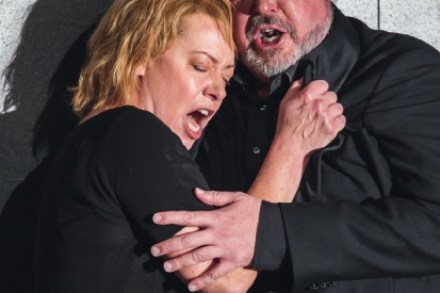
La Donna del Lago, based on a poem by Sir Walter Scott, is one of the nine serious, dramatic operas that Rossini wrote for Teatro San Carlo in Naples between 1815 and 1822. At the time the opera was produced he had at his disposal not only a great soprano, for whom he wrote with considerable flair, but two expert tenors and a contralto taking the part of the young male lover. In the first-ever production at the Met in New York that has just opened, the colours move from the sultry sky of Scotland in the first act to the starkness of a field after battle and then the sumptuous golds in King James V’s palace in the second act. Something like this happens too in the vocal writing, which ranges from the stunningly beautiful to tones that are darker and more restrained.

Mastersingers of Nuremberg, ENO, review: ‘a triumph’

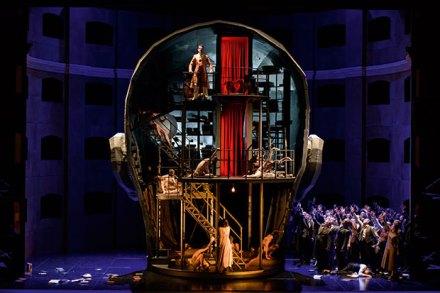
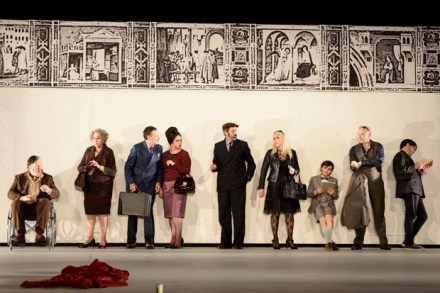
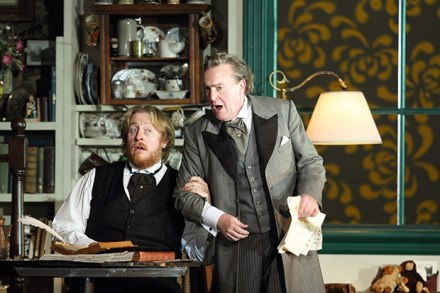
ENO’s new production of Wagner’s The Mastersingers of Nuremberg is a triumph about which only the most niggling of reservations can be set. Every aspect — orchestral, vocal, production — works in harmony to effect one of the richest, most intensely absorbing, energising and delightful afternoons and evenings I have ever spent in the theatre. It is above all a team effort, and since individuality and teamwork are very much what Mastersingers is about, that made it still more satisfying. However, two people must be singled out: Richard Jones for the finest of all the productions of his I’ve seen. This one comes from Cardiff, where it was unveiled almost five years ago.

Why we should say farewell to the ENO

It’s easy to forget what a mess of an art form opera once was. For its first 100 years it had no name, it had no fixed address, it didn’t really know who it was or what it was doing. You’d find it at schools, at weddings, at political functions. It was an artistic whore for hire. Embroiled in an epic tug-of-war as to which of the three art forms — word, music or dance — should be primary, it was also lithe and experimental. In fact, it was more like performance art than anything you’ll witness in a modern opera house. Why this historical detour?

An artistic crime is committed at the Royal Festival Hall

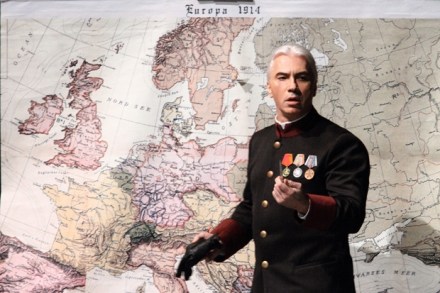
In one of the more peculiar concerts that I have been to at the Royal Festival Hall, Vladimir Jurowski conducted excerpts from Das Rheingold in the first half of the programme, and Rachmaninov’s little-known opera The Miserly Knight in the second half. The idea, I gleaned from a pre-concert chat by the conductor and others, was that the first half would shed some light on the second, showing that although Rachmaninov, at one time an industrious operatic conductor, almost certainly never conducted Wagner, he was strongly influenced by him. The point seems academic, unless you are interested in the minutiae of musical history. Anyway, the Rheingold excerpts failed miserably, on their own terms and as a portent.

Andrea Chénier, Royal Opera House, review: like a Carry On – but without the jokes

Who on earth could have predicted that a hoary old operatic melodrama set in revolutionary France would find resonance in the present where the pen as a weapon against bigotry and hypocrisy has suddenly achieved iconic status. But hold up, let’s not get carried away. We’re talking about Giordano’s Andrea Chénier. Though its eponymous poet does indeed extol free expression at the service of love, the sentiments — the voices of reason in a time of high anxiety — don’t run too deep. And so we’re back where we started, with a hoary old melodrama.

Royal Opera’s Orfeo, Roundhouse: shouts its agenda so loudly the music struggles to be heard

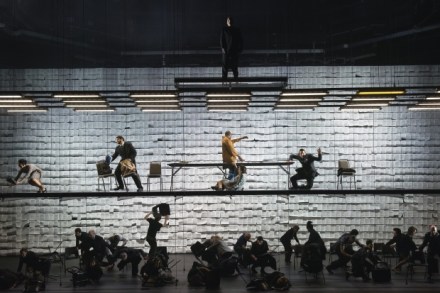
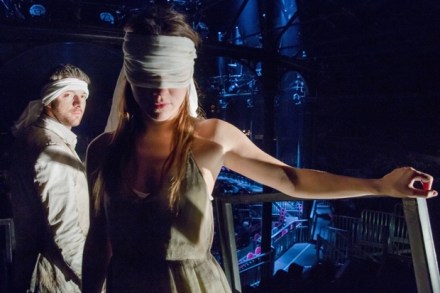
What a week to stage an opera about art’s power to challenge institutional authority, oppression — even death itself. Orfeo’s weapon might be a lyre rather than a pen, but the metaphor is silhouetted clearly against the monochrome backdrop of the Royal Opera’s new production of Monteverdi’s opera. Director Michael Boyd, former artistic director of the RSC, has taken a world of nymphs and shepherds and stripped it for conceptual parts. A battle between Gods and men is reinvented as a struggle between individual creative autonomy and faceless obedience to church and state. In Tom Piper’s designs, meadows and bucolic loveliness are out and 24-style metal walkways and gantries are in.

Royal Opera’s Un ballo in maschera: limp, careless and scrappy

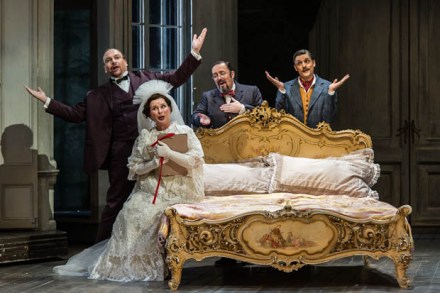
Whether by chance or bold design, the Royal Opera’s two Christmas shows were written at precisely the same moment, between 1857 and 1859, and both mark a high point of refinement in their respective traditions. Both Wagner’s Tristan und Isolde and Verdi’s Ballo in maschera sometimes give the impression of being entranced by their abstract musical fantasy; the drama on stage is suspended, drawn out, barely engaged with as the characters and audience peer down into the writhing or transfixed world being created in the orchestra pit. In my view, neither composer ever did anything better in musical terms. But sometimes you feel that there is no hope for Ballo.

Royal Opera’s Tristan und Isolde: an absurd production – but still a magnificent night

Any adequate performance of Tristan und Isolde, and the first night of the Royal Opera’s production was at least that, leaves you wondering what to do with the rest of your life, as Wagner both feared and hoped it would. What Tristan does — one of the things — is to present an image of romantic love, in both its torments and its ecstasies, which makes everything else seem trivial; and at the same time to undercut that image by asserting the claims of ordinary life, but in the subtlest way.

Agents will be queuing up to sign this 26-year-old baritone from Sichuan

The Royal Academy of Music’s end-of-term opera can always be looked forward to because it never disappoints: the repertoire is enterprising, the musical performance is invariably on a high level, and the productions are almost always sane and unpretentious: qualities that can’t be relied upon in more prestigious houses. This term’s production(s) were no exception: the strongest two of Puccini’s Il trittico. If you have to say that one of the three is weaker than the others, my vote goes to Il tabarro, Puccini’s attempt at verismo, a B-opera comparable to B-movies of the 1940s, except that they tended to be not quite so relentlessly conscientious in building atmosphere and more intent on actually getting on with the plot.

Forget the Germans. It’s the French who made classical music what it is

The poor French. When we think of classical music, we always think of the Germans. It’s understandable. Instinctive. Ingrained. But unfair. We forget that most of the heavy lifting — most of the intrepid leaps forward in harmony, colour, rhythm and form — was done by the likes of Berlioz, Debussy and Boulez. The most completely forgotten of these Gallic explorers is Jean-Philippe Rameau (1683–1764), who died 250 years ago this year. His operatic output, begun when he was 50 and comprising 30 works, is an acquired taste. I remember the exact moment I fell for him. The exact notes in fact. It was the opening aria of his one-acter Pigmalion. Three flutes, comforted by strings, sob in a corner.

ENO’s Gospel According to the Other Mary: great music weighed down by a worthy staging

Terrorism; East-West diplomacy; nuclear war: John Adams’s operas have poured music into the faultlines of 21st-century global politics, and the tremors have been significant. Simply staging The Death of Klinghoffer recently was enough to see the Met picketed on charges of anti-Semitism. While The Gospel According to the Other Mary isn’t going to start any riots, Adams’s latest work marks a turning point, both in the composer’s music and his social mission. No longer content to comment and observe, Adams turns his gaze to the story of the Passion — reclaiming and rewriting the originary narrative of the Christian West.

Royal Opera’s Idomeneo: get seats but make sure they’re facing away from the stage

Mozart’s first great opera, Idomeneo, is not often performed, and perhaps it’s better that way. It should be seen as a festival work, celebrating qualities that we rarely reflect on, but are of the utmost importance. In his fine essay on the opera, David Cairns writes that it encompasses ‘love, joy, physical and spiritual contentment, stoicism, heroic resolution; the ecstasy of self-sacrifice, the horrors of schizophrenia, the agonising dilemma of a ruler trapped in the consequences of his actions; mass hysteria, panic in the face of an unknown scourge, turning to awe before the yet more terrible reality; the strange peace that can follow intense grief.

Mariinsky’s Boris Godunov – a revelation

Anyone who thinks opera singers and orchestral players are overworked should spare a thought for the Mariinsky Opera on its trek round England and Wales this week. After Prokofiev’s Betrothal in a Monastery in Cardiff on Sunday, the whole caravan rolled up at the Barbican in the shorter — but not exactly lightweight — first version of Musorgsky’s Boris Godunov. And by the time you read this it will have added Shchedrin’s The Left-Hander and (in Birmingham) the first two instalments of Wagner’s Ring, plus, for the chorus (not required in The Ring till Sunday’s Götterdämmerung), two concerts of Russian sacred music in London and Cardiff.

Met Opera Live’s Macbeth: Netrebko’s singing stirred almost as much as her décolletage

This season of live Met relays got off to a most impressive start, with an electrifying account of Verdi’s tenth opera and first really great, though uneven piece, Macbetto (as I think it should be called; that’s what the central figure is called throughout). Fabio Luisi showed that he is far more at home conducting Verdi than Wagner — though his Bruckner performances are also magnificent. What made this the most stirring performance of Macbetto that I have seen was the strength of Željko Lucic’s performance in the title role.

Glyndebourne’s Turn of the Screw: horrors of the most innocent and creepy kind

We all know that ‘They fuck you up your mum and dad’, but nowhere is this more reliably (and violently) true than in the opera house. If you have the misfortune to be born into an operatic family you can expect to be murdered by your own mother (Médée, Lucrezia Borgia), killed by your grandmother (Jenufa), or even bumped off by a hitman hired by your father (Rigoletto). Perhaps most insidious, however, are the crimes not of violence but of absence, neglect rather than active cruelty. Productions of Verdi’s I due Foscari and Britten’s The Turn of the Screw whispered some of the darkest unspokens of parent-child relations, conjuring nightmares all the more potent for their subtle horrors.

Opera North’s Coronation of Poppea: a premium-rate sex-line of an opera

Virtue, hide thyself! The Coronation of Poppea opens with a warning and closes with a love duet for a concubine and a psychopath, their union celebrated in sinuous melismas over a blameless passacaglia. First performed in 1643, Monteverdi’s final opera is all about talking dirty and talking tough. Seductions, threats, boasts and betrayals are snapped, spat, stuttered and smooched over harmonies that pinch and squeeze like a premium-rate sex-line. Does it work in English? Yes and no. There are casualties in Tim Albery’s slick, vicious Opera North production, some historical, some poetic, some musical. In Laurence Cummings’s hybrid edition, drawn from the Venice and Naples scores, transpositions and cuts proliferate.

ENO’s The Girl of the Golden West is irresistibly seductive

Puccini’s La fanciulla del West is, one suspects, one of those works that modern audiences struggle to keep a straight face through. The hero, for a start, decides to call himself Dick Johnson. The piece’s Wild West trappings, long since staled into Hollywood cliché, still seem a strange fit for the operatic stage (it was performed here as The Girl of the Golden West, with Kelley Rourke’s translation delivered in a variety of American accents). The redemptive, into-the-sunset conclusion takes for granted a belief that capitalism in its most primitive, brutal form could leave a group of hardened Gold Rush miners capable of forgiveness. That it might have done, ENO’s programme told us, is not actually that wide of the mark, historically speaking.

Royal Opera’s Rigoletto: your disbelief may wobble but your excitement won’t

One of the greatest tests of how an opera house is functioning is the quality of its revivals. Both the Royal Opera and the English National Opera score highly in that respect. You can go to the Met, to Munich, to the Vienna State Opera and see pathetically run-down performances, the cast thrown on to the stage and told to get on with it. That never happens at the two London houses. The latest revival of Rigoletto at the Royal Opera is, in most ways, fresher than the first run in 2001. It’s the production with the split-second full-frontal male nude in the opening scene, now prolonged to two split seconds. Actually, the opening scene, revealing the Duke of Mantua’s court in all its libidinous squalor, is the least convincing part of the proceedings.

Robo-Tell hits Welsh National Opera

Is there a fundamental, insuperable problem with staging Rossini’s Guillaume Tell on a budget, without the resources to conjure up the sense of scale that was part of grand opéra’s appeal and raison d’être? Take away the special effects, whip away the phantasmagorical curtain, and, as with any Hollywood blockbuster, you are left with a modest little plot whirring away at its centre. In Tell, this involves the love between Arnold and Mathilde across a national divide. It’s the struggle of the Swiss — in a time before neutrality and cuckoo clocks — against their Austrian oppressors that, along with the Alps, forms the backdrop.

Is Anna Nicole’s absurd life worth our while? Not as much as Otello’s

So how did London’s two big opera companies launch their new seasons last week? Not perhaps in the way you might expect. Decked with pink balloons and the acrid smell of popcorn, the Royal Opera House waved the garish contemporary flag with Mark-Anthony Turnage and Richard Thomas’s Anna Nicole of 2011, revived before a youthful opening-night crowd attracted by specially subsidised tickets. It was left to the friskier English National Opera to offer a new production of sober mien and an audience containing some people who dressed up. Standard repertoire, too: the opera was Verdi’s Otello — filled enough with base passions, but not with phrases like ‘douchebag’ or the delightful ‘skid-marked panties’. The Coliseum threw the best party, by far.