Opera

Michael Tanner: Why I prefer Donizetti to Strauss

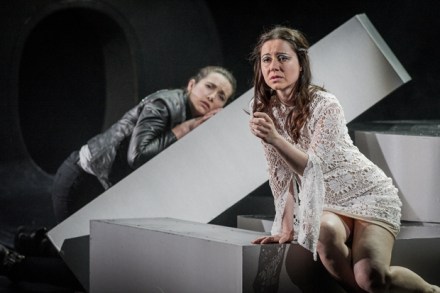
Three operas this week, each of them named after its (anti-)heroine: one of the heroines (the most sympathetic) murders her husband, one of them spends her time successfully plotting the deaths of her mother and stepfather, one insists on the murder of a prophet who refuses her advances, and has an orgasm as she kisses the tongue of his severed head. Very much standard operatic fare. Two of them belong in the grand tradition of German high romanticism, one to the Italian tradition of bel canto melodrama of the first half of the 19th century. Unfashionably, I much prefer Donizetti’s Lucia di Lammermoor to Richard Strauss’s Salome and Elektra, indeed to any of his operatic works with the exceptions, perhaps, of Intermezzo and Capriccio.

Mariinsky’s Les Troyens — a bad night for Berlioz and Edinburgh

I wonder whether grand opéra really takes war as seriously as this year’s Edinburgh Festival wanted it to. These vast works, written to exploit and reflect the power, resources and tastes of mid-19th-century Paris, tended to favour history and its battles for the scenic opportunities they afforded rather than for the lessons they taught. It was the cross-cultural love stories in the foreground that were the dramatic focus; whatever the context, the obligatory ballet always had to be shoehorned in. Berlioz provided a work that ostensibly fitted the formula with his Troyens, fashioned from Virgil’s Aeneid during the 1850s, painstakingly, obsessively and with minimal reward. It was rejected by the Paris Opera and for many decades performed only in truncated, bisected versions.

The small rewards of small-scale opera

Perhaps I should come clean straightaway and admit that, despite the fact that OperaUpClose is about to celebrate its fifth birthday, I’d never been to see one of its shows before last week. This has not been a conscious decision; maybe, though, I’d been unconsciously put off by the company’s early braggadocio — by the manner in which it gleefully trumpeted the Violetta-like decline of ‘traditional’ opera so that it could offer itself up as a timely cure.

In defence of Puccini

During my opera-going lifetime the most sensational change in the repertoire has, of course, been the immense expansion of the baroque repertoire, with Monteverdi, Rameau and above all Handel being not only revived but also seen now as mainstays in most opera houses. To think that only 50 years ago it was regarded as daring for Glyndebourne to mount L’incoronazione di Poppea, even in Raymond Leppard’s abbreviated and sumptuous version, which has been most unfairly denigrated in recent years. Yet just as remarkable, though hardly ever remarked on, has been the instatement of Puccini (who never needed reviving, since after initial scandals and flops he has always been more or less responsible for opera houses sometimes being in the black).

Strauss and Hofmannsthal deserve better from the Salzburg Festival

The Salzburg Festival’s reputation might largely be one of cultural conservatism, but it made an impressive commitment to new works when it announced in 2011 that it had commissioned four operas, to be unveiled at the rate of one a year between 2013 and 2016. The first was to have been by György Kurtág, but he failed to deliver on time. And it sounds as though the French composer Marc-André Dalbavie might also have given the Salzburg management a bit of a scare. His Charlotte Salomon made it to the stage on time for this year, but there had been substantial reworking of the piece’s Epilogue by Dalbavie and his director, Luc Bondy, right up until the start of rehearsals.

Jonas Kaufmann’s illness, a muddled production – nothing can stop Bavarian State Opera’s La forza del destino

Rather than brave the boos and the first reprise of Frank Castorf’s half-hearted Ring at Bayreuth, I decided to pay a visit to Munich and catch the last two days of its annual opera festival. Less of a festival, as one usually understands the term, than a ramping-up of activity in the final month or so of its regular season, it mixes new stagings with starrily cast revivals. I caught one of each: a new production of Monteverdi’s L’Orfeo, with Christian Gerhaher in the title role, and a revival of La forza del destino that was rendered a little less starry by the last-minute illness of Jonas Kaufmann — that’s destino for you, I suppose.

In Norwich, a director is caught trying to murder Wagner’s Tannhäuser

Seventeen years ago the Norwegian National Opera staged two cycles of the Ring in Norwich’s Theatre Royal, performances that have remained vividly in the minds of anyone who saw them. Now Theater Freiburg has visited Norwich with two performances each of Parsifal and Tannhäuser. I was hoping to see both, but transport problems meant that I was only able to go to the second performance of Tannhäuser. I shall have quite a few criticisms to make, but all told it was a triumph, and was warmly received by a far from capacity audience. There aren’t many chances to see this problem child of Wagner’s, and this was the finest account I have seen in several decades, much more moving than the Royal Opera’s production of nearly four years ago.

I can’t see the point of Glyndebourne’s La traviata

One of the highlights of last year’s Glyndebourne Festival was the revival of Richard Jones’s Falstaff, spruced up and invigorated by Mark Elder’s conducting of the Orchestra of the Age of Enlightenment and a beautifully balanced cast. Elder is also in charge again for the festival’s third new production of this year, Tom Cairns’s La traviata, although with the London Philharmonic this time. His conducting is extremely fine once more, managing to be lucid and intelligent, thrillingly dramatic and lovingly shaped. The playing of the LPO is of supremely high quality throughout, while the cast features a genuinely exciting leading couple.

Buxton Festival sticks its neck out with two rarities by Dvorak and Gluck

Dvorak’s The Jacobin and Gluck’s Orfeo ed Euridice, the two operas that opened this year’s Buxton Festival, are both relative rarities today, but their creators’ fortunes tell an interesting story. Dvorak’s operas — or at least Rusalka — joined the repertoire around the same time, during the 1980s, that Gluck’s arguably starting slipping from the stage, to the extent that now means the UK’s main companies are all but ignoring the composer’s 300th anniversary this year. Both works, in their different ways, also explore the power of music.

Royal Opera’s Maria Stuarda: pathos and nobility from Joyce DiDonato, lazy nonsense from the directors

London is lucky to have heard Joyce DiDonato at the height of her powers in two consecutive seasons. The American mezzo has arguably done less well out of the arrangement, however, finding herself at the centre of two disappointing new productions. Last year it was Rossini’s La Donna del Lago, an intractable non-drama which John Fulljames’s staging (sponsored by Harris Tweed) turned into an unconvincing treatise on constructions of Scottish nationalism. This season it’s Donizetti’s Maria Stuarda — similarly, if even more obliquely, concerned with Anglo–Scottish relations.

Opera North’s Götterdämerung is astounding (nearly)

It seems a very short time since I interviewed Richard Farnes about Opera North’s planned Ring cycle, the dramas to be done one a year, semi-staged in an idiosyncratic way. In fact, it is four years, and now the complete cycle has been performed to universal acclaim, with the loudest cheers going to the conducting and the stupendous playing by the orchestra of Opera North, with some reinforcements — all six harps, and so on. Farnes explained to me in the interview that he was studying the Ring, with which he had previously had no professional connection.

Manon Lescaut: Puccini’s Anna Nicole?

This season has already seen Manon Lescaut appear in several different operatic guises across the UK, but it was Covent Garden’s new production of Puccini’s version (its first staging of it in three decades) that was the hottest ticket of all. The Latvian soprano Kristine Opolais and the superstar tenor Jonas Kaufmann were tackling the roles of the lovers, Manon and Des Grieux, for the first time. Antonio Pappano, in the repertoire where he most reliably excels, was in the pit. In an introductory talk before the production opened, the conductor tentatively drew a comparison between Puccini’s first major success and Mark-Anthony Turnage’s Anna Nicole, which opens the Royal Opera’s next season.

Tilting at metronomes: Massenet’s Don Quichotte opens at Grange Park Opera

To suggest that the ageing Jules Massenet identified himself with the title character of his Don Quichotte is nothing new — and late works such as this by definition encourage biographical interpretations. One of the main liberties of the opera, premièred in 1910 and very loosely based (via a contemporary verse play) on Cervantes, was to bring the character of Dulcinea (here ‘La Belle Dulcinée’) out of the realm of the imagination and to embody her as a distinctly flesh-and-blood mezzo-soprano. That the first singer to perform Dulcinée, Lucy Arbell, was the object of Massenet’s infatuation only emphasises the biographical parallels, all of which give extra layers to a gently wise and touchingly melancholy work.

Terry Gilliam turns to eye-watering excess for his staging of Berlioz’s Benvenuto Cellini

Operas about artists are not rare. However — perhaps for obvious reasons — those artists tend to be musicians, singers, or at least performers, able to persuade and cajole both us in the audience and the other characters on stage through their eloquence. Berlioz, in his first opera, presents the renaissance sculptor Benvenuto Cellini, in an episode loosely adapted from his autobiography. But the final casting and unveiling of his new statue of Perseus, against all the odds, provides a climax that music (let alone stagecraft) seems fundamentally ill equipped to portray.

Dialogues des Carmélites brings out the best in Poulenc – and the Royal Opera House

Poulenc’s Dialogues des Carmélites is an audacious work, much more so than many others that advertise their audacity. It deals with Love and Death, the central topics of opera, but the love is that of God; and death, rather than being a romantic consummation or a stirring tragedy, is something to be terrified of. The central character, Blanche de la Force, is terrified of life too, and her determination to enter a convent is seen initially as an attempt to escape, so that in the powerful second scene of the opera, after being given a hard time by her father and brother, she is subjected to searching questions by the Old Prioress, herself very ill and shortly to face death.

WNO’s production of Schoenberg’s Moses und Aron is an overwhelming experience – but make sure you close your eyes

On paper, Moses und Aron might seem intractable and abstract: a 12-tone score setting a libretto that meditates on God, faith, the essential inadequacy of language to express the ineffable, and a great deal more. Put it in the theatre, as Welsh National Opera has done as the first part of its ‘Faith’ mini-season, and it’s an overwhelming experience, compelling because of, rather than in spite of, its subject matter and musical methods. And just over 80 years after Schoenberg stopped work on it (he left it incomplete, having written only a fragmentary text for the third act), its themes are as pertinent as ever.

A Rosenkavalier without a heart ain’t much of a Rosenkavalier

In all its minute details, Der Rosenkavalier is rooted in a painstakingly stylised version of Rococo Vienna that, paradoxically, is further fixed in a web of cannily juxtaposed anachronisms. Upset their balance and you risk upsetting the balance of the whole piece. That’s no bad thing, of course, but Richard Jones’s bold new production for Glyndebourne — opening the festival’s 80th season — shows exactly the advantages and disadvantages of doing that. Out go the dusty stucco-work and wobbly walls of elderly traditional productions; in come Paul Steinberg’s sharp sets and Jones’s trademark garish wallpaper, which Mimi Jordan Sherin’s brilliant lighting floods with further shifting colours.

More woe for Oedipus

I had high hopes for Julian Anderson’s first opera, Thebans. Premièred at the Coliseum last Saturday, it promised to mark a departure from the trendiness of ENO’s recent commissions, Nico Muhly’s Two Boys, for example, or the dreadful Sunken Garden — in fact, ENO’s next season seems to reflect a company at last a little less enamoured of innovation for its own sake. Thebans, the advance publicity suggested, was to be a serious, grown-up work, closer in spirit, perhaps, to Detlev Glanert’s Caligula, of which ENO gave the UK première two years ago. The company had put a lot of faith in Anderson, currently composer-in-residence at Wigmore Hall and a master of orchestral colour and texture.

Khovanskygate is about the dreadfulness and possible glory of being Russian

Within the space of a few weeks we have had the rare chance of seeing the two great torsos of Russian opera, Borodin’s Prince Igor, unfinished because the composer was often otherwise engaged, and Musorgsky’s Khovanshchina, unfinished because its composer died of drink. Prince Igor at the Coliseum was musically magnificent, and dramatically utterly absurd, ‘self-parody’ that did not do justice to its low-jinks. By contrast, Birmingham Opera Company’s Khovanskygate is musically at least as superb, and dramatically gripping though questionable. As is usual with BOC, the location is unorthodox, in this case an immense tent in the middle of Cannon Hill Park.