Opera

In two minds

There are some operas, as there are some people, that it is impossible to establish a settled relationship with, and in my case Debussy’s Pelléas et Mélisande is one of them, in fact by far the most pressing one. I never know in advance how I’m going to react to it, and to some extent the actual performance I see is not the determining factor. I’d like, just once, to see the play and find out how I reacted to that. For Debussy offers such a vivid and sometimes perplexing counterpoint to Maeterlinck’s words that one’s reactions to the characters and their actions are always in flux — at least so long as you don’t see the opera too often.

Double trouble | 7 January 2016

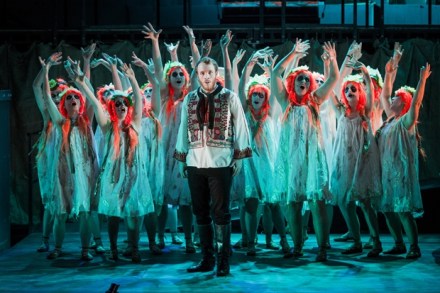
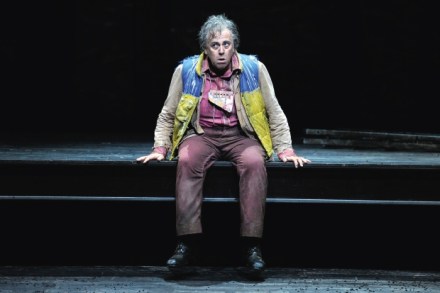
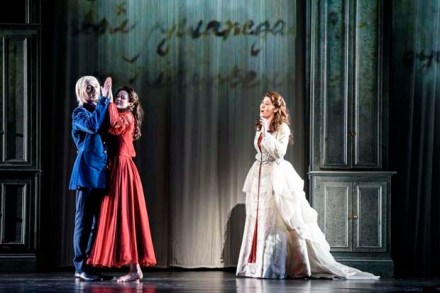
It’s scene five of Kasper Holten’s production of Tchaikovsky’s Eugene Onegin and Michael Fabiano’s Lensky is alone with a snow-covered branch and his thoughts. Well, not quite alone. At the other side of the stage stands the man he is about to face in a duel: his friend Onegin, who’s apparently arrived ahead of the appointed time and is listening to every word of Lensky’s anguished soliloquy. Except he isn’t: this is the Onegin of the present, looking back on a tragedy in his past. Or possibly imagining it? He can’t, after all, have heard Lensky’s words, for the practical reason that he wasn’t there. Can he? Oh, is that applause? The aria’s over.

Royal Opera’s Cavalleria rusticana isn’t nearly vulgar enough

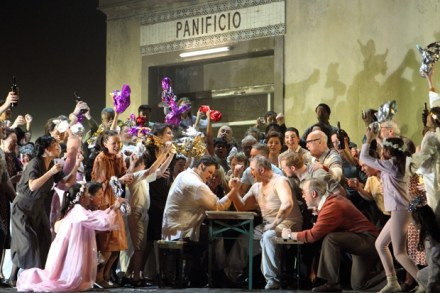
How often do you get a chance to see two operas by Leoncavallo in the same city in the same week? Never, until this last week in London, when Opera Rara gave a concert performance of Zazà at the Barbican, and six days later the Royal Opera mounted its first production since the 1980s of Cav. and Pag. Both Leoncavallo and Mascagni are routinely thought of as one-opera composers. Zazà didn’t do a lot to undermine that view, and I doubt whether if it had been staged it would have made any stronger an impression. Like Pag., its libretto is by the composer: Wagner seems to have made that temporarily mandatory. But the plot is feeble almost to the point of nonexistence.

Lost in translation | 3 December 2015

About 15 minutes into act one of Jenufa, the student in the next seat leaned over to her companions and whispered, ‘They’re singing in English!’ And so they were, in Otakar Kraus and Edward Downes’s translation. Janacek was obsessed with the shapes and intonations of speech; for a non-Czech speaker, a first-rate singing translation is really the only way to make Jenufa strike home with anything like the immediacy and realism he intended. But even with surtitles, the effort is useless if — as was the case throughout much of act one of this performance by Opera North — the singers are almost inaudible. It might have sounded clearer in the circle. From the front stalls, however, the situation was impossible.

Has there ever been a better time to be a lover of Baroque opera?

Time was when early music was a 6 p.m. concert, Baroque began with Bach and ended with Corelli’s Christmas Concerto, and speeds were so portentously slow that you’d have to start the B Minor Mass shortly after lunch in order to make it home in time for bed. Those dark days — caught between Baroque and a hard place — are over now. Period ensembles have never been better or more numerous, Handel and Monteverdi are a staple of operatic programming, and even Vivaldi, Cavalli, Cesti and Steffani are making their mark. Baroque is back, and this time it’s here to stay. One of the biggest success stories of recent years is the Globe’s new indoor theatre. Opened just last year, it’s already hard to remember musical life before the Sam Wanamaker Playhouse.

All at sea | 19 November 2015

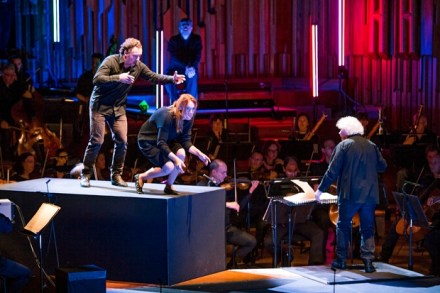
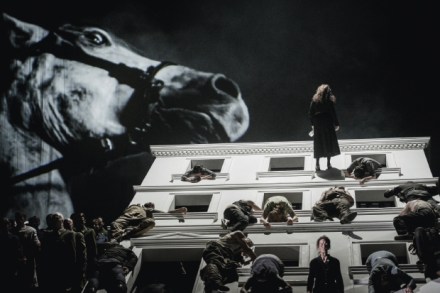
The Royal Opera House seemed nervous about Georg Friedrich Haas’s world première Morgen und Abend. They sent out a pdf of the libretto in advance, which they only ever do when they think that the words or the plot are unintelligible. Thrilled to report that it was a double whammy. An introductory soliloquy was spoken by actor Klaus Maria Brandauer. He’s apparently an Austrian national treasure. I’m not sure he’d get a part in Hollyoaks here. He wobbled on to the stage in wellies, paunch, beard and alcoholic’s nose. He was the spit in fact of Ricky Tomlinson in The Royle Family, except he said things like ‘he’ll be alone for ever alone’, instead of ‘my arse’, which coincidentally were very close to my feelings that evening.

That Force of Destiny isn’t a great evening is the fault of Verdi not ENO

The Force of Destiny, ENO’s latest offering to its ‘stakeholders’, as its audiences are now called thanks to Cressida Pollock, the new CEO, is perhaps Verdi’s most interesting failure. It’s an opera with too much fine, even magnificent, music to be neglected, but it doesn’t add up to a satisfactory experience. Even epics, which Force is routinely categorised as, have their limits of accommodation. Henry James described War and Peace as ‘a loose, baggy monster’, but what would he have called Force if he had had the least interest in opera or music? There are times when we are longing for the central story of vengeance and fate to get a move on.

Northern Ireland Opera’s Turandot will fill you with awe and revulsion

Chords as bright and sweet as pomegranate seeds burst and spill in Turandot, a splinter of bitterness at their centre. Left incomplete at Puccini’s death in 1924, the opera is his most radical and most cruel. You can taste something of Stravinsky’s Rite of Spring in the instrumentation, a musky roughness that rubs against the Italian composer’s customary silky precision. Woodwind and strings cling to the voices of the monstrous princess Turandot, her intoxicated suitor Calaf, and Liù, the slave who slavishly adores him because he once smiled at her. So closely scored is the writing that it is almost suffocating. This is love as an addiction: violent, sleepless, lethal. The renaissance of opera in Northern Ireland has not been timid or gentle.

Irish ayes

It’s Halloween, and right on lightning-flash cue enters an operatic ghost story exhumed from the grave of long-since-buried works. You couldn’t hope for more discerning grave-robbers than Wexford Festival Opera, however, who have long made it their mission to bring forgotten operas back to life. Mascagni’s Guglielmo Ratcliff is a proper blood-on-the-tartan gothic thriller, all duels, doomed lovers, fainting heroines and family curses, with a score as fleshy with tunes as the composer’s more famous Cavalleria rusticana — think Lucia di Lammermoor without the fey bel canto warblings. So why so long neglected? There are no musical mad wives lurking in Guglielmo Ratcliff’s attic, but there are more than a few technical demons.

I doubt Goethe intended Werther’s sorrows to be as unremitting as this

There are some things the French do better than everyone else. Cheese, military defeats and extra-marital affairs are a given, but what about opera? English Touring Opera’s autumn tour sets out a tasting plate of the nation’s Romantic finest, hoping to persuade audiences that there’s more to France than just Carmen. Debussy’s delicate tragedy Pelléas et Mélisande sits between the fragrant melodies of Offenbach’s The Tales of Hoffmann and the Armagnac-soaked passions of Massenet’s Werther. It’s a typically wide-ranging programme from this small company, but one whose compromises inevitably equal its ambitions.

Ariadne shows what a wonderful operetta composer Richard Strauss could have been

‘Oh, those Greeks! They knew how to live. What is required for that is to stop courageously at the surface, the fold, the skin, to adore appearance... Those Greeks were superficial — out of profundity [Nietzsche’s own italics].’ Thus said Nietzsche in the preface to The Gay Science. I expect Richard Strauss knew the passage. At any rate, many of his works give the impression of being composed by someone who wasn’t sure how profound he could be, or wanted to be, or indeed what profundity was. This is most evident in Ariadne auf Naxos, which deals explicitly with these issues. To add to his perplexities at this time, Strauss had Hugo von Hofmannsthal lecturing him in letters.

Please let’s have more musicals like this Kiss Me, Kate at Opera North

Opera North’s new production of Cole Porter’s masterwork Kiss Me, Kate has been so widely and justly praised that I wonder whether there is much for a week-later reviewer to add. It’s not as if the work needs much exegesis or critical commentary, though it may be worth pointing out that what we hear in Leeds amounts to a new critical edition, in which the conductor, David Charles Abell, has played a major role. Musicals have been treated with as little respect as Italian operas were in the 19th century, with arias and whole scenes added or subtracted according to the taste and abilities of the performers, the management’s judgment of the initial reception, and the casualness with which manuscripts and orchestral parts have been handled.

Lady killer

‘Kiss me, Sergei! Kiss me hard! Kiss me until the icons fall and split!’ sings Katerina Ismailova, adulterous antiheroine of Lady Macbeth of Mtsensk. Stalin was not amused by Shostakovich’s bleak black comedy but our culture would be poorer without bored wives like Katerina. Perhaps all that Emma Bovary, Anna Karenina and Laura Jesson needed was a proper kiss — the sort that mutes the white noise of disappointment. But a kiss is never enough in these cautionary tales of bourgeois bed-hopping. One thing leads to another and before you know it you’re knocking back the arsenic, throwing yourself in front of a train or back home listening to the wireless with poor dear Fred, a man whose kisses were never that hot.

Fossilised Figaro

Is there a more extraordinary, more heart-stilling moment in all opera than the finale of Mozart’s The Marriage of Figaro? The Count, suddenly understanding his wife’s fidelity, begs her forgiveness — ‘Contessa perdono!’ Her answer comes like a musical benediction, but not until after the very slightest pause — space to doubt, to hope. It’s a touchstone for any production, and it says everything about the current revival of David McVicar’s long-lived Figaro that, on press night, the audience laughed. Since 2006, McVicar’s elegant period update — poised in the fragile political hinterland between France’s First and Second Republics — has done the business at the Royal Opera.

All roads lead to Callas

Bellini belongs to that category of not-quite-great operatic composers whose works are also very difficult to perform adequately, and don’t seem to be all that popular when they are. But Welsh National Opera’s theme for the season of Madness means that as one of the leading exponents of operatic insanity Bellini is bound to turn up, and WNO does him proud vocally, if not in production, by mounting I puritani, his last and for some aficionados his finest opera. Norma seems to me to be clearly superior, certainly as drama. I puritani has a wretched libretto, not only linguistically feeble but also with a hopeless plot. It certainly does contain wonderful music, above all of course Elvira’s mad scene in Act II (she has one in each of the three acts).

Get me to an opera house

In anyone’s hands, Verdi’s Aida is not the easiest opera to raise up to greatness on the stage. How does a director spotlight hidden subtleties, musical or dramatic, in a libretto and subject so easily swamped by the spectacle of marching breastplates, roaring divas, Egyptian bling and the aroma and sway of live camels? Novice audiences may have their own problems, grappling with characters named Aida, Amneris, Amonasro, Radamès, Ramfis — almost always A and R. If only the librettist, Antonio Ghislanzoni, had called someone Doris. Imagine, then, the difficulties faced when the opera is performed by Opera Australia on a wide-open platform, built over water, at this year’s Handa Opera on Sydney Harbour.

Strauss-ful

Richard Strauss’s Daphne is one of the operas he wrote during the excruciatingly long Indian summer of his composing life, where he seems, in one work after another, to be looking for a subject worthy of his skills, and only finding one in Capriccio, his last opera. For that, he and his ideal interpreter Clemens Krauss collaborated on a libretto that, while garrulous, has a real topic to deal with, and handles it with no portentousness or pseudo-depth. None of that can be said about the depressing series of operas he composed in the 1930s, which either have a serious topic to deal with but not the drama or the music to do it justice, or are nothing more than word- and note-spinning.

Stravinsky’s ingenious toy

Is Stravinsky’s The Rake’s Progress anything more than an exercise in style? ‘I will lace each aria into a tight corset,’ Stravinsky told Nicolas Nabokov, and for most of three acts that’s pretty much what he does, deftly fitting W.H. Auden and Chester Kallman’s libretto to a steadily chugging parade of his smartest, pertest neoclassical tricks. The motor-rhythms, the acid harmonies, the borrowings from Mozart, Rossini and Handel: it’s all brilliantly accomplished and supremely knowing. In small doses, it’s appetising enough, and even at full length there’s much to enjoy — especially when played with the relish that Sir Andrew Davis and the Scottish Chamber Orchestra brought to this concert performance.

Watching the clocks

When I saw the first performance of this production of Ravel’s two operas at Glyndebourne three years ago, I thought it was the nearest thing to operatic perfection I had witnessed. But this revival is even finer. Whereas I concluded last time that L’heure espagnole was fundamentally an old-time bore that goes on for far too long — only 50 minutes, but it seemed much longer — this time I found it absorbing from start to finish, though I still think it is no funnier than most of what used to be called dirty jokes. The decisive difference, I think, is the conducting of Robin Ticciati (or was it where I was sitting, the front row of the circle as opposed to the centre of the stalls?).

Welcome to Bedlam

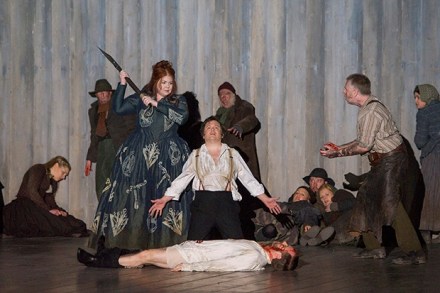
Caius Gabriel Cibber’s statues of ‘Melancholy’ and ‘Raving Madness’, their eyes staring blindly into the void, petrified in torment, once posed on top of the gate to Bedlam. In 1739, when Handel’s dramatic oratorio Saul was first performed, you could pay a modest fee to pass beneath them and gawk at the living spectacles within, victims of ‘arbitrary passions’ including pride, lust and envy. In Barrie Kosky’s Glyndebourne staging of Saul, Cibber’s archetypes are animated and given voice by Christopher Purves as the king driven mad by ‘Envy! Eldest born of Hell!’ Saul was the second of Handel’s great studies of madness.