More features

Celebrations: Christmas is always a blast at our house

I’m a real sucker for Christmas. I still have home-made decorations, angels and hanging ornaments made by the children 35 years ago. Our old wheelbarrow, rusted and full of holes, nonetheless gets a coat of red paint each year to turn it into Father Christmas’s cart. (The reindeer that pulls it is a rocking horse with battered cardboard antlers and tinsel trappings.) Year after year I patiently tie cotton loops to Quality Street toffees and hang them on a silvered, now rather shabby, branch. It all takes hours. I love everything about Christmas: stirring the pud, icing the cake, cutting the holly. When we were children we had a ritual annual outing to see Selfridges’ Christmas window displays and the lights in Regent Street.

Ethical Eating: How to raise and, perhaps, even kill your own Christmas turkey

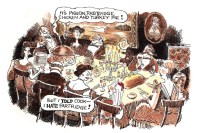
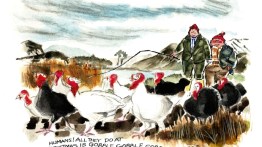
Christmas is a time of celebration and giving thanks. In the old days we did this by feasting on meat. Whether it was a goose or a turkey at the centre of the table, it was a treat. The whole family would understand where the animal came from and perhaps have contributed to feeding, killing and preparing it. Every morsel would be appreciated. Nothing would be wasted. Somewhere along the way, we have forgotten this. We eat meat all year round, including turkey. We have little idea of how the bird was raised, slaughtered or even cooked. We just gobble it up without a thought and the bones go in the bin. Call it middle-class angst, but I’ve been worrying about this. If I’m going to eat meat, I want to be an ‘ethical carnivore’.

Cider: How I made my own pear cider: it’s called Fred’s Perry

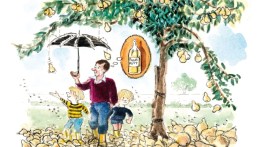
When we moved into the new house, we felt lucky to have a pear tree in our garden. How grown up, we thought. Then September came and the tree started raining fruit. Masses of fruit. Our green and pleasant lawn transformed into a carpet of greeny-yellowy-brown pears, which squelched gruesomely underfoot. I invited my children and nephews to help, offering them 5p for every pear they picked up. Big mistake. The boys quickly realised they were on to a winner and I had to fork out about £25. The worst part, though, was not knowing what to do with this unwanted harvest, which rotted quickly and attracted thousands upon thousands of fruit flies, which then began to colonise the kitchen. We ended up loading great sackfuls of the mangy fruit into the car and driving them to the dump.

A cure for Christmas: the pleasure (and perils) of preserves

My family knows that once the flaming pudding is on the table, late on Christmas Day, all meals will be picnics. Bar a few potatoes flung into the oven to bake, all cooking stops and eating becomes a forage into a squirrelled hoard of treats: the jars, tins, balsawood boxes and less pretty but functional vacpacs, inside which lie the delicate results of ‘cures’ achieved using sugar, salt, booze or smoke. Preserves are as much a part of my Christmas as the big fat bird and Brussels sprouts, only I find them far more interesting. Often they are memories of past Christmases. We recall the specialities our forebears once loved; the image of an elderly relative eating plums in brandy while watching the telly.

Whisky: A new star in the East to rival Scotch whisky

There’s a dirty Scottish secret. Nothing to do with the price of Brent crude, or who votes for Nicola: it’s that our global triumph, whisky, is now done rather brilliantly by others. Your reviewer is no bigot. I have gurgled and gargled Canadian, Swedish, Welsh and American whisky. These days, winter isn’t winter without Woodford Reserve. Even the English produce drinkable drams — drinkable, that is, for the curry-contaminated palates of chain-smoking Swindon estate agents. But the problem is specific. It’s Japanese. They came, they pottered around our distilleries, they chewed and they spat. A few decades on, serious international blind tastings give them the prize.

Join the preservation society… drink fortified wine

The sherry industry always used to admit that 75 per cent of its UK sales occurred in the weeks before Christmas. A large proportion of this was to teetotallers, who needed something to offer the family, or the vicar, or Father Christmas, or whoever happened to drop by over the holidays and was in need of what my late lamented nanny used to call ‘Festive Cheer’. The great advantage of a bottle of sherry was that, after the guests had departed and there was something left in the bottle, it wouldn’t turn to vinegar as rapidly as the remains of a bottle of wine. That’s the point about fortified wines. That’s why they were invented in the first place.

The office party should not be hard work

Is anything worse than the office Christmas party? It is almost always a horror show. Colleagues who are cheerful all year round turn into angry drunks. Usually benign bosses become second-rate pimps. The interesting become boring and the boring become interminable. The average office Christmas do tends to leave you wishing you didn’t have to come back to the grind next year. Why should it be so? Most of us like the people we work with— give or take — so a few hours of celebration should be fun. The problem, I think, is that office party organisers, who tend to be drawn from the management caste, can’t get themselves out of work mode. As a result they don’t think enough about what really makes a party.

Cocktails: Talking ’bout milk and alcohol

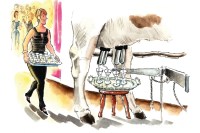
A few years ago, I came across an interview with an illustrious French chef who had made his home in Britain. I’ve forgotten which chef, but I do remember him going to some lengths to impress on us rosbifs just how lucky we are with our dairy cows. When he moved here, he was astonished by the quality of milk available to the average Briton and remade a number of his dishes to celebrate our heavenly liquid. And of course, anyone who has gazed at the UHT nonsense you find in French supermarkets will believe him, having experienced this epiphany in reverse. His enthusiasm now seems poignant as it becomes clear how disgracefully Britain treats its dairy farmers (the French wouldn’t stand for it) and what complacent consumers we are.

English Cooking: Discover the true value of pie

We all know what we think of as the great English Christmas lunch/dinner — turkey (originally from America) or goose (a worldwide bird, first domesticated in Ancient Egypt), Brussels sprouts (from Rome via Belgium), potatoes (also from the Americas). So, in fact, there is no such thing as a great English feast. Or is there? While the poor had little choice of food, the English traditionally knew how to feast. Christmas, which took over from the Roman pagan festival of Saturnalia, has for centuries been the year’s best excuse for eating, drinking, dancing, and showing off – showing off not just in silly tinsel hats, but in what you spread before your guests on the table. The stuffed bird is a key centrepiece of any English feast.

The transvestite, the fat cyclist and the woman from Chest Monthly: writers’ tales of weird dates

Toby Young Status anxiety columnist About 15 years ago, when I was single and living in New York, I acquired what I can only describe as a stalker. A woman took exception to a newspaper article I’d written and started bombarding me with emails. For about a year, she sent me three or four emails a day, demanding a reply. In one of these emails she claimed to be a columnist for a magazine called Chest Monthly, and that piqued my interest. So I invited her on a date. We agreed to meet in a café and she was quite difficult to spot because, contrary to my fevered imaginings, she was completely flat-chested. I asked her how she’d managed to land a job as a columnist for Chest Monthly.

The Christmas lunch

Illustrated by Carolyn Gowdy There was no soup in the freezer. She surveyed the jettisoned items and there, on a can of creosote, was a tub The early Christmas lunch party had been Bunny Wedgewood’s idea. But Bunny had pulled out the day before, having been sectioned by her daughter and son-in-law. Notification came from Bunny herself, apparently calling from a phone box in the cafeteria of the psychiatric wing of Leicester General Hospital. Bunny claimed to have been admitted ‘just for Christmas and the worst of the winter’ and expected to be home — albeit on tablets — by Shrove Tuesday. Unless it was a joke — one never knew with Bunny.

The Servant

You will see, alas, that all of this is true. One morning, I awoke in a feather bed in a room in a tavern and reached, as I always did, for my purse of gold, but it was not there. I had been travelling on business for many months and weeks with only my faithful coachman Joseph for company. Wherever I stayed, I would put the purse of golden coins by my pillow. Each night it was the last thing that I touched, and the first thing I touched in the morning. Sometimes, when I climb a flight of stairs, I have a strange feeling, which may be peculiar to me. I misjudge the number of steps and then, at the top, I put my foot down on nothing. Then my whole body feels dizzy. It is as though the world has made a mistake and not I. I had that feeling when I reached for my purse.

Not all single malts from Islay are for peat freaks

Even in the driving rain, the Isle of Islay is a heart-stoppingly beautiful spot. High in the hills behind the Bruichladdich distillery, there are sweeping views east across Loch Indaal, and I fancied I could just about pinpoint Bowmore distillery across the foaming grey waters. The wind was gusting, the sheep were bleating, the geese were honking: it was wild, magnificent and dramatic. The lure of Bruichladdich was too strong, however, and moments later I was in the warmth of the distillery shop itself, getting a dram of the Laddie Valinch, a limited edition release available only in the shop. The 22-year-old, matured in a former bourbon cask for 18 years and then a former sherry cask for four, was invigorating. It was 50.7 per cent and I prudently added water.

At last, trendy gins are tasting like gin again

I blame my mother. Although gin wasn’t her ruin, I have to admit, she did enjoy a gin and tonic. And as any student of the spirits industry will tell you, you never drink what your parents drink. The problem, I now realise, was that gin in the 1970s wasn’t very good. Tonic water was even worse: the primary aim of even the best known (Ssssssh — you know who you are) being to disguise the roughness of the gin. And vice versa, I suppose. Gin was dying on its feet, being replaced by the infinitely cooler vodka, which clever advertising in the 1970s had transformed from the equivalent of grappa into the current generation’s choice.

A critic’s guide to theatre bars

Head upstairs. That’s my tip for thirsty play-goers during the interval. Most West End theatres are sunken affairs built in scooped-out craters, and this quirk of their design places the stalls 20 feet beneath the earth’s crust (hence the belly-rumble of Tube trains that wakens sleepy-heads during Twelfth Night or The Winter’s Tale). So the stalls bar is invariably a cramped dungeon with flock wallpaper and a ventilation system that pipes fresh air in from the Gents. Up a flight or two, you’ll find lightness, space and perhaps a view. But it seems that bunkers are now the first option of theatre architects. The Old Vic’s basement bar has been given the full SM treatment. Hot light bulbs glare angrily at sweating walls and stag-beetle black tiles.

The uneasy marriage of Jamaica’s two greatest exports

Music and booze go together. Just think of Keith Richards in the 1970s with his Jack Daniel’s. There’s the love affair between hip-hop and luxury French booze: Busta Rhymes wrote a song called ‘Pass the Courvoisier’. And think of Puff Daddy and his Cristal champagne, though he later changed his name to P Diddy and started drinking Moscato d’ Asti — not so cool. What about reggae and rum? As Jamaica’s two most famous exports, you expect them to have an affinity. But they’ve had an uneasy relationship. Rums from former British territories trade on images of piracy and the Royal Navy, as if still marketing to a Victorian audience. It might have something to do with Jamaica’s third biggest export, ganja.

Seven apps to help you drink wine

After lots of practice, I’ve reached the stage where I can usually tell a good wine from a bad one. But there’s an awful lot of bluffing involved. If I’m asked for an assessment, I mutter something about ‘tannins’ and ‘structure’, while eyeing the bottle for the alcohol content and price. A good-looking label helps too: simple but classy, with a hint of grandi-loquence lurking at the periphery. It’s people like me who are likely to benefit most from the spate of wine scanner apps hitting the market, challenging the expertise of wine buff show-offs. These apps analyse bottle labels and provide information about the wine, region, grapes, price and food pairings.

Michael Seresin – from film noir to pinot noir

Michael Seresin claims, rather modestly, to ‘have no palate’, choosing instead to describe wine with light, colour and form. These are not your typical winemaker’s terms, but they make perfect sense given his unusual back story. Born and raised in New Zealand, Seresin emigrated to Europe in 1966 to pursue a career in cinematography. Movie buffs will know what happened next — Seresin, in his own words, ‘did really well, really quickly’, making a name for himself with a series of Alan Parker flicks: Bugsy Malone, Midnight Express, Fame. It was during this period that he leased a house in Italy — still his ‘favourite country in the world’ — and fell in love with wine.