More features

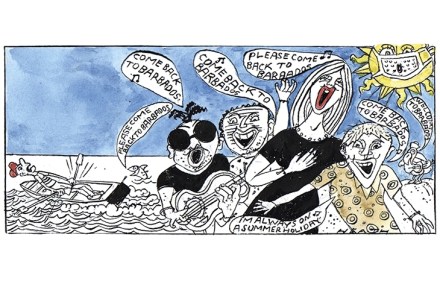
Did I give Russ Abbot Covid?

For the past few weeks there’s been a 7 p.m. curfew in Barbados as part of what the government calls a ‘national pause’ (lockdown, essentially). I’m actually grateful because it’s been manic lately. The excitement started with the visit of Captain Sir Tom Moore in December. I was commissioned by a golfing group called the ‘Sandy Lane Swingers’ to write and perform a song, ‘Marching on to Victory’, at a charity lunch. It’s a jaunty tune, composed by my co-writer Jeremy Limb, with a singalong at the end. Captain Tom joined in, waving his napkin in the air. As an encore I sang a verse of ‘You’ll Never Walk Alone’ and he mouthed all the words.
What have you changed your mind about? A Spectator Christmas survey

Grayson Perry In 1992 I created a graphic novel called Cycle of Violence. Reading it now, the initially striking thing is that it predicts the rise of cycling culture in the UK and a working-class boy called Bradley winning the Tour de France. But it mainly reflected the state of my mind at the time — it contained a lot of perverted sex, dysfunctional parenting and mercilessly mocked the process of psychotherapy. In 1992 our daughter Flo had just been born and my wife Philippa seemed to have read every parenting book under the sun. Our house was full of the jargon and ideas associated with psychotherapy.

The King of Christmas: A short story by Owen Matthews

The Christmas King steps slowly from his house and sniffs the evening’s chill. His tread is dainty, for all his heft, and his handsome head swings proudly as he surveys a kingdom of carrot tops and mud. He smells woodsmoke, the sows’ reek, the night’s damp rising from the river. From the kitchen door he hears the teasing voices of boys, the clatter of scullions’ ewers loaded with his dinner. On the hill, Wytham Wood hisses like the sea. All summer Harry has dined on sour curds and burned crusts, lettuce roots and swedes, and the rich scrapings of the pottage pot. Now winter brings him even greater plenty. A mess of oats and gravy bones cooked special for his Majesty.

Eggs and hard liquor: Spectator writers on their favourite examples of meals in literature

P.J. O’Rourke I love poems but hate poetasters, love wine but detest oenophiles, love food but can’t stand foodies. Therefore my favourite passage about food in fiction is Lionel Shriver’s entire book Big Brother. In her tale of obese totalitarianism and comestible fascists Shriver destroys every pretention and abstract conception about food — starves it to death or fattens it for the kill. And she does so in prose that is poetry: ‘You have to ask yourself if there was ever a time people just ate something and got on with it. Every time I open the refrigerator I feel like I’m staring into a library of self-help books with air-conditioning.

The economic case for smart meters

Britain’s smart meter rollout is the biggest change to our country’s energy infrastructure in a generation. This vital upgrade to an outdated, analogue system is creating a decentralised and decarbonised energy network which can help Britain meet its climate change targets, whilst also ensuring customers receive reliable, sustainable and cost-effective energy now and in the future. We’re already seeing how smart meters are helping us take control of our energy use at home. But, on a national level, the information provided by smart meters – which give near real-time information on our energy usage – will help drive a deeper transformation of our energy system, and one which could save Britain billions each year.

Why we need a smart energy system

The UK has committed to becoming carbon neutral by 2050. But to achieve our ambitious climate targets, we need to change our energy system radically. We need a smarter and more flexible system to supply more renewable, efficient and low-carbon energy to households, and help us all to manage our valuable natural resources more efficiently. It’s called a smart energy system — and the 14.9 million smart meters we are having installed in our homes are playing an integral role in making it a reality. Why upgrade? Our current energy system can’t accurately map the demand from homes and smaller businesses and, as a result, a lot of energy goes to waste between the point of generation and supply to the customer.

Britain’s smart energy upgrade

Britain is in the middle of the biggest upgrade to its energy infrastructure in a generation. Millions of households have already made the move to smart meters — enjoying a better understanding of their energy usage and using that knowledge to change habits, save money and cut their carbon footprint. While householders enjoy the personal benefits of smart meters, many are unaware that by simply arranging their installation, they have played a role in helping to create a decarbonised energy system fit for our growing demands. This flexible new system will play a significant role in Britain’s commitment to reaching net zero carbon emissions by 2050. Smarter and greener Smart meters are a crucial part of a smarter energy infrastructure.

The star dreamer

‘Wake up, boy! Wake up...’ My father was shaking me and I was confused because it seemed that I had only just gone to sleep. ‘Get dressed. Hurry.’ The lamps were not lit and the house was silent. Outside, the night sky glittered with stars and silken moonlight shone across the sand. My father was the baker in our village not far from the city, and we could see the lights of braziers and torches and the oil lamplight, that seemed to run up and down inside itself, like water. We heard the bells and the blowing of the ram’s horn, the shouts of men as they shooed their animals through the narrow streets and called their wares in the market place.

Jeeves and the Midnight Mess

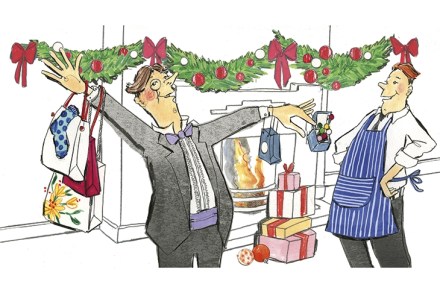
‘Christmas Eve in Mayfair, Jeeves! There’s nothing in heaven to top it. Even with the terror of eleventh-hour shopping for the gang Travers.’ ‘Indeed, sir.’ ‘But we can’t pitch up at Brinkley Court tomorrow bereft of g., f., and the other one.’ ‘Myrrh, sir? No, sir.’ ‘I fear I’m both a little later and much tighter than expected. I bumped into Bingo, you see, and had a snifter at the Feverish Cheese. Then we met Tuppy for a quick ’un at the Startled Shrimp, and finally we were accosted by Barmy who marched us for a gargle or two at the Mottled Oyster.’ ‘Very good, sir.’ ‘But I did not forget the Christmas presents!

Review: Mr Oscar Wilde’s poems

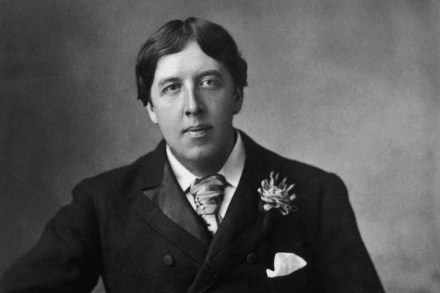
190 years of The Spectator   13 August 1881 The reading of this book fills us with alarm. It is evidently the work of a clever man, as well as of an educated man, but it is not only a book containing poems which ought never to have been conceived, still less published, but it is almost wholly without thoughts worthy of the name, entirely devoid of true passion, with very few vestiges even of genuine emotion, and constituted entirely out of sensuous images and pictures strung together often with so little true art that they remind one more of a number of totally different species of blossoms accumulated on the same stem, than of any cluster of natural flowers.

The duty of England and the American crisis

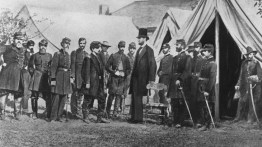
190 years of The Spectator   1 June 1861 The time has arrived when the national will on the American quarrel ought to be expressed. A party, numerous in Parliament and powerful in the press, is beginning to intrigue for the recognition of the South. They are aided by the fears of the cotton dealers, who dread an intermission of their supplies, by the anxiety of commercial men, who see their best market summarily closed, and by the abiding dislike of the aristocracy for the men and manners of the North. For the moment, their object is apparently to deprecate debate. They dare not as yet brave openly the prejudices of freemen, or advocate a cause based on antagonism to all that Englishmen hold dear.

The country gentleman and the Corn Laws

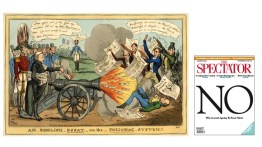
190 years of The Spectator   14 January 1843   The country gentlemen of England never committed a greater blunder than when they passed the Corn Law of 1815. If they would but allow themselves to examine dispassionately their own objects, they could scarcely fail to discover this, and also the necessity of retreating as speedily as possible from the false position in which they then placed themselves. The country gentlemen are the most powerful body in England, and they are fond of their power and proud of it. But the passing of the Corn Law gave a rude shock to the opinion favourable to the power of the country gentlemen. It placed them in the invidious light of men who perverted the office of legislators into the means of passing a law to keep up rents.

To our non-political readers

190 years of The Spectator   21 May 1831   Lucretius tells us, in some famous lines, that it is a pleasant thing to watch the sea in a tempest, from the shore: it is a far more gratifying employment to be throwing out Manby’s lifesaving apparatus, and saving the sinking mariners from the wreck. We have more than once observed, that it is difficult to be a mere spectator in times like these. It is all very well, in the piping times of domestic content, to sit still and report progress; but when, as in the great business of Reform, everything is at stake, it is the duty of even neutrals to arm. It is sometimes criminal not to take a side — there are cases in which he that is not with us must be against us.

Sweeping the streets

190 years of The Spectator   6 September 1957 There are two ways of looking at sexual immorality. One is to regard all illicit intercourse as a crime; the other is to regard it as a sin but not as something which concerns the State unless it has obvious anti-social consequences. The first has been out of fashion since the 17th century, when adultery was still a capital offence, and in most civilised countries the second attitude now prevails. But in England for the last 80 years there has been one notable exception. Since the Criminal Law Amendment Act of 1885 homosexual actions between consenting males have been criminal, even when they are performed in private.

Out – and into the World

190 years of The Spectator   4 June 1975   At no time during the campaign have the opponents of our membership of the EEC been remotely as unbalanced, as hysterical or as deliberately personally insulting as those in the opposite camp. Naturally, as in any vigorously fought campaign, there have been some fibs and half-truths on both sides; and each partisan has looked eagerly at evidence which may have several possible interpretations in order to find material that will support his cause. But nothing on the anti-Market side has even begun to equal the tirade of personal insults, and the sickening appeal to fear, that has characterised everything the pro-Marketeers have done.

The new club of rich young men

190 years of The Spectator   15 March 1986   It is difficult to estimate the number of young investment bankers, stockbrokers and commodity brokers earning £100,000 a year. Perhaps there are only a couple of thousand, but they are so mobile and noisy that they give the impression of being far more numerous. Most are aged between 26 and 34, and two years ago they were being paid £25,000, in some cases even less, until the opening up of the City markets precipitated an epidemic of headhunting and concomitant salaries. In this respect they resemble the lucky winners on Leslie Crowther’s television quiz The Price is Right, in which a random selection of wallies get the chance to win microwave ovens and Clairol foot spas.

The awful rise of ‘virtue signalling’

190 years of The Spectator   18 April 2015 Go to a branch of Whole Foods, the American-owned grocery shop, and you will see huge posters advertising Whole Foods, of course, but — more precisely — advertising how virtuous Whole Foods is: ‘We are part of a growing consciousness that is bigger than food — one that champions what’s good.’ This is a particularly blatant example of the increasingly common phenomenon of what might be called ‘virtue signalling’ — indicating that you are kind, decent and virtuous. We British do it, too. But we are more sophisticated, or underhand.