Features

Community spirit

If you really want to know how obtuse, how jaded, how downright bizarre Britain’s planning system is, you need only consult the findings of Lord Walker, the Supreme Court Judge who last week answered the question: should you show deference to local golfers? An odd question for sure, but one upon which rested the £55 million development of 300 homes on the Teeside coastline in a place called Coatham Common. The five residents who brought the case fought a six-year battle to preserve their local green space which, by the time it reached Lord Walker, had spent longer in court than Perry Mason. His ruling stated that simply because local strollers had showed civility towards golfers on the common did not mean they had lost the right to use the land as a public amenity.

A manifesto for the 2010 Tory intake

If the Conservatives win the next election, a majority of the Tory benches will be made up of members of the 2010 intake. We will be, in terms of numbers, the most significant intake for 60 years and will have huge influence on the party in years to come. So, what do I and my colleagues believe? We all share a commitment to people power and we see the potential for a new social covenant establishing that government belongs to the people and is the servant of the people. We want a government that is more transparent and accountable and we want to roll back the ‘surveillance state’. We subscribe to Lincoln’s vision of ‘government of the people, for the people, by the people’.

Time for the dynamic state

A visitor returning to Britain after 30 years could easily be fooled — by the sight of privatised buses and by the replacement of heavy nationalised industries by hi-tech business parks — into thinking that Britain has been transformed from a sub-socialist society into a dynamic free enterprise economy. In some ways that may be true, yet paradoxically the public sector is actually larger relative to the rest of the economy than it was in the dying days of the last Labour government. In 1979 the government accounted for 45 pence in every pound spent in the UK economy. This financial year it will be 47.5 pence. What are public sector workers doing if they are no longer mining coal, driving buses or making steel?

Tear up Britain’s ‘Renewables Obligation’

Unaffordable and unsustainable, Rupert Darwall explains why Labour’s worst stealth tax must be abolished The bubble has burst; there are no proceeds of growth to share and Britain’s budget deficit is, in the words of one central banker, truly frightening. Can Mr Cameron give voters a break, one which will leave them tangibly better off and is unambiguously good for the economy? Yes he can. The Renewables Obligation can claim to be Labour’s worst stealth tax. Unlike VAT, it is bundled into people’s electricity and gas bills without them knowing how much it costs. The money it raises is then spent with minimal accountability or regard for value for money. Since its introduction in 2002, the Renewables Obligation has cost consumers and businesses £4.

Today’s welfare state is making poverty permanent

‘Drug addiction, alcoholism, criminal records, language difficulties, a lack of skills, depression...’ Anyone working alongside Britain’s long-term unemployed can recite a grim litany of social ills. ‘Drug addiction, alcoholism, criminal records, language difficulties, a lack of skills, depression...’ Anyone working alongside Britain’s long-term unemployed can recite a grim litany of social ills. But when I speak to a welfare adviser in Tower Hamlets – one of London’s poorest boroughs – he emphasises a single factor, above all others, to explain the area’s endemic worklessness: ‘the benefits trap’ – the idea that you can be better off on benefits than in work.

Time to lift the House of Commons off its knees

What if we win office, but nothing changes? What if, instead of running a new government, triumphant Tory ministers discover that the machinery of government runs them? Making sure that does not happen requires a strategy. Opposition may be a time for tactics, but how we fare in office will hinge on having a robust, coherent plan. We must have a strategy to make government properly accountable to parliament, and parliament to the people. The MPs’ expenses scandal has turned many people against democracy. ‘If this is how those scoundrels behave,’ runs the argument, ‘MPs can’t be trusted with anything.’ It is almost as if being elected to public office now serves as a disqualification for being put in charge of anything.

The Blanket Repeal Bill

How can a new government undo Labour’s mistakes? It should simply repeal everything, says Matthew Parris And finally, we shall in our first Queen’s Speech be introducing a measure whose like has never been seen among the manifesto commitments of an incoming government. It will be known as the Blanket Repeal of Legislation (Failure of New Labour, 1997-2010) Bill. The effect of the Act will be to repeal en masse and at a stroke all new legislation brought in since the fall of the Conservative government in 1997. The only exceptions will be those measures which, by affirmative resolution of both Houses, parliament votes to rescue.

How to defuse the pensions timebomb

Frank Field argues that a radical reform of Britain’s pensions policy could enrich both pensioners and the exchequer Ten years of austerity must deliver the country a radicalism that ten years of abundance has failed to achieve. The Prime Minister’s economic war council must decree that the necessary budgetary strategy also forges a radical agenda. Every secretary of state should be instructed to bring forward one major reform which, while cutting the size of a departmental budget, also begins to transform the political landscape. Combining these individual initiatives would lay the basis for a five-year reform programme, comparable to the models of 1906 and 1945.

The unelected bodies that just won’t die

Unruly, bizarre and hungry for your money, Britain’s quangos must be stopped, says Matthew Sinclair They are our longest-running political horror story. And, under Labour, they have been ever more unruly, increasingly dangerous and always ready to suck the blood of taxpayer’s wealth. For several decades politicians have been discussing cutting the number of Quasi-Autonomous Non-Governmental Organisations (quangos). Back in 1991, even Gordon Brown was talking about it. But it seems Britain’s vampire quangos cannot be killed. The most recent TaxPayers’ Alliance survey found that there are now 1,148 national quangos and other arm’s-length bodies in the UK, spending over £90 billion of taxpayers’ money and delivering huge areas of policy.

And in the event of a hung parliament…

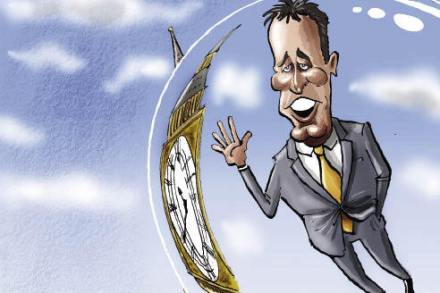
David Cameron may have to rely on Nick Clegg to form a majority. But Julian Glover says that a deal should be simple – if they focus on areas where they already agree In late 2007 two fresh-faced, privately educated party leaders gave speeches setting out their philosophies. ‘We’ve always been motivated by a strong and instinctive scepticism about the capacity of bureaucratic systems to deliver progress,’ said one. I want ‘a politics of people, not systems, of communities, not bureaucracies; of individual innovation, not administrative intervention,’ said the other. ‘The days of big government solutions – of “the man in Whitehall knows best” – are now coming to an end,’ they could have chorused together.

Can Nick Clegg sing the blues?

Nick Clegg’s office already has a Downing Street feel to it. Since becoming leader of the Liberal Democrats, he has had it redecorated so that portraits of old party leaders hang on the staircase up to his room, as portraits of former prime minsters do in No. 10. It starts plausibly enough, with portraits of Palmerston, Gladstone and Asquith. The gravitas is somewhat lost when we get to Charles Kennedy and Ming Campbell. But neither came as close to power as Mr Clegg is now. If the polls are right, then he might be just weeks away from government. The idea of a Lib-Con coalition is not one any Conservative relishes. But there is a limit to how long even the most optimistic Tory can keep ignoring opinion polls.

Nick Clegg’s only true allegiance is to his belief in a federal Europe

When Nick Clegg assures us that he is a man of principle, he is telling the truth. He does have one deeply held principle: the ground of his political being. He believes in a federal Europe. Europe is not only his continent. It is his country. But there is a problem. Such views are not widely popular with the electorate. They are not even popular with Mr Clegg’s own MPs, who would like to hold on to their seats. This is why Nick Clegg often seems anaemic and insipid. To be obliged to remain silent on the one subject which could transmute platitudes into eloquence; there could be no greater handicap for a politician.  At times, it can be a grovelling and humiliating silence. In 2005, the Liberals were prepared to sound courageous on the proposed EU constitution.

‘I went into the war as a student and came out as an artist’

Ronald Searle, who turned 90 this month, talks to Harry Mount about being captured by the Japanese, chronicling the 1950s and inventing both St Trinian’s and Molesworth High in the mountains of Provence, in a low-ceilinged studio at the top of his teetering tower house, Ronald Searle is showing me the simple child’s pen he uses. As he draws the pen down the page, the ink thickens and swerves; a few sideways strokes, a little cross-hatching, and suddenly the famous Searle line comes to life: part Gothic, part anarchic, part comic. The girls of St Trinian’s, Nigel Molesworth, Adolf Eichmann, thousands of Punch caricatures, the Goya-like pictures of dying prisoners of war... all utterly different, all enclosed by that distinctive Ronald Searle line.

Why does the BBC air Islamist propaganda?

Down at that self-proclaimed centre of ‘tolerance and harmony’, the East London Mosque, they’ve been holding some pretty tolerant and harmonious meetings lately. On 9 July last year, for instance, there was the half-day conference on ‘social ills’. One of the ‘social ills’ — with an entire session to itself — was ‘music’, described by one of the speakers, Haitham al-Haddad, as a ‘prohibited and fake message of love and peace’. Then there was the talk, on 26 June, by a certain Bilal Philips — named by the US government as an ‘unindicted co-conspirator’ in the 1993 World Trade Center bombing.

Let’s not mess with the sparrowhawks

It’s unlikely that birds of prey have anything to do with the decline in garden songbirds, says Rod Liddle, and anyway, what right have we got to play God with wildlife? But oh! The crewel sparrer’hawk E spies im in is snuggery, E sharpens up is bleedin’ claws An rips im aht by thuggery anon, 19th c. There was a fearful commotion outside, in the garden, a screeching and frantic flapping, the sound of water being urgently displaced, of aggression and terror. I rushed to the door and looked through the glass; three feet away from me, in my daughter’s half-collapsed paddling pool — replete with winter snow-melt and rain — a wood pigeon was getting its head kicked in.

Greek sex, infallible logic and fearless honesty

It is not difficult to see why the greatest Greek scholar of his generation, Sir Kenneth Dover, who died last Sunday, was a man who attracted controversy. His edition of Aristophanes’ comedy Clouds (1968) was the first to go into the same detailed explanation of its sexual jokes as of its textual cruces. Readers were appalled: surely you did not pick up a classical text to read about the relationship between erections and pre-ejaculation fluid? That it was the finest commentary ever produced on every aspect of a comedy featuring the controversial figure of Socrates seemed to pass people by. His Greek Homosexuality (1978) caused even more of a rumpus.

Britain must be saved from the financial abyss

A few months ago, Alistair Darling was asked how long he thought his government could continue to borrow £600 million a day. Might creditors one day refuse? The Chancellor gave an oblique reply. ‘When you walk over ice, you never know it is too thin — until you fall through.’ He said no more, but his message came across. If the bottom falls out of the British economy, it will do so instantly and dramatically. There will be no warning. For some time now, Gordon Brown’s government has been walking on the thinnest of ice. But it has been helped, ironically, by the widespread expectation of its electoral annihilation.

Let’s set schools free

Our dismal education system means that too often poverty is a life sentence, says Michael Gove. But it doesn’t have to be this way. Schools can be freed from stifling state control I owe Peter Bazalgette an apology. A very big apology. Peter is the man who brought Big Brother to our TV screens. His genius in spotting the potential of the original show has brought him riches and helped Channel 4 fund years of genuinely creative TV. But at a price I used to think far too high. I used to write a regular column in the Times and I took advantage of my platform there to denounce Mr Bazalgette for using his undeniable intelligence to exploit the stupidity, indeed more properly the frailty, of others for his own ends.