Features

How much defence can we afford?

Max Hastings says that the stakes are high for Liam Fox’s strategic defence review: but we must maintain our current troop numbers and cut in other areas to pay for them Britain’s armed forces are entering a dangerous period of upheaval. The new government’s strategic defence review (SDR) will impose swingeing cuts, and the only uncertainty concerns where the axe will fall. Defence Secretary Liam Fox has announced — in the Sunday Times, rather than to parliament, that the Chief of Defence Staff, Air Chief Marshal Sir Jock Stirrup, will step down in the autumn. Stirrup will therefore remain as a lame duck while the SDR is carried out. This is deliberate.

The Afghan ‘mineral strike’ is just spin

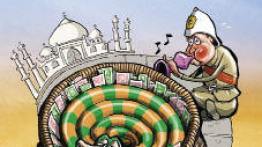
This week, just as things were looking at their bleakest in Afghanistan — growing casualties and the damning report on the links between Taleban leaders and the Pakistani secret service — the Pentagon pulled a rare piece of good news out of the hat: Afghanistan, it turns out, is not only a poppy-growing paradise but also a mining El Dorado. Around $1 trillion worth of minerals has been discovered (says the US Geological Survey) and according to enthusiastic US and Afghan officials, this stunning potential could make mining the future backbone of the Afghan economy. Well, hooray, then let’s not pull out so hastily, people have begun to say.

The Tories’ history man

Andrew Gimson talks to Alistair Cooke, the godfather of the Cameroons, about Dave’s temperament and Hilton’s penchant for ponchos As David Cameron solicits approval for deep spending cuts, he has assured the public: ‘We’re not doing this because we want to, we’re not driven by some theory or ideology.’ Cameron remains very anxious not to be taken for a closet Thatcherite, who beneath the cloak of necessity is pursuing ideological politics. If the Prime Minister wished to make a properly Tory case for cutting himself free from an outdated programme, he could do worse than turn to Alistair Cooke, who played a part in the political education of most of the Tory authors of the coalition government.

Aunt Barbara’s fireplace

Charlotte Moore on her intrepid relative, who numbered many of the great Victorians — Rossetti, Gertrude Jekyll, George Eliot — among her closest friends ‘A young lady... blessed with large rations of tin, fat, enthusiasm, and golden hair, who thinks nothing of climbing up a mountain in breeches, or wading through a stream in none.’ So Dante Gabriel Rossetti described his new friend Barbara Leigh Smith, later Bodichon. ‘Aunt Barbara’ stood out, vibrant even among a pretty exceptional bunch. She was an artist, traveller, journalist, feminist agitator, co-founder of Girton College, architect of the Married Women’s Property Act, philanthropist, plantswoman and friend.

More power to the press

It has for many years been a commonplace of political analysis that journalists have grown in stature as we politicians have shrunk. But the full reality of our reduced condition was rammed home to me, yet again, on the morning after the general election. On the invitation of the BBC I went on telly to comment on the prospects of an exciting new Lib-Con coalition. I was falteringly trying to give my opinion when my interviewer, Jeremy Paxman, broke in. ‘Haven’t you got a city to run?’ he said with his trademark testiness. ‘Then why don’t you go off and run it!

Meet Mr Efficiency

On the table outside Phillip Hammond’s office is a red box with the words ‘Secretary of State for Transport’ embossed in gold. Realising it has caught my eye, Hammond opens it up — it’s empty, as befits a diligent minister. I ask if he follows the ‘Yes Minister rule’ — starting at the bottom to see what his department doesn’t want him to read. I expect him to smile but he looks puzzled, then explains methodically that he takes all the papers out and sorts them in order of importance. This rather sums him up: Mr Efficiency. He even walks in an efficient way, his long legs taking sensible strides and his arms swinging just enough. Until the Conservatives fell short of an overall majority, he was also the party’s Mr Efficiencies.

Glastonbury is for middle-aged masochists

Europe’s biggest musical festival is now just a massive authoritarian pigpen, says Brendan O’Neill. No wonder the young are staying away Most people, when they hear the word Glastonbury, think of mud, drugs, drunkenness, moshing, free love, the lighting up of spliffs, and generally harmless experimentation in a field. Well, they’re right about the mud. Yet far from being a site of hippyish self-exploration, the Glastonbury music festival has become a tightly regimented gathering of middle-class masochists who don’t mind being bossed around by nosey cops and kill-joy greens for three long days.

Monty Hall will change the way you think

Here’s a game to play this evening with your wife or your catamite. It is an incredibly boring game, but it will help you understand the world better than a bunch of Nobel prize-winners and more than 100 mathematical geniuses, who we will come to in good time. Take three cards — an ace and a couple of jokers. Shuffle them up. Lay the cards face down in front of your partner and tell her that if she picks the ace, you’ll give her a bourbon or maybe a garibaldi biscuit. If she picks one of the jokers, however, she gets nowt. Tell her not to turn over the card of her choice just yet, simply to tap it. When she’s done that, pick up the two other cards.

Letter from Syria

No question about it, the world is becoming increasingly homogenised — not only, indeed not so much, in big things such as democracy and free trade as in small. No question about it, the world is becoming increasingly homogenised — not only, indeed not so much, in big things such as democracy and free trade as in small. No snippet of news illustrates this more clearly than the ban on smoking in public places introduced last month in Syria. A few years ago, it seemed exotically health-conscious to legislate against the cigarette in Britain, let alone in nations across the Channel traditionally addicted to café society and dangling Gauloises.

The papal visit is in jeopardy

Damian Thompson reveals the turmoil behind the scenes in the preparations for Pope Benedict XVI’s keenly awaited visit to Britain — and how the trip has been hijacked by a Blairite cadre Last week, the Catholic Arch-bishops of England and Wales were summoned to a private meeting in London where they were given astonishing news about Pope Benedict XVI’s visit to Britain. The pontiff is due in four months’ time (16-19 September), yet preparations were going badly wrong. Some of the major venues, while announced, had still not been booked. And worse, the Church’s share of the cost of the four-day trip had veered wildly out of control, from £7 million to a figure nearer £14 million.

No one outside England thinks we’ve got a prayer

Rod Liddle wouldn’t risk more than a tenner on the team getting beyond the group stage in the football World Cup. The truth is, we usually perform more or less exactly as well as might be expected given the size of the country Nobody outside of this country thinks that England stands a cat’s chance in hell of winning the association football World Cup, which is due to kick off in South Africa very shortly — if all the teams are not abducted upon arrival and shot.

‘His only vice is women’

Vittorio Sgarbi, the mayor of Salemi in Sicily, is a notorious philanderer who is obsessed with art, beauty — and the mafia. James Silver spends a day with him When Silvio Berlusconi was in trouble last year, accused of trysts with girls young enough to be his granddaughters, his former undersecretary for culture Vittorio Sgarbi rode nobly to his defence. ‘The thing you have to understand about Silvio,’ he declared, ‘is that unless he gains sexual satisfaction he cannot govern properly.’ Such a claim could only be taken seriously in Italy, where womanising is a national pastime and the more colourful public figures are widely admired. They don’t come much more colourful than Mr Sgarbi. Now mayor of Salemi, Sgarbi is a celebrity in Italy.

We need a compact with Muslim Middle England

Andrew Gilligan says the new coalition must reformulate our relationship with moderate Muslims — and marginalise the extremists for good One of the unsung heroes of this year’s election campaign was the Labour MP for Poplar and Limehouse, Jim Fitzpatrick. Alone in his party, Mr Fitzpatrick stood up before the election and said something that everyone in east London Labour knew, but no one else had the guts to put on record. To my newspaper, the Sunday Telegraph, and Channel 4’s Dispatches, he blew the whistle on the way that, in his words, the Tower Hamlets Labour party had been infiltrated and ‘corrupted’ by a radical Islamist group, the Islamic Forum of Europe, rather as the Militant Tendency operated in the 1980s.

The end of Israel?

Perhaps the least important aspect of Sunday night’s events in international waters off Israel is what actually happened. In the world in which Israel operates, the rights or wrongs of what Israel actually does are irrelevant. Reaction to Israeli behaviour is no longer governed by facts or by rational responses. The country is judged — and found guilty in advance — in the context of a perception on which all right-thinking people agree — that Israel is the enemy of peace. Whenever Israel acts, the default response is to condemn first and inquire later. That has certainly been the pattern this week. The pattern is well established. Remember the Jenin ‘massacre’ in April 2002?

Where’s the gain in the capital gains tax?

The idea of ‘squeezing the rich’ may be politically attractive. But, says Arthur B. Laffer, it means less tax revenue — as the coalition may be about to learn the hard way Britain’s new coalition government has a simple mission: to walk the thin line separating huge deficits and political correctness. Just how can a government patched together from former political adversaries raise the revenues needed — and still be fair to the poor, the various minorities and the disenfranchised? The answer they seem to have alighted on is the old saw of ‘tax the rich’. The first salvo in this new class warfare skirmish is to raise the capital gains tax rate, with new upper rates of 40 per cent and even 50 per cent being discussed.

The death of the male working class

This recession is a global ‘mancession’, says Matthew Lynn, with male-dominated industries collapsing and women getting a greater share of new jobs. But if work is turning into a female domain, what are we going to do with all the redundant men? Remember the feminist slogans of the 1970s? Phrases such as ‘A woman needs a man like a fish needs a bicycle’ and ‘Adam and Even’ sounded comic at the time. Now, 40 years on, they seem less like the absurd hopes of the dungaree-clad sisterhood, and more like shrewd insights into the economic future. The once preposterous-sounding idea that women would outnumber men in the workplace is now a reality. It has just happened in America and, if current trends persist, it will happen in Britain in four years time.

Adventures in La-la land

As the Coalition forces prepare to pull out, other Brits commit to real ‘nation-building’ — educating the next generation. Mary Wakefield reports from rural Afghanistan Snow melts in the Hindu Kush, trickles through the foothills, sluices across flood plains scattered with pink anemones then runs noisily through Worsaj district down to the village of Qanduz, where it is drowned out by the sound of children shouting, ‘I love you!’ They’re either side of a dirt track, the children, throwing glitter, clapping, waving plastic flowers. In front of me, Sarah Fane, the object of their devotion, shakes hands and accepts so many garlands that soon only her eyes are showing above the frills.