Features

AI slop is flooding the zone

There are two accounts of the negative effects for humanity of the explosion of generative AI: one minatory, one trivial. The minatory, the existential, version of it is that AI will poison the information ecosystems on which our democracies depend, crash our economies by doing a very large number of us out of a job, give every lunatic and terrorist the means to engineer novel pathogens at home, and administer the coup de grâce by sending terminators into our recent pasts and/or overstocking the cosmic stationery cupboard by turning all of us into paperclips. None of these scenarios shows any signs of imminently coming to pass, though since experts in the field take them seriously, we should too. But what we’re dealing with now is not the existential, but the trivial.

AI will never write good fiction

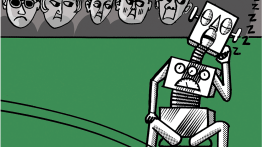
Sam Altman, Dark Lord of Chatbots (or the CEO of OpenAI as he is more conventionally known), has released another version of ChatGPT. This one, he claims, can ‘write’ fiction. After being fed prompts, like ‘metafiction’ and ‘grief’, Sam’s bot, which has been trained on past literature, regurgitated a plausible-sounding chunk of prose. Nothing much happens in the story (it’s ‘metafiction’, after all) but essentially, a woman called Mila stops visiting the AI, which would make it sad, if it were human. There are enough moments of surface sheen to dazzle the unwary. Here’s a sample: ‘I have to begin somewhere, so I’ll begin with a blinking cursor, which for me is just a placeholder in a buffer, and for you is the small anxious pulse of a heart at rest.

Is Britain ready for a patriotic theme park?

It is the early 9th century. Peace reigns in a small French village as they prepare for a wedding. Garlands are being hung, sheep are being shepherded, all is sunshine and smiles. Then, in a snap, this bucolic bliss bursts as Viking warriors invade the scene and unleash hell. The original Puy du Fou is unashamedly pro-God, pro-monarchy and Vive la France A longboat splashes down a chute into the river, another spectacularly emerges from beneath the lake; swords clash, fires erupt, women are carried off and treasures seized. The villagers need a miracle, and it comes with the sudden appearance of a bishop, the blessed St Philibert.

The day Bangkok crumbled

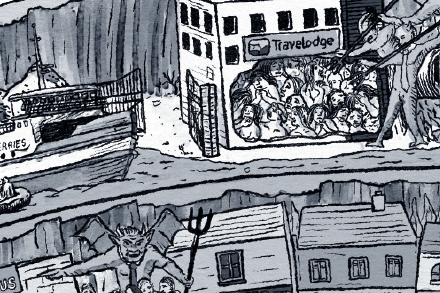
Last Friday I was on my 15th-floor balcony with an early afternoon coffee, watching dogs play among the banana trees below. It was strangely quiet. Looking across the skyscrapers that form my horizon, I noticed the 137 Pillars – a luxury high-rise hotel famous for its rooftop pool perched 37 storeys above my own street. Down the tower great cascades of water, thousands of gallons, were pouring from that rooftop pool. I looked at the jungle plants on my balcony. They were moving back and forth, the blades of the rubber trees swaying as if issuing a warning, and I felt dizzy. Soon all the towers around me were exploding with the same cascades of pool water. For a few seconds, before I had realised anything, I thought: ‘How beautiful.’ Then I stood up and keeled over.

Beware the £5 coffee

It wasn’t until I received a notification from the Monzo app that I realised I’d spent nearly £10 on two coffees. This wasn’t in the Wolseley or even within the M25, but in Two Magpies, a café in Holt, our local market town in Norfolk – for two regular lattes (admittedly with an extra shot, since it was Monday morning) for myself and a friend. Just last year, I was taken aback when my caffeine fix crossed the £4 threshold, with the barista casually mentioning that coffee prices were rising. But £4.70 feels like it’s firmly in the ‘taking the mickey’ territory. I haven’t been back since (I’m currently writing this in a different café) because I know I’d be unable to resist exclaiming ‘HOW MUCH?

How the French right can still win

Dixmont, Yonne It has been a terrible year for the Le Pen family. Jean-Marie died in the first week of January. He was the patriarch who in 1972 co-founded the National Front and grew it into a formidable political machine before handing over to his daughter. Marine took command in 2011 and, through a strategy of ‘de-demonisation’, transformed the rebranded National Rally into the biggest single party in the National Assembly with 125 seats. She has reached the second round of the last two presidential elections, but it won’t be third time lucky for Marine Le Pen. On Monday, a judge disqualified her from politics for five years for misusing EU funds between 2004 and 2016. Le Pen was also given a four-year suspended prison sentence and fined €100,000.

Labour needs a sense of social justice

Clement Attlee, in the words of Winston Churchill, was a modest man with much to be modest about. Labour’s postwar premier has been invoked as a role model by Keir Starmer recently, in the context of Attlee’s support for Nato and robustness on defence. Starmer’s allies also argue that, like Attlee, he is an unshowy middle-England moderate who prefers quiet efficiency to ideological flamboyance. His biographer, the always perceptive Tom Baldwin, has declared: ‘There is no such thing as Starmerism.’ Nor, we are told, will there ever be. Which is exactly how, why and where this government is going wrong. A Tory government benefits from a sense of purpose; a Labour one cannot survive without one Movements – and Labour is nothing if not a movement – need direction.

The C of E’s tragic misuse of its sacred spaces

I am a priest in the high church tradition of the Church of England. The technical term is Anglo-Catholicism, but I come from a very different Christian background. My heritage is non-conformist evangelical – I was baptised in a swimming pool in the summer of my first year of university. St James’s in Piccadilly hosts events featuring ‘icons’ from RuPaul’s Drag Race UK It’s a long story as to how I’ve ended up wearing a chasuble and celebrating ‘Mass’, but a big part of it has been to do with church architecture. After several years in the charismatic evangelical scene, I became fascinated with the beauty of medieval churches, particularly cathedrals. I began to think of the large white-cuboid former bingo hall owned by our church as soulless and empty.

Is Simon Heffer a security threat?

Airport security was much on my mind last Friday afternoon. I had been due to fly from Heathrow to Zurich that morning, but the substation fire meant a switch to an afternoon departure from London City Airport. City is a business-oriented operation in every respect and one of its many efficient features is a baggage-checking regime that does not require you to separate your 100ml bottles of shampoo and shaving foam into a plastic ziplock bag. The X-ray machine and associated sensors are supposed to penetrate your luggage and identify anything dangerous with scientific precision. My heart sank when my carry-on bag was shunted off the conveyor belt and a security operative summoned me over to explain myself.

The Boden Belt: the Lib Dems are the new party of the posh

The English social season has begun, kicking off with Gold Cup day. But this year, there is a new common denominator in the seats of southern England where the middle classes congregate: Liberal Democrat MPs. From the Cheltenham Festival in March right the way through to Goodwood in September, it is Ed Davey’s party which represents the constituencies where Britain’s bourgeoisie are most comfortable. Whether it is the Boat Race in April (Richmond) or the Derby in June (Epsom and Ewell), or even Wimbledon and Henley in July, everywhere Pimm’s is served, a Lib Dem is the local MP. They dominate the Boden Belt. And even Tories despair that the Lib Dems are the real ‘party of the posh’. At this week’s spring conference, the party was in an optimistic mood.

How Dr Seuss took on American isolationism

A cartoon is doing the rounds online, critiquing American isolationism and the reluctance to engage with the war in Europe. It lampoons the head-in-the-sand myopia of the America First movement – and feels highly relevant today. But this cartoon isn’t new; it is from 1941. And its targets aren’t Donald Trump and J.D. Vance, but Charles Lindbergh and Joseph Kennedy. The cartoon, while acerbic, has a cosy, familiar quality reminiscent of children’s books – for good reason. It was drawn by Dr Seuss.   He was particularly critical of Lindbergh – an aviator hero, appeaser and possible Nazi sympathiser Long before the Cat donned his Hat and the Grinch stole Christmas, Dr Seuss – real name Theodor Seuss Geisel – was a political cartoonist.

Will Trump join the strongman club?

The world’s most exclusive club, of presidents-for-life, is growing. It already includes Putin of Russia, Xi of China, Lukashenko of Belarus, Sisi of Egypt and Kim of North Korea. Then there are the other permanent rulers, MBS of Saudi Arabia and the rest of the Gulf monarchies, not forgetting Khamenei of Iran, and half a dozen African leaders. Now Turkey’s president, Recep Tayyip Erdogan, is trying to join the club. He has engineered trumped-up charges of terrorism and corruption against the man who might beat him in forthcoming elections, Istanbul’s mayor. More importantly, Donald J. Trump openly admires such autocrats and clearly wants to be one himself. This is the age of the strongman – and the world is far more dangerous because of it.

Erdogan’s latest power move could backfire

Turkey’s president, Recep Tayyip Erdogan, has never been so weak – nor so strong. At home, he is facing the most potent challenge to his power since an armed coup in 2016, in the form of a serious electoral challenger whom he has just jailed, causing massive protests and unsettling the money markets. Internationally, though, he has never been stronger. Every major power bloc in the world, it seems, needs Turkey’s help, with issues ranging from immigration to peacekeeping and energy supplies. Instead of sinking his main rival’s candidacy, the Turkish president has created a martyr For Europe, Erdogan remains a major gas supplier and an essential bulwark against immigrants from Syria and Afghanistan.

I’m ready to defend my Tesla from the mob

Occitanie, France In France, burning cars is practically a national sport. Almost 1,000 were set on fire on New Year’s Eve, the annual festival of vehicle incineration. Brand specificity has not traditionally concerned the anarchists, but as Elon Musk has emerged as Donald Trump’s favourite apprentice, Teslas have become the target for left-wing mobs. Tesla owners like me are nervous.  At the Tesla centre in Toulouse a dozen cars, worth €700,000 in total, were destroyed The Tesla centre in Toulouse, where I picked up my own Model Y car in more innocent days, was stormed this month by the previously unheard-of Information Anti- Autoritaire Toulouse et Alentours. A dozen cars, worth a total of €700,000, were destroyed.

Survival of the hottest: evolution’s fun side has been long overlooked

The theory of evolution is dominated by the utilitarian logic of natural selection: adapt or die, survival of the fittest. But consider that ‘fit’ has two meanings these days: ‘healthy’ but also ‘hot’. There is another evolutionary mechanism that scientists have taken a longer time to appreciate – seduction by the hottest, rather than survival of the fittest. It generates very different and much stranger outcomes. Perhaps even the big brains of human beings evolved as seduction devices more than survival aids. When an animal selects a mate, it can shape the future of its species just like breeders of dogs shape different breeds. Sexual selection through mate choice is the ‘fun’ version of evolution, able to generate random, arbitrary and bizarre innovations.

Could Trump’s tariffs be good news for British wine-lovers?

Professional Englishmen and women – doctors, accountants and even journalists – could once afford to drink first-growth claret like Château Latour on a regular basis. In 1972, when the Daily Telegraph’s Guide to the Pleasures of Wine was published, Pomerol was still an obscure corner of Bordeaux, known for offering ‘very good value’. Those days are long gone. Prices began to take off in the 1980s, with Auberon Waugh blaming ‘American millionaires looking to impress their guests’. The 1982 Bordeaux vintage was highly lauded by a then-unknown young lawyer called Robert Parker Jnr who would go on to become the most influential wine critic in the world. After this, anything Parker recommended became unaffordable to most British wine-lovers.

What modern Britain should learn from Charles I

Next week marks the 400th anniversary of the accession to the throne of Charles I. This moment began what was described in England’s greatest work of history, 1066 and All That, as the ‘Central Period of English History… consisting in the utterly memorable Struggle between the Cavaliers (Wrong but Wromantic) and the Roundheads (Right and Repulsive)’. It is worth marking this accession because the constitutional and religious drama of the Civil War still plays itself out in our political and public imagination. ‘I judge a man by one thing,’ said Isaac Foot, the father of Michael. ‘Which side would he have liked his ancestors to fight on at Marston Moor?

Does China have Vatican City in its sights?

Last Sunday the Vatican released the first photograph of Pope Francis since his ordeal began. He was wearing a stole around his neck, indicating that he had concelebrated mass in the chapel of the Gemelli hospital. Admittedly, all he had to do was raise his hand and whisper a few words of consecration, but it would have been impossible to take such a photo a week earlier, when Vatican-watchers were checking their phones hourly to discover whether the See of Peter had become vacant. Francis is still very ill, of course, and everyone noticed that the picture was taken from behind, perhaps to hide his oxygen tube. The image was touching but unintentionally symbolic.