Features

The beautiful Balkans on horseback

My husband and I decide we are up for a horse-riding adventure. We’ve done a few and have realised it’s the only way to travel: the truest way to experience an up-close and personal with a country and its people. You’re out of your comfort zone, there’s no turning back, you must abandon all control and anything can happen. There’s nothing like extreme vulnerability to induce trust and affection in your guide and his horses. But gratitude for surviving your holiday aside, it’s not hard to fall for everything the trip has to offer. We arrive in Apriltsi, a small Bulgarian town at the foot of the central Balkan Mountains, after a three-hour drive from Sofia.

Cockfighting: the last, hidden link to Bali’s warlike past

Driving around Bali, the first thing I noticed was the big wicker baskets by the roadside. Inside each basket was a cockerel. I asked my friend Wayan why these birds were there. ‘They put them by the road to make them used to people,’ he told me. ‘Then they won’t be scared when it’s time for them to fight.’ ‘What do you mean, time to fight? A cockfight?’ He nodded. Cockfighting is a clandestine activity here. No one talks about it, but those baskets are everywhere. Cockfighting is an ancient Balinese tradition. The Indonesian government frowns on it, and the heavy gambling that goes with it (men can lose farms on a single fight), but it remains a part of daily life.

What’s behind the Boris Johnson show?

Coming in from the pouring rain, I make my way to the office on the eighth floor of City Hall. With its curving windows, many books and bust of Pericles tucked away in a corner, it reminds me both of a classroom and the cockpit of a spacecraft. Its occupant is waiting for me, looking a little crumpled but less dishevelled than I had expected. He greets me very pleasantly but this is what I’m thinking. Here is the most famous person I have ever interviewed. In his own way, he is almost as iconic as the Queen or Churchill, the nodding dog in those insurance commercials. He is Boris, one of a tiny handful of politicians/celebrities instantly known by their first name.

How to fix Britain’s immigration crisis (without leaving Europe)

The response to the Ukip surge has reached the panic stage. Just as British business and academia chorused the economic benefits of Union in the final stages of the Scottish referendum campaign, now their refrain is of the economic benefits of immigration. A letter from ten chief executives in the Financial Times pronounced that unimpeded immigration from Eastern Europe is highly valuable. The previous week economists estimated that immigration from Eastern Europe had contributed £20 billion net in taxes. But Ukip supporters are no longer overawed by businessmen and dons, so what is to be done? Within the accepted rules of English social hierarchy, the tempting implication for the rest of us is condescension.

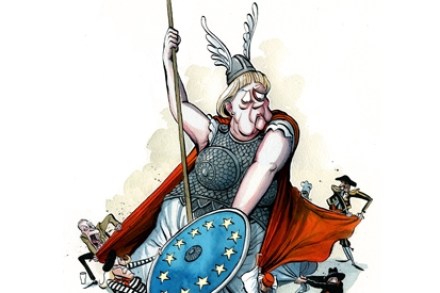
Europeans no longer fear Germany. But do the Germans still fear themselves?

In the old Death Strip between East and West Berlin, which runs through the centre of the city, there is a graveyard full of German war heroes and a few war criminals too. From the Red Baron to Reinhard Heydrich, the best and worst of the German military are buried here. There’s also a mass grave full of civilians, killed by Allied air raids, and a memorial to the 136 East Berliners who died trying to cross the Berlin Wall — which ran through this cemetery. The Death Strip is still an empty space. Germany has been marking two anniversaries this year — one a celebration, the other a painful duty. The 25th anniversary of the Mauerfall (as Germans call the fall of the Berlin Wall) is one of those rare events in German history about which they can feel unequivocally happy.

Has the Chief Inspector of Schools really gone rogue?

What’s up with Sir Michael Wilshaw? The chief schools inspector was once seen as a pillar of common sense and an enthusiastic partner of Michael Gove in pragmatic schools reform. Now, he stands accused of trying to enforce a particularly toxic form of political correctness as his inspectors mark down a succession of rural English schools for being insufficiently multicultural — or as some newspapers inevitably framed it, for being ‘too white’. Some critics go further and say that Ofsted suppresses as much good teaching as it fosters and is now poised to present young people with a warped version of our national values. Sir Michael, in other words, stands accused of going rogue. He has certainly had a most erratic year.

Alan Turing’s last victory

‘So were you levitating with rage by the end?’ I asked her. She — a veteran of Bletchley Park — and I were discussing The Imitation Game, the new film about the mathematician and code--breaker Alan Turing, featuring Benedict Cumberbatch and a host of historical inaccuracies. But she remained sanguine: ‘Not at all, I really enjoyed it a lot. A little dramatic licence here and there, but that’s what you get with films.’ Indeed. Still, the film didn’t take the biggest dramatic liberty of them all, thank goodness — that of suggesting that Bletchley’s triumphs were entirely down to the Americans.

Interview: Alex Salmond’s game plan for the Commons

Alex Salmond is losing his voice but that’s not going to stop him from talking — I doubt that anything would, or could. I meet him in the Savoy, after The Spectator’s Parliamentarian of the Year Awards (he won top gong) and he orders a hot toddy — setting out the ingredients just in case the Savoy Hotel is too English to know how to make one. No one talking to Scotland’s former first minister today would have any idea that his political dream was clearly rejected by Scottish voters just three months ago. He is relishing the SNP surge and the likelihood of his party holding the balance of power at Westminster next year, which he gleefully describes as ‘the favourite’s bet just now’.

Why are we abandoning the Middle East’s Christians to Isis?

She took the call herself the night the Islamic State came into Mosul. ‘Convert or leave or you’ll be killed,’ she was told. The callers, identifying themselves as Isis members, knew the household was Christian because her husband worked as a priest in the city. They fled that night. Like many of their Christian neighbours they sought refuge in the monastery of St Matthew. But Isis took that over, tore down the Cross, smashed all Cross-decorated windows, used it for their own prayers and flew their black flag on top of the church. Across what was Nineveh, Iraq’s Christians spent this year fleeing from village to village, hoping to find safety somewhere. This woman’s husband and son continued their ministry among the scattered congregations of Iraq.

Straight white males are the winners in the sexual counter-revolution

When it comes to the battle of ideas, it’s often said that the right won the economic argument and the left won the cultural one. But consider the case of the radical lesbian with the deluxe dildo I met at a north London squat party in the early 1980s. We were having an argument about sexual politics. She was drunk and trying to be provocative when she pointed the dildo at me and declared, ‘You lot are finished. The future belongs to us: the sexual freaks.’ By ‘you lot’ she meant white, middle-class heterosexual men like me. (And ‘us’ were radical lesbians, gays, the S&M brigade, bisexuals, transsexuals, try-anything-once-sexuals.

The threat to Christmas carols – and how to save them

So, Christmas carols — they haven’t really gone away, but we don’t sing them as much as we used to. We aren’t, in general, much good at massed singing these days. Look around you at a church wedding when it’s time for a hymn and watch the congregation standing in mute embarrassment, the only sound coming from the organ and the choir (if there is one). That’s partly because hymns nowadays are known only to churchgoers, and they are in a minority; but it’s also inhibition. Singing is like swimming — a natural, healthy and intensely pleasurable physical activity — but you have to try it, preferably when very young, to make this discovery. If, as an adult, you enjoy singing, you probably came to it as a child.

The crash of the ruble — and what’s next for Russia

Since the Russian invasion of Crimea last February, many different phrases have been used to describe the tactics of the Russian President, Vladimir Putin. Some have spoken of a ‘new Cold War’. Others have described him as ‘anti-western’ or ‘anti-American’. But there is another adjective one could also use to describe his behaviour: ‘experimental’. For apart from everything else he has said and done, Putin has, in effect, launched a vast experiment into whether it is possible to extract a large and relatively well-integrated country from the global mainstream, and to reject the rules by which that mainstream runs. In truth, the experiment began long before Crimea.

Uncovering the hidden key to Pope Francis’s politics

Is the Pope a conservative? After the papal zingers which landed in Strasbourg last week, some — Nigel Farage, writing in the Catholic Herald, for instance — seem to think so. Europe was ‘now a grandmother, no longer fertile and vibrant’, Pope Francis told a startled European Parliament, before saying that, to reconnect with ordinary people, the EU had to respect national values and traditions. ‘In order to progress towards the future we need the past, we need profound roots,’ he told the Council of Europe, a phrase redolent of Edmund Burke. If some (including many Catholics) were surprised, it is understandable: most people still don’t know how Pope Francis thinks.

The grim state of South Africa one year after Nelson Mandela

 Cape Town Nelson Mandela was so much the father of our new democracy that when he died a year ago South Africans felt like orphans. The joyful moment when he became our president 20 years ago has been replaced with a sombre mood now. South Africa has political stability, a fairly healthy democracy and has lifted millions of her people from the lowest rungs of poverty, but economic growth has been pitifully low, unemployment is at 37 per cent, and dreadful levels of violent crime terrorise the whole population, particularly the poor. The education of black children is among the worst on earth. The civil service, central and local, is bloated, incompetent and corrupt. State hospitals, state electricity supply and the state airline are failing.

How HS2 has blighted my parents’ lives

Waiting to appear before a Commons select committee, my father turned to me. ‘This was not on my bucket list,’ he said. My father should be enjoying his retirement. Instead, he and my mother are still working full time in their seventies because they cannot sell their home due to the blight of HS2. And here they were now, about to present themselves to Parliament to petition the High Speed Rail Bill. Theirs is one of more than 1,900 petitions brought by people whose lives have been so adversely affected by the planned rail link that they will need to be heard in person by MPs before the Bill can be passed. Because of their age, I decided I would be the one reading a statement to the cross-party committee examining the effects of the Bill.

A beautiful speaking voice is a window to the soul

Recent text from a female friend. ‘I’m in love with Neil MacGregor.’ To which I reply, ‘But of course! Up there with the Dean of Westminster and Frank Gardner.’ The same day, walking in Kensington Gardens, another friend admits, ‘I think I’m in love with Neil MacGregor.’ We mourn the fact that MacGregor’s Wikipedia entry tells us he’s ‘listed in the Independent’s 2007 list of most influential gay people’, so the director of the British Museum is, sadly, out of reach to womankind. It’s his beautiful speaking voice that does the trick. I like the way, in his Radio 4 series Germany: Memories of a Nation, MacGregor pronounces ‘Germany’, with a sounded ‘r’.

The perils of being a posh boy on the telly

The first time it happened was at the cinema. I was queuing for my ticket-for-one when the woman behind me exploded. ‘Omigod I saw you on television!’ ‘Oh, er, yes,’ I mumbled. The next time was in the cinema, as I squeezed down the row: ‘Sorry, but I have to say, I saw you on that show,’ grinned the young man. I suppose we were on the King’s Road, so it wasn’t surprising everyone had been watching Posh People: Inside Tatler. It was only when I was stopped by a blonde in Shoreditch the next day that I began to worry for my ego. I joined Tatler last year — ten years after I started my career as a receptionist at The Spectator. On my first day, filming began for the BBC’s fly-on-the-wall documentary.

What’s going wrong in Bristol?

When a man is tired of London, he just needs to relocate to Bristol — or so the stream of westbound émigrés would suggest. Each year, hundreds up sticks and flee the capital in search of its laid-back lifestyle. Bristol prides itself on being the chilled-out alternative to the big smoke — a bit like Brighton, but further west and therefore cooler. Here they swap the ruthless capitalism of their blowhard cousins in London for giant water slides, balloon festivals and radical street art. But the city is still chippy about London’s cultural dominance.