Features

How Islamic State commanders squeeze their hostages for every penny

 Turkish/Syrian border ‘They asked $5,000 to $10,000 for every move they made. Emirs are making a living by such means’ It was Abouday’s heavy metal T-shirt that started the trouble. Two jihadis at a checkpoint said the fire-breathing dragon showed he was a devil worshipper. In fact, he worshipped only Metallica, but he did not realise the danger he was in. People had scarcely heard of the Islamic State in Iraq and Syria back then. His mother, Faten, sat weeping at her kitchen table as she told me how she had begged him not to travel at night. After being seized at the checkpoint, Abouday was interrogated by a 20-year-old ‘emir’, or commander, a man the same age as him. Faten was told he would be sentenced to memorising the Koran.

The real winner at the US mid-terms: Hillary Clinton

The American election cycle is beginning to resemble the 1993 comedy Groundhog Day. In the film, you may recall, Bill Murray plays an egomaniacal Pittsburgh weatherman named Phil Connors who discovers that he’s stuck in a time loop in which the same day repeats itself over and over. He goes bonkers, driving a truck over a cliff in a suicide attempt, only to wake up again the next morning. Substitute the American public for Connors and you have a sense of the prevailing political atmosphere in the US. Ever since 9/11 shattered its illusion of omnipotence, the United States has been unable to escape its troubles. Instead, it has been subjected to a series of psychic blows, large and small.

To make asylum work, we’ll have to talk frankly

[audioplayer src="http://traffic.libsyn.com/spectator/TheViewFrom22_6_Nov_2014_v4.mp3" title="Justin Marozzi, Douglas Murray and Fraser Nelson discuss immigration" startat=53] Listen [/audioplayer]It is the easiest thing in the world to say who should come to Britain and why. But if there are people who should be coming here, then surely there are others who should not? It is through our unwillingness to address the second part of this question that our problems arise. All polls show a majority of the British public want immigration reduced. But our politicians do not know what to do about it. One answer is to be honest. The Canadian and Australian ‘points-based systems’ we often hear about these days is just cover-speak for ‘who we want to let in’.

The shameful truth: Britain lets in far too few refugees

Pictures from Calais have returned to our television screens, showing desperate men and women trying to break into lorries bound for Britain. A Sudanese man died jumping from a bridge onto a lorry heading for Dover. Another perished after falling from the axles of a bus. The mayor of Calais has blamed Britain for being an ‘El Dorado’ offering aspirational benefits to migrants — but as she’d know, the Africans arriving in her morgues would never have qualified for welfare. They risked death due to a sense of desperation, and hope, that we can scarcely imagine. The same is true in the Mediterranean, where 2,500 have died after embarking on unseaworthy boats heading for Europe. Corpses of Syrians, Egyptians and others now regularly wash up on Italian shores.

What Angela Merkel really wants (it’s not good news for Dave)

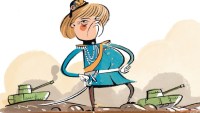
Angela Merkel is misunderstood. Last winter, when Russia moved to annex Crimea after the overthrow of Ukraine’s government, American officials put it about that the German Chancellor had described Russia’s leader Vladimir Putin as ‘living in another world’ and ‘out of touch with reality’. No evidence has emerged that she ever said any such thing. Europhiles in the press and in Westminster have now pulled the same trick on David Cameron. The Prime Minister has lately been ruminating about quotas for migrants from certain European Union countries. He complained last month when an unannounced £1.7 billion upward adjustment in Britain’s EU payment turned out to be triple the levy on anyone else.

How did Britain ever have unarmed criminals?

The release of Harry Roberts, the man responsible for shooting dead three policemen in 1966, has sparked a vigorous debate about whether he should have stayed in prison until he died. The idea that ‘life should mean life’ for anyone who kills a policeman is a police-pleasing policy that the Home Secretary promised she would implement in a speech to the Police Federation last year. But a more interesting aspect  of the Roberts story is what it shows about the changing nature of Britain’s career criminals, and the values — if that is the right word for them — that they share. Until quite recently, criminals in this country did not routinely carry guns. The relative rarity with which criminals went armed made it possible to have an unarmed police force.

Is the way our hospitals treat old people down to underfunding – or organised neglect?

I am leaving London soon, coming to the end of my time as a voluntary hospital visitor working from a chaplaincy in a London teaching hospital. I have been roaming around a variety of wards for the last three years, only one day a week, but in those few hours I have seen quite a lot. The most disturbing things have been the poor quality food, which cannot aid anyone’s recovery, and the neglect of the very old and vulnerable, the patients rather ominously labelled ‘bed blockers’. On my last visit, the Anglican chaplain was not in the hospital, so instead of attending a morning service with him in the hospital chapel, I went up onto the wards early, at breakfast time. In one ward there is a neighbour of mine, an old man I’ve known for years.

Watch out Pope Francis: the Catholic civil war has begun

‘At this very critical moment, there is a strong sense that the church is like a ship without a rudder,’ said a prominent Catholic conservative last week. No big deal, you might think. Opponents of Pope Francis have been casting doubt on his leadership abilities for months — and especially since October’s Vatican Synod on the Family, at which liberal cardinals pre-emptively announced a softening of the church’s line on homosexuality and second marriages, only to have their proposals torn up by their colleagues. But it is a big deal. The ‘rudderless’ comment came not from a mischievous traditionalist blogger but from Cardinal Raymond Burke, prefect of the Apostolic Signatura — that is, president of the Vatican’s supreme court.

The fightback against wackiness starts here

[audioplayer src="http://traffic.libsyn.com/spectator/TheViewFrom22_30_Oct_2014_v4.mp3" title="Henry Jeffreys and Sarah Coghlan from Movember discuss wackiness" startat=1491] Listen [/audioplayer]At Glastonbury in 2000 I noticed two young men both wearing enormous Y-fronts and carrying an even bigger pair with the word ‘pants’ written on it. They both looked miserable as you would if you’d come up with the idea while drunk and then found yourself stuck like that for the duration of the festival. Some of the more thuggish elements jeered and threw beer cans. Seven years later, at another festival I attended, they wouldn’t have attracted a second glance, because dressing up had become ubiquitous.

Why I’ve joined Lebanon’s exodus

In early autumn I was on a train travelling from London to Brighton, on the final leg of a journey that began earlier that day in Beirut, and which was taking me back to live in Britain for the first time in 22 years. It was late Friday afternoon and the man opposite me was droning into his mobile phone. He had not drawn breath since he joined at Clapham Junction except to take a swig from one of three bottles of Black Sheep beer he had lined up on the table. Friday night clearly couldn’t start soon enough. Back then, the Islamic State had just begun to pick at the edges of Lebanon. A force of 6,000 fighters from IS and the Nusra Front were scrapping with units of the Lebanese army in and around the Bekaa Valley border town of Arsal.

Jonathan Sacks on religion, politics and the civil war that Islam needs

Jonathan Sacks has an impressive track record for predicting the age we are in. In his 1990 Reith Lectures, ‘The Persistence of Faith’, the then chief rabbi pushed back against the dominant idea that religion was going to disappear. In the early 2000s, he predicted a century of conflict within Islam. And he was one of the first religious leaders and thinkers not only to critique multi-culturalism (‘the spanner in the works for tolerance’) but to try to think of a path beyond it. We recently talked over some of this at his house in London, where he lives during gaps in a busy teaching schedule that also takes him to New York.

The myth of the White Widow

Over the past year or so, a determined and fanatical Islamist has been waging a deadly and bloody war against the western world. This enemy is capable of moving unnoticed across continents and inflicting savage violence in each of them; inspires young Muslim men to become suicide bombers and die in their thousands. The enemy is particularly horrifying for being a traitor, born in Britain and a woman to boot. The ‘White Widow’, remember her? Samantha Lewthwaite from Aylesbury, usually described by our tabloid press as one of the most evil and powerful women alive. But is she really evil? Is she really even much of a threat?

Rand Paul is like Nigel Farage – except he might win

When America’s National Institutes of Heath said that it hadn’t cured Ebola yet because of budget cuts, Senator Rand Paul had an acidic answer. No, he told an audience of Republicans, the problem was not underfunding. It was bad priorities. ‘Have you seen what the NIH spends money on?’ he asked. ‘$939,000 spent to discover whether or not male fruit flies would like to consort with younger female fruit flies. $117,000 spent to determine if most monkeys are right-handed and like to throw poop with their right hands.’ And best of all, $2.4 million for an ‘origami condom’, which suggests something shaped like a swan. In fact, it’s modelled on the accordion.

How Cameron could make the EU a winning issue (and why he won’t)

[audioplayer src="http://traffic.libsyn.com/spectator/TheViewFrom22_23_Oct_2014_v4.mp3" title="James Forsyth, Mats Persson and Matthew Elliott discuss Europe" startat=60] Listen [/audioplayer]Imagine if David Cameron actually meant it. Imagine if he really did follow through with his implied threat to campaign for Brexit in the absence of better terms from Brussels. You can picture the televised address. An oak-panelled background with a large union flag hanging sedately in the corner, the PM with that furrowed house-captain expression he sometimes does. The script pretty much writes itself. ‘All of you know how hard I tried to secure a new deal. I was often criticised for being too conciliatory, but it was my duty to do whatever was in my power to reform the EU.

Bourbon from Bush, envy from Nixon… and running into Herbert Hoover: encounters with eight presidents

I feel a bit of a fraud writing about the ‘presidents I knew’, since journalists do not really get to know the great figures they interview or shake hands with. Indeed the relationship between journalist and great personage is about as false as any relationship can be, since each is trying to make use of the other. So in all likelihood my dreamed relationship with President Herbert Hoover — which began and ended in 1933 when I was aged 11 and only lasted for about a minute — came nearer to being a genuine human relationship than all the other journalistic ones later — which included Harry Truman, Dwight Eisenhower, Jack Kennedy, Richard Nixon, LBJ, Ronald Reagan and George H.W. Bush. Quite a mouthful. My Hoover story — to the best of my childish memory — happened like this.

It’s time to shave that beard: the decade of the hipster is over

[audioplayer src="http://traffic.libsyn.com/spectator/TheViewFrom22_23_Oct_2014_v4.mp3" title="Harry Mount and Aleks Eror discuss hipsters" startat=1572] Listen [/audioplayer]Calling all hipsters, it’s time to get the razor out! You have hit peak beard. You’ve had a decade of getting away with those narrow, short trousers and the studiously thought-out socks; with the Victorian archdeacon beards and the shaven sides to your heads. It wasn’t even that good while it lasted. Like gay fashionistas — but without any humour or bite — the hipsters stood in front of the wardrobe for an age every morning.

Escape from Omnishambleshire: the case for the old county boundaries

[audioplayer src="http://traffic.libsyn.com/spectator/TheViewFrom22_23_Oct_2014_v4.mp3" title="James Forsyth, Matthew Engel and Tom Holland discuss counties" startat=785] Listen [/audioplayer]Just over 35 years ago, in August 1979, Christopher Booker wrote a cri de coeur in The Spectator calling for the return of England’s ancient counties and the repeal of the 1972 Local Government Act, under which most of them had been either merged, mauled, mangled or murdered. It drew a large and almost wholly supportive response from figures as distinguished as Professor Richard Cobb (‘Booker has rendered us all a ray of hope’) and Michael Wharton, a.k.a.