Politics

Read about the latest political news, views and analysis

Europe’s leaders back the deal – but its real test is still to come

There was no great last-minute drama. The European Council signed off the Brexit deal in brisk fashion this morning, with leaders stressing that this is the best deal that they are going to offer the UK. But, of course, this doesn’t mean that everything is done and dusted. For now, Theresa May has to get this deal through parliament. This morning there have been two reminders of how difficult this will be. First, Iain Duncan Smith confirmed that he will be voting against the withdrawal agreement. This is a blow as if IDS is voting against it, then the ERG rebellion is going to be north of 20—making it very hard to see a way through for this deal.
No10: a response to Martin Howe QC

In this week’s Spectator, Martin Howe QC gives the legal verdict on Theresa May’s Brexit deal, and finds: ‘This is not a bad deal. It is an atrocious deal.’ His analysis was so widely circulated amongst MPs that No. 10 has written a response to it. For more on Theresa May’s bad deal, here’s Mr Steerpike’s list of the top 40 horrors lurking in it. Claim Once the Protocol is in force, the UK cannot leave it except by ‘joint’ decision of the UK and the EU. This gives the EU a right of veto over the UK’s exit. In agreeing to this clause, the government has caved in over seeking a right to leave. Response The Protocol is explicit in the legal text that it is intended to be a temporary arrangement.

Boris Johnson’s speech to DUP conference: ‘we are on the verge of making a historic mistake’

On Friday evening, Philip Hammond headed to DUP conference in a bid to win over Arlene Foster’s party after they went on strike over the Irish backstop. With Foster telling the BBC that the DUP’s confidence and supply agreement could be over permanently if Theresa May’s deal is voted through, the future does not look bright when it comes to Tory/DUP relations. But could a new leader change all that? In recent weeks DUP politicians have been keen to stress that their agreement is not with Theresa May specifically – but with the Conservative party as a whole. So, it was an interesting move by Boris Johnson to speak at the conference this weekend. Attendees at the events report of Boris-mania sweeping the venue.

Is the backstop vulnerable to challenge under human rights law?

The most contentious part of Theresa May’s Brexit deal are the Northern Ireland specific provisions of the backstop. These would see various EU rules and regulations apply in Northern Ireland even after the UK has left the EU. If they came into force, they would create—in some areas—a kind of regulatory border in the Irish Sea. But, as I say in The Sun this morning, these provisions might be illegal under European Human Rights law. A case in 1999 brought against the UK government, the Matthews case, at the European Court of Human Rights established that people have a right to vote in elections to the parliaments that set their laws.

Revealed: Philip Hammond’s speech at DUP conference – Boris, Rees-Mogg and the backstop

With the DUP currently refusing to vote with the Tories following grievances over the proposed Irish backstop, Theresa May's party is having to try out life as a minority government. Piling on the pressure, DUP leader Arlene Foster has told the BBC that her party would have to revisit its confidence and supply deal with the Tories permanently if May's Brexit deal passes through Parliament. So, spare a thought for Philip Hammond. Spreadsheet Phil was given the task of being sent to DUP conference to charm attendees on behalf of the government. Mr S's mole in the room reports that the Chancellor managed to crack a few jokes at the expense of his Tory colleagues. On recent cabinet resignations: 'I look around the room and I see some people I know. I see a lot of new faces.

Will May’s Brexit deal stop us making jokes about Juncker?

Article 129 (3) of the withdrawal agreement provides that ‘the United Kingdom shall refrain, during the transition period, from any action or initiative which is likely to be prejudicial to the Union’s interests, in particular in the framework of any international organisation, agency, conference or forum of which the United Kingdom is a party in its own right.’ What does that mean? That we are not free at the UN Security Council to oppose any item of EU foreign policy? That we cannot cut our rate of VAT? That we must not make jokes about Jean-Claude Juncker? Needless to say, there is no reciprocal obligation on the EU to do nothing prejudicial to the interests of the United Kingdom.

Scrapping juries in rape trials would be a mistake

Juries, and the right to a fair trial, are under threat from the left. The latest attack came from Ann Coffey, the Labour MP for Stockport, who believes that we should consider abolishing juries in rape cases. A few months ago, the tax barrister Jolyon Maugham QC – no friend of the current Labour leadership, but something of a weather vane for more moderate left-wing thinking – floated the same idea. Coffey's argument is that 'juries view evidence through the lens of prevailing stereotypes shared with the wider community.' As a result, she says, 'the most common cause of unsuccessful prosecutions in rape prosecutions is jury acquittal'. Her suggestions to resolve this include the idea that jurors in rape cases should be 'vetted for preconceived bias.

Supporters of a second referendum should be careful what they wish for

The campaign for a second referendum continues to grow. On the Conservative side, nearly a dozen Tory MPs now support a 'People's Vote’ and if Theresa May's deal gets voted down, this number is likely to rise further. Among Labour MPs, support is even greater; if it wasn't for Jeremy Corbyn and John McDonnell, it seems safe to say that a second vote would almost certainly be Labour party policy by now, with the SNP and the Lib Dems also on board with the idea. But a question remains: have those calling for a second vote really thought about the possible consequences? It is clear that many of those campaigning for another referendum have a simple objective: to block Brexit. But this could easily end up backfiring. Take the 2014 Scottish independence referendum.

Diane Abbott’s warning to second referendum supporters

Diane Abbott has a stark warning for those clamouring for a second referendum: be careful what you wish for. The Labour MP's warning won't go down well with those from the 'People's Vote' campaign, who desperately need the support of the Labour party if their wish is to come true. On Nick Robinson's podcast, Abbott was asked what would happen if another vote took place. Here's what she said: 'My view is that if we had a second referendum tomorrow, Leave would win again. And not only would Leave win again, but Leave voters would say: what didn't you understand about Leave the first time?' Mr S thinks Abbott is talking sense...

Watch: Theresa May dodges Brexit deal question

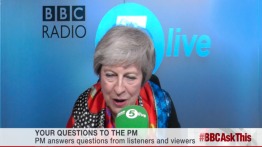
Theresa May is back on the radio flogging her Brexit deal to a sceptical public. Unsurprisingly, few of those who phoned in to BBC 5 Live seemed impressed by what the Prime Minister had to offer. One listener asked the PM to tell him, without any 'political waffle', whether her deal is better than staying in the EU. But May's bid to do just that didn't exactly work out to plan. At the end of May's minute-long answer, the host Emma Barnett asked for the caller's verdict: EB: 'Michael, did the PM answer your question?' Caller: 'No' Emma Barnett ended the interview by asking May how she and Philip would celebrate if the deal got through Parliament. The PM seemed momentarily stumped by the question before the Maybot kicked in with an answer: TM: 'If...well...er...I will...

Dominic Raab is just saying what a lot of Leave MPs are thinking

After resigning as Brexit Secretary over Theresa May’s proposed deal, Dominic Raab has restyled himself as one of the more loyal of the Brexiteer rebels. He used an appearance on the Andrew Marr show over the weekend to say that although he would note vote for the deal as it currently stands, he still backed Theresa May as Prime Minister and would vote for her in any confidence vote. This morning he is upped the ante, however, with an interview on the Today programme. Discussing both the withdrawal agreement and the future framework (which was set out on Thursday), Raab was frank in his assessment. The Tory Brexiteer said he would prefer EU membership to what’s currently on the table.

Listen: Nigel Farage calls for another leader to go

Since Nigel Farage stepped down as the head of Ukip in 2016, the subsequent leaders have, to put it mildly, struggled to stay in power for very long. First there was Paul Nutall, who stepped down after nine months following a disastrous election showing - and some questionable claims about his involvement in the Hillsborough disaster. Then there was Henry Bolton, who barely got through five months before he was ousted due to his relationship with Jo Marney - a model who had sent racist texts. Current leader Gerard Batten replaced him in February, and has held on to power ever since. But could that be about to change? Former leader Nigel Farage was on the Today programme this morning, and called for Batten to go, after the party instated Tommy Robinson as a grooming advisor.

What’s in the small print of Theresa May’s “political declaration”?

Granted, it's not another 40 horrors list but Mr Steerpike was struck by Paragraph 79 of the EU/UK Political Declaration: 'The future relationship must ensure open and fair competition. Provisions to ensure this should cover state aid, competition, social and employment standards, environmental standards, climate change, and relevant tax matters, building on the level playing field arrangements provided for in the Withdrawal Agreement and commensurate with the overall economic relationship.' That would suggest that the starting point for the supposedly final UK-EU trade deal relationship is… wait for it…. the backstop. The one that we're never supposed to use.

The failure of the Climate Change Act: ten years on

The Climate Change Act is ten years old. It was passed in a different age. David Cameron had been hugging huskies to de-toxify the Tories. It was a year before the Copenhagen Climate Conference. ‘Fifty days to set the course for the next 50 years,’ Gordon Brown declared. China and India’s veto put paid to that, but Britain is still lumbered with a law that puts huge economic power into the hands of an unaccountable body, the Committee on Climate Change, which entrenches climate policy unilateralism. However much greenhouse gases the rest of the world puts into the atmosphere, the Climate Change Act compels Britain to almost completely decarbonise.

Letters | 22 November 2018

There is no ‘good’ Brexit Sir: David Harper claims to know ‘what the population of the UK voted for’ in the EU referendum (Letters, 17 November), yet no definitive Brexit plan was ever offered by the Leavers. That is one reason why the government, having prematurely triggered Article 50 and recklessly established its ‘red lines’, has been floundering in an attempt at damage limitation. Harper’s disparagement of the single market ignores the fact that any gains from new trade agreements with non-EU countries would be greatly outweighed by the costs of leaving it and would require exports to these countries to grow at a rate that is unfeasible.

Spoken vs written word

The country’s champions of free speech — the police — were recently out in force to ensure that the alt-right Trump-supporting Steve Bannon could address the student union in Oxford. The students, inevitably, wanted him silenced. But what were they so afraid of? Plato knew: it was a matter of the difference between the spoken and the written word. In Plato’s dialogue Phaedrus, Socrates told a story that the Egyptian wise man Theuth was responsible for many inventions, but presenting them all to the king Thamus, he claimed that writing was the finest of the lot, ‘the magic key to memory and wisdom’. Thamus disagreed: writing would destroy memory, and therefore internalisation of learning.

The Spectator’s Notes | 22 November 2018

It will be interesting to see whether the about-face of the Daily Mail on Brexit makes the slightest difference to anything. Paul Dacre was admirably consistent when he was editor and the paper did well. But on the whole, the history of the Mail is that it is happy dramatically changing sides on major issues. Under David English, for instance, it suddenly switched to Europe and Heseltine away from his earlier Thatcher-worship, and few seemed to notice. Thus, after attacking the High Court judges as enemies of the people in 2016, under Dacre, it can move effortlessly to attacking the Brexiteers as ‘preening peacocks’ etc, under Geordie Greig.

Diary – 22 November 2018

‘Away with the cant of “measures not men”! — the idle supposition that it is the harness and not the horses that draw the chariot along. No, Sir, if the comparison must be made, if the distinction must be taken, men are everything, measures comparatively nothing.’ George Canning said this in 1801 and recent events remind us that he was right. In the end the only way to change the policy is to change the person, as the individual determines the direction and is rarely willing to try a different route. As I have known this quotation for decades, it was naïve of me to expect the Prime Minister to change her policy. It is not how it works: the wrong policy means the wrong person.