Politics

Read about the latest political news, views and analysis

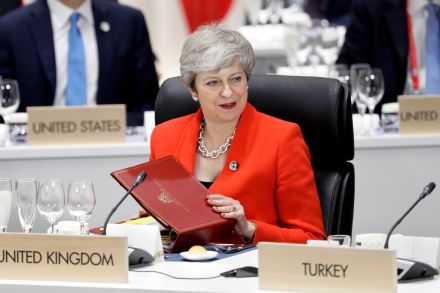
Theresa May says goodbye to old friends at Japan’s G20

Theresa May makes her final bow on the world stage in Japan, where she is attending the G20 heads of government meeting in Osaka. It’s a funny place for it all to end. Japan’s second city prides itself as the country's comedy capital. It is home to Japan’s ‘manzai’ tradition – a slapstick straight man/funny man double act which involves a lot of head slapping and cross talk. Besides their sense of humour, Osakans are known for their garrulousness, gaudy clothing and their suspicion of haughty, overly serious Tokyo. Think of Glasgow’s relationship to Edinburgh, or Newcastle’s to London, and you’re not far off.
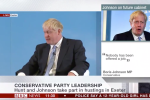
Watch: Boris suggests the Foreign Office is behind ‘turdgate’

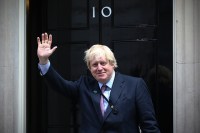
Last night it was suggested that when Boris Johnson was Foreign Secretary, he was caught on camera by a BBC fly-on-the-wall documentary saying that the French were 'turds' for their intransigence during the Brexit negotiations. According to the Daily Mail the Foreign Office then allegedly lobbied the BBC to remove the offending line from the documentary when it aired last November. As shocking revelations go, being caught secretly insulting the French is probably not going to seriously harm Johnson's prospects with the Tory membership. Nonetheless, speculation has already turned to where the story came from. Johnson certainly fuelled the rumours today when he was asked about the incident during Tory leadership hustings.

Are Tories fanatics? The New York Times thinks so

The New York Times’s strange jihad against post-Brexit Britain continues. Some readers may have missed the paper’s insistence that having only just finished eating mutton, the British public are currently stock-piling food and all but preparing to start eating each other (see here, here, and here just for starters).  But yesterday they have returned to the fray with the international edition of the paper carrying a front-page piece declaring ‘Extremists hijacked UK politics’.  The online version of the story is headlined ‘A fanatical sect has hijacked British politics’.

Brexit party MEP Claire Fox shows solidarity with Boris

Tom Penn and Eve Leigh, the next-door Remainer neighbours of Boris Johnson and Carrie Symonds who recorded their late-night row, managed to spark a lively debate about the balance between public interest and privacy when they passed the recording on to the Guardian shortly after the incident last weekend. It appears though that the Brexit party's Claire Fox is squarely in camp Boris when it comes to the couple's right to argue in their own flat. Speaking at Forest's 40th Anniversary Gala Dinner, the Brexit party MEP and Moral Maze panelist hit out at their neighbours' decision to pass the recording on to the newspaper.

Boris Johnson will make us long for Theresa May’s return

He just will not do. Sexual incontinence alone should not disqualify Boris from the premiership, though it is hardly an asset. But the latest incident dramatises the flaws in his character. Indeed, one could say that he is all flaw and no character. There are three major flaws. The first is serial dishonesty. He simply has no concept of truth. As Philip Stephens of the FT once put it, Boris has lied his way through life and politics. He will say whatever is necessary to get himself out of a hole of his own digging. But if anyone quotes Boris back to himself, even a couple of days later, his reaction will be incomprehension and irritation. The second is profound selfishness. For Boris, other people only exist as an instrument of his own gratification.

Rory’s classic mistakes

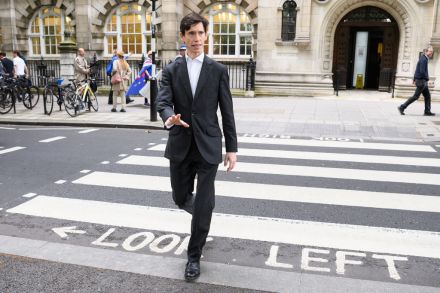
If Rory Stewart had taken full advantage of his education at Eton and read classics at Oxford rather than PPE, he would not have made the basic mistakes that blew apart his short-lived campaign to become prime minister. Not that his failure was one of content: far from it. His views on public services and Brexit were entirely predictable and could be correct. So what went wrong? His failure was one of rhetoric, the skill of peaceful persuasion dissected by Aristotle and further refined by Cicero; and his failure consisted in his being so swept away by his millions of followers on social media that he started to believe his own hype, as if that guaranteed victory. But to win, you must persuade those who are not your followers.

Ignoring Iran

Crises in the Gulf and Conservative leadership elections come around with unnerving regularity. It is not unknown for both to coincide — that happened in 1990, when Margaret Thatcher was overthrown in the lead-up to the first Gulf War. On that occasion, drama on the domestic front did not smother Britain’s response to the international crisis — unlike now. It is bizarre to have a US president threatening to ‘obliterate’ Iran while our Foreign Secretary hardly bothers to respond, preferring to pose with fish and chips and Irn Bru on the campaign trail.

Diary – 27 June 2019

I spent the early part of last week in London, filming what are known in the television trade as PTCs (‘pieces to camera’). These will form the connecting tissue for a three-part documentary series loosely based on my most recent book, The Square and the Tower. Ten years ago, I did a lot of this kind of thing. A series of books, beginning with Empire, started life as television scripts, in an effort on my part to bring history to a wider audience. (The effort was quite successful but earned me the disdain of a certain kind of academic prig.) In those days, PTCs were delivered on location, and the more exotic the better — I have an especially stomach-turning memory of dangling from a helicopter over the Victoria Falls.

Barometer | 27 June 2019

To debate or not to debate Is Boris Johnson wise to shun TV debates? — Prior to the 2015 Labour leadership election, TV debates had not been part of party leadership debates, and have only been part of general elections since 2010. — The first election to feature a TV debate was the 1960 US presidential election, when JFK and Nixon met for four debates. The first, staged by CBS, went out on TV and radio, when radio audiences favoured Nixon and TV audiences favoured Kennedy. Nixon had just left hospital, and had applied a product to cover up his five o’clock shadow. Under the TV lights it began to melt, making it look as if he was dribbling. Six per cent of the electorate said the TV debates had played a role in making up their mind, and Nixon went on to lose by 0.

Ed ‘Double O’ Davey’s leadership pitch

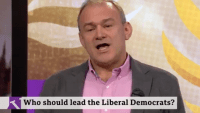
Has the excitement of pitching to be the next leader of the Liberal Democrats gone to contender Ed Davey's head? Yesterday, the potential successor to Vince Cable was forced to apologise for his violent language, after he said a Remain alliance should 'decapitate' the 'blond head' of Boris Johnson in an opinion piece for the Times. The embarrassing U-turn appears not to have discouraged Davey though from his adventurous approach to winning the leadership contest. Taking part in a leadership debate on Victoria Derbyshire this morning, Davey revealed that he had been approached by MI6 at one point in his career: 'As a younger man I almost served our country in a different way. MI6 tried to recruit me to be a spy overseas.

Battle of Hastings

Sir Max Hastings, whom I engaged as editor of the Daily Telegraph in 1986 and who stayed in that role for about nine years, seems to have installed himself at the head of the rabid mob of journalistic haters of Boris Johnson. In recent pieces in The Spectator and the Guardian he has described Boris as ‘a tasteless joke’ interested only in ‘fame and gratification… a scoundrel or a mere rogue’ (a subtle distinction), and in any case a man afflicted by ‘moral bankruptcy’. Max concedes that Boris is likely to be the next prime minister and preemptively accuses him of conducting a ‘celebrity government as in Ukraine and the US’.

My advice to Boris’s keepers

I had never heard of Mark Field until he was suspended for removing, in a commendably vigorous manner, the Greenpeace protester Janet Barker from a black tie event in London, where guests had gathered to listen to a speech from the man who is still Chancellor for a bit, Philip Hammond. I wondered immediately if Field could be shoehorned into the leadership contest somehow, given his decisiveness and admirable restraint. Faced with Ms Barker, I might have acted with less restraint, even if I agree with most of the stuff she’s protesting about. She posed a possible danger to guests and for feminists to say that she didn’t, because she’s a lady, seems to be having one’s cake and eating it. But it is not that that enrages.

Boris’s biggest challenge

Every campaign has a wobble — and Boris Johnson is getting his in early. A mix of complacency (he felt confident enough to allow his campaign fixer, James Wharton, to catch up on his other commitments) and the drama at his partner’s flat have combined to put him on the back foot. To compound matters, Jeremy Hunt has gone on the offensive. It’s starting to resemble an actual contest. Or it might, if there were really any serious prospect of him losing. As one veteran of Tory leadership contests puts it: ‘The members are still behind Boris. It is Brexit, Brexit, Brexit.’ This Tory argues that when the Brexit-backing members hear the attacks on Boris Johnson, they assume it is as much about stopping Britain leaving the EU as anything else.

Casanova Corbyn

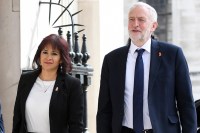
He has been married several times, has a way with the ladies and always seems to land on his feet no matter how colourful his romantic life. Not even the 20-year age gap between him and his current squeeze has tripped him up in the court of public opinion. His looks aren’t conventional and yet women seem to find our potential new prime minister unfeasibly attractive. I don’t get it, personally. But maybe I’m in the minority. When an old schoolfriend of mine met him at a business event recently she posted pictures of herself on Facebook hugging him. He clearly had her completely captivated. But as he could be the next leader of our country, should we not think a little more closely about his private life?

Prophets of gloom

There’s a lot of anger about — and it’s not pleasant. But at least it means people are engaged as well as enraged. What’s more worrying and increasingly irritating is the negativity, the drip-drip of despondency that’s been allowed to seep into so much of daily life. Everything is broken! All is lost! The end is nigh! Which is fine if you’re a Jehovah’s Witness or believe that the eschatological prophecies of the Bible have pretty much all come to pass. Every day we are told repeatedly that ‘catastrophe’ awaits.

Alms for arms

In the rush to declare Isis dead now that its caliphate has been routed from Iraq and Syria, it’s easy to forget that its Nigerian fellow traveller, Boko Haram, is still going strong. April’s five-year anniversary of the Chibok schoolgirls’ kidnapping, for example, passed with barely a celebrity tweet to mark it, despite the fact that 112 of the girls are still missing. Nor is much fuss likely to be made next month, when an insurgency that has killed nearly 30,000 will enter its second decade as violent as ever. Out of sight and out of mind, Boko Haram’s power is growing. And to find out why, all you have to do is follow the children who beg on the streets of Nigeria’s northern cities.

We should never have expected the SFO to bring banks to justice

Friends of former Barclays chief executive John Varley — I don’t mean ‘people who speak to the media on his behalf’, but rather people like me who have known him all our working lives and hold him in high regard — were relieved to hear he has been cleared of fraud charges relating to the bank’s 2008 capital raising from Qatar. Charges against Barclays itself were dropped last year but Varley’s co--defendants Roger Jenkins, Tom Kalaris and Richard Boath now face a retrial — so I’ll say no more for now about the Serious Fraud Office’s handling of this dossier. But it’s fair to ask, in general, how well our criminal justice system has dealt with the ramifications of the financial crisis.

What Rory Stewart did next

Rory Stewart’s pitch for prime minister seems strangely distant now, lost in the enveloping chaos of Boris Johnston’s shamble to glory. All is not lost, however. The divergent metrics of parliamentary and public sentiment – and the character deficits of the frontrunner, who claims to be able to square that circle – make it abundantly possible that Stewart will have another chance to shine before the year is out. So what should he be doing in the meantime? I was peripherally involved in Stewart's leadership campaign, helping to organise some of his Northern Ireland visit, including a trip to my home county (and Britain's true Lake District) Fermanagh.