Politics

Read about the latest political news, views and analysis

A no-confidence vote might help Boris Johnson

I am up on the far north-west coast of Scotland, where the weather is changing every five minutes under vast skies and huge seascapes. Go to the beach and look left, and it’s a sparkling Mediterranean scene, bright white sand and opalescent turquoise water, what you might call Rossini weather. Swivel your gaze right, and vast dark clouds tower up, obliterating mountain ranges — Bruckner weather. Me? Like Isabel Hardman, of this parish, I just walk straight into the sea and swim. The choppy water is certainly cold but the whole experience is elating, and good for clearing the head. Which is, of course, what we need this summer. August politics is changing faster than the August skies, and this autumn looks set to be the most politically dramatic in my lifetime.
Meet the Brexit party’s secret weapon: a stand-up comedian

He looks nothing like a financial expert. Moneyweek journalist, Dominic Frisby, has a huge Santa beard and he dresses like a funeral director from a Roald Dahl fantasy: a top hat, a white shirt with wing-collars and a flowing silk cravat. As a gesture of solidarity with the gilets jaunes he sports a bright yellow high-vis waistcoat as well. I meet him at the Edinburgh festival just after he finishes his stand-up show, Libertarian Love Songs. Frisby has recently been adopted as a parliamentary candidate for the Brexit party and he’s keen to parade his skills as a financial commentator rather than as a clown: ‘I got interested in politics after I started investing in gold in the early noughties. And gold is a very political investment because it used to be money.

Can France keep Germany in check after Brexit?

‘France has a German policy, she has no other’, remarked the seasoned observer of international affairs and future editor of Le Monde André Fontaine in 1952. With a British withdrawal from the EU she is again confronted by an old demon dating from 1871 : management of a dominant Germany on the continent of Europe. Paris has sought to counter German power, whether military, political or economic, by two broad means since 1900. The first means was to secure Britain as an ally and ensure she remained committed to the security of continental Europe. This she was successful in doing prior to 1914 and 1939. However, the immediate post-war years were a different story.

Boris’s nightmare is that the EU accepts his Brexit offer

As was to be expected, the EU’s reaction to Boris Johnson’s offer of revisiting the Withdrawal Agreement if the backstop is removed has been to reject it out of hand. But there are still 68 days to go before the UK is due to leave the EU and if the EU’s resolve wavers between now and then, Boris’s high-risk strategy could come back to haunt him. Reading Martin Howe’s evisceration of the Withdrawal Agreement, one is reminded of Jerome K Jerome’s visit to the doctor in Three Men in a Boat. Rather than explaining that he was suffering from the symptoms of pretty much every disease known to mankind, J found it easier to tell his doctor the one thing that was not wrong with him: housemaid’s knee.

What would George Orwell make of Brexit?

In the London Review of Books this month, James Meek wrote a long article about Jacob Rees-Mogg and his ‘curious duality’ in being both a high Catholic, fogey Brexiteer and a founder of Somerset Capital Management, which the author sees as globalist and ruthless. The piece is elegantly done, but entirely sneery. It makes not the slightest attempt to enter into the Mogg’s (or any Brexiteer’s) mind with any sympathy. I was thinking about this because the LRB’s publicity emphasised that Meek is an Orwell Prize winner. How we need an Orwell on the subject of Brexit.

Stop thinking Merkel will save us, Dominic Cummings warns

Is Boris Johnson more likely to get a Brexit deal after his meetings with Angela Merkel and Emmanuel Macron? The Prime Minister today tried to dampen hopes, saying that while the 'mood music' had been 'very good' during his meetings with the two leaders this week, it was still going to be hard to persuade the EU to give way. Speaking during a visit to Devon, Johnson said: 'This is not going to be a cinch, this is not going to be easy. We will have to work very hard to get this thing done.' Much of the week has been spent trying to work out what various comments and bits of body language really mean. Was Johnson celebrating successful talks or just having a stretch when he arrived back in Downing Street after his meetings?

CCHQ leaves potential candidates scratching their heads

Mr S was curious to spy a puzzling email sent out by CCHQ to their prospective parliamentary candidates today. The message asked would-be Tory runners to send in their CVs so that the party can select candidates for the next general election. Recipients were told that anyone selected as a parliamentary contender would cease to be a candidate if 'an existing MP exercises an incumbency right over it'. The email reads: The Board of the Conservative Party has decided to proceed with selections in constituencies that would be affected by Major Boundary changes under the Parliamentary Boundary Review.

Macron’s no-deal Brexit gamble could backfire

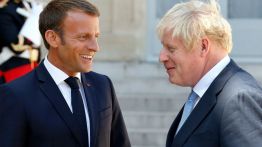
The ‘Non’ was not quite as frosty as it might have been. When Boris Johnson met up with France’s president Emmanuel Macron there were at least some pictures of the two men talking amicably. Even so, while Germany’s chancellor Angela Merkel and some of the EU’s other leaders have at least left the door a tiny bit open to renegotiating the UK’s departure from the EU, Macron made it clear it was almost completely shut. In fact, Macron is making almost as big a bet as Johnson. His calculation is that a no-deal Brexit will work to France’s advantage. Yet he may well have mis-calculated – and it could easily drive his own economy into recession.

Brexit poetry competition: Winner announced

The time has come to announce the winner of our much-lauded Brexit poetry competition. Earlier this week, we called on our good readers to provide us with a poem to commemorate the UK's exit from the European Union on 31 October. Our announcement came in response to the Poet Laureate Simon Armitage saying that he had 'no plans' to pen a piece for Brexit day. The winning poem was short and sweet. Step forward, MrToad76: Brexit, Brexit Just get on with it. The judges were impressed by MrToad76's delicate balance between brevity and passion.

Brace yourself for no deal

I AM up on the far north-west coast of Scotland, where the weather is changing every five minutes under vast skies and huge seascapes. Go to the beach and look left, and it’s a sparkling Mediterranean scene, bright white sand and opalescent turquoise water, what you might call Rossini weather. Swivel your gaze right, and vast dark clouds tower up, obliterating mountain ranges — Bruckner weather. Me? Like Isabel Hardman, of this parish, I just walk straight into the sea and swim. The choppy water is certainly cold but the whole experience is elating, and good for clearing the head. *** WHICH is, of course, what we need this summer. August politics is changing faster than the August skies, and this autumn looks set to be the most politically dramatic in my lifetime.
Boris is facing his Sparta moment

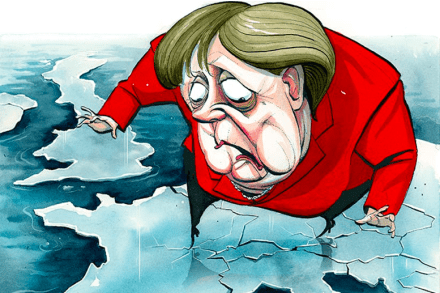
The PM’s hero is the Athenian statesman Pericles, and a Periclean crossroads is now approaching. According to the biographer Plutarch, Pericles’ influence begins during Athens’s golden age, when its power was expanding at the expense of Sparta, its rival city-state. Though an aristocrat, Pericles turned himself into a populist, but took care not become too familiar a figure. He was seen in public only when on political business and generally kept a low profile (as Boris was accused of doing in last week’s Spectator editorial). Pericles then began to ‘borrow’ money on various pretexts, pouring it into public festivals, fees for public services and fabulous major building works (one of which was the Parthenon).

To get a deal Boris needs to show (or fake) some humility

There were many Brexiteers who were urging Boris Johnson to travel to Washington before he went anywhere else, to underline that Britain’s most important relationship is with the United States. And if the EU felt nervous seeing the UK cosy up to America, so much the better. But the Prime Minister’s first visit was to Berlin, and then to Paris, to see if a Brexit deal can be negotiated and the needless disruption of a no-deal exit avoided. It seems, at present, a rather long shot. Theresa May famously said little in one-to-one meetings with European leaders. Boris Johnson can be a lot more forthright, and should speak with candour about his own lack of room for manoeuvre.

The good, bad and ugly of Boris Johnson’s Brexit letter to the EU

Boris Johnson has written to European Council president Donald Tusk, setting out key aspects of his government’s approach to Brexit. The four-page letter has a number of positive points but also some worrying ones. The good bits: The letter condemns the Irish backstop as undemocratic and inconsistent with both UK sovereignty and the Good Friday Agreement. It also rightly notes that the backstop would lock the UK into a customs union with the EU indefinitely with no means of escape. The letter also states that the UK government cannot continue to endorse the commitment its predecessor made in the Joint Report of December 2017 to ‘full alignment’ with wide areas of the single market and customs union.

Why Britain, like Iceland, will thrive outside the EU

I have no doubt that Britain will thrive after leaving the EU, whether or not it leaves with a deal. I say this as a former prime minister of a country, Iceland, which left the EU before it had even joined — and which went on to prosper in a way which would have been impossible had its application for membership been carried through to conclusion. I think Britain can learn from Iceland’s experience and find a way to avoid any major disruption when 31 October comes round. In late 2008 Iceland suffered especially harshly from the international financial crisis. The country’s banking system experienced a near-total collapse. The value of the currency tumbled, inflation surged, government debt as a percentage of GDP more than tripled in an instant.

We need the monarchy more than ever

One part of our unwritten constitution has been functioning perfectly during the Brexit upheaval: the monarchy. Unhappy behaviour by some younger royals reminds us how jealously the institution must be protected. It will also be essential to guard the monarchy’s impartial ‘light above politics’ (Roger Scruton’s happy phrase) with more care than ever in the inevitable Brexit arguments of the next few months. Since Elizabeth II came to the throne in 1952, aged only 25, she has provided a comforting, non-political presence throughout immense and often unsettling change in this country. There is no way in which a succession of republican presidents (probably politicians kicked upstairs) could have done the same.

It’s time to talk about what no deal really means

The main reason Conservative MPs prefer Boris Johnson’s government to Theresa May’s is because of its clarity of message. The government now has direction and purpose. Briefings from Tory HQ, delivered even to those MPs who have managed to get away on holiday, have gone from intermittent and inconsistent to daily and succinct. The message is simple: Brexit will be delivered by 31 October, crime is being tackled and the NHS properly funded. We can expect to hear these messages, or variants thereof, for the next few months. But there is one area where the government seems less sure of itself: what will happen in the event of no deal?

The false equivalence between victims and perpetrators of the Troubles

Julian Smith used to have the unenviable task of being Theresa May's chief whip. As the newly-appointed Secretary of State for Northern Ireland, he now has an even harder job. Wrangling unbiddable MPs pales into insignificance when arbitrating the causes and consequences of a brutalised polity. Members of Northern Ireland’s devolved government still refuse to sit with each other and the legislative assembly is defunct. The police service is chased off Northern Irish housing estates by teenagers and regularly targeted for murder by dissident republicans. Putrid commemoration of dead terrorists saluted by gunfire and sinister paramilitary parades barely raises an eyebrow.

Is Imran Khan Pakistan’s prime minister or a puppet?

When Pakistan's prime minister Imran Khan handed the country’s army chief, general Qamar Javed Bajwa, a three-year extension on Monday, press reports didn't tell the full story. The true picture is very revealing of Khan’s own position and shows how his views have changed dramatically. To start with, this was no simple extension for a man appointed to Pakistan's most powerful position. That would suggest Bajwa's term of office had been increased by a limited period. In fact, general Bajwa was given a full second term. The official notification from the prime minister’s office makes this clear: “Gen. Qamar Javed Bajwa is appointed Chief of Army Staff for another term of three years from the date of completion of current tenure”.

Watch: Boris Johnson makes the Germans laugh

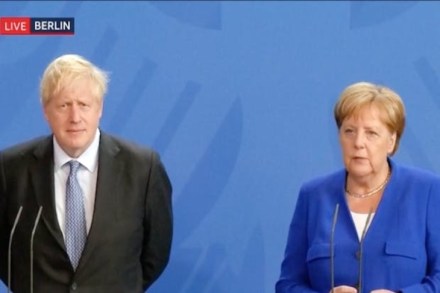
Boris Johnson's critics predicted that he would be something of a disaster on the world stage, but his debut as Prime Minister in Berlin has got off to a good start. Firstly, he avoided the fate of Theresa May, who managed to get locked into her car when she arrived to meet Angela Merkel. And Boris has also cracked the famously difficult German sense of humour. During a press conference with the German chancellor, Boris turned to Brexit and said that he was optimistic that a Brexit deal could be done. He then borrowed Merkel's own phrase, 'Wir schaffen das' – or we can do this – which she famously used at the height of the 2015 migrant crisis. His comment went down well with the audience in Berlin. But Mr S wonders whether Merkel also saw the funny side...