Politics

Read about the latest political news, views and analysis

The Amazon fires are as much a political story as an environmental one

We do not yet know which 100 citizens will make it to the ‘Citizens’ Assembly’ to be chaired by the Archbishop of Canterbury, which will look at ways of preventing a no-deal Brexit. So we cannot yet judge whether the organisers have come up with a system of selection which improves on the representative powers of parliament. But really we do not need to, because we know already that they will not be able to bring the ‘reconciliation at a time of national emergency’ which the Archbishop seeks. This is because the idea that a no-deal Brexit must be prevented is not an irenic proposition around which people can unite, but an intensely political one over which they inevitably divide.
For a solution to the backstop, team up like Rome and Carthage

The EU is demanding that, in return for a new deal, the UK must come up with a solution to the Irish backstop problem. But since the UK will happily leave with no deal, the EU will have to find a solution anyway. Let the Romans help out. Latin foedus (cf. ‘federal’) meant a treaty that guaranteed peace and friendship between Rome and another state, in perpetuity. There were two standard models. A foedus aequum (‘equal’) put both parties on an equal footing. The first we hear of between Rome and the local cities of Latium agreed eternal peace, mutual assistance against enemies, equal sharing of spoils and speedy settlements of commercial disputes. Here both parties wanted exactly the same outcome.

Ruth Davidson: why I had to resign as Scottish Tory leader

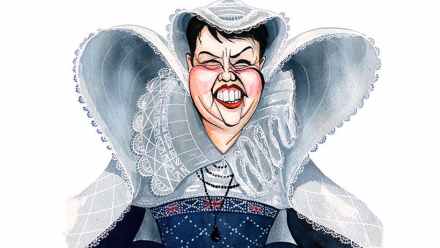
It has been the privilege of my life to serve as the leader of the Scottish Conservative and Unionist party. The almost eight years I've spent at the helm have coincided with one of the most remarkable and important periods of recent Scottish political history. I am proud of the teams we have built in Holyrood, Westminster and in council chambers across the country and proud of our electoral successes in recent years. All of that pales in significance compared to the vital role our party undertook in the Scottish independence referendum of 2014. I will always consider that the most important contribution of my working life and my commitment to keeping the United Kingdom together remains undimmed.

The treatment of EU nationals will be a litmus test of Boris Johnson’s Brexit

What makes Boris Johnson an improvement on Theresa May? Those of us who cheered him on into 10 Downing Street have a long list. He backed Brexit, so would stand a far greater chance of getting it done. He’d hire better people, who could outwit and outmanoeuvre his parliamentary enemies (as we have seen this week). He is acting with a pace and with a daring that is extraordinary – and commensurate with the challenge he faces over Brexit. But the real point of Boris as leader is that he promised to give his party a better chance of healing the divisions of the referendum and uniting the country. This might sound fanciful, when his enemies are howling over the prorogation of parliament and referring to him as a dictator.

What will the Tory and Labour election campaigns look like?

We know that the Conservatives are gearing up for an election in the next few months. Their official line is that they don't want one, largely because it will appear better if they are apparently pushed into a poll, but that doesn't mean that preparations aren't well underway. One of the main benefits of proroguing parliament is that it allows the Tories to produce an election manifesto before there is an election, using the Queen's Speech. In today's Guardian, I've written about what's going to be in that manifesto/Queen's Speech: the focus will be on education and crime.

The rage against Boris

This morning, a petition demanding ‘Do not prorogue Parliament’ is doing the rounds. At the time of writing, more than 1.4 million people have signed it. Remainers are very excited. They’re holding the petition up as proof of a mass outpouring of democratic disdain for Boris Johnson’s decision to suspend Parliament for a few more days than is normal. It is no such thing. It looks more like yet another middle-class hissy fit against Brexit and the people who voted for it.  As the petition map demonstrates, the signatories are strikingly concentrated in certain parts of the country, especially the leafy, super-middle-class bits of southern England.

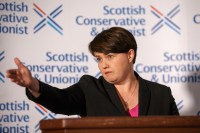
Ruth Davidson takes a pop at David Cameron in her resignation speech

Ruth Davidson’s departure is a blow to the Tory party and the Union. Without her, the Tories will find it even more of a struggle to keep hold of their Scottish seats at the coming Westminster election. At the same time, the removal of such a formidable campaigner will make it that bit easier for the pro-independence parties as they try and win a majority at Holyrood in 2021—something that would almost certainly lead to a second independence referendum. Davidson’s press conference this morning was an understated affair: this was not an emotional goodbye, more a matter-of-fact resignation. I suspect that Number 10 will have been relieved by the fact that Davidson while not hiding her differences with Boris Johnson over Brexit, took no swipes at him.

It’s time for Boris Johnson’s opponents to decide what they want

Boris Johnson sees method in and admires some of Trump's apparent madness: not the 'send them home' abusive chants about ethnic minority Democrat critics, but the refusal to play by the normal rules of politics or international relations (threatening to nuke North Korea before talking with its despot; imposing new tariffs on China while claiming to want a trade deal; ripping up the international entente with Iran prior to saying just days ago he could be the first US president since the toppling of the Shah to meet an Iranian leader). In case Johnson hasn't noticed, Trump hasn't enjoyed any conspicuous success with what can perhaps best be described as governing through organised chaos – though equally the world hasn't ended. Or at least not yet.

Watch: Jacob Rees-Mogg hits back on prorogation

There were howls of outrage yesterday when Boris Johnson announced that he was calling for a Queen's Speech on 14 October, and suspending parliament for several weeks beforehand. MPs, Remainer commentators and even the Speaker of the House of Commons chimed in to label the move a 'constitutional outrage', and accused the government of politicising the Queen by requesting prorogation for political purposes. In response, the government sent out their own constitutional expert this morning to do a broadcast round, and to defend its decision.

Will Paul Mason miss his own protest?

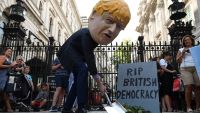
Last night, hundreds of people gathered in Parliament Square to vent their fury at Boris Johnson and his decision to prorogue parliament for several weeks in September. The crowd were in a raucous mood, but none were in finer spirits that the left-wing journalist Paul Mason. In a video published online, Mason could be seen (with added special effects) leading a chant among the crowd, where he issued a threat to Boris Johnson and promised to protest outside his Downing St home at the weekend, exclaiming: 'We, the British people, will be outside Downing Street and 12 o'clock on Saturday. We are coming for you Boris Johnson, ready or f****** not.' https://twitter.com/chunkymark/status/1166782775128711169?

Might there be a Brexit deal after all?

Parliament has not yet returned from its summer break but we are already in a bitter constitutional battle, with the Prime Minister pitted against the Speaker of the House of Commons and the opposition parties. Boris Johnson’s decision to prorogue parliament is a deliberate attempt to raise the stakes. He wants to deny time to any effort by MPs to pass a law forcing him to request a Brexit extension. His message to them: bring me down or let me get on with Brexit. When parliament returns on Tuesday for a two-week session, MPs will have to decide how to respond to Johnson’s move. Opposition MPs had previously agreed to try to use legislative means to compel the government to seek an extension, as they did before the last Brexit deadline with Yvette Cooper’s bill.

Germany’s military has become a complete joke

It is not hard to think of times when German military weakness would have been lauded as good news across the rest of Europe, but perhaps not when the German minister accused of running her country’s armed forces into the ground has just been named as the next president of the European Commission. The most recent embarrassment for the Bundeswehr — the grounding of all 53 of its Tiger helicopters this month due to technical faults — is just the latest in a long series of humiliations to have sprung from Ursula von der Leyen’s spell as defence minister. A country once feared for its ruthless military efficiency has become a joke among European powers.

A bridge to the past: Tintagel’s complex history

Halfway across the brand new bridge that links the two halves of Tintagel Castle, there’s a gap where you can look down at the waves crashing on the rocks below. Don’t worry; it’s only a few inches wide so there’s no danger of falling through it. But it’s a thrilling reminder that you’re suspended between an island and the mainland; between the present and the past. Like a lot of places in Cornwall, Tintagel has a complicated history. It was a big settlement during the Dark Ages, bigger than London at the time, and very well connected with the lands around the Med. More Mediterranean pottery has been found here than anywhere else in Britain. Why was Tintagel so important? No one seems sure.

Ruth Davidson’s true enemies have always been in her own party

Ruth Davidson is on the brink of resigning as leader of the Scottish Conservative and Unionist party. As I write this, party sources are making it clear there will be no statement on her future this evening. The absence of an immediate, dismissive, denial, gives greater credence to the suggestion that she will resign soon. Not everything is about Brexit and this is one of these things that is not entirely about Brexit. For some weeks now Davidson’s future has been the matter of some whispering at Holyrood. Very quiet whispers but whispers nonetheless. Earlier this summer one of her closer colleagues speculated to me about her future. Ruth wasn’t at the top of her game, he said, and worse her heart didn’t seem to be in it either.

Justin Welby’s Citizens’ Assembly will not bring the reconciliation he seeks

We do not yet know which 100 citizens will make it to the ‘Citizens’ Assembly’ to be chaired by the Archbishop of Canterbury, which will look at ways of preventing a no-deal Brexit. So we cannot yet judge whether the organisers have come up with a system of selection which improves on the representative powers of parliament. But really we do not need to, because we know already that they will not be able to bring the ‘reconciliation at a time of national emergency’ which the Archbishop seeks. This is because the idea that a no-deal Brexit must be prevented is not an irenic proposition around which people can unite, but an intensely political one over which they inevitably divide.
Why it makes sense for Boris Johnson to behave like Donald Trump

Boris Johnson is being widely accused of subverting the British version of democracy with his plan to suspend or prorogue parliament for four weeks – unprecedented in modern times. His apparent aim is to make it much harder for MPs to take control of the process of when and whether the UK leaves the EU. But in behaving more like a Trumpian president than a British prime minister, he is simply following the logic of the massive constitutional changes that the 2010 and 2015 parliaments perhaps recklessly and thoughtlessly pushed through. These were, of course, the Fixed-Term Parliaments Act and the referendum on whether to leave the EU.

Boris Johnson’s Brexit strategy gives MPs a simple choice

Talking to various figures in Government today, it is clear that Boris Johnson's team want the choice for MPs to be between their Brexit strategy and making Jeremy Corbyn prime minister. They believe that ultimately there aren’t enough MPs prepared to make Corbyn prime minister; meaning that they’ll get to carry out their Brexit strategy. The decision to prorogue Parliament is designed, in large part, to limit the amount of time available to the opposition to find a legislative way to force the Government to seek an extension. At the same time, it also sends a message about how hard forcing Boris Johnson to request an extension will be.