Arts Reviews

The good, bad and ugly in arts and exhbitions

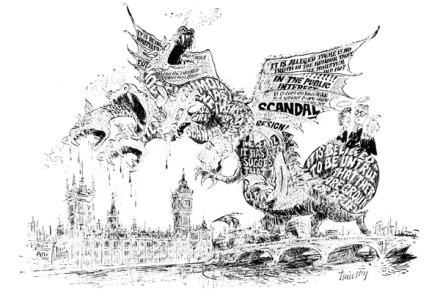
Timothy Birdsall – the greatest cartoonist you’ve never heard of

Few people under the age of 65 will have heard of the cartoonist Timothy Birdsall, who died 50 years ago on 10 June 1963, having produced his finest work in the last months of his life here in The Spectator and  in Private Eye. But had his career not been cut cruelly short by leukaemia at the age of only 27, he would today be revered as one of the outstanding cartoonists of our time. Tim was part of that talented late-1950s Cambridge generation, along with a galaxy of others later to become famous, from Peter Cook to Ian McKellen. On coming down in 1960 he was employed to do pocket
The Straw Manikin

after Goya The hooded penitents have passed – the shackled Nazarenos holding their long candles – and the altar boys, carrying the trappings of the Passion on their pillows: the hammer and nails, the crown of thorns, the chalice and the pliers; the soldiers’ flail, the soldiers’ dice. What shall we give him? The straw man is sick. We’ll finish him off, and beat him with sticks. The pasos have drifted away: statues of full-size wooden Christs and Virgins painted till they came alive – glass eyes, glass tears, eyelashes of human hair, ivory teeth and nails – on floats borne by fifty men, invisible under curtained palanquins. Poor puppet,

Trinity Hospital

There was a gunboat on the river when you led me to your new favourite spot: a home for retired sailors; squat, white, stuccoed, with a golden bell. It could have been a lost Greek chapel, a monument to light, designed to remind the old boys of their leave on Ionic shores among tobacco and fruit trees. Just after rain, sunlight stood between us like a whitewashed wall. You were lit skin, gilt and honey, dressed in olive. No paper trail connects us. No procedure of law would tell you where to stand in your sleek black mourning dress if I die but as you turned towards me the golden

‘Basically, we’re stuffed’

You might expect a chief executive of English Heritage to look quite English, and Simon Thurley certainly does. He has the pale eyes, and fine bones, of the English upper classes. He has the clipped vowels of the English upper classes, too. In his nice pink shirt, in his nice white office, in a nice big Victorian building near Chancery Lane, he has the air of a man who lives a nice, quiet, clean, ordered life. He also has a very big job. He looks after, or at least the organisation he runs looks after, more than 400 historical sites. He advises the government on ‘England’s historic environment’, which must

Exhibitions review: William Scott

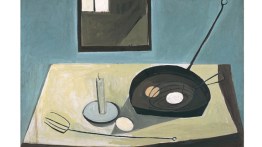
The centenary celebrations for William Scott (1913–89) are well under way, and the retrospective of his work that started in January at Tate St Ives is currently in Wakefield. There are more works in its latest incarnation and more archive material, and the installation looks very impressive in The Hepworth’s riverside galleries. Scott has not always fared well in historical surveys of 20th-century British painting (he was famously excluded from the Royal Academy’s 1987 exhibition), and his reputation does not stand as high today as it might. In his lifetime, he was much acclaimed, represented this country at the 1956 Venice Biennale and enjoyed a significant degree of international esteem.

David Goodhart makes Hay

What a pity. It seems that Dave Goodhart, director of Demos and editor-at-large of Prospect, has made peace with the Hay Festival organisers, who decided against showcasing his new book on immigration on the annual luvvie field trip. Hay Director Peter Florence described Goodhart’s The British Dream as ‘sensationalist’, and apparently told Goodhart that Hay stood ‘for pluralism and multiculturalism’ and that he is half-Italian. Goodhart hit back at these ‘ultra-liberal, slightly lefty multiculturalist’ views, saying:  ‘it’s [the book] probably been more widely reviewed than any non-fiction book so far this year – both favourably and unfavourably, so when my publisher said there was no interest from Hay I was

Notes on…the great English garden

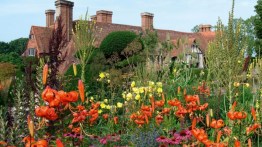
‘Write about the best English gardens,’ says the email from the deputy editor, ‘or what makes a good garden?’ That’s a bit like saying, ‘write about the best paintings, or the best music.’ Beauty is in the eye of the beholder and we now behold so many varieties of English garden that it is hard to tell what Englishness is any longer. But it is probably safe to say that the trend is no longer lavender and roses and formal enclosures of yew and box, nor grassy parks with statues and studied references to high learning. When Kent leaped the fence in the 18th century and saw all nature as

Radio review: The Truth about Mental Health, Yes, Nina Conti Really Is on the Radio

‘Grief is work,’ said one of the parents of the teenagers killed by Anders Breivik on the island of Utoya in Norway. ‘To deal with grief — that’s work from the moment you wake up till the moment you fall asleep. And even then many people struggle with their grief when they sleep.’ His frank, no-nonsense approach was striking given that he had experienced probably the worst thing that could happen: to lose a child and in such a terrible way. He was talking to Claudia Hammond for her new World Service series, The Truth about Mental Health (Fridays). The six programmes take us on a global tour of the

Why watching Britain’s Got Talent is like giving yourself a lobotomy

The kids are back for half-term so we’re having to watch absolute crap again on TV. Monday night, I wanted to watch The Fall (BBC1). But I couldn’t, obviously, because Britain’s Got Talent (ITV1) was on. ‘Dad! Dad! You’ve got to see this!’ So I come in to see what I’ve got to see and it’s a man called Aaron Crow whose unique and remarkable skills are that he never speaks, he has an interesting haircut, and he does mildly scary magic tricks which aren’t quite as good as Dynamo’s. Also he pronounces his name ‘Aran’ — as in sweater. Is this some other annoying new trend I didn’t know

Theatre review: Relatively Speaking, Disgraced

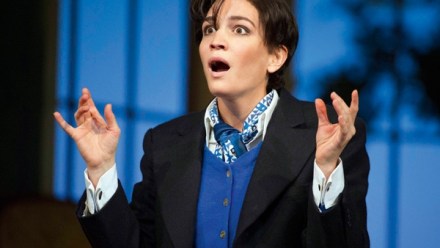
Here are your instructions. Relatively Speaking by Alan Ayckbourn is a comedy classic so you’d better enjoy it or else. The play dates from 1967 when Ayckbourn was working as a sketch writer for Ronnie Barker. It was his first hit. Notes in the programme testify to the play’s excellence. A telegram sent to Ayckbourn by Noël Coward is quoted twice.  ‘Congratulations on a beautifully constructed and very, very funny play.’ Take the Master’s kindness with a pinch of salt. The script is ingeniously strung out from a rather threadbare premise. Two couples, both with infidelity problems, meet and talk at cross-purposes for an afternoon. The action opens in a

Gemma Arterton’s new vampire flick, Byzantium, is melancholia at its most trying

Neil Jordan’s Byzantium may well be stylish and moody — so moody, in fact, I wanted to send it to its bedroom with the instruction it could only come down again when less sulky — and Gemma Arterton and Saoirse Ronan may well be fine actresses, but yet another vampire film? Really? True, it plays with the tropes a little. There’s a mother and daughter twist. There are no pointy teeth, just pointy thumbnails. But that thing vampires do, after they’ve sucked human blood and then look up, with blood-smeared lips and chin? That’s here, plentifully, and it always makes me wonder why vampires have such bad table manners. Weren’t

Le Corbusier was ashamed of the house he built

On the outskirts of La Chaux-de-Fonds, an industrial town in the Swiss Jura, stands one of the most beautiful houses I’ve seen. Elegant and understated, La Maison Blanche is the kind of house you dream of living in. Wide windows overlook a wooded valley. The rooms are bathed in silver light. The ambience is serene and timeless, more like a temple than a townhouse. You’d never guess the man who built it was the bogeyman of modern architecture — the man who began a movement that replaced terraced streets with tower blocks. In this lovely house, and the art-nouveau villas he built beside it, you can see the traditional architect

Dance review: Raven Girl, Symphony in C

Last Friday, ballet’s overcrowded aviary welcomed a new addition: Raven Girl.  Sexy, sleek, troubled and troublesome, she is the creation of the bestselling author Audrey Niffenegger and Royal Ballet’s resident choreographer Wayne McGregor.  Expectations were high, as McGregor is not a choreographer one would normally associate with balletic storytelling. The work, with stunning designs by Vicki Mortimer, splendid lighting by Lucy Carter, great video design by Ravi Deepres and a lusciously seductive score by Gabriel Yared, enthrals the senses and sits perfectly with McGregor’s vision of a creatively synergetic unity of the arts. It’s a pity that neither the choreo-graphy nor the dramaturgy were as impressive. The problem, a typical

From Harvey and the Wallbangers to Covent Garden: Christopher Purves interviewed

One of ‘the great operatic artists of the present’ sips coffee in his quiet Oxford kitchen. The artist is Christopher Purves, the description Michael Tanner’s (Arts, 13 March). In recent years, Purves’s fluid, eloquent baritone and considered acting have received rolling acclaim: Glyndebourne, La Scala, Teatro Real Madrid; Falstaff, Mephistopheles, Beckmesser and more. This year has seen his psychotic Protector in Written on Skin at Covent Garden, and now Walt Disney in Philip Glass’s The Perfect American at English National Opera. But first we talk about his children, whose pictures mosaic the kitchen cabinets, and mine. Purves is my cousin Edwina’s husband, and my son Benedict’s godfather. Over 20-odd years,

BBC’s Nick Robinson: why I said sorry for my ‘Muslim appearance’ remark

It was my first taste of free love — for the brain. A first visit to what Bill Clinton dubbed the ‘Woodstock of the Mind’. With just one afternoon at the Hay festival, I rolled up at the first thing that caught my eye — a distinguished prof talking about nanotechnology. Bear with me here. I was soon learning that making things nano-sized changes their essential properties. Surfaces can be made which repel water. A single drop can be made bouncier than a children’s rubber ball. So what, you ask. Well, we’ll all soon have mobile phones which we can drop in the bath, which raises the exciting — if, perhaps somewhat distasteful,

Night-fishers

They might almost be bushes, boulders, they sit so still. Night floods the meadow at their shoulders, brims the canal, and renders rod and line invisible. Traffic on the by-pass sighs as if asleep. A mallard claps derisively and flies. Cows rip the grass. Its being chosen makes the silence deep. The rooms that penned them flicker in synaptic light; eyes gaze at screens; ears buzz with din; the mirror that enchants these fishermen is lost to sight. Upon it, jobs, debts, children, wives leave not a mark; its stillness underlies their lives and raises wordless thoughts, as shy as fish, out of the dark.

Wellcome

My plans exist in my mind like a jigsaw puzzle … and gradually I shall be able to piece it together(Sir Henry Wellcome, 1853-1936) As though a neolithic arrowhead he’d unearthed at the age of four had entered his bloodstream, its sliver of flint sparking an obsession, the items he acquired over the years ranged from Darwin’s whalebone walking-stick, Napoleon’s toothbrush and a pair of Florence Nightingale’s mocassins to shrunken heads and tons of ancient armour. But despite all his squirrelling, the museum to house them remained illusory. Picture him, his explorer’s garb and trappings laid aside, increasingly hemmed in, until overwhelmed by the mouldering mountain, moth-eaten, worm-ridden, filling his

Spectator Play: what’s worth watching, listening to or going to this weekend | 24 May 2013

This Saturday’s Eurovision contest was never going to be a triumph for the UK, that much was for certain. What was slightly surprising, however, was the Danish victory with their song Only Teardrops The song might have been one of the favourites to win, but the triumph of what Fraser Nelson described as a collaboration between ‘one of Scotland’s world class folk musicians’ and ‘the voice of a rising star of the Danish folk scene’. In this week’s arts lead Emma Hartley interviewed Eurovision winner Emmelie de Forest’s mentor, Fraser Neill, about the making of a very Scottish performer. Here’s a video of the two of them performing Anne Boleyn