Arts Reviews

The good, bad and ugly in arts and exhbitions

The Armour at Langham Hotel reviewed: three new playlets that never get going

One of last year’s unexpected treasures was a novelty show by Defibrillator that took three neglected Tennessee Williams plays, all set in hotel rooms, and staged them in suites at a five-star dosshouse in central London. The Langham Hotel, an antique hulk of marble and glass overlooking Broadcasting House, is justly proud of its raffish literary history. Arthur Conan Doyle once met Oscar Wilde there for a chinwag and a cup of tea and by the time the bill arrived they’d conceived a fictional detective named Holmes. The Langham’s management is keen for Defibrillator to repeat last year’s success but how? Search the archive for more plays set in hotels?


Poldark review: drama by committee

By my calculations, the remake of Poldark (BBC1, Sunday) is the first time BBC drama has returned to Cornwall since that famously mumbling Jamaica Inn — which may explain why even the lowliest yokel here tends to project from the diaphragm. Leading both the cast and the diaphragm-projection is Aidan Turner as Ross Poldark, initially seen as a British Redcoat in a wood rather unconvincingly captioned ‘Virginia, America, 1781’. The short scene that followed efficiently established that he had a rackety past and some politically radical ideas, before the American rebels attacked, leaving several extras dead. Ross himself suffered injuries bad enough to bring on a severe case of flashback,

Suite Francaise review: what is this film playing at, when it comes to Jews in attics?

Suite Française is being billed as a second world war romance about ‘forbidden love’ and, in this regard, it is handsome, solid, well played and probably fine, if you haven’t read Irène Némirovsky’s novel, but if you have? Then you may have been hoping and praying for something deeper, something more special. As you know — because I have been nothing if not repetitive down the years — I desperately try not to compare films with their source material. Let a film live or die by its own merits. But this book nags like nothing else on earth. What? Really? No! And where did that Jew in the attic come

Alan Bennett shows how hypocrisy is a National issue

Alan Bennett announced on Radio 4 last week that ‘hypocrisy’ is the defining characteristic of the English. ‘In England, what we do best is lip service,’ he sighed, before going on to admit that even he is a hypocrite. While many have taken issue with his claim, Mr S was reminded of Bennett’s words on a recent trip to the National Theatre. The playwright – a Primrose Hill millionaire who claims to hate rich privilege – has just penned a fluffy essay about soon-to-retire National boss Sir Nicholas Hytner (who just happens to have used public money to stage Bennett’s latest play People). The essay appears in programmes at the National and gushes that

MoMA’s new Björk exhibition cramps the singer’s style

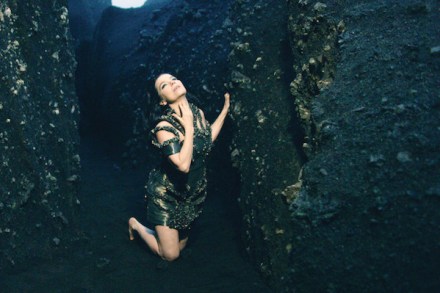
Was intimacy the goal of Björk at MoMA? Co-curated by the Icelandic musician herself and Klaus Biesenbach, MoMA chief curator at large, the exhibition allows for a closer look at the objects that go into her productions, from custom-made instruments to haute-couture costumes and personal notebooks. The centrepiece, however, is the new commission Black Lake. At a press conference on Tuesday, Biesenbach made much of the live experience of museums in contrast to the detachment of seeing art through phones. The problem is, Björk’s exhibition isn’t live. It’s quite the opposite. The culprit is the narrative installation called Songlines. An audio component entreats you to take it slow and to consider the device hanging around

How Ridley Scott’s sci-fi classic, Blade Runner, foresaw the way we live today

In 1977 a journeyman actor called Brian Kelly optioned a science-fiction novel called Do Androids Dream of Electric Sheep? The book’s author, Philip K. Dick, had been writing science fiction since the early 1950s. He was 49 years old, with 30 novels behind him. He had a cult reputation, but he barely scraped a living. Kelly only paid him $2,500, but Dick was happy with this windfall. He’d written this book for half as much, back in 1968. After five more years, and many rewrites, Dick’s book finally became a film. Directed by Ridley Scott and renamed Blade Runner, it’s now commonly — and quite rightly — regarded as one

Inventing Impressionism at the National Gallery reviewed: a mixed bag of sometimes magnificent paintings

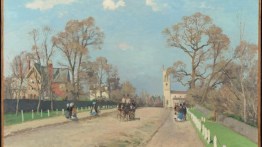
When it was suggested that a huge exhibition of Impressionist paintings should be held in London, Claude Monet had his doubts. Staging such an exhibition, he wrote to his dealer Paul Durand-Ruel, would be ‘unwise’ and only likely to baffle a London public that ‘knows very little about us’. That was in 1904. What, one wonders, would Monet make of Inventing Impressionism, which has just opened at the National Gallery 111 years later? It can hardly be said now that the British know little of the Impressionists. On the contrary, you could argue we’ve seen quite enough of them in recent decades. The challenge for a gallery planning to put

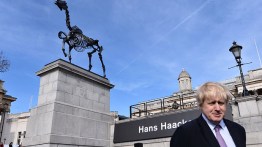
Hans Haacke’s Gift Horse, Fourth Plinth, review: cringe-worthy – but at least it’s not David Shrigley

There is good art, there is mediocre art and there is bad art. In the same ratio – about 3:65:32 – there is good political art, mediocre political art and bad political art. There is also a slender sub-genre of this last category, known as so-bad-it’s-good political art. And of this, I am a connoisseur. This week I encountered the best example of this I’d seen for quite some time. I’ll spare the numpty who painted it the blushes of a namecheck, but the picture was a faux-naïf (?) riff on the Last Supper, earnest as you like, in which  Jesus and the disciples are throwing up their arms in Nazi

The Heckler: Tate Britain is a mess. Its director Penelope Curtis must go

Things have not been happy at Tate Britain for some time. Last year Waldemar Januszczak wrote an article culminating with this cri de coeur: ‘Curtis has to go. She really does.’ The meat of the argument against Tate Britain’s director was that she had presided over a run of misconceived exhibitions disliked as much by critics and scholars as by the public. In her defence, these were not the blockbuster shows but the low-cost fillers that UK museums must put on when the coffers are low. As such they tend to be long on ideas and short on jaw-dropping loans. It is not much of a defence. The massive unseen

The Great European Disaster on BBC4 reviewed: propaganda worthy of Leni Riefenstahl

My favourite bit of The Great European Disaster (BBC4, Sunday) was the lingering shot that showed golden heads of corn stirring gently in the breeze. It was captioned ‘Europe’. I cannot even begin to describe what a powerful effect this had on my subconscious. It was worthy of Leni Riefenstahl. Indeed, when I experimentally turned off the colour, it was Leni Riefenstahl. ‘Bloody hell!’ I thought to myself. ‘Suddenly it all makes sense.’ But my journey of discovery and enlightenment was only just beginning. I haven’t yet told you what the Ukrainian peasant said. I forget his exact words, but it was something along the lines of, ‘When I think

ENO’s Indian Queen reviewed: Peter Sellars’s bold new production needs editing

When is an opera not an opera? How much can you strip and peel away, or extend and graft on to the genre, before it simply ceases to be itself? These questions dominated a week in which directors turned vivisectors for new productions — reimaginings — of Purcell’s Indian Queen (ENO) and Mozart’s Don Giovanni (Silent Opera). Anyone familiar with Peter Sellars’s work will know better than to expect any paring back from the larger-than-life American. Amplification is the order of the day for Purcell’s semi-opera — expanded from a trim 50 minutes of unfinished music yoked to a play by Dryden and Howard to a three-and-a-half-hour musico-dramatic spectacle. If

Still Alice review: you can see why Julianne Moore won an Oscar but the film’s still boring

There’s always seemed something masklike about Julianne Moore’s face: she seems walled in by her beauty. When she smiles, the only thing that moves is her mouth; that superb fenderwork of bone remains as impassive as a sphinx. This very inexpressiveness gives her an air of trapped intelligence, which she used to great effect in the early part of her career playing a string of numbed-out beauties— her coked-up porn actress in Boogie Nights; her neurasthenic housewives in Safe and Far from Heaven, all dying behind the eyes. More recently, she has cut loose to channel something of Diane Keaton’s scatterbrained comedy in The Kids Are All Right, in which

Why George Bernard Shaw was an overrated babbler

When I was a kid, I was taught by a kindly old Jesuit whose youth had been beguiled by George Bernard Shaw. The provocative ironies of ‘GBS’ were quoted everywhere and he was, for several decades, the world’s leading public intellectual. But as a schoolboy I found it hard to assent to the infatuations of my elders and though I relished Shaw’s aphorisms (‘we learn from history that we learn nothing from history’) I conceived a suspicion that he was smug and overrated. A babbler. Perhaps even a bore. Man and Superman, rarely revived at full length, offers us GBS with all the taps running. Imagine Fry, Brand and Norton

Harry Potter star Rupert Grint makes a million

Since finishing filming Harry Potter, Rupert Grint has struggled to match the success of his former co-stars Daniel Radcliffe and Emma Watson in the acting world. The actor received mixed reviews for his recent turn on Broadway in  It’s Only a Play, with the Washington Post claiming his performance exhausted ‘the comic possibilities’. However, Mr S is happy to reveal that while his acting credentials may have taken a beating of late, financially the 26-year-old thespian is still sitting comfortably. According to annual reports posted on Companies House today for his company Clay 10 Limited, the actor has made a profit of  just under £1.1 million for the year ending August 2014. The company is owned by Grint and has his father Nigel acting

The Spectator declares war on bad public art

Like peace, love and lemon-meringue pie, ‘public art’ seems unarguably attractive. Who but a philistine curmudgeon would deny the populace access to the immediate visual thrills and the enduring solace of beauty that the offer of public art seems to promise? Public art is surely a democratic benefit. Never mind that in the past century its most forceful expression was the grim and malignantly deceitful narratives of Soviet socialist realism, with their ruddy-faced, grinning and buxom tractor drivers disguising a more real reality of starvation, intolerance and torture. Public art is here to be enjoyed at a desolate piazza near you. And then you begin to think about it. Has

Sculpture Victorious at Tate Britain reviewed: entertainingly barmy

In the centre of the new exhibition Sculpture Victorious at Tate Britain there is a huge white elephant. The beast is not, I should add, entirely colourless. On the contrary, it has a howdah richly decorated in gold and green, and numerous trappings, and tassels covering its pale grey hide. Its whiteness is entirely proverbial. After all, what can you do with a porcelain pachyderm, standing over seven feet tall? The Victorian period, a text on the wall proclaims, was ‘a golden age for British sculpture’. This is perfectly true, in the sense that a colossal amount of the stuff was turned out during Victoria’s reign. But, as the exhibition

Paul Mason’s diary: My Greek TV drama

It’ll be a Skype interview, says the producer from Greek television, and not live. In TV-speak that usually means not urgent and not important, but I’ve become vaguely interesting to Greeks because of the ‘Moscovici draft’ — a doomed attempt to resolve the crisis, leaked to me amid denials of its existence. The interview goes on a bit and the tone is deferential. At the appointed time, I fire up Greek television to see how many clips they’ve used. Instead of me, a panel of five bearded men in an expansive studio are conducting an earnest preview of my interview. When it starts, my face is on a studio screen

Small things in the cathedral

A place to see the little things between the monuments and tombs. As in the chapel of St Gabriel, a pencil. Here they are, behind the obvious. Next to the chapter house, a cupboard with a bowl, four toilet rolls. How small things quietly wait, make us forgivable. Inside the vestry, just inside the door, an iron.