Conquest’s Third Law (as proposed by the historian Robert Conquest) states: ‘The behaviour of any bureaucratic organisation can best be understood by assuming that it is controlled by a secret cabal of its enemies.’ In no other area is this better demonstrated today than the arts. And if you don’t think of the arts as a bureaucratic organisation, you haven’t been paying attention.
Alexandra Wilson’s Culture Vultures is a diatribe against the attempt to turn the arts into mediocre, unappealing, deplorable shadows of themselves. There are the Guardian reviewers who are so bound up with their loathing of the past that they delightedly assert that a Cecil Beaton exhibition contains only one portrait of a ‘woman of colour’ when there are actually two more – and at least three ‘men of colour’ – in a show documenting prewar British society.

There is the idiot who wrote a book about the Bloomsbury Group claiming that Virginia Woolf should be considered as ‘identifying as non-binary or trans’. ‘If we do not rethink these texts through the lens of the present, they will cease to have meaning for the present,’ another opines. A curator explains that a painting by Manet of a ham shows his appalling attitude to women’s rights. There are the commentators who, having spent years complaining that certain classes of society are excluded from ‘the arts’, respond to a black man beautifully playing an Elgar concerto with the observation that ‘a black cellist cancels itself out’. (In what other context would it be OK to refer to a black man as ‘it’?)
Worst of all are those resentful productions of classic plays and operas demonstrating how evil their creators were. Recent examples include a Parsifal with a satanic hero and a production of Oklahoma! portraying Ado Annie as the victim of the patriarchy, or racism, or nonconsensual sex – anyway as a tragic casualty and therefore no longer funny. I anticipate productions of The Sound of Music showing the dark heart of child exploitation and of The Merry Widow emphasising the origins of Hanna Glawari’s fortune in the Atlantic slave trade – but they’ve almost certainly happened already.
Never before have there been so many forces working to ensure that only the few will continue to enjoy what the administrators term ‘content’ (or what you and I know as Brahms’s G Major String Sextet). Those few have the privilege of being educated before 2000; or perhaps they have ancestry in East Asia, where there is no nonsense about a great pianist such as Yuja Wang cancelling herself out.
This lowering movement possibly began with the assertion that ‘all art is political’, a product of the undergraduate seminar table. So we learn that the fields in which Gainsborough’s ‘Mr and Mrs Andrews’ appear were actually owned by them. Fascists! And that Keats’s ‘Ode to Autumn’ was written after a devastatingly poor harvest in which farm workers underwent great suffering and tried to form trade unions. What shocking oppression! And how wonderful that we, from our position of wisdom at the University of the West of Glamorgan, have now seen through these works of art, and are fully qualified to stick a complaining label next to paintings in the museums where we got our first jobs.
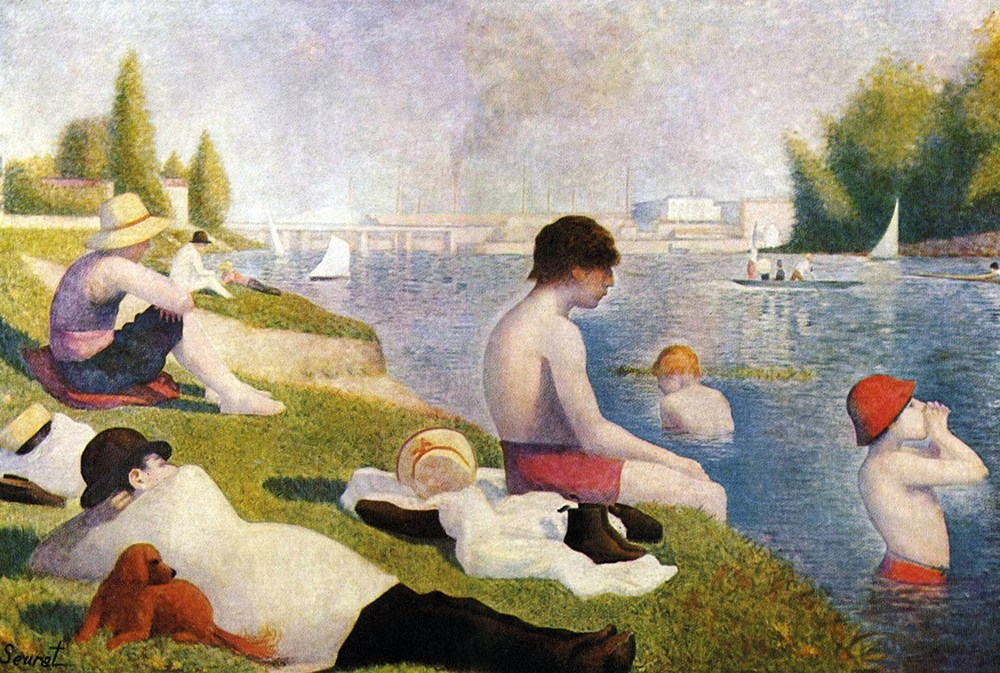
In reality, when a book is explicitly political, like John Buchan’s Greenmantle, or when some incidental illumination of society may be extracted, as in Seurat’s painting ‘A Sunday on the Grande Jatte’, it may not be the most interesting thing about it. Anyone can explain about industrialised labour and excluded minorities in Seurat’s ‘Bathers at Asnieres’ – the boys have skived off on a weekday for a dip, and so has the bowler-hatted clerk gazing lecherously at them – but nobody goes on looking at it because it’s disapproving of capitalism or heteronormativity. The curators and the commentators of this world are convinced otherwise.
This fundamental error has led to some truly terrible works, guaranteed to put anyone off painting or music or literature forever. If the arts of the past are shown to possess some element that would not appeal to the average thirtysomething with a trust fund living in Hoxton today, it is decided that they should be replaced. If written or painted by a dead white male, then all the worse.
Admittedly, some of the substitutes turn out to be of the first rank, such as a Barbara Hepworth or Amy Beach’s piano quintet. (It is noticeable that the novel is less prone to censure, having been embraced by women, racial minorities, gays, lesbians, and, for more than a century and a half, working-class writers.) It seems inadequately accepted, however, that if you play a curious 12-year-old Holst’s ‘Planets’ suite, they will grow up to love good music; but if you play them an orchestral novelty commissioned for last year’s Proms on the grounds of inclusion by an official body, they will listen because they have to and never give it another thought.
Wilson’s book is richly exasperated, full of examples of people who shouldn’t be let within a mile of an art gallery or an orchestral podium. But her general, somewhat despairing feeling seems to be that we should just continue to enjoy excellence where we find it. Some of her positive comments might even be a little naive: she suggests that train stations that have taken to playing classical music in their ticket halls do so because it has a calming effect. Actually, it’s because the loitering thugs can’t stick the Egmont overture for more than20 seconds and will certainly take their mischief off elsewhere.
I think there are more practical actions that the arts could take to reconnect with the public, starting with the assumption that the person who pays for something has a say in what it consists of. The great John Gilhooly, who runs the Wigmore Hall, recently decided that he was going to get along very nicely without state funding. Glyndebourne has dropped the touring part of its operation, dependent on public money, and just has the private summer festival now.
Sadly, most opera could not continue to exist without some public funding because of the size of the inherited auditoria and complexities of the operation. Other art forms that currently depend on public funding could shed it. The collapse in visitor numbers to Tate galleries, which must be due to the demented policies driving the choice of objects on display, has no consequences for the institution. If galleries charged for entry they would soon put on exhibitions that people actually wanted to see.
Yet other art forms don’t need public funding at all. There is no justification what-ever for funding literature. Anyone who wants can write a novel while holding down a full-time job, and there is no reason to pay somebody to stay at home. Funding should be reserved for the demonstrably excellent. It should have kept English National Opera going, and the Britten Sinfonia, now at death’s door. If a market of consumers, across the range of society, had been created, and given access to practitioners who were doing what they wanted to do, then we would soon see an end to this idiocy.
Long ago Lord Macaulay observed:
In general, poetry, history and philosophy ought to be suffered, like calico and cutlery, to find their proper price in the market, and that to teach men of letters to look habitually to the state for their recompense is bad for the state and bad for letters.
Just how right he was is demonstrated by the antics Wilson catalogues.


Comments