Literature

Why are Lawrence Osborne’s novels suddenly popular in Hollywood?

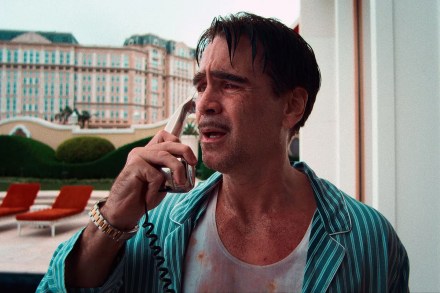
The film Ballad of a Small Player opens with a blast of classical music, a shot of the Macau skyline and Lord Doyle (Colin Farrell) waking up in a hotel suite littered with Champagne bottles, cigarette butts and designer loafers that are starting to show their wear. While he dresses and shaves, a voice-over informs us he has three days to live. A sharp observer might notice he seems to have considerably less than that. Either way, for the next 100 minutes, director Edward Berger (All Quiet on the Western Front and Conclave) treats us to a sumptuous vision of one English con man’s final spree before oblivion. It will take an even sharper-eyed observer to catch, as the final credits snap past, that they have just watched an adaptation of a Lawrence Osborne novel.

slipshod

Slipshod: a short story by Sarah Perry

It was months before the difficulty with Marnie and Addison was talked about, or even alluded to. The sight of their names in emails circulated around the department was enough to cause a pall to settle on everything, like ash from fires only just put out. Besides, the nature of the difficulty (that was the word we all used) was both so opaque and so distressing we’d have had trouble talking about it, even if we’d wanted to. It fell to me to piece things together. My brief from Helen was simply to satisfy the university that nobody in the department was to blame. It fell to me because I am, she tells me, part of the furniture: unremarkable, functional, predictable.

The Anthony Bourdain Reader leaves a reader hungry

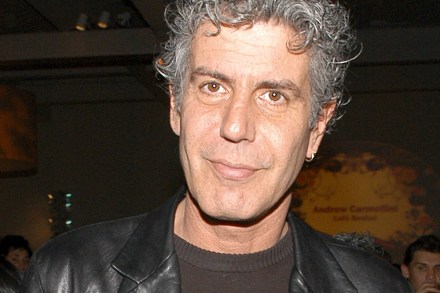
Charismatic, handsome and with a great white shark’s feral cool, Anthony Bourdain was someone that everyone wanted to be. The chef, writer and TV presenter described the premise of his award-winning shows, No Reservations and Parts Unknown, as “I travel around the world, eat a lot of shit and basically do whatever the fuck I want.” They cemented his image as a gadabouting, kamikaze gourmand. Bourdain scarfed down andouillette and warthog anus, drank sun-bear bile and polished off the still-beating heart of a cobra, plonked into a shooter of Vietnamese firewater. He showed Barack Obama the correct way to slurp bún chả noodles on a steamy Hanoi side street, and he and his team watched from their hotel pool as Israeli jets strafed downtown Beirut during the 2006 invasion.

anthony bourdain

Tom Stoppard was himself to the end

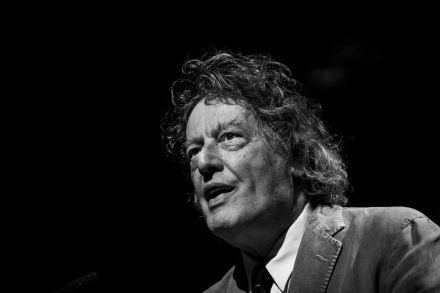
"Tom Stoppard is dead." For anyone who cares for the theater, the English language, and especially for those of us who knew him, these words are as unthinkable as they are hard to bear. How can such a force of nature, such a generosity of spirit, such a voice of sanity, have fallen silent? And yet he has gone. To the end, his body emaciated by cancer, he was still the old Tom: self-deprecating but full of ideas and plans. He might have one more play inside him, he told me, but his fingers could no longer physically write and dictation somehow stopped the words from flowing. He was cared for by his magnificent wife Sabrina, who entertained us tirelessly.

Anne of Green Gables perfected the kitchen mishap

There’s something wickedly entertaining in reading about other people’s kitchen debacles, whether actual or fictional. They’re just so relatable. The jelly that won’t jell in Louisa May Alcott’s Good Wives is cruelly hilarious, but the best culinary catastrophe in classic fiction, for my money, is in Anne of Green Gables. Stylish guests, including the upper-crust Mrs. Chester Ross, are dining at Green Gables and our ebullient Anne is on her very best behavior. All goes well until Marilla arrives with the pudding and a pitcher of pudding sauce. On spotting the pudding sauce, our heroine’s eyes grow wide and terrified.

kitchen mishap

‘Media Literacy’ and the decline of Woke

What is “woke”? To Jordan B. Peterson it is “postmodern neo-Marxism.” To James Lindsay it is “critical race theory” and latterly “revisionism” in general. These theories of what woke means take for granted that one of its core tenets is a denial of objective truth under the influence of what is broadly called “critical theory,” but the thinking behind contemporary wokeness falls far short of these theoretically exalted standards. Critical theory was a movement, primarily among academics, in the mid 20th century which had a diverse array of followers, but the common denominator was the belief that texts, whether literary works like novels, or historical documents, had no inherently “true” interpretation.

Media Literacy

A lack of national identity has killed off the Great American Novel

Is there hope for literature in America this century? The forecast looks grim. One walk through the literary fiction section at a bookstore is a testament to the art form’s cultural bankruptcy. Just about every other book on the new release table is a treatise on your racism masquerading as a tale of collective uplift. Fine, if you want to expiate your sins of privilege – but all in all, a snoozefest. Novels held a central place in America as a vital cultural force; novelists were worshipped as electrifying sages Same goes for most of the books on the New York Times list of the 100 best books of the century so far. The subjects of race, gender and oppression generally dominate.

A crisp and refreshing account of the apple

In Food for Life, Tim Spector’s book on the science of eating, the author gives the chemical makeup of a mystery food, listing more than 30 scary-sounding E numbers, sugars, acids and chemicals, before revealing that it is an… apple. Sally Coulthard’s book, The Apple, shows that it’s the apple’s complexity as well as its familiarity, that makes it the ideal punchline for Spector, and, for Coulthard, a perfect vehicle to carry the history of how we grow, trade, cook and eat together and take responsibility for each other and the environment (or not).

apple

Evie Wyld’s latest novel is unsettling yet hopeful

Evie Wyld’s powerful fourth novel opens from the perspective of Max, a ghost who haunts the south London apartment where he lived with his girlfriend Hannah. A ghost story is new ground for Wyld, the multi-award-winning Anglo-Australian writer, but her signature traits are immediately evident — poetic observations of unusual details; a pervasive sense of grief and palpable trauma, leavened with a wry sense of humor (Max notes his "strong urge to file a complaint" about being a ghost); and an intricate plot that compels readers to delve into complex past events.

Wyld

Ali Smith’s latest novel falls flat

"Gliff" is a word which can mean "a short moment," "a wallop," and "a post-ejaculatory sex act;" to "dispel snow," "to frighten," and to "escape something quickly." It’s "really excitingly polysemous," says one of Ali Smith’s characters. It’s certainly an apt title for a book which can’t seem to define itself. At its center are two children, Briar and Rose, who have been abandoned. Their mother is absent, caring for a sick sister, and their other responsible adult leaves to find her. The children exist in a stock dystopian world (people are surveilled by CCTV cameras and zombified by screens) with a twist: they repeatedly wake up to find that a red line has been painted around their house or camper van. They are on a list of "Unverifiables.

Gliff

Why Goethe matters

Johann Wolfgang von Goethe bears one of the most famous names in world literature, though he is largely unread by English-speakers. He is most closely associated with the novel and dramatic form, so many would be surprised to know that he primarily spoke of himself, for much of a long life that spanned from 1749 to 1832, as a scientist. He was a pioneering exponent of the science of evolution, and in two wonderful poems, The Metamorphosis of Plants and The Metamorphosis of Animals, he explored his belief that nature evolves from simpler, earlier life forms. This, rather incredibly, was seventy or eighty years before Charles Darwin began to write.

Goethe

The chameleonic life of Claire Clairmont

Commentary on the young Romantics can be curiously puritanical. Not on saintly John Keats, who died too young to cause any trouble. But Byron and Shelley? Beastly to women, negligent as parents, destructive as friends, oblivious to their own privilege. Feminist observers tend to resemble the English visitors to Geneva in 1816 who borrowed telescopes to spy on the renegade inhabitants of the Villa Diodati across the lake, hoping to be scandalized. A central character in the summer that saw the birth of Frankenstein was the only non-writer of the villa’s gathering, Byron’s young lover and Mary Shelley’s stepsister, Claire Clairmont.

Clairmont

The problem with westerners seeking enlightenment in Asia

Call it a prejudice if you like. Living in Japan in the 1970s, I had a slight aversion to a particular type of westerner. He — for it was mostly a he — usually lived in Kyoto, sometimes wore a kimono and liked to sit in ancient temples chasing after that presumably blissful moment of enlightenment, awakening, satori, or whatever one wishes to call it. These seekers were less interested in Japan as a society of human beings. They wanted to float in higher spheres. As Christopher Harding explains in The Light of Asia, the Zen adepts, the Buddhist chanters, the rock-garden worshippers, the kimonoed fools (in my no doubt blinkered eyes) were part of a long western tradition.

Asia

The talented Evan S. Connell

When the journalist Steve Paul began his biography of the writer Evan S. Connell, a young librarian was helping him access research material. She happened across a photograph, and remarked, “What a suave-looking dude.” Connell had movie-star good looks. Of his eight novels, two are now packaged as classics of American literature. This on top of a biography of Goya; a 2009 Man Booker International nomination for lifetime achievement; and a bestselling history of a battle in the Great Sioux War of 1876. Acolytes recommend his greatest book, Mrs. Bridge, with the confident smile that looks forward to welcoming another member to the exclusive band of Connellites.

Connell

The peculiar American attitude toward death

Dying sensibly has always eluded Americans — from Elvis to Houdini — and that’s before you even get to the funeral part. In fact, in America, something peculiar has occurred over the last century. Traditional obsequies have fallen out of favor as Americans increasingly opt for “anything but” the conventional when it comes to final resting places: that is, no more six feet under. According to the National Funeral Directors Association (NFDA), the majority of Americans now choose cremation, with the rate expected to surpass 80 percent by 2045. Ecofriendly departures — think hemp coffins or ashes strewn over a living coral reef — are also becoming more popular; 60 percent of respondents to one recent survey expressed an interest in “green funeral options.

death

Blake Butler: ‘I don’t want this story to end as “Molly killed herself”’

A recent controversy rocked the literary world when coverage of author Blake Butler’s memoir, Molly, about his late wife, notable poet Molly Brodak, hit tabloids and spun for the worst. The coverage sparked debate over the ethics of writing about relationships, as online attackers made accusations that the widower weaponized Brodak’s private life and exploited her death for fame or revenge.   Claims gained ground that it was a “shameless cash grab,” “literary revenge porn,” or that it shouldn’t have been published due to privacy concerns, since the memoir reveals Butler’s discovery of his late wife’s affairs after her passing.

blake butler

Literary festivals are no fun

This is the season when literary festivals start to happen all over the UK. From the highlands of Scotland to the South London lowlands of Deptford, there are book festivals for every taste and tribe. Festivals devoted to crime fiction, women writers, LGBTQ writers and young novelists. Even old Marxists are having their own summer festival. I’m thinking of starting a literary festival for neglected and bitter writers like me who don’t get invited to literary festivals. I ask myself: why should I care? But I do. I spend long nights of self-torment scrolling through the lists of people appearing at various festivals and shouting at my laptop screen: who the fuck is he? What has she written? Why is Bono there and not me? For heaven’s sake, who invited Minnie Driver?!

The death of the Western literary tradition

A regular reader of Le Figaro for some years, I have been noting the frequency with which the editors print articles relating to the Académie française, founded by Cardinal Richelieu in 1634 for the purpose of acting as the protector and patron of the French language, fixing its usage and giving it exact rules to make it competent to deal clearly and elegantly with the arts and sciences. It was decreed that the academy should consist of precisely forty members, and that upon the death of any one of them the candidate to replace him should pay court to the remaining thirty-nine to be selected to fill his numbered seat. The sitting forty were known as “les Immortels.

literary

How America influenced George Orwell

Some of the most tantalizing pieces of George Orwell’s journalism are the reviews written on the hoof, filed against deadlines, sent straight to the typewriter while World War Two raged above his head. One of them is a round-up of four reprinted dystopian novels supplied to the weekly magazine Time and Tide in July 1940, shortly after the fall of France. (Today, it’s rarely reissued and barely available outside the stout bindings of volume XII of Orwell: The Complete Works.) The four books are Jack London’s The Iron Heel (1908), H.G. Wells’s When the Sleeper Wakes (1910), Aldous Huxley’s Brave New World (1932) and Ernest Bramah’s The Secret of the League (1907).

orwell

A literary pilgrimage to Dublin

From the lilting normcore of Sally Rooney’s Normal People to the frenetic genius of poetic, post-(post?) punk band Fontaines D.C., I’m drawn to talented Irish voices of late. Martin McDonagh’s Oscar-nominated tragicomedy, The Banshees of Inisherin, won three Golden Globes, and my heart, to boot. And quite rightly. It’s news to no one that the Irish have always been exceptional storytellers; some stereotypes stick because they are true. Plenty of the finest words ever written hail from the town of the hurdled ford, Baile Átha Cliath, Dublin. This fact was recognized by UNESCO in 2010, when they named it a City of Literature.

dublin