Culture

Culture

The good, the bad and the ugly in books, exhibitions, cinema, TV, dance, music, podcasts and theatre.

Superb: Stereophonic, at Duke of York’s Theatre, reviewed

Theatre

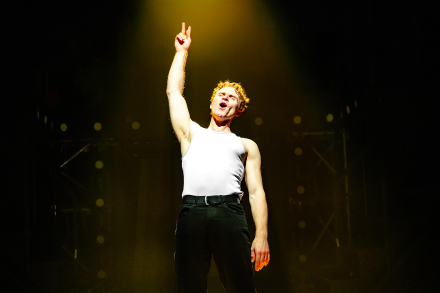
Stereophonic is a slow-burning drama set in an American recording studio in 1976. A collection of hugely successful musicians, loosely based on Fleetwood Mac, are working on a new album which they hope will match the success of their previous number one smash. This is an absolute treat for anyone who appreciates subtle, oblique and quietly daring theatre The studio could almost be an orphanage because the characters keep squabbling and bickering like siblings in need of a parent. The self-appointed leader is Peter (Jack Riddiford) who dresses in classic hippy mode with a kaleidoscopic shirt and a droopy moustache. But he rules the studio with a rod of iron.

Magnificently bloodthirsty: 28 Years Later reviewed

Cinema

First it was 28 Days Later (directed by Danny Boyle, 2002), then 28 Weeks Later  (Juan Carlos Fresnadillo, 2007) and now Boyle is back at the helm with 28 Years Later, which is, as I understand it, the first in a new trilogy. This post-apocalyptic horror franchise could go on for ever. As the last film was generally (and rightly) regarded as a desultory cash grab, there is much riding on this one. The verdict? It’s entertaining but not outstanding. The biggest surprise is its tonal swerve into sentimentality. Jodie Comer and Ralph Fiennes, however, bring character and heft and, just to put your minds at rest, yes, it’s as magnificently bloodthirsty as ever.

The charm of Robbie Williams

Pop

What could it possibly feel like to be a sportsperson who gets the yips? To wake up one morning and be unable to replicate the technical skills that define you. To suddenly find the thing you do well absolutely impossible. Golfers who lose their swing, cricketers whose bowling deserts them, snooker players who can’t sink a pot. Stage fright – something both Robbie Williams and Cat Power have suffered from – is much the same. Williams took seven years off touring last decade because of it, which must have been devastating for someone whose need for validation is so intense that he has made it his brand.

Summer opera festivals have gone Wagner mad

Opera

Another week, another Wagner production at a summer opera festival. This never used to happen. When John Christie launched Glyndebourne in the 1930s, he hoped to stage the Ring. So he gathered a team of refugee musicians from Germany, who quickly assured him that it was impossible and he should stick to Mozart. The man who changed all that was Martin Graham, the plimsoll-wearing founder of Longborough Festival Opera, who died in April at the age of 83. Graham was irrepressible; a self-taught enthusiast. With no one around to tell him it couldn’t be done, he pushed ahead regardless, staging the Ring cycle twice in as many decades. And now look.

Ingenious: the Globe’s Romeo & Juliet reviewed

Theatre

Cul-de-Sac feels like an ersatz sitcom of a kind that’s increasingly common on the fringe. Audiences are eager to see an unpretentious domestic comedy set in a kitchen or a sitting-room where the characters gossip, argue, fall in love, break up and so on. TV broadcasters can’t produce this sort of vernacular entertainment and they treat audiences as atomised members of racial ghettos or social tribes. And they assume that every viewer is an irascible brat who can’t bear to hear uncensored language without having a tantrum. The result is that TV comedy often feels like appeasement rather than entertainment. Theatre producers are keen to fill the gap, and the latest effort by writer-director David Shopland declares its ambitions in its title.

Compelling: Little Simz’s Lotus reviewed

Pop

It is not uncommon for (predominantly male) music critics to invert the ‘great man/great woman’ dictum in order to suggest that behind the success of every powerful female artist there simply must be a moustache-twirling Svengali pulling the strings. It’s less common for the artist themselves to pose the question. On ‘Lonely’, the penultimate track on her compelling sixth album, London rapper and actor Simbiatu Ajikawo, who performs as Little Simz, interrogates the doubts and insecurities she felt while writing and recording this record. In doing so, she asks: ‘I’m used to making it with [redacted]/ Can I do it without?

Thrilling: Garsington’s Queen of Spades reviewed

Opera

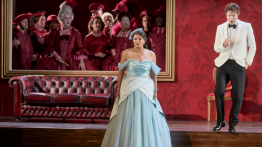
Tchaikovsky’s The Queen of Spades is one of those operas that under-promises on paper but over-delivers on stage. It’s hard to summarise the plot in a way that makes it sound theatrical, even if you’ve read Pushkin’s novella, and I’ve never found a recording that really hits the spot. And yet, time and again, in the theatre: wham! It goes up like a petrol bomb. With a good production and performers, Tchaikovsky hurls you out at the far end feeling almost hungover – head swimming, and wondering where those three hours went. The cast and staging at Garsington are very, very good.

Sincere, serious and beautiful: Glyndebourne’s Parsifal reviewed

Opera

‘Here time becomes space,’ says Gurnemanz in Act One of Parsifal, and true enough, the end of the new Glyndebourne Parsifal is in its beginning. We don’t know that, at first: the sickbed image that’s glimpsed during the prelude doesn’t resolve itself until the opera’s closing scenes. In between, characters appear on stage in multiple forms, at different ages – past and future selves attendant on the present, whatever ‘present’ means in Monsalvat. Wagner, after all, makes it clear enough that time in the Grail Domain moves in mysterious ways, and his whole musical strategy reinforces that truth.

Anyone irritated by Springsteen’s speeches hasn’t been paying attention

Pop

No one who went to see Bruce Springsteen’s Broadway residency a few years back came away disappointed because they knew what they were getting: a tightly scripted show, in which there was more speech than music. The country star Eric Church – who made his name with a single called ‘Springsteen’ – appeared to have been taking notes, for that was the model for his ‘residency’ at the Albert Hall. All that he lacked was the tight script – and Springsteen’s charm and charisma. It was, the MC told us, Church’s first time in the UK in eight years, but the place was horribly undersold, the top tier almost empty and spaces all around the stalls.

Everyone should see the Globe’s brilliant new production of The Crucible

Theatre

Sanity returns to the Globe. Recent modern-dress productions have failed to make use of the theatre’s virtues as a historical backdrop. The Crucible by Arthur Miller is set in the 1690s (about a century after Shakespeare’s heyday) and the script works beautifully on this spare, wooden stage. To make the groundlings feel involved, the playing area has been extended into the pit with two separate platforms for the judges and the witnesses. James Groom, as Willard the demented jailer, terrifies the crowd by striding around the arena, barking madly at anyone who gets in his way. It grabs your attention. The dashing Gavin Drea (John Proctor) looks terrific in the lead role alongside Phoebe Pryce as his mistrustful, nervy wife, Elizabeth. Both play their parts with strong Irish accents.

A lovely album: Saint Leonard’s The Golden Hour reviewed

The Listener

Grade: A+ The kids with their synths and hip producers, dragging the 1980s back: I wish they would stop. It was, in the main, an awful decade for music, the bands trite yet portentous, the stupid burbling bass guitars, hubris-stricken vocals and tinny drums. The kids retread all the dross. Yet if you were actually around and sentient in that avaricious decade, as was Saint Leonard, you could find a certain chill beauty in hidden corners. Not the New Romantics, not Japan, not SAW. Just small niches here and there of inventiveness and clever pop.

RIP to new music’s gentle, smiley radical

Danish composer Per Norgard – whose death at the age of 92 was announced this morning – was a towering presence in European new music, and the shine-bright timbres and heady narrative drive of his eight symphonies posed crucial questions about what it meant to be a symphonist during the late 20th century. In 2000 I was despatched to interview Norgard for a magazine and found a man as gentle and thoughtful as his music suggested he would be, with eyes that gleamed just like his woodwind writing. He had been in London to hear a performance of one his works – I forget which – but under discussion that afternoon was a new recording: the violin concerto he'd written in 1987, Helle Nacht.

The forgotten story of British opera

Arts feature

British opera was born with Purcell’s Dido and Aeneas, and then vanished for two-and-a-half centuries, apparently. Between the first performance of Dido in 1689 and the première of Britten’s Peter Grimes in 1945, serious British operas effectively didn’t exist – or so we’re told in textbooks and biographies. But what if there was a different story; a forgotten story of a lively, eclectic British operatic tradition that thrived in those missing centuries, and was buried only through a combination of accidents, economics and our enduring national snobbery about theatre that’s sung rather than spoken? And what if there was an organisation devoted to excavating these forgotten works and giving them a chance to live again?

Christopher Wheeldon’s real gifts lie in abstract dance

Dance

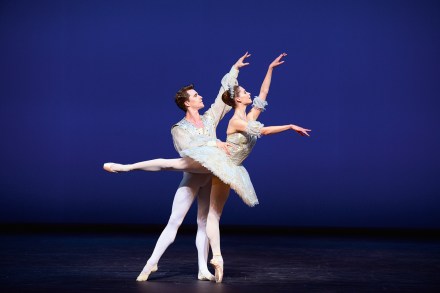
Christopher Wheeldon must be one of the most steadily productive and widely popular figures in today’s dance world, but I’m yet to be persuaded that he has much gift for narrative. His adaptation of the novel Like Water for Chocolate was a hopeless muddle; his response to Alice’s Adventures in Wonderland is mere vaudeville; and I’m praying to St Jude that nobody is planning to import his dramatisation of Oscar Wilde’s downfall, premièred in Australia last year. But as the elegant craftsman, and sometimes the inspired artist, of more abstract dance, he is without doubt a great talent. The Royal Ballet’s programme of four of his shorter pieces showcases his strengths.

We’ve underestimated Francis Rossi

Pop

I have a friend who insists that had Status Quo hailed from Düsseldorf rather than Catford, they would nowadays be as critically revered as Can, Faust, Neu! and those other hallowed Teutonic pioneers of unyielding rhythm from the 1970s. Maybe so. Very probably not. Canned Heat and ZZ Top seem more reachable comparisons. But it’s true that ‘the Quo’ have been underestimated and unjustly derided throughout their six-decade career, not least by themselves. The band has happily perpetuated their position as rock and roll neanderthals: a 2007 album is titled In Search Of The Fourth Chord. There was always a little more to it than that. Personally, I have always divined a terrible sadness at the heart of their music.

A spate of re-releases suggests that Wolfgang Sawallisch was no B-lister

The Listener

Grade: A It’s clearance-sale time for the great classical labels of the 20th century. As streaming platforms drain the remaining value out of once-prestigious recorded catalogues, even B-listers are being pulled up from the vaults and remastered for one last re-release. Eleven-disc Rafael Frühbeck de Burgos edition? Walter Weller’s complete Decca recordings? Now’s your chance: everything must go! The Bavarian conductor Wolfgang Sawallisch, who died in 2013, was never exactly B-list. His name always commanded respect. But in the golden age of LP collecting he was regarded as a safe pair of hands rather than a blue-chip name. Listening to a mini spate of Sawallisch re-releases suggests that we underrated him.

Our half-time scorecard on the Royal Opera’s Ring cycle

Opera

With Die Walküre, the central themes of Barrie Kosky’s Ring cycle for the Royal Opera are starting to emerge, and one of them seems to be wood. Not trees, so much; at least not as a symbol of life. After the rapid assembly of a world from theatrical nothingness (a bare stage), Hunding’s forest hall is simply a wall of blackened planks, with no World Ash Tree in sight. Then you notice the protruding hilt of the sword Nothung: no, that is the World Ash Tree, and Hunding has recycled it into building material. We knew he was a wrong ’un, but really: this is Sycamore Gap-level wickedness. Various ex-trees recur in Rufus Didwiszus’s designs. The huge, maimed log from Das Rheingold reappears during Siegmund and Hunding’s duel, spewing blood as the betrayed hero falls and dies.

I think I’ve found the new Van Morrison

Pop

Young male singers won the right to be sensitive in 1963, when The Freewheelin’ Bob Dylan was released. And in the 63 years since, being young and vulnerable and questing has been one of the great default settings. I’d say you can’t go far wrong singing sadly about your feelings, but of course you can, as the great mountain of discarded troubadours proves. Yet the size of that rejects mountain also tells us how alluring the prospect of baring one’s feelings to strangers can be. Zach Condon, who works as Beirut, and Dove Ellis are at different points on the sensitive young man spectrum. Condon is 39 for a start, so the young bit doesn’t even hold true.

Two hours of yakking about Israel: Giant, at the Harold Pinter Theatre, reviewed

Theatre

Two hours of yakking about Israel. That’s all you get from Giant at the Harold Pinter Theatre. Endless wittering laced with venomous bigotry. The year is 1983 and the celebrated kiddie author, Roald Dahl, has kicked up a massive stink by denouncing Israel for attacking Lebanon in late 1982. His latest scribble, The Witches, is about to be published in America but a handful of bookshops are threatening to boycott his work. Tom and Jessie, two executives from Dahl’s publishing firm, visit him at home and beg him to withdraw his anti-Semitic rant. Dahl refuses because he loathes the Jews, hates Israel and endorses all the usual myths about Jewish control of politics and finance.

Budget Ballets Russes: BRB2’s Diaghilev and the Birth of Modern Ballet reviewed

Dance

Although I doff my hat to Carlos Acosta’s BRB2, Birmingham Royal Ballet’s junior troupe, for a reminder of what is owed to the Ballets Russes – nothing less than the creation of a new art form – the programme it’s presenting in Diaghilev and the Birth of Modern Ballet is neither well balanced nor coherent. Between some highlights of the most familiar Fokine repertory, an extract from Nijinska’s Les Biches has oddly been inserted, and there was nothing here to suggest the fact that Massine was by far the most dominant choreographer of the Ballets Russes’s interwar era and someone indeed who had personally worked with BRB in its previous incarnation.

The powerfully disorienting world of Mark Eitzel 

Pop

There’s a lot to be said for an artist making an audience feel uncomfortable. Richard Thompson used to say that he considered it sound practice to keep punters ill at ease and on their toes. Mark Eitzel would probably agree, although it’s never been entirely clear whether the nervous exhaustion he induces among his fans is deliberate or unintended. Mercurial is one way of describing his on-stage aura. Volatile and unpredictable others. The first time I saw Eitzel perform, in 1993, he was still the singer in the great San Francisco group, American Music Club. That night, he drank a pint of whisky and returned for the encore with a slice of processed ham stuck to his forehead.

The repetitiveness made me cry with boredom: Mark Pritchard and Thom Yorke’s Tall Tales reviewed

The Listener

Grade: B+ You are in the wrong hands here for what is a homage to this duo’s favourite electronic music. The only Radiohead album I like is the guitar-driven Pablo Honey (and I wasn’t terribly mad on that to be honest.) My inclination is to mark down the genre itself, for its wafting and beeping and farting portentousness, all the way back to Stockhausen. But I suppose one has to put such prejudices aside. What we have is Yorke’s anguished, puppy-dog falsetto, occasionally tenor and on one song contralto, with Pritchard’s sweeping aural soundscapes and clever but often annoying rhythms. At times the repetitiveness made me cry with boredom, but I do understand that repetitiveness is part of the shtick.

Inspired: Scottish Opera’s Merry Widow reviewed

Opera

The Merry Widow was born in Vienna but she made her fortune in the West End and on Broadway. The original 1905 Viennese production was a shoestring affair. It was the English-language revivals in London and New York that made the Widow a global smash, and that happened only after extensive rewriting, done with Lehar’s wholehearted endorsement. Hanna Glawari (deemed unpronounceable) was renamed Sonia Sadoya, Zeta became Baron Popoff and the comedian George Graves inserted a humorous monologue about a chicken called Hetty. You probably had to be there. Anyway, the point is that operetta is protean. Rewrites, updates and changes of setting are not only forgivable; they’re intrinsic to the genre.

Igor Levit’s 12-hour performance of Satie’s Vexations was far too short

So, in the end, it was long but not that long. Twelve hours, compared to the 20 hours-plus many of us had been anticipating. The fastest on record? Very possibly. Igor Levit had started Satie’s Vexations just after 10am on Thursday 24 April, and completed repeat number 840 of this niggly little bastard of a phrase around 10.30pm, preventing any kind of mass sleepover at the Queen Elizabeth Hall. No screens were required in the end either – screens that the Guardian had reported were scheduled to appear around the pianist to hide his modesty when the toilet beckoned. (The logistics of this seemed ambitious.) Instead whenever Levit decided it was time for a loo break he simply walked off stage.

Igor Levit performing Satie's Vexations. Image: Pete Woodhead

Imagine Dua Lipa releasing an album of Victorian parlour ballads

More from Arts

Grade: B+ This is unexpected. A bright young cellist – one of the brightest, in fact – makes his recorded debut with a collection of opera fantasies. In the 19th century, touring virtuosos routinely ransacked hit operas for melodies, then decked them out with every conceivable bit of flummery, dazzlement and top-end-tinsel, the better to excite their fans. They were wildly popular. The young Wagner spent a miserable few months in Paris compiling opera fantasies for cash in hand. The process basically radicalised him. Nowadays, there’s no less fashionable genre, and for the excellent 26-year-old American cellist Zlatomir Fung to record a whole disc of the silly things – well, it’s as if Dua Lipa had suddenly released an album of Victorian parlour ballads.

Confusing but highly watchable: Slade in Flame reviewed

Cinema

Slade in Flame was glam-rock band Slade’s first foray into film – and also their last. It was a flop on its release in 1975 and that would have been that, end of story, gone and forgotten, except it has been rediscovered in recent years, with critic Mark Kermode even hailing it as ‘the Citizen Kane of British pop movies’. That, I think, may be something of an overstatement but it’s still a highly watchable 90 minutes, does offer some banging tunes, and Noddy Holder, who plays the lead, does not embarrass himself on the acting front. (The other band members play lesser roles, perhaps mercifully.)  Newly remastered by the BFI for its 50th anniversary, the film is currently out in cinemas and will be available on Blu-Ray/DVD from 19 May.

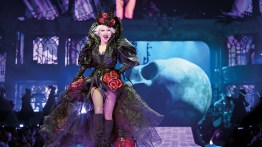
A triumphant show: Self Esteem, at Duke of York’s Theatre, reviewed

Pop

The most compelling character in the newish documentary One to One: John & Yoko isn’t either John or Yoko. It’s one A.J. Weberman, inventor of ‘Dylanology’ and ‘garbology’. He’s shown practising both in the film, rummaging through Bob Dylan’s bins for clues to the thought process of genius.  Fifty years on, two things struck me. The first is how odd it is that Lennon and Dylan would let someone as obviously potty as Weberman anywhere near them. The second is that everyone is now Weberman. Think of the Swifties who decode every missive from Taylor; the fanatics who obsess over the sexual antics of boy bands based on convoluted readings of song lyrics; and people like me who spend wintry Saturdays driving around the Jersey shore visiting Springsteen locations.

The disturbing ambient music of William Tyler

Pop

One could argue that all musical forms are essentially incomplete until the listener joins the party, but ambient music seems more needily co-dependent than most. Given that a typical sound bed is a blank canvas of amniotic electronica, much depends on the interpretation of whatever is laid over it: the drip and the drift; the scrape and the scratch; the arbitrary beauty of found sounds and field recordings. The meaning can be as banal or as profound as desired. Is that distant clanging the bells of mortal dread tolling for us all; or simply next door’s bin lid clattering on to the pavement?

The case for replacing nurses with robots

Theatre

Tending is a work of activism on behalf of the NHS. The script brings together the testimony of 70 nurses in a show spoken by three performers. It’s full of surprises and shocks. All NHS nurses are obliged to annotate their actions as they work. ‘If you haven’t documented it, you haven’t done it,’ they’re told. A nurse estimates that she spends 20 per cent of her time caring for patients and the rest of it chronicling her doings on bits of paper. There appears to be no feedback mechanism that enables the nurses to help managers find ways to improve the service. A nurse tells the story of a lunatic who barricaded himself inside a lavatory cubicle and slit his throat open. He couldn’t be helped because the locks operated from the inside only. Could this flaw be corrected?