Culture

Culture

The good, the bad and the ugly in books, exhibitions, cinema, TV, dance, music, podcasts and theatre.

Reminiscent of Roxy Music’s cocktail sound: The Weather Station reviewed

Pop

One of the unforeseen consequences of the rise of streaming was a change in the very structure of the pop song. Listeners who needed only to click a button to explore an unfathomable amount of music rapidly lost patience. They were less willing to listen to long songs; they were less willing to wait for songs to develop, even over the course of three minutes; they liked songs that sounded the same as other songs they were familiar with. And so, over the past decade or so, pop has adopted a formula: songs now tend to open with a huge hook, then throw more hooks on top of that, and then — because a small cadre of songwriters and producers are viewed as safe hands — they get remade in barely different forms again and again.

Is Jed Mercurio bored with Line of Duty?

Television

When a drama begins with news of a ‘Chis handler’ receiving ‘intel graded A1 on the matrix’ that causes a ‘conflab with the SFC’, it can mean only one thing: you’re watching a new series of Line of Duty. And just to confirm it, shortly afterwards a bunch of armed police carried out a raid that didn’t go to plan — possibly because it was being led by a bent copper. As ever, too, there’s a big name playing the potential wrong ’un, with Kelly Macdonald (Trainspotting, No Country for Old Men) guest-starring as DCI Jo Davidson, leader of the Murder Investigation Team.

How 20th-century artists rescued the Crucifixion

More from Arts

Two millennia ago, in the outer reaches of the empire, the Romans performed a routine execution of a Galilean rebel. Tortured and publicly humiliated in front of family and friends, Jesus of Nazareth was slowly asphyxiated over six hours. The Crucifixion is the centrepiece of Christianity. But artists have long adapted the devotional image of the Cross for their own purposes. As far back as the early 5th century, woodcarvers working on a door for the Basilica of Santa Sabina in Rome crafted a Christ whose palms are impaled with nails, but who is not hung on a cross. A devotional statue in Panama dating from the 17th century made Christ not Middle Eastern, but black African. James Tissot (c.

The dark history of dance marathons

Arts feature

On 31 March 1923, Alma Cummings put her feet into a bowl of cold water. Then, tired-eyed but smiling obligingly for the photographer, she held up her dancing shoes. There were holes in both soles. Cummings had just finished a 27-hour stint of waltzing at a Manhattan ballroom, wearing out not just her shoes, but six male partners in the process. The dance instructor was one of the Americans responsible for a strange cultural phenomenon that swept the United States over the next two decades — dance marathons. Cummings’s record was soon beaten and within a few years promoters were organising public competitions across the States in which couples danced for hours, days, months even, to win prize money. Some collapsed and even died in the process.

Why are the Oscars such a lousy guide to great cinema?

More from Arts

Chloé Zhao’s Nomadland, predicted to win big at this year’s Oscars, is not a terrible film. It’s a slight, sentimental Grapes of Wrath-ish journey through the Discourse, with essential Discourse stop-offs at an Amazon warehouse and the rust belt. It belongs in the New Yorker, not on screen. As with almost every film to win big since No Country for Old Men 13 years ago, you just think: the ‘highest honours in filmmaking’? For that? Amid all the change that’s being trumpeted at this year’s Oscars — more women directors, more ethnic minorities — the one thing missing is any discussion about why the awards are such a lousy guide to great cinema.

Apple TV+’s new series damn near cost me my marriage: Calls reviewed

Television

Calls is the very antithesis of televisual soma. In fact it’s so jarring and discomfiting and horrible that I think this week’s column damn near cost me my marriage. ‘Why are we having to watch this hideous drivel?’ grumbled the Fawn, who felt cheated of a soothing night glued to our new addiction, the French series Call My Agent! (Netflix). ‘Because it’s my job and this is a new thing and Call My Agent! isn’t,’ I said. So I had to watch on my own. I do understand the Fawn’s objections. Really, it’s more like radio than TV and might work better enlivening a long car journey.

The mystery and romance of the cassette tape

Music

May the gods of Hiss and Compression bless Lou Ottens. As head of new product development at Phillips, the Dutch engineer invented the compact cassette in 1963 and changed music for ever. Ottens died last week at 94. A good age, and a good number. You could get a full album on each side. For many of us born in the 1970s, who came of age musically in the 1980s and 1990s, the blank cassette has an unkillable romance. We measured our lives in spools of magnetic tape: C60, C90, the occasional C46. Inside those hard plastic shells we surfed the thin end of the aural wedge, composing scrappy love letters in the medium’s notoriously tinny register — no bass, all treble. Tapes were desirable not for their audio quality, which was sub-prime, or aesthetic appeal.

Why In Our Time remains the best thing on radio

Radio

In Our Time is the best thing on Radio 4, possibly the best thing on the radio full stop. It is broadcast regularly from a parallel universe where everyone is interesting, everything is worth knowing and anyone can know it if they want to. It gets the best out of its medium by being somewhat contemptuous of it. It understands that the overproduced trimmings of modern radio are entirely extraneous. There will be no sound effects, no music and no catchphrases. All that we need by way of introduction is the word ‘hello’. After that, there’s no telling what will follow. ‘Hello. In 541 AD, in the realm of Justinian, there was a plague in which the whole human race came near to being destroyed.’ ‘Hello.

Spellbinding: Preparations to be Together for an Unknown Period of Time reviewed

Film

The premise for the unsnappily titled Preparations to be Together for an Unknown Period of Time is this: a Hungarian neurosurgeon meets a fellow Hungarian neurosurgeon at a medical conference, falls in love, and gives up her shiny life and career in America to be with him in Budapest. They had agreed to meet on one of the city’s bridges. He doesn’t show. She tracks him to the hospital where he works. He says he’s never met her before. And now we are on board. Now we have to know: is he gaslighting her? Is she crazy? How is this going to play out? This is one of those films that has you in the palm of its hand right from the off.

Revelatory and grubby: Framing Britney Spears reviewed

Pop

The most headline-grabbing of these three pop docs was Framing Britney Spears, part of the New York Times Presents documentary series, and a bit of a worldwide sensation. It was both revelatory and grubby. As many have noted, the footage of interviews with Spears as a prepubescent and teenager was so deeply unpleasant, so unrelentingly sexual, that it seemed to come not from 20 years ago, but from Neanderthal times. The simple accumulation of the public record was horrifying. No wonder people such as Jimmy Savile were able to thrive. If television interviewers could ask a teenage girl about her breasts, about whether she was having sex, then is it any wonder young women could be treated as sexual chattels behind closed doors?

How real is the performing arts exodus?

Arts feature

Think back 12 months to when you first felt the pandemic. Not when you first read about Covid-19, but the moment of impact — the lurch in the stomach as it hit you that this time, it really wasn’t going to be OK. For Emma Cook, a freelance stage manager on the John Cleese farce Bang Bang!, the moment came during a rare week off. ‘I was sitting in a restaurant near the Bush Theatre in London, waiting to go and see The High Table, and I got a message from a friend who had just flown back from overseas: “Why are the theatres all closed?”. I thought, no they’re not, I’m about to see a show. So I walked over to the theatre and they told us: “No, sorry. We’ve had to stop everything.” And that was when Covid suddenly became big and real.

The V&A’s restructuring plans are baffling, disturbing and wrong

These are challenging times for all cultural institutions, not least for the Victoria & Albert Museum and for its director Tristram Hunt. The museum was riding high at the start of 2020 with strikingly successful exhibitions, record attendances and the ongoing realisation of the ambitious plans put in place by Martin Roth, Hunt’s predecessor – with branch museums in Shenzhen, in Dundee, and in East London, where a new museum will open together with a state-of-the-art Collections and Research Centre. But now, with a ten million pound deficit, no one can doubt that in response to the Covid-19 pandemic, staffing cuts will have to be made. The axe has already fallen on jobs in Retail, Conservation, and Collections Management.

Barack Obama will make you cringe: Renegades: Born in the USA reviewed

Radio

Barack Obama wants the world to know how much he loves singing. In his new podcast, which takes the form of a series of conversations with Bruce Springsteen, he’s rarely without a tune on his lips. ‘Further on up the road…/ you been laughing, pretty baby…’ A shower-singer, a bedroom warbler, an Air Force One air guitarist with an okay voice, the former president is proof that you really can be embarrassing without feeling an ounce of embarrassment. Oh, to have seen his daughters’ faces when he broke into ‘Let’s Stay Together’ in front of Al Green. The sound team at the fundraiser in Harlem urged him to do it, he tells Springsteen, but no one’s buying it.

The best film of the year: Judas and the Black Messiah reviewed

Film

Judas and the Black Messiah is a biopic about Black Panther leader Fred Hampton, but it’s not your regular biopic because it’s told as crime thriller, through the eyes of a snitch, who may be found out at any minute. This film says what it has to say — about race, injustice, police brutality — but excitingly, thrillingly and non-formulaically. It’s the best film of the year so far, which may not be saying much, given how few films have been released, but you get the sentiment. (The Bond film No Time to Die has been postponed so many times I fear none of us will see it in our lifetimes.) Directed by Shaka King, and written by King, Will Berson, Kenny Lucas and Keith Lucas, the film is based quite accurately, as far as I can fathom, on true events.

The death of the mainstream band: Black Country, New Road reviewed

Pop

Twitter was awash with mockery last week, after Adam Levine, the singer of the American group Maroon 5, was interviewed on Apple Music and told Zane Lowe: ‘It’s funny, when the first Maroon 5 album came out there were still other bands. I feel like there aren’t any bands any more, you know?’ Out came the outraged, citing their favourite bands with fanbases numbering in the dozens. What about the fertile deep sludge scene based around Pimple Nose Records of Butt Wipe, Montana, eh? Then there were the K-Pop stans, demanding BTS — a seven-piece vocal group who, had they been formed in England in the 1990s, would clearly have been a boyband — be recognised as functionally equivalent to the Rolling Stones (there’s no moral judgment there, BTS stans.

Undemandingly enjoyable (just don’t read the episode’s title): McDonald & Dodds review

Television

Well, this a bit awkward. A fortnight ago, in my last TV column, I confidently asserted that, despite the involvement of Jed Mercurio, Bloodlands (BBC1) was nothing like the programme it was being compared to in all the advance publicity. Two episodes, several twists and at least one bent copper later, my ringing conclusion ‘Just don’t expect Line of Duty’ feels somewhere between premature and spectacularly wrong. Luckily, this is not a mistake anybody could make about Bloodlands’ Sunday night crime rival, McDonald & Dodds, which has been building up a solid following on ITV. The central idea it depends on is, like that of many a cop show before it, two mismatched detectives.

Three new releases that show the classical recording industry is alive and well

Classical

Rachmaninov’s First Symphony begins with a snarl, and gets angrier. A menacing skirl from the woodwinds, a triple-fortissimo blast from the brass, and then the full weight of the strings, hammering out one of those doomy Russian motto-melodies like lead boots dragging you to the bottom of the Neva. ‘Vengeance is mine; I shall repay’ glowers the epigraph that Rachmaninov inscribed at the top of the score, and you’d better believe it. The symphony’s première in 1897 was a disaster that stunned the 23-year-old composer into near-silence.

Grotesquely plodding: Late Night Staring At High Res Pixels reviewed

Theatre

The Finborough’s new show is a love story with the male partner absent. Two women, one Irish and one American, explain their feelings for a London businessman, aged 45, who seems to be connected with the fashion trade. The women, known as ‘I’ and ‘A’, have different functions. ‘I’ is a young Irish model and ‘A’ is the absent man’s co-worker. Both are besotted with him for obscure reasons. We know nothing about him except that he visits east London every Sunday to devour his parents’ roast dinner. ‘A’ attends these meals but ‘I’ is excluded so she texts him snaps of her boobs instead. The women aren’t remotely troubled by his cold, exploitative attitude.

Clubhouse left me with one question: why am I here?

More from Arts

For my 13th birthday in 1995 I requested — and got — my own ‘line’. This meant that I could jabber all night without taking the phone out of service for everyone else. Getting your own line was a rite of passage for teenage girls in America back then, and everybody just sighed and let us get on with it. Talking on the phone all the time was simply something girls did. Women, meanwhile, at least according to film and TV, spent their time sitting by the phone eagerly awaiting calls from men that usually didn’t come. But then the feminised world of the endless, open-ended voice call dwindled with the arrival of mobile phones and a preference for texting, messaging, tweet-messaging, and the easy WhatsApp voice note.

Astonishing, relentlessly pleasurable rediscovery – tantric opera: Luigi Rossi’s Il Palazzo incantato reviewed

Classical

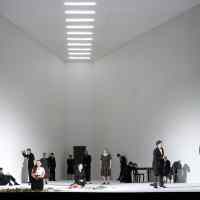
I don’t say this lightly, but after 20 years of opera-going, Luigi Rossi’s Il Palazzo incantato might just be the most baffling opera I’ve ever seen. And I’ve seen Stockhausen’s Licht. It starts with 27 named roles and originally featured no fewer than ten castrati among its cross-dressing, all-male cast. This operatic game of Twister was premièred in Rome in 1642, where it originally played out over seven scintillating hours and nearly 3,000 verses of poetry written, incidentally, by the man who would go on to become Pope Clement IX.

How stupid do the script writers of Sky’s Devils think we are?

Television

Here’s a worried question I want to plant in your head: when is TV drama going to start depicting the world we actually live in, where almost everyone wears masks, even outdoors? The current state of affairs — watching people on screen in familiar locations interacting closely, as we used to, and not wearing face-coverings — is a bit jarring. But it’s greatly preferable to the alternative: mumbled lines even more unintelligible than they are usually, smiles and teeth and noses and lips hidden behind a rag — and concealed with them not just beauty or character but half the means our faces use to convey emotion. I wonder, though, how long this nostalgic dream state is going to last.

Claudia Winkleman’s new Radio 2 show gets off to a brainless start

Radio

Last Saturday on Radio 2 Claudia Winkleman was inaugurated as the host of what was formerly Graham Norton’s mid-morning spot. She announced her arrival by playing ‘Help!’ by the Beatles and offering a line-up comprised solely of fellow Saturday-night TV presenters. Here was Sir Tom Jones, calling in from ‘a terrace overlooking the Thames’ and repeating more or less the same interview he had delivered on Graham Norton’s TV show last month. Half an hour later came David Walliams, and to round things off Ant & Dec were prevailed upon to talk about their ‘jampacked’ ITV show later on that day. ‘How do you not unravel doing it?

It’ll please small kids, but they’re never to be trusted: Raya and the Last Dragon reviewed

Film

Raya and the Last Dragon has everything you might want nowadays from a major Disney film — feisty kick-ass heroine, non-white representation, a narrative that isn’t hung up on romance — but no one involved appears to have asked themselves: do we have an interesting story? Do we have any fresh ideas? Is it fun? This may please very small kiddies who don’t know any better, and there are plenty of them about, but Raya’s not a classic in the making. It’s gorgeously depicted, needless to say, but disappointingly unanimated in all other ways. While this film may please small kiddies, remember: they are not to be trusted.

How Algernon Newton made great art out of empty streets and dingy canals

More from Arts

Quite late in life Walter Sickert paid his first visit to Peckham Rye. He was excited, apparently, because he had often heard about it but never actually been there. Evidently Sickert had a sense of London as an unknown city, full of potential. And he was far from being the only artist fascinated by the hidden recesses of this vast urban labyrinth. Algernon Newton, another case in point, was equally fascinated by unfashionable byways of the metropolis. For Sickert it was music halls and dingy bedrooms in Camden that seemed full of visual possibilities; for Newton it was terraced streets and urban water courses, their banks empty of people. Not for nothing was he dubbed ‘the Regent Canaletto’.

In Chet Baker’s albums you can hear America’s romantic self-image curdling

Music

The thing to remember about Chet Baker, an old acquaintance says of the errant jazz musician in Deep In A Dream, James Gavin’s exemplary 2002 biography of Baker, is that ‘he can hurt people even after he’s dead’. Baker could be dangerous but mostly he hurt himself. He died, squalidly, in 1988, and his music, at least, can still wound. In Baker’s oeuvre the ballads are deep blue and the up-tempo tunes are somehow tinted even darker. The ‘jazz James Dean’, the ‘Prince of Cool’, Baker was extremely pretty in his younger days and made music that cast a similar enchantment. His trumpet style was lyrical, his singing voice light and seductive.