Culture

Culture

The good, the bad and the ugly in books, exhibitions, cinema, TV, dance, music, podcasts and theatre.

Somewhere in this production lies Shakespeare’s tragedy: Almeida’s Macbeth reviewed

Theatre

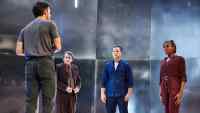
Yaël Farber’s Macbeth sets out to be a great work of art. The director crams the Almeida’s stage with suggestive props, glass panels, microphones, a wheelbarrow full of jackboots. The witches are not the usual vagrants or carbuncled mystics. These grim-looking ladies have expensive hairdos and nicely ironed shirts — like a panel of disgruntled academics at a tribunal. William Gaunt is a decrepit Duncan who looks ready to receive his telegram from the Queen. He can barely rise from his NHS wheelchair. But one wonders why this frail old chap had to be knifed to death? Much easier to smother him with a pillow and claim he expired naturally.

A highly polished exercise in treading water: Season 3 of Succession reviewed

Television

At one point in an early Simpsons, Homer comes across an old issue of TV Guide, and finds the listing for the sitcom Gomer Pyle, U.S.M.C. ‘Gomer upsets Sergeant Carter,’ he reads — adding with a fond chuckle, ‘I’ll never forget that episode.’ Even for British viewers unfamiliar with the show, the joke is clear: that’s what happens in every episode. Sad to say, this popped into my head while watching the first in the new series of Succession. The acting, script and direction are as brilliant as ever.

The death of the live album

Pop

Next week The The release The Comeback Special, a 24-track live album documenting the band’s concert at the Royal Albert Hall in June 2018. Meanwhile, Steely Dan’s last man standing, Donald Fagen, has just released two live albums recorded in 2019. Their musical qualities notwithstanding, these releases feel like relics from a lost world. Much like the fondue set, the live album is much reduced from its 1970s and 1980s heyday, when a pretty blonde sideman-turned-solo artist called Peter Frampton could somehow shift eight million copies of the anodyne Frampton Comes Alive! The stand-alone contemporary live album is now an endangered species; MTV’s Unplugged series in the 1990s offered a final down-home twist on the format.

Paintings dominate – the good, the bad and the very ugly: Frieze London 2021 reviewed

Exhibitions

There’s a faint scent of desperation wafting through the Frieze tent this year. Pre--pandemic, this was where you came to see gallerists and artists at the top of their game, knocking back the Moët with collectors to toast another big-ticket sale. But it’s been a tough few years. No art fairs, paltry sales and now there’s a limit on visitor numbers to the fair and travel restrictions are keeping international buyers at bay. So, wandering around the gleaming alleys of the fair, you feel like prime meat being eyed by starving lions. Sadly for them, my bank account is more spam than filet mignon. The first visual thing that hits you about Frieze London 2021 is the near overwhelming amount of painting.

‘You should see some of the other scripts that come through’: Robert Carlyle interviewed

More from Arts

‘I always feel slightly sick when I hear actors talking politics,’ says Robert Carlyle — that polished Glaswegian burr sounding no less arresting over a slightly patchy Zoom connection. ‘I mean we’re all entitled to an opinion,’ he continues, sounding for a second as though he might be about to opt for a more diplomatic track. ‘I just find that too many actors find it difficult to get theirs across without sounding like a twat.’ It’s a fair point, you might think. But for Carlyle, it’s also been a good professional move. Reflecting on his career, he credits this aversion to mouthing off with inspiring his long-term commitment to keeping his head down.

How the Beano shaped art

Arts feature

Superman and the Beano are both 83 years old. The American superhero first pulled on his tights for Action Comics No. 1 in June 1938. The following month, roughly 443,000 copies were sold of the Beano’s first issue, featuring Pansy Potter (the Strongman’s Daughter), Big Fat Joe, Wee Peem (He’s a Proper Scream) and, my personal role model, Lord Snooty. Not until Grand Theft Auto launched in 1997 has anything so culturally significant come out of Dundee. But there is a key difference between Superman and the Beano. While American heroes in general and Superman in particular uphold rules, the Beano’s success — its 4,000th edition in 2019 made it the world’s longest-running weekly comic — is predicated on characters who break them.

Dave Chappelle’s show is a rip-off

Towards what seemed like the halfway point of his show in London last night, Dave Chappelle announced to the crowd he was going to tell us something he was refusing to tell the media.  He wanted us to know, he said while looking sadly at the floor, that his quarrel was not with the gay or the trans communities . No, no. Looking up and raising an index finger, he explained: 'I’m fighting a corporate agenda that needs to be addressed.' Thinking we still had another hour of the show to go, we cheered. ‘You fight those corporate vampires, Dave!’ we thought. He then let us know, whenever it was possible, that we should be kind to one another. Very shortly after that he raised his thumbs aloft and walked off stage: 45 minutes. Friday night tickets are £160.

Lurking beneath the gore are moments of wit and sensitivity: Squid Game reviewed

Television

Should we be worried that Squid Game is the most popular show in Netflix’s history? If it’s a case of art imitating life, then the prognosis for our civilisation is not good: most of us will die, horribly, sooner rather than later, but for the very few who survive there will be untold riches to enjoy in the company of the cruel and capricious controlling super-elite. Squid Game is a Korean update of the Japanese cult classic Battle Royale (2000) which spawned — or revived; let’s not forget Rollerball (1975) — the genre known as ‘death games’. These films take place in a dystopian future where ordinary, desperate folk compete in a series of gladiatorial to-the-death contests for the amusement of the ruling oligarchy.

The best podcasts where girls sit around talking about ghosts

Radio

‘I’ve actually seen ghosts.’ This statement comes less than ten minutes into the first episode of Dark House, a limited-series podcast about ghosts, houses and interior decoration from House Beautiful magazine. And this is the moment, I assume, a certain number of people roll their eyes and switch over to the next podcast in their queue. Humans are fascinated by ghosts. We tell the stories, we take the city tours of hauntings when we travel, we see all the films in the Conjuring and Insidious series. But that’s a bit different from seeing real ghosts, which is just someone taking things too far. It was a shadow, or a dream, or a trick of the light, or a flaw with the camera.

Hang in there for the gripping final half an hour: The Last Duel reviewed

Cinema

Ridley Scott’s The Last Duel is set in the 14th century and is a tale of rivalry and rape told from three points of view, when two would probably have been sufficient. The best is saved to last, perhaps unforgivably. It’s the woman’s story, starring Jodie Comer who is sensational, so do hang on in there for that. However, I can’t guarantee that you won’t have severe battle-scene fatigue by then.

We’ll be talking about Royal Opera’s Jenufa two decades from now

Opera

Leos Janacek cared about words. He’d hang about central Brno, notebook in hand, eavesdropping on conversations and trying to capture their exact rhythm and intonation in scribbled semitones and quavers. So there’s a tidy irony in the fact that the opera that made his name isn’t really called Jenufa at all. Janacek called it Jeji Pastorkyna, and if it’s easy enough for non-Czech speakers to understand why that was never likely to travel, it’s not without consequence. Another woman drives this story, and in the original title she’s present but unnamed: Jenufa’s stepmother, described simply as Kostelnicka, or churchwarden. Jeji Pastorkyna translates roughly as ‘Her Stepdaughter’. No matter.

A triumph: Young Vic’s Hamlet reviewed

Theatre

Here goes. The Young Vic’s Hamlet, directed by Greg Hersov, is a triumph. This is a pared-back, plain-speaking version done with captivating simplicity and perfect trust in the text. The star is Shakespeare and the production merely opens up an aperture to his dazzling account of human greatness and frailty. The action takes place on a small, level stage that could be covered by two bedspreads. Designer Anna Fleischle adds an oblong arch of distressed stone along with three tall blocks that rotate to create internal hiding places, corridors and cubby-holes. That’s all she needs to suggest a house of horrors, a court of nightmares, a royal palace beset by plots and whispers of secret killings.

A terrible joke gone wonderfully right: Rick Astley and Blossoms Perform the Smiths reviewed

Pop

Many of us who grew up loving the Smiths have rather shelved that affection in recent years. Many of us, being lily-livered liberals, have rather taken against Morrissey’s politics and his public support for the far-right For Britain party. Even those inclined to agree with him might have tired of his unrelenting self-pity and his inability to say anything nice about anyone, ever. Yes, we’ve still got lovely Johnny Marr playing the songs in his solo shows, but with the greatest goodwill in the world — and Marr gets granted the greatest goodwill in the world by being such an obviously decent fella — he’s no one’s idea of a great singer.

The frisky side of a classical master: National Gallery’s Poussin and the Dance reviewed

Exhibitions

In the winter of 1861, visitors to the Louvre might have seen a young artist painstakingly copying one of the museum’s 39 paintings by Poussin. The subject was ‘The Abduction of the Sabine Women’ and the artist was the 27-year-old Edgar Degas, then at work on his own classical battle of the sexes, ‘Young Spartans’. Although lumped with the impressionists, Degas was a classicist at heart. ‘The masters must be copied over and over again,’ he believed, ‘and it is only after proving yourself a good copyist that you should reasonably be permitted to draw a radish from nature.’ A dedicated copyist himself, Poussin would have approved.

How the culture wars are killing Western classical music

Arts feature

Musicology may appear an esoteric profession. But several events in the past few years have pushed musicological debates into the columns of national newspapers, from the American academic who claimed that music theory was a ‘racial ideology’ and should be dismantled, to the Oxford professor who allegedly suggested that studying ‘white European music’ caused ‘students of colour great distress’, to the high-profile resignation of a professor at Royal Holloway, University of London, reportedly in response to academic ‘cancel culture’. These disputes have not emerged from nowhere.

A well-meaning but dull Official History: Olivier’s Normal Heart reviewed

Theatre

The Normal Heart is not about Aids. Larry Kramer’s play is set in New York in 1981 at a time when clinicians were struggling to find a link between a handful of rare diseases that struck only gay men and heroin addicts. The term ‘Aids’ wasn’t adopted until late in 1982. And this dampens the wheels of Dominic Cooke’s production. A playgoer is likely to stifle a yawn as the characters on stage try to discover medical facts that have been common knowledge for decades. There are other problems with Kramer’s ageing script. The story follows an indignant activist, Ned, who has to persuade the city authorities to take the plague seriously. He embarks on a laborious campaign whose numerous battlegrounds the script exhaustively covers.

The Sunday Feature is one of the most consistently interesting things on Radio 3

Radio

The story is likely apocryphal — and so disgraceful I almost hesitate to tell it — but it goes like this. On the night of 14 November 1940, as more than 500 Luftwaffe rained bombs on the people of Coventry, the newly appointed city architect Donald Gibson was watching the fires. Gibson had been appointed to the newly created position of ‘city architect’ three years earlier by the radical Labour council that had come to power in a local election. His job was to modernise what was then Britain’s best-preserved medieval city, and build the ideals of social justice and equality into the city’s brick and mortar.

If it were any better, it would actually be a terrible pity: Diana – The Musical reviewed

Film

This week, an excellent film (Moving On) and a film that isn’t at all, but is entirely worth it as it’s one of the super bad ones that don’t come along too often. It’s the kind that, if it were any better, it would actually be a terrible pity. (See also: Cats.) It’s Diana: The Musical and it’s two hours of ‘whaaaaaat?’ and pinching yourself that this is really happening. (After two hours I was black and blue, with the pinching.) I don’t know what the best lyric is but ‘Harry, my ginger-haired son, you’ll always be second to none’ has to be up there. (Also: ‘It’s the Thrilla in Manila but with Diana and Camilla’ has to be in the game. The top spot is highly contested.

Hits you where it hurts: Welsh National Opera’s Madam Butterfly reviewed

Opera

‘It’s generally agreed that in contemporary practice, this opera proposes significant ethical and cultural problems,’ says the director Lindy Hume in the programme book for her new production of Madam Butterfly, and if you’ve just shelled out 75 quid in the expectation of attractive scenery and luscious tunes, that’s you told. In truth, it’s rarely advisable to read what a director thinks about their own work, at least until after the show, when it can serve as a bemusing footnote to the evening’s entertainment. Ah, so that’s why they were wearing pink beehive wigs! If a director is any good at their job, it’ll come across on stage without any need for commentary.

The genius of Frans Hals

Exhibitions

Since art auctions were invented, they have served to hype artists’ prices. It can happen during an artist’s lifetime — Jeff Koons’s ‘Balloon Dog’ — or half a millennium after their death — Leonardo’s ‘Salvator Mundi’. And it can sometimes restore a lost reputation, as happened with Frans Hals. When the picture now famous as ‘The Laughing Cavalier’ came up for auction in Paris in 1865, Hals was all but forgotten. A successful portraitist in his lifetime, he never made much money — with a wife and at least ten children, he remained a renter throughout his career — and after his death his reputation, overshadowed by Rembrandt’s, was tarnished by claims that he was a piss artist.

Banal and profound, bent and beautiful: Nick Cave & Warren Ellis at Edinburgh Playhouse reviewed

Pop

Nick Cave has always been drawn to parable and fable, but more than ever these days he is engaged in the necessary work of mining magic from the base metal of day-to-day existence. The key lines in this show came early, during ‘Bright Horses’: ‘We’re all so sick and tired of seeing things as they are,’ Cave sang in that hollow, sorrowful baritone. ‘This world is plain to see/ It don’t mean we can’t believe in something.’ Cave’s recent songs have a terrible and powerful context: the death of his teenage son, Arthur, in 2015. As an artist he has confronted this personal tragedy side on, acknowledging its profound impact without letting it overwhelm his writing.

In defence of Marvel

Arts feature

The teaser for Spider-Man: No Way Home, out this Christmas, which had a record number of 355 million views in the first 24 hours of online availability, delivers three minutes of thrills. Tom Holland is back, in the titular role, with his girlfriend from the previous Spidey movie, his best friend Ned, references to Mysterion, jokes from Benedict Cumberbatch as master wizard Dr Strange, plus engagement with that most playful of Marvel concepts, the multiverse. Bring in the multiverse, and anything, everything, is possible. Are you old enough to recall that moment in Dallas when the shooting of JR was revealed to be a dream? Well, the multiverse does all that, and some. Time is not a constant.

Gripping slice of old-fashioned entertainment: Old Vic’s Camp Siegfried reviewed

Theatre

Boy meets girl. Girl gets pregnant. Then the entire world collapses. That’s the story of Camp Siegfried, which is set in the late 1930s at a holiday park in Long Island where German-Americans come to enjoy the outdoor life and to celebrate their ancestral culture. The boy is a strapping 17-year-old who chats up an awkward geeky girl with little sexual experience. Or so it seems. The boy is keen on Germany’s dynamic new chancellor but the girl finds Hitler too ‘excitable’. But when she’s invited to give a speech to the entire camp, she becomes an overnight convert and extolls the Nazi virtues of unity and patriotism. And she’s tempted to believe a rumour that the Führer himself travelled from Germany to hear her speak.

The best recordings of the Goldberg Variations

Classical

I sometimes think the classical record industry would collapse if it weren’t for the Goldberg Variations. Every month brings more recordings of Bach’s monumental, compact and rhapsodic keyboard masterpiece. And that’s impressive, given that nowhere else does the composer demand such sustained technical brilliance from the performer, who must execute dizzying scales and trills that wouldn’t sound out of place in one of Liszt’s fantasies. If the Goldberg Variations are an ordeal for harpsichordists, they’re a bloody nightmare for pianists, because they have to tackle music written for two manuals on just one. Their fingers tumble perilously over each other; it looks a bit like high-speed knitting.

Made me buzz like an electron: Science – Clear+Vivid with Alan Alda reviewed

Radio

Given my affection for M*A*S*H, I can’t think why I haven’t listened to Alan Alda’s podcasts before now, besides the fact that they look quite uninviting. There is Clear+Vivid, on the power of communication, and Science: Clear+Vivid, on the power of scientific research. As someone who used to fall asleep listening to cassettes for A-Level physics, I am not easily excited by protons, and was prepared to give the latter particularly short shrift. Five hours on, however, Alda is still in my ears, and I am buzzing like an electron. Unlike many presenters, Alda, 85, doesn’t pretend not to know something just so that his interviewee will explain it to the audience, but nor does he strive to reveal how much he knows.