Culture

Culture

The good, the bad and the ugly in books, exhibitions, cinema, TV, dance, music, podcasts and theatre.

Film’s most unforgettable scene

Arts feature

The actor never knew they would use a real horse’s head. This was May 1971 and John Marley was preparing to perform in the most infamous scene in The Godfather, playing the corrupt movie producer who wakes up to find a horse’s head in his bed. Reportedly, Marley assumed this would just be a plastic prop. But the director, Francis Ford Coppola, had other ideas. In a note to himself, Coppola observed: ‘If the audience does not jump out of their seats on this one, you have failed.’ So he quietly sent an assistant to a dog-food factory to pick up a genuine head, newly hewn from the shoulders of a racehorse. She brought the stinking object back in a freezer box and it was slipped into the bed with Marley for maximum authenticity.

Beautiful and revealing: The Three Pietàs of Michelangelo, at the Museo dell’Opera del Duomo, Florence, reviewed

Exhibitions

The room is immersed in semi-darkness. Light filters down from above, glistening on polished marble as if it were flesh. This is the installation for Le Tre Pietà, a remarkable micro-exhibition that has just opened at the Museo dell’Opera del Duomo in Florence. It is low in quantity, containing just three works. But stratospherically high in quality, since it comprises Michelangelo’s three versions of the Pietà – that is, the Madonna mourning the dead Christ. He carved these over almost 70 years: one in his early twenties, the next in his seventies, the last in his eighties. Admittedly, the first and the last are present only in a rather old-fashioned virtual form: high-quality plaster casts.

Saudi Arabia’s burgeoning art scene

Arts feature

A little more than a century ago, a charismatic British army captain called T.E. Lawrence and fearsome Bedouin warriors swept through the sublime canyons around the desert city of Al-’Ula where I stroll today. They blew up the Hejaz railway, built to transport hajjis from Damascus towards Mecca but repurposed during the first world war by Turks to ferry munitions and troops. Such was the 1916-18 Arab Revolt that threw off Arabia’s Ottoman yoke. Today a very different kind of Arab uprising is sweeping through Al-’Ula. The canyons resonate not with bombs but with art. Dubai-based Zeinab Alhashemi has constructed boulders made from camel hides for a piece called ‘Camouflage 2.0’.

The genius of Iannis Xenakis

Classical

This year is the centenary of the birth of Iannis Xenakis, the Greek composer-architect who called himself an ancient Greek stuck in the contemporary world. His instrumental music at times suggests an alien species trying to communicate with us through our musical instruments, his electronic music a distressed animal on the receiving end of amateur dentistry. For his part, Xenakis said that music ‘must aim… towards a total exaltation in which the individual mingles, losing his consciousness in a truth immediate, rare, enormous and perfect’. Of all the post-war European firebrands, Xenakis remains the most influential today.

Too neat but it has hooks aplenty: Avril Lavigne’s Love Sux reviewed

The Listener

Grade: B Yay, life just gets better and better. World War Three and now this. More petulant popcorn pre-school punk in which Avril spells words stupidly and tells ‘bois’ how much she weally, weally hates them but acksherly weally loves them. This was momentarily captivating on the magnificently catty glam-rock thrash of ‘Girlfriend’ 15 years ago. Trouble is, Avril is now 37, older than the Prime Minister of Finland – and there’s something a little unbecoming in a mature woman still hanging around the school bike sheds and shrieking at those bois: ‘When I think of you I wanna throw up!’ Shouldn’t she be writing about pre-nups, the onset of the menopause and the spiralling cost of divorce lawyers?

Some of the best social commentary around: Celebrity Book Club with Steven & Lily reviewed

Radio

When I was ten years old I had a babysitter who was a beautiful graduate student at an Ivy League university who loved to read celebrity gossip tabloids to ‘turn her brain off’. After I’d finished my homework, she and I would watch the only reality TV show I’ve ever loved, The Hills, and read magazines about Brangelina. This all ended when I was with my mom at the grocery store and I tried to buy a tabloid, and my mother, a Woman of Taste, asked what on earth I was doing. I said, copying my babysitter, ‘it’s to turn my brain off’, and my mom flipped out and made me to go to my room and read something like Stella Gibbons’s Cold Comfort Farm.

Enthralling and unusual – even if you don’t care about Kanye: Netflix’s Jeen-yuhs: A Kanye Trilogy reviewed

Television

The most disappointing pop performance I’ve ever seen – and in the course of my 15-odd years as a music critic I saw an awful lot – was Kanye West at Glastonbury in 2015. Perhaps he was making some kind of ironic statement on the nature of celebrity and fan expectation: blinding lights all focused on himself; no attempts to engage with the crowd; relentless, mechanical rapping but with most of the amusing samples and catchy hooks removed, the better to punish us all by ordeal with loud, righteous verbiage.

Humourless and stale: The Batman reviewed

Cinema

The latest Batman film, The Batman, may be a reboot, or even a reboot of a rebooted reboot that’s been rebooted. Hard to tell any more. Tracey Ullman once joked that her mother had served leftovers for so long that no one could recall the original dish and this feels like that. What was the original dish? Was it Tim Burton’s version from 1989 starring Michael Keaton? I don’t know. All I know is that you hope each time for something fresh and surprising and entertaining but every film since has simply attempted to out-film noir the last. We can go darker still! Bruce Wayne, more traumatised by his childhood than ever before! I should also warn you that it’s three hours long having been cut down from four. (Holy cow, Batman!

Swings between violence and comedy: Pina Bausch’s Kontakthof, at Sadler’s Wells, reviewed

Dance

When you take in the richness of a Pina Bausch production — the redolent staging, the eloquent, eccentric twists of the choreography — it’s everything and it’s something. Kontakthof, created in 1978, sounds the bell of hopeful passes and freighted expectations, centuries of hearts on the line, desperate to elude solitude. A keystone of her back catalogue, the piece illuminates the convoluted, often rotten thrusts of human desire, with special emphasis on women’s vulnerability in the dating game. A gramophone pipes out vintage love songs as the ensemble to and fro across a dance hall in Bausch’s standard-issue suits and gowns.

A beautiful, frustrating bore: Florian Zeller’s The Forest, at Hampstead Theatre, reviewed

Theatre

The Forest is the latest thriller from the French dramatist Florian Zeller, translated by Oscar winner Christopher Hampton. It’s a well-worn yarn of adultery, betrayal and vengeance set among the yuppie classes. The action is located in France but the actors speak in Home Counties accents. (In theory, at least. Some are better at imitating BBC newsreaders than others.) Zeller makes his story deliberately arty and obscure. Man 1, also known as Pierre, is a wealthy doctor whose wife, or ‘The Wife’, is played by Gina McKee. Pierre has a hysterical girlfriend, known as ‘The Girlfriend’, who threatens to reveal their affair and destroy Pierre’s marriage. The Girlfriend dies bloodily in their love nest. But was this suicide?

The buzz band of 2022 sound like they’re from 1982: Yard Act, at Village Underground reviewed

Pop

One of the curiosities of modern pop’s landscape is that no one knows any longer how to measure success. An artist can be a huge live draw, but make no impact on the charts; they can be consistent chart-toppers but minnows among the streamers; they can stream by the bazillion, but have no live following to speak of. The metrics of success are so unrelated to each other that anyone can prove anything these days: any band can be the biggest young band in Britain right now. Yard Act are one of those biggest young bands in Britain. Their debut album was a No. 2 hit at the start of this month. Properly big, right? Well, no, perhaps not. For one, it stayed in the chart for only two weeks.

If you like First Dates, you’ll love This is Dating

Radio

The tagline of This is Dating, a new podcast from across the pond, is ‘Come for the cringe, stay for the connection.’ This sums up the listening experience pretty well. If the prospect of eavesdropping on a series of strangers’ first dates sends a shiver down your spine (some of us have endured enough disastrous dates of our own), give it ten minutes and cupid’s arrow should slowly begin to sink in. The concept is similar to that of First Dates, the reality TV show in which lonely hearts pair up for dinner and judgment while a sexy French maitre d’ looks on, pitying the lack of social skills on display before him. The difference is that This is Dating doesn’t play for laughs.

Deserves to become an ENO staple: The Cunning Little Vixen reviewed

Classical

Spoiler alert. The last words in Janacek’s The Cunning Little Vixen come from a child playing a frog. The story has come full circle — there was a frog near the start of Act One, and naturally you assume it’s the same one. But no: ‘That wasn’t me. That was my grandaddy. He used to tell me about you.’ It’s the final sad-sweet sting; the orchestra swells and the curtain falls. Perfection. Or so Janacek thought, anyway: ‘To end with the frog is impossible,’ insisted his German translator Max Brod — the same well-meaning meddler who either rescued or (according to taste) wrecked Kafka. Brod wanted a final hymn to nature from the central human character, the Forester. You know, a proper peroration.

Perfection: The Duke reviewed

Cinema

The Duke is an old-fashioned British comedy caper that is plainly lovely and a joy. Based on a true story, it’s an account of the 1961 theft of a Goya painting from the National Gallery, stars Jim Broadbent and Helen Mirren, and is directed by Roger Michell (of Notting Hill fame). Many films have all their ducks in a row yet are somehow disappointing, but this is perfect, capturing the spirit and joie de vivre of the old Ealing comedies. I could probably watch it all day every day for the rest of my life. Broadbent plays Kempton Bunton, a 57-year-old, working-class Newcastle taxi driver — although he has trouble holding down any kind of job — who has aspirations to be a playwright. We first meet him putting his latest play in the post to the BBC.

How good is he? Pissarro: Father of Impressionism, at the Ashmolean Museum, reviewed

Exhibitions

Two markers: ‘Cottages at Auvers-sur-Oise’ (c.1873) is a sweet especial rural scene of faintly slovenly thatched cottages with, at its centre, an outside privy, its door modestly shut. A discreet little detail. Second, early in the exhibition, Corot’s ‘Duck-Pond’ (1855–60), an indicator of the tradition to which Pissarro belongs — a world of unconsidered trifles, granted a quiet importance. Linda Whiteley’s excellent, informative catalogue essay quotes Pissarro on Corot: ‘Happy are those who see beauty in modest places where others see nothing. Everything is beautiful, the whole secret lies in knowing how to interpret.’ He is writing this credo to his son Lucien in 1893.

In praise of the Dome

Arts feature

London’s City Hall stands empty. The bulbous, Foster + Partners-designed ‘glass testicle’ — in Ken Livingstone’s words — occupies one of the best sites in the capital: Thames-side, squaring off to the Tower of London, and overlooking Tower Bridge. But in December, its occupiers — the Mayor, the London Assembly and the Greater London Authority — deserted their glitzy £43 million headquarters for a cheaper building more than five miles east at the Royal Docks in Newham. It took them less than 20 years to outgrow their purpose-built home. According to the architectural commentator John Grindrod, City Hall is a giant glass-and-steel metaphor.

Glorious and bracing interrogation of the world’s smartest people: Conversations with Tyler reviewed

Radio

Tyler Cowen is a man who leaves you at once in awe and perturbed. He is the Holbert L. Harris chair in the economics department at George Mason University, and the co-host of the popular economics blog Marginal Revolution. But his intellectual interests are staggering in scope, enough to unsettle. He is a true polymath. He embodies the American work ethic. He goes through ‘five or ten books’ a day. His Marginal Revolution blog is not for the faint of mind: he sends up to 40 emails each week. At any time of his choosing, Tyler pops into your inbox to show you a new study he’s found (‘which words do men use more than women?’), tips for getting better at watching films (‘get a mentor!’) or news from Norwegian sex resorts.

Stupendous: The World of Stonehenge at the British Museum reviewed

Arts feature

This exhibition is Hamlet without the Prince, and all the better for it. Stonehenge is not there; it remains in Wiltshire. But 430 astonishing artefacts from the neolithic and bronze ages fill a hairpin course like a Roman chariot-racing circuit in a vast room. It is blessedly free from videos of prehistoric Britons tugging on ropes to move monoliths. There is a henge on display, though. (The word in its technical sense was invented in 1932 by Sir Thomas Kendrick, later director of the British Museum.) This is the Seahenge that emerged on the shore at Holme-next-the-Sea in 1998: 55 big oak posts round a two-ton upturned rooted trunk. Gloriously, being trees, they can be dated to a year: 2049 BC. It was sad that it had to be dug up, but here it is, anatomised in a museum.

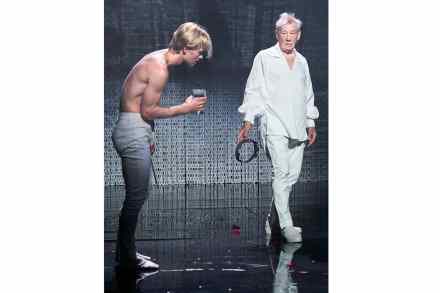
All a bit Blackadder: Hamlet, at the Sam Wanamaker Playhouse, reviewed

Theatre

Never Not Once has a cold and forbidding title but it starts as an amusing tale set in an LA apartment. We meet Allison, a happily married lesbian, whose grown-up daughter, Eleanor, arrives with a hunky new boyfriend to show off. This set-up has the makings of a flatshare sitcom. You combine a straight younger couple with an older pair of lesbians and you throw in the mother/daughter relationship for extra instability. It could be a laugh. But a new wrinkle appears. Eleanor learns that she was conceived during a one-night stand and she decides to track down her absentee father. But he’s extremely reluctant to discuss what happened that evening. Too much booze, he shrugs, and the major details escape him. Flora disagrees with this version. Eleanor’s father raped her, she claims.

Expectations were met and then exceeded: Arooj Aftab, at Celtic Connections, reviewed

Pop

We gathered on a freezing Sunday night, inside a barrel-vaulted church designed in the 1890s by Charles Rennie Mackintosh, to witness a cresting wave. Vulture Prince, the third album by the Brooklyn-based Pakistani singer, composer and producer Arooj Aftab, was one of the most accomplished and interesting records of last year. A keening song of loss, dedicated to her late brother, Vulture Prince is almost impossible to pin down. It’s a flood plain of merging musical streams, a genre-phobic blend of jazz, minimalism, Sufi devotional music, acoustic textures and torch song. Sung almost entirely in Urdu, its beauty and import are immediate, its emotional pull universal. Following two Grammy nominations and a fat wodge of critical acclaim, Aftab’s stock is in the ascendant.

Amusing and entertaining – though not very taxing: Amazon Prime’s Reacher reviewed

Television

Jack Reacher is back on the screen and aficionados of the hugely successful Lee Child airport thrillers in which he appears must be hugely relieved. This time he is played not by pint-sized Tom Cruise but by someone much closer to his 6ft 5ins height: a musclebound giant called Alan Ritchson. Not having read any of Child’s 100 million-selling oeuvre (probably because I’m bitterly envious: he’s a Midlands-born ex-media type, like me, but has a slightly larger bank balance), I can’t tell you how true to the original Ritchson is. But he plays him as if he’s on the autistic spectrum — a loner uncomfortable with too much dialogue or human emotion of any kind, who just wants to get the job done. That job is killing all the baddies.

Pretty astonishing: Black Country, New Road’s Ants From Up There reviewed

The Listener

Grade: A+ It is not true, fellow boomers, that there is nothing new under the sun nor no good new music being made. Just almost nothing new and almost nothing good. The majority is indeed toxic landfill, rehashes of that least appealing of decades, the 1980s, and performed by pasty-faced, limp-wristed, deluded woke idiots whose chief concern is to tell you their gender. But there are yet pockets of brilliance, just as there were in 1975 and 1995 — and this youngish Cambridge band (the only other place they could have come from is Oxford) inhabit one of those pockets. Upon completion of this, their second album, the lead singer Isaac Wood left the band because, so far as I could tell from his confused message on the band’s website, he was going round the bend.

Old-school excess, star power and spectacle: Royal Opera’s Tosca reviewed

Opera

London felt like its old self on Friday night. Possibly it was just me; when you visit the capital once a week, your impressions will only ever be snapshots. Still, it’s been a while since I’ve battled such a flood tide of commuters on the ramp at Euston, or since the Royal Opera House seemed to be buzzing quite so excitedly. Crowds were four deep at the champagne bar; a latecomer in a spangly tux squeezed past and into his seat, grinning a slightly tipsy apology. And at the heart of it all — the succulent hunk of well-aged rump steak generating all this sizzle — was a revival of Jonathan Kent’s lavish period staging of Puccini’s Tosca, with a marquee name in the title role.

May put you off Chaplin for ever: The Real Charlie Chaplin reviewed

Cinema

Charlie Chaplin is one of the most famous movie stars ever and is certainly the most famous movie star with a little toothbrush moustache. He was around when I was growing up as his films were often on television, particularly, if I recall rightly, on Saturday mornings. My sisters and I resented that as we wanted to watch The Partridge Family (or The Brady Bunch) on the other side but my father loved him, and I do remember being struck by his childlike innocence, as well as all the falling over. (Chaplin’s, not my father’s.) I now regret watching this documentary. Not because it’s bad (it isn’t) but because I know things about him that I wish I didn’t. It may even have put me off Chaplin for ever.

Astonishing and gripping: Van Gogh’s Self Portraits at the Courtauld reviewed

Exhibitions

In September 1889, Vincent van Gogh sent his brother Theo a new self-portrait from the mental hospital at Saint-Rémy-de-Provence. ‘You must look at it for some time,’ he instructed, then ‘you’ll see, I hope, that my physiognomy has grown much calmer, although the gaze may be vaguer than before, so it appears to me.’ Vincent was severely ill and was in the hospital to recover from his affliction, the nature of which remains controversial. Yet he carried on creating marvellous pictures, including several of himself. One of the questions raised by Van Gogh. Self-Portraits, the wonderful exhibition at the Courtauld Gallery, is simple but fundamental: why? We take it as a given that artists depict themselves; but some never do, and others only rarely.

Handel as Netflix thriller: Royal Opera’s Theodora reviewed

Opera

The Royal Opera has come over all baroque. In the Linbury Theatre, they’re hosting Irish National Opera’s production of Vivaldi’s 1735 carnival opera Bajazet; unsurprisingly, its first appearance at Covent Garden. Upstairs in the big room, they’re doing Handel’s Theodora: premièred at Covent Garden in March 1750 and then ignored by the Royal Opera and its forebears for the next 272 years. In fairness, it isn’t actually an opera. It’s an oratorio, and it was a flop. Handel attributed its neglect to the fact that the story ‘is a virtuous one’, though the music’s emotional appeal is uncompromising, and the basic morality — Christians and virtuous pagans vs a tyrannical Roman governor — is clear-cut.