Culture

Culture

The good, the bad and the ugly in books, exhibitions, cinema, TV, dance, music, podcasts and theatre.

Only goodwill will get you through this reboot: Paramount+’s Frasier reviewed

Television

Remember the groans of dismay, possibly including your own, which greeted John Cleese’s announcement in February that he was reviving Fawlty Towers? Happily, there appears to be much more goodwill behind the return of Frasier – the bad news being that, judging from the first three episodes, it might well need it. Kelsey Grammer’s entrance – 39 years after Frasier Crane showed up in Cheers – received a huge audience ovation. All references, however straightforward, to his earlier incarnations got a guaranteed laugh. Nonetheless, for those of us desperately hoping the new series won’t be a letdown, the result so far has required an increasingly effortful keeping of the faith.

Scherzinger is superb but why’s the set so dark and ugly? Sunset Boulevard, at the Savoy Theatre, reviewed

Theatre

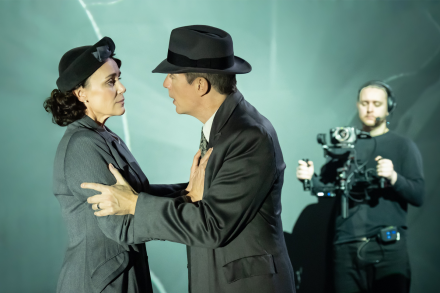
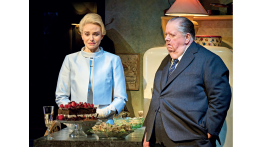
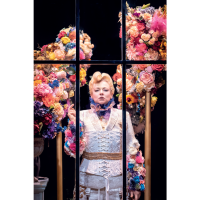
Sunset Boulevard is a re-telling of the Oedipus story set in the cut-throat world of Hollywood. Pick a side in this tortured yarn. There’s Norma, a burned-out sex-goddess, who wants to make a comeback as a teenage ballerina in a dance epic. Or there’s Joe, a penniless scribbler, who becomes Norma’s reluctant toyboy while he works on her doomed screenplay (which stands for a stillborn child). Clinging to Joe is Betty, a drippy girlfriend who represents escape and artistic integrity. The final piece in the jigsaw is Norma’s discarded husband, Max, who stands for sadistic and destructive obsession. Each day he sends Norma a new batch of counterfeit love letters from non-existent fans.

Epic, immersive and tiresomely long: Killers of the Flower Moon reviewed

Cinema

Martin Scorsese’s Killers of the Flower Moon is a Western crime drama that runs to three-and-a-half hours. (Sit on that, Oppenheimer!) But which is it: an epic masterpiece? Or just very, very tiresomely long? There are certainly pacing issues, and things that needed further explanation – there is no hand-holding. That said, the running time does allow for world-building, and it builds a world so engrossing that when I came out of the cinema onto the high street it was weird to see a Superdrug and Costa Coffee rather than dusty tracks and horses and vast landscapes beset by oil derricks. So I guess it’s epic and also tiresomely long. Does that help? This isn’t a thriller.

How the Georgians invented nightlife

Arts feature

Modern nightlife was invented in London around 1700. So argued the historian Wolfgang Schivelbusch, who traced this revolution in city life to its origins in court culture. Medieval and Renaissance courts held their festivities while it was still light outside, but by the late 17th century, aristocrats preferred to party after dark. The trend was rapidly commercialised: a new kind of conspicuous consumer descended on pleasure gardens like Vauxhall and Ranelagh, to eat, drink, stroll and listen to music by the many-coloured light of thousands of oil lamps.

As gripping as an Agatha Christie thriller: Shooting Hedda Gabler, at the Rose Theatre, reviewed

Theatre

The unlovely Rose Theatre in Kingston is a modest three-storey eyesore. The concrete foyer looks like an exercise area on a North Sea oil platform, and the auditorium itself is a whitewashed rotunda that resembles the chapel in a newly built prison. Yet this cheerless, functional space is perfect for a mischievous new satire, Shooting Hedda Gabler, about recent developments in the acting trade. The central character, Hedda (Antonia Thomas), is a washed-up American starlet who wants to gain artistic credibility by taking the lead in a pretentious film version of Hedda directed by Henrik, a tyrannical Norwegian auteur. ‘There is no script,’ he announces on the opening day. But he’s lying.

What happened to the supermodels of the 1990s?

Radio

‘What advice would you give to your younger self?’ has become a popular question in interviews in recent years. It’s meant to generate something profound but, musing privately, I always find it a puzzler. Sometimes I think that maybe I shouldn’t have wasted so much of my twenties talking nonsense in pubs, but on the other hand I really enjoyed it. So I usually settle on: ‘Don’t buy a sofa bed, especially not the kind with a concealed metal frame that you pull out.’ Unbelievably, I’ve done this twice. These vast, unwieldy contraptions cost a bomb, weigh a ton, make a terrible sofa and an uncomfortable bed. If you’re 16 and reading this, be warned.

The Goldberg crown has settled on a new head: Vikingur Olafsson’s Golberg Variations reviewed

The Listener

Grade: A+ In 2018, the Icelandic pianist Vikingur Olafsson released a solo Bach album. It bounced along unforgettably. Olafsson’s subsequent albums for Deutsche Grammophon were all lovely, but like many ‘intellectual’ pianists blessed with a pearly touch he could sound a bit precious. I missed the playfulness of his Bach, and so when he announced he was recording the Goldberg Variations I was excited. Could he sprinkle the magic of his original album over this famous Aria and its 30 tightly argued variations, at a time when there are more than 200 rival recordings on piano floating around – and roughly the same number on harpsichord? (When Glenn Gould cut his sensational Goldberg Variations in 1956, the only competition was a forgotten disc from Claudio Arrau.

New Order’s oldies still sound like the future

Pop

The intimate acoustic show can denote many things for an established artist. One is that, in the infamous euphemism coined by Spinal Tap, their audience has become more ‘selective’. Attempting to make the best of a bad job, the artist shifts down a gear while aiming upmarket, much in the manner of a balding man cultivating a fancy moustache. The cosy concert is also favoured by pop stars craving some old fashioned string-and-wire authenticity. Occasionally, the urge is a creative one, propelled by the sense that the material being promoted lends itself to a less triumphalist approach.

I watched it so that you didn’t have to: ITV2’s Big Brother reviewed

Television

Big Brother is Nineteen Eighty-Four rewritten by Aldous Huxley. The detail that George Orwell got wrong is that far from being terrified and brainwashed into submission by Big Brother, the populace would embrace the all-seeing eye as their route to fame, prosperity and freedom. Some of the populace, at any rate. We met 16 of them – there were 30,000 applicants, allegedly – on ITV on Sunday night, mugging and pratting around and enjoying their newfound semi-celebrity en route to entering the new-look Big Brother house, vying to win a £100,000 prize and, presumably, a career in minor-league showbiz by abasing and humiliating themselves in public. Into monopede DJs with disco lights on their false leg?

Proof that Rubens really was a champion of the female sex: Rubens & Women, at the Dulwich Picture Gallery reviewed

Exhibitions

‘She is a princess endowed with all the virtues of sex; long experience has taught her how to govern these people… I think that if Her Highness could govern in her own way, everything would turn out very happily.’ The ‘princess’ in question was Isabel Clara Eugenia, Infanta of Spain and regent of the Spanish Netherlands; ‘these people’ were the pesky, ungovernable Flemings and the author of the glowing testimonial was Peter Paul Rubens who, since the death of Isabel’s husband the Archduke Albert in 1621, had become her trusted diplomatic adviser. It was quite a step up for a mere court painter, especially one with a skeleton in the family closet.

Has VR finally come of age?

Arts feature

A heavily made-up Iranian woman in bra and knickers is dancing seductively before me. We’re in some vast warehouse, and she’s swaying barefoot. But then I look around. All the other men here are in military uniforms and leaning against walls or sitting at desks, smoking and looking at her impassively. I slowly realise we are in a torture chamber and this lithe, writhing woman is dancing, quite possibly, for her life. Me? I have become one of her tormentors. You can immerse yourself in war-ruined Ukraine, go on the run from the Holocaust, become a mushroom Welcome to The Fury, a bravura attempt by Iranian artist Shirin Neshat to use virtual technology in her art. ‘Have you ever experienced VR before?

A great subject squandered: Golda reviewed

Cinema

Born in Tsarist Kyiv in 1898, Golda Meir grew up with what she called a ‘pogrom complex’. That perhaps explained why later, as Israeli prime minister, she had such harsh words for Palestinians and Arabs. But then she had harsh words for a lot of people. Moses, she complained, ‘took us 40 years through the desert in order to bring us to the one spot in the Middle East that has no oil’. Women’s Lib, she averred, was ‘foolishness’, since the real discrimination was that men were unable to bear children.

Shocking: Channel 4’s Partygate reviewed

Television

If there were special awards for Most Subtlety in a Television Drama, Tuesday’s Partygate would be unlikely to win one. You could also argue that, in contrast to most of its characters, it didn’t really bring much to the party. And yet, in a rare challenge to the law of diminishing returns, the more it pounded away with its sledgehammer, the more effective it became. Despite the programme’s commitment to a thoroughly researched veracity that extended to the use of on-screen footnotes, the framework for the pounding was supplied by two fictional characters. Grace Greenwood (Georgie Henley) was a shining-eyed true Johnson believer from Darlington, who couldn’t believe her luck at ending up with the cool kids in No. 10.

Godot with gags: It’s Headed Straight Towards Us, at Park200, reviewed

Theatre

It sounds like a barking-mad student sketch but the final product is marinated in wisdom and maturity. It’s Headed Straight Towards Us is a mellow riot of a play. The setting is a rocky glacier in Iceland during the filming of a corny sci-fi movie. Hugh (Sam West) is a cerebral thesp who specialises in playing butlers and high-status toffs. On set, he meets his best friend from drama school, Gary (Rufus Hound), whose career has declined to the point where he’ll accept any role going. Tragic Gary used to be a star who earned a fortune as a cockney villain in the 1980s but he succumbed to alcoholism and ill discipline, and he now has little in common with Hugh who lives in London with a couple of pet dogs and a solicitous male lover.

An awfully long night for a band without any bangers: The National, at Alexandra Palace, reviewed

Pop

Over the past few years, the National have become the most important band in modern rock music. The strange thing is that this has happened at a point when their own work has perhaps lost a little of its earlier intensity. They’ve become important because they have come to represent something to other artists: a kind of adventurous but accessible integrity. The brothers who are the musical core of the band – guitarists Aaron and Bryce Dessner – have been so in demand that they have worked with, between them, (deep breath) Taylor Swift, Ed Sheeran, Michael Stipe, Sharon Van Etten, Bon Iver, Philip Glass, Steve Reich, Paul Simon, Sufjan Stevens, Nico Muhly, Jonny Greenwood, Bruce Springsteen and Ryuichi Sakamato. And those are just the ones you might have heard of.

Ebullience and majesty: Opera North’s Falstaff reviewed

Opera

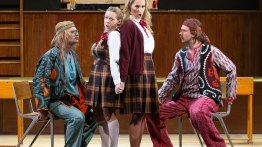
Opera North has launched a ‘Green Season’, which means (among other things) that the sets and costumes for its new Falstaff are recycled. On one level, that’s nothing new: this eternally underfunded company has been performing miracles of sustainability for years now, and there’s usually at least one production each season that looks like it’s been cobbled together from the lumber room. A few seasons back, when ON rebooted their ‘little greats’ season of one-act operas, they mixed ’n’ matched sets between wildly different operas, with cheerful abandon.

Marina Abramovic’s show is only of interest to diehard fans

Exhibitions

‘Do women have to be naked to get into the Met Museum?’ More than 30 years after the Guerrilla Girls posed this question on their feminist poster, the answer suggested by the Royal Academy’s Marina Abramovic retrospective – touted as the first solo show by a woman artist in the main galleries – is: ‘They don’t have to, but it helps.’ Abramovic achieved fame in the 1970s with a series of gruelling performances that tested the limits of her mental and physical endurance.

Stone is the solution to many of our architectural problems

Arts feature

The story of ‘The Three Little Pigs’ is hammered into us all from an early age. But its moral lessons obscure its more literal advice about building: skimping on materials is a false economy. It’s a lesson learned too late for schools built with reinforced autoclaved aerated concrete (Raac). Who would’ve predicted that concrete made cheaper by cutting it with air, puffed up like a Malteser, would end up crumbling like one too? It’ll soon prove that the initial cost savings of Raac will be wiped out multiple times over once the risk to life and expensive, disruptive repairs have been taken into account. Getting materials wrong almost cost the little pigs their bacon. Is it any surprise that we are returning to building in solid, dependable masonry?

Striking but not altogether successful: ENB’s Our Voices reviewed

Dance

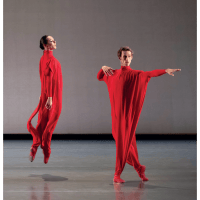
Aaron S. Watkin, an affable bearded Canadian, is the new artistic director of English National Ballet. He arrives from Dresden, where he ran a similarly scaled company comfortably subsidised by public funds. Doubtless, he finds what the Arts Council gives ENB meagre to the point of stingy. One may wonder, therefore, what the attraction is, but he certainly inherits from Tamara Rojo a solid organisation and a fine body of dancers, particularly strong on the male side. His inaugural piece of programming is striking but not altogether successful. It starts gloriously with Balanchine’s Theme and Variations, an essay in his grand tsarist style, set to some noble music by Tchaikovsky, that poses notorious challenges for the leading couple.

Soapy and sentimental: Ken Loach’s The Old Oak reviewed

Cinema

Ken Loach has said The Old Oak will be his last film – he’s 87; the golf course probably beckons. It’s not one of the ones he’ll be remembered for. At least, however, it is starkly different from the others as it’s a cheerful, sunny romcom set in Paris in the spring. I’m joshing you. It’s set in the deprived north-east where the skies are permanently grim and tensions rise due to the arrival of Syrian refugees. As you’d expect, it is a compassionate film that is respectful all round but it is also heavy-handed, soapy and sentimental, with a redemptive ending that is unearned. I wish him joy on the golf course and can only hope he has better luck keeping his eye on the ball there.

Enjoyable and informative but where’s the drama? Political Currency reviewed

Radio

The first episode of George Osborne and Ed Balls’s new podcast, Political Currency, opened with an old clip of the pair arguing across the despatch box. Osborne had described his latest Budget as ‘steady as she goes’ and Balls was having none of it. ‘What kind of ship does he think he’s on, the Titanic?’ If producers hoped that the duo would bring something of this, er, biting dynamic to their podcast, they were in for a surprise. The opening number saw little in the way of sparring between the former opponents. Seated in a studio in east London, they spent most of the time doing what so many in their milieu are doing at the moment, chummily sharing their views and frustrations and trying to squeeze some entertainment out of it.

ENO’s Peter Grimes shows a major international company operating at full artistic power 

Opera

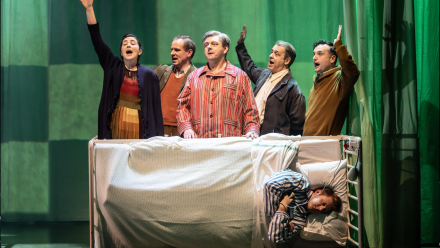
In David Alden’s production of Peter Grimes, the mob assembles before the music has even started – silhouetted at the back, muttering and menacing. Ah, Britten’s mob: simultaneously the source of some of the most electrifying, elemental choral writing since Mussorgsky and a licence for British directors to indulge in premium-strength snobbery. Fully endorsed by the composer, of course: it’s essential to Britten’s artistic schema that we believe the inhabitants of small-town England are only ever one beer away from forming a lynch mob. As their hatred boils over, Alden has them pull out little Union Flags, completely without pretext. There’s no trace of political nationalism anywhere in the libretto or score.

The real reason you shouldn’t buy Roisin Murphy’s new album

The Listener

Grade: B The rather wonderful, liberating thing about being a sentient human being, rather than a moron, is that one can agree with Roisin Murphy that giving kids puberty blockers is a kind of child abuse, while at the same time not liking her new album very much. Just as a sentient human being can enjoy watching Michael Sheen pretending to be other people quite well in films, while thinking him an egregious tit. The cancellation of Murphy was, of course, as obscene as it was predictable – but I do not quite swallow the idea that we are required, as a consequence, to buy Hit Parade. The title is a bit of a misnomer: three or four decent songs does not, to my mind, constitute much of a parade.

The splendour of Edinburgh’s new Scottish galleries 

Arts feature

For nearly 50 years, the Scottish collection at Edinburgh’s National Galleries has been housed in a gloomy subterranean space beneath the main gallery, rarely visited, never celebrated. If you didn’t know it was there, don’t be ashamed. Just 19 per cent of visitors ventured into the bowels to find the jumble of Scottish paintings, dimly lit and hanging on colour-sucking, mucky green walls above a depressing brown carpet. Of those who did get there, lots immediately turned and fled back upstairs to the luminous comforts of Titian, Velazquez and Rubens. Safe to say, the space was not exactly showcasing Scottish art; a puzzling strategy for the country’s flagship gallery. The hang is uncluttered. Each painting has room to breathe But no more.

A Picasso doc that – amazingly – focuses on how great he was

Television

Earlier this year, the Guardian took a break from arguing that ‘cancel culture’ is a right-wing myth to ask the question, ‘Should we cancel Picasso?’ He is, after all, ‘the ultimate example of problematic white guys clogging up the artistic canon’. Given the programme’s title – and the BBC’s increasing loss of nerve – you could be forgiven for thinking Picasso: The Beauty and the Beast was bound to get bogged down in the same tedious and apparently non-mythical 2020s obsessions. Instead, Thursday’s first episode of three proved gratifyingly deft at dealing with them.